سیارات سرگردان

ستاره‌شناسان گونه‌ای از سیارات را کشف کرده‌اند که به دور از نور هر ستاره‌ای، در تاریکی فضا سرگردانند. به اعتقاد آنان چنین سیاراتی در زمان تکوین منظومه‌های سیاره‌ای به بیرون رانده شده‌اند.
این یافته بر اساس پیمایشی مشترک میان نیوزلند و ژاپن، در طول سالهای ۲۰۰۶ و ۲۰۰۷، با بررسی مرکز کهکشان راه شیری، شواهدی دال بر وجود بیش از ۱۰ سیاره سرگردان به اندازه مشتری ارائه کرده است. این کرات منزوی ،تقریبا ۱۰۰۰۰ تا ۲۰۰۰۰ سال نوری از زمین فاصله دارند.

ماریو پرز از دانشمندان برنامه سیارات فراخورشیدی ناسا می‌گوید: اگرچه وجود چنین سیاراتی قبلا پیشبینی شده بود، اما کشف آن‌ها مدلهای دیگری از تکامل سیارات را در اختیار ما قرار خواهد داد. به اعتقاد دانشمندان، این کشف نشان می‌دهد که تعداد این سیارات جه بسا از تعداد ستارگان و نیز سیارات دوار به گرد آن‌ها نیز بیشتر باشد. نشریه نیچر، جزئیات بیشتری از این تحقیق را، به سرپرستی تاکاهیرو سومی از دانشگاه اوزاکا ژاپن، نوزدهم می منتشر کرده است. دیوید بنت از ناسا می‌گوید: به روش سرشماری نفوس، ما بخشی از کهکشان را به عنوان نمونه برگزیدیم و آنچه را که در این بخش یافته‌ایم به کل کهکشان تعمیم می‌دهیم. این پیمایش به سیارات کوچک‌تر از زحل و مشتری حساس نیست. اما تئوری‌ها نشان می‌دهند که سیارات کم جرم‌تر و به اندازه زمین ،بسیار بیشتر از سیارات بزرگ‌تر، از ستارگان مادرشان به بیرون دفع می‌شوند. 


مشاهدات پیشین، حاکی از وجود تعدادی اجرام سرگردان شبیه به سیارات است که در زمان تکوین خوشه‌های ستاره‌ای، با جرمی بیش از سه برابر مشتری تشکیل شده‌اند. اما دانشمندان گمان می‌کنند که نحوه شکل گیری این اجرام گازی به تولد ستارگان بیشتر شباهت دارد تا سیارات. این کرات کوچک و تاریک در اثر رمبش توده‌های گاز و غبار بوجود می‌آیند اما جرم کم آن‌ها، انرژی لازم برای شروع گداخت هسته‌ای و تابش را تامین نمی‌کند. به نظر می‌رسد که کوچک‌ترین کوتوله‌های قهوه‌ای، جرمی به اندازه سیارات بزرگ دارند. احتمالا برخی از سیارات در اثر مواجه گرانشی نزدیک با سایر سیارات یک منظومه ستاره‌ای آشفته یا حتی خود ستاره مادر، از زادگاه خود به بیرون رانده شده‌اند. بدون یک ستاره مرکزی، این سیارات سرگردان، سر انجام در مداری پایدار، گردش خود به دور مرکز کهکشان را آغاز کرده‌اند.

به اعتقاد دانشمندان این پروژه، اگر سیارات سرگردان همانند ستارگان متولد شده باشند، انتظار می‌رفت که ما در این پیمایش به جای ۱۰ سیاره، موفق به کشف یک یا دو تای آن‌ها می‌شدیم. نتایج این تحقیقات نشان می‌دهند که ناپایدار شدن سامانه‌های سیاره‌ای، سرانجام موجب رانده شدن برخی از سیارات (خصوصا سیارات کم جرم‌تر منظومه) از محل تولدشان می‌شود. مشاهدات، قادر به تعیین احتمال قرار گرفتن این سیارات در مدارهای بسیار دور، به دور دیگر ستارگان نمی‌باشند. اما دیگر تحقیقات نشان می‌دهند که احتمال گردش سیارات سرگردانی که به اندازه مشتری هستند، به دور ستاره‌ای دیگر، هرچند در مداری دور دست، بسیار اندک است. در این پیمایش، از پدیده ریز عدسی‌های گرانشی استفاده شده است. زمانیکه یک سیاره یا ستاره از مقابل ستاره بسیار دوری عبور می‌کند، گرانش ناشی از جرم آن موجب انحراف نور ستاره زمینه خواهد شد و همانند یک عدسی، آنرا بزرگ‌تر و درخشان‌تر نشان می‌دهد. گذر سیارات کوچک‌تر از مقابل یک ستاره دور (نسبت به خط دید ما) تنها برای چند روز موجب تعییر اندک در اندازه و درخشندگی ستاره خواهد شد.


بازدیدکنندگان عزیز؛ توجه نمایند که این ترجمه دقیق پست قبل نیست، بلکه ترجمه ای از مقاله منتشر شده در سایت ناسا میباشد که دوست عزیزم "آرش اسماعیلی" زحمت ترجمه آنرا کشیده اند.

لینک مقاله در وبلاگ

Unbound planets could abound in the universe

Ten planets that appear to be drifting in interstellar space have been spotted by an international team of astronomers. The planets are so far from any host stars that they may not orbit a star at all, and could be drifting unbound through space. The team believes that such rogue planets could outnumber normal stars almost 2:1 and their existence could confirm computer simulations of solar-system formation.

More than 550 planets have so far been found beyond our solar system. The vast majority of these extrasolar planets – or exoplanets – have revealed themselves by their gravitational influence on their host star, or by the dip in brightness that they cause as they pass in front of their star. However, a clutch of 12 worlds had previously been found by gravitational micro-lensing.

This technique relies on the object of interest passing directly between the observer and a more distant background object. The mass of the foreground object acts like a lens and magnifies the light from the object beyond. If the foreground object is a star, then any orbiting planet leaves its own tell-tale fingerprint in the shape of the magnification. However, due to the need for an exact alignment, fewer than one in a million stars in the central part of the Milky Way are micro-lensed at any given time. This is why the number of exoplanets detected this way is low.

Sifting through 50 million stars

In an attempt to get around this problem the Microlensing Observations in Astrophysics (MOA) collaboration observes many stars at once. The new rogue planets were found in MOA observations of 50 million stars within the Milky Way between 2006 and 2007. "Over all the stars observed we are very confident that we witnessed 474 definite lensing events," lead-author of the study Takahiro Sumi, of Osaka University, Japan, told physicsworld.com. Of these 474 events, 10 lasted for less than two days. Seven of these 10 events were later confirmed by data from the Optical Gravitational Lensing Experiment (OGLE) collaboration.

The more fleeting the duration of the event, the less massive the lensing object; a duration of less than two days implies the mass of the foreground object to be much less than that of a star. In fact, Sumi believes the culprits to be planets roughly the mass of Jupiter. What is more, no stars were observed within 10 astronomical units of the lensing objects – one astronomical unit is the distance between the Sun and the Earth and Saturn orbits at about 9 astronomical units. "There is a possibility that these planets do have a host star. However, direct imaging of exoplanets by other teams suggests that such distant planets are very rare," Sumi explains. "This led us to conclude that the lensing objects are freely floating planets, unbound from any star," he adds.

Because they are short-lived events, and the result of chance alignments, Sumi didn't expect to uncover such a high yield of planet-lensing events with MOA. From statistical analysis of his data he was able to extrapolate a figure for how common these free-floating planets might be. "We found that unbound planets, with roughly the mass of Jupiter, should be 1.8 times more common than the stars we observed," Sumi explains.

Scattered into space

The existence of rogue planets isn't completely unexpected: they have been predicted from computer models of solar-system formation. "We think they are formed in the same way as other planets but get scattered from the system by gravitational interactions between them," says Sumi. Joachim Wambsganss, of the University of Heidelberg, Germany, who was not involved in the work, says that this research quantifies this process for the first time. "We just didn't know how often this happened," he said. "This research gives us an idea," he adds.

Wambsganss went on to describe the research as using a "clear and solid method", however he thinks some people may not believe the claims of the rogue planets' abundance. "They used a very extensive statistical analysis, using several different factors, but others may argue with the numbers they used," he explains. One way of strengthening the research's claims will be to use the next stage of data from the MOA experiments. "There are three more years of data for 2008–2010 that they can work through in the same way. They should find more of these events and this will provide an even stronger statistical basis for their claims," he says.

نظریه ریسمان و ابعاد اضافه

معرفی نظریه ریسمان و ابعاد بیشتر به زبان ساده، توسط فیزیکدان نظری، برایان گرین

سخنران یکی از نظریه‌پردازان «نظریه ابرریسمان» است که علت وجود ذرات بنیادی و نیروهای طبیعت را نحوه نوسان تارهای ریز مرتعش انرژی در ۱۱ بعد فضایی می‌داند. از زمان اینشتین، یافتن یک «نظریه یکپارچه» از رویاهای فیزیکدانان بوده است، و به عقیده شماری از فیزیکدانان شاید نظریه ابرریسمان کاندید خوبی برای این مقصود باشد. این فرضیه فعلا در حد معادلات ریاضیاتی است و هنوز امکان آزمون آن در جهان واقعی وجود ندارد. شاید آزمایشگاه‌های جدید فیزیک مثل برخورددهنده بزرگ هادرونی امکان تست این ایده جالب را فراهم کنند.

دانلود ویدیو با زیرنویس فارسی

استيون هاوکينگ،: بهشت وجود ندارد، بهشت يک افسانه است

استيون هاوکينگ، فيزيکدان و فضا شناس سرشناس بريتانيايی در يک مصاحبه اختصاصی با روزنامه گاردين ديدگاههای خود را در مورد مرگ، دلايل وجود انسان و تصادفی بودن موجوديت هستی و بشر را تشريح کرده است.

استيون هاوکينگ، می گويد اعتقاد به وجود بهشت و يا نوعی از حيات پس از مرگ در حقيقت « افسانه ای » است برای مردمانی که از مرگ می هراسند. او با صراحت می گويد که پس از آخرين فعاليت مغز انسان ديگر حياتی برای وی وجود ندارد. اعلام اين نظر نشانی از مخالفت صريح وی با توجيحات دينی در اين زمينه است.

استيون هاوکينگ، از سن ۲۱ سالگی به بيماری شديد فلج اعصاب مبتلا شد. وی برای دوره ای تحت تاثير اين بيماری به شدت بد بين بود ولی در نهايت به اين نتيجه رسيد که با وجود همه ترديدها و بی اطمينانی از ادامه زندگی بايد از تمام لحظات زندگی لذت ببرد.

وی می گويد:« در ۴۹ سال گذشته من همواره با احتمال وقوع يک مرگ زودرس زندگی کرده ام. من از مرگ نمی ترسم ولی عجله ای هم برای مردن ندارم. از نظر من مغز مثل کامپيوتری است که با از کار افتادن قطعات آن از حرکت باز خواهد ايستاد. چيزی به عنوان بهشت و يا حيات پس از مرگ وجود ندارد. اين يک داستان افسانه ای برای کسانی است که از تاريکی مرگ می هراسند.»

روزنامه گاردين می افزايد که اظهار نظرهای استيون هاوکينگ، از آنچه که در کتاب خود در سال گذشته نوشته بود فراتر می رود. وی در کتاب آخر خود به نام « طرح عظيم » اعلام کرد که برای توضيح عالم هستی نيازی به وجود يک آفريدگار مطلق نيست.

اين کتاب واکنش گروهی از پيشوايان دينی را برانگيخت که هاوکينگ، را به « کفر گويی» متهم کردند. برخی از دانشوران نيز ديدگاههای وی را تفسيری شخصی از علوم تجربی دانسته و اعلام کردند که هاوکينگ به عنوان يک دانشمند نمی تواند وجود يا عدم وجود خدا را ثابت کند.

کتاب استيون هاوکينگ، به نام « تاريخ فشرده ای از زمان» که در سال ۱۹۸۸ انتشار يافت حدوده ۱۰ ميليون نسخه فروش رفت و وی را به يک چهره علمی مشهور بدل ساخت. در آن کتاب وی می گويد:« اگر دانشمندان بتوانند محاسبات و فرضيه های لازم برای توضيح هر پديده و ماده موجود در هستی را کشف و تنظيم کنند در آن صورت بشر خواهد توانست فکر خدا را بخواند.»

در مصاحبه با روزنامه گاردين و در پاسخ به سئوال « رسالت انسان چيست و آدمی چگونه بايد زندگی کند؟» استيون هاوکينگ می گويد:« ما بايد به دنبال آن باشيم که از اعمال خود بزرگترين ارزشها را بيافرينيم.» به عنوان مثال او به موارد مهمی از دستاوردهای علمی مثل دوگانگی «دی ان ای» (DNA) و يا معادلات پايه ای علم فيزيک اشاره کرده و چنين پيشرفت هايی را رسالت و ارزش زندگی بشری می داند.

وی تاکيد می کند که ارزش علوم و دانستن در اين است که جهان هستی فقط به اين وسيله شناخته می شود. از نظر وی شکل گيری کائنات، منظومه ها و سياره ها روندی نامنظم و بی مقدمه است و بنابراين موجوديت انسان روی کره زمين يک امر تصادفی است.

امکان وجود حیات فرازمینی در سیارات هیدروژنه

ظاهراً سیاره‌ی ما در موضع مطلوبی گرداگرد خورشید واقع شده که اقلیم‌اش این قدر معتدل است. نه‌چندان نزدیک به شعله‌های توفنده و جهنمی ِ خورشید، و نه‌چندان دور از محدود‌ه‌ی گرمای حیا‌ت‌بخش آفتاب؛ در نوار باریک و سکنی‌پذیری که آب در آن، طاقت مایع بودن‌اش را می‌آورد و حیات امکان رشد می‌یابد. اما به ادعای دو دانشمند، اگر زمین حتی دورتر از خورشید و در حوالی سیاره‌ی زحل هم واقع شده بود و به‌همان نسبت هوایش آکنده از گاز هیدروژن می‌بود، همچنان امکان میزبانی از حیاتِ ظریف و شکننده‌اش را داشت. اگر حق با این دو دانشمند باشد، آنگاه ممکن است که میلیاردها سیاره‌ی سکنی‌پذیر و شلوغ، در فواصلی بس دورتر از محدوده‌ی متعارف گرداگرد ستاره‌ی میزبانشان که ستاره‌شناسان انتظار مایع بودنِ آب را در آنجا می‌کشند، وجود داشته باشد. زمین، اکثر گرمایش را مدیون لایه‌ی کربن‌دی‌اکسید و بخار آبِ پراکنده در طبقات جوی‌اش است که باعث گیر افتادن گرمای خورشید می‌شوند؛ اما ابن گازهای گلخانه‌ای، در صورت انتقال به فواصل دورتر از خورشید، بی‌تردید در آن سرمای طاقت‌فرسا یخ می‌زنند. اما هیدروژن همچنان حالت گازی‌اش را حفظ می‌کند و در فشارهای بالا می‌تواند نقش یک گاز گلخانه‌ای را ایفا کند.
 
«ریموند پیرهامبرت» (Raymond Pierrehumbert) از دانشگاه شیکاگو و «اریک گیدوس» (Eric Gaidos) از دانشگاه هاوایی، تأثیر گرمابخشی ِ یک لایه‌ از گاز هیدروژن در سیاراتی به‌ابعاد زمین و همچنین سیارات بزرگ‌تری که به «ابرزمین» مشهورند را محاسبه کردند. این دو دریافتند که چنین سیاره‌ای در صورت میزبانی از یک جو هیدروژنی که ضخامت‌اش چندین برابر یک لایه‌ی نیتروژنی‌ست؛ می‌تواند گرمای کافی برای پشتیبانی از حیاتِ زمینی تا فاصله‌‌‌ای معادل ١٥ برابر فاصله‌ی کنونی زمین از خورشید را تأمین کند. علاوه بر این پیرهامبرت و گیدوس نشان داده‌اند که با وجود ضخامت بالای این لایه‌ی هیدروژنی، نور خورشید هنوز امکان دسترسی به سطح سیاره و راه‌اندازی فرآیند فتوسنتز را داراست. «جیمز کستینگ» (James Kasting) از دانشگاه ایالتی آریزونا می‌گوید: «ایده‌ی هوشمندانه‌ای‌ست. اما شک دارم این سیاره وجود خارجی داشته باشد». شکِ کستینگ در این است که یک سیاره‌ی زمین‌مانند، یا یک ابرزمین غول‌پیکر نمی‌تواند تا این حد از هیدروژنِ لازم برای چنین شرایطی را از ابر گازیِ گرداگرد ستاره‌ی مادرش بربیاید. او ضمناً اضافه می‌کند که سیاراتِ دورتر، طبیعتاً کم‌نورترند و تشخیص‌شان هم عملاً دشوارتر. از این‌رو کشف چنین سیاراتی (در صورت وجود داشتن) به‌سادگی ممکن نیست؛ چه برسد به تعیین اوضاع جوی‌شان.
 
با این وجود، پیرهامبرت و گیدوس اشاره به سیاره‌ی فراخورشیدیِ آشنایی می‌کنند که ممکن است انتظارشان را برآورده کرده باشد. این سیاره که OGLE-05-390Lb نام دارد، حدوداً شش برابر زمین جرم دارد و با فاصله‌ای معادل ٢.۶ برابر فاصله‌ی زمین از خورشید، به‌گرد یک «کوتوله‌ی سرخ» می‌چرخد (ستاره‌‌های ریز و کم‌نور و سرد را اصطلاحاً کوتوله‌ی سرخ می‌نامند). یک سیاره‌ی لُخت اگر فاصله‌اش تا ستاره‌ای چنین سرد، زیاد باشد؛ طبعاً زمهریر نامطلوبی برای رشد حیات خواهد بود. اما به‌گفته‌ی پژوهش‌گران، وقتی‌که یک جو ضخیم ِ هیدروژنی اطرافش را گرفته باشد، مستعد میزبانی از آب مایع است.
 
با این وجود اگر این سیاره میزبان حیات هم باشد؛ این حیات، حکم مرگِ خودش را خود امضا کرده است. ساکنان این سیاره، چیزی بیش از میکروب‌های ریز و درشتی که غذایشان را هیدروژن و کربن‌دی‌اکسید شکل می‌دهد، نخواهند بود. هنگامی‌که همین هیدروژن هم مصرف شود، میکروب‌ها با دست خود این سیاره را به زمهریر غول‌پیکری بدل کرده و اینگونه خودکشی می‌کنند.

یادبودنامه آلبرت اینشتین؛ قسمت نهم

از دیدگاه نخست(تائید از سوی آزمایش)،ترکیب نورشناسی موجی با تصویر مکانیکی جهان،می بایست به شبهاتی جدی منجر شود.اگر نور به صورت حرکتی موجی در جسمی کشسان (اثیر) تعبیر می شد،این جسم باید ملاء ای به شمار می آمد که در همه چیز نفوذ می کرد و چون امواج نور،امواج عرضی بودند،باید به جسمی جامد می مانست،ولی این جسم جامد می بایستی غیر قابل تراکم باشد تا امواج طولی در آن بوجود نیاید.چون به نظر نمی رسید که این اثیر در برابر هیچ حرکتی از سوی اجسام «ثقیل» مقاومتی نشان دهد،ناگزیر باید در جوار انواع دیگر ماده،زندگی شبح مانندی را سپری کند.برای توضیح ضرایب شکست اجسام شفاف و نیز فرآیند های جذب و گسیل اشعه لازم بود که کنشهای متقابل پیچیده ای میان این دو نوع ماده فرض شود،کاری که نه تنها به توفیق نینجامید بلکه مجدانه نیز دنبال نشد.علاوه براین،نیروهای الکترومغناطیسی فرض وجود جرمهایی الکتریکی را ضروری ساخت که گر چه ماند قابل ملاحظه ای نداشتند ولی با یکدیگر به کنش متقابل می پرداختند و نیز کنش متقابل آنها،بر خلاف نیروی گرانش،از گونه ای قطبی بود.

عاملی که سرانجام پس از تردید و تعلل بسیار توانست فیزیکدانان را بتدریج از این عقیده منصرف کند که می توان همه فیزیک را بر شالوده مکانیک نیوتنی قرار داد،الکترودینامیک فارادی و ماکسول بود؛زیرا این نظریه و تایید آن بوسیله آزمایشهای هرتز نشان داد که پدیده هایی الکترومغناطیسی وجود دارند که ماهیتا مستقل و جدا از ماده ثقیلند-یعنی امواجی در فضای تهی که از «میدانها»ی الکترومغناطیسی تشکیل شده اند.اگر بنا بود که مکانیک به عنوان شالوده فیزیک باقی بماند،باید تعبیری مکانیکی برای معادلات ماکسول فراهم می آمد.این تلاش با جدیت تمام دنبال شد ولی حاصلی نداد؛در همان حال این معادلات،سودمندی خود را هر چه بیشتر به ثبوت می رساندند.


جهت مشاهده قسمتهای گذشته این یادبودنامه اینجا را کلیک کنید.

به نقل از وبلاگ علمی و تحقیقی

یادبودنامه آلبرت اینشتین؛ قسمت هشتم

پس جای تعجب نیست که همه فیزیکدانان قرن گذشته،مکانیک کلاسیک را شالوده مستحکم و نهائی همه فیزیک،بل همه علوم می دانستند و هرگز از این کوشش باز نایستادند که نظریه الکترومغناطیس ماکسول را بر پایه مکانیک قرار دهند،نظریه ای که در عین حال اندک اندک می رفت که بر مکانیک چیره شود.حتی ماکسول و هرتز،که از دیدگاه کنونی ما ویران کننده این عقیده اند که مکانیک،بنیان نهایی تفکر فیزیکی است،به هنگام تفکر هشیارانه خود آن را اساس محکم فیزیک می شمردند.ارنست ماخ بود که در کتاب «تاریخ مکانیک» خوددر بنای این ایمان جزمی تزلزل افکند.کتاب ماخ از این لحاظ،هنگامی که هنوز دانشجو بودم،در من تاثیری عمیق کرد.من بزرگی ماخ را در استقلال رای و شکاکیت فسادناپذیرش می دانم؛اما در سالهای جوانی،موضع معرفتشناختی ماخ نیز سخت در من اثر کرده بود.موضعی که اکنون به نظر من اساسا قابل دفاع نیست.زیرا او سرشت سازنده فکر،خاصه تفکر علمی را بدرستی در نمی یافت؛در نتیجه او نظریه را در از جنبه هایی محکوم می کرد که در آنها سرشت نظری-استنباطی آن،مثلا در نظریه اتمی جنبشی،به نحوی کتمان ناپذیر آشکار می شود.


برای مطالعه متن کامل این یادبودنامه اینجا را کلیک کنید  و همچنین جهت مشاهده قسمتهای گذشته این یادبودنامه اینجا را کلیک کنید.

به نقل از وبلاگ علمی و تحقیقی

School on selected topics in Strongly Correlated Systems

ثبت درخششی خیره کننده توسط تلسکوپ فضایی فرمی

تلسکوپ فضایی پرتو گامای فرمی ناسا، ۱۲ آوریل سال جاری، شراره‌ای ناگهانی در سحابی خرچنگ ثبت کرده است که پنج بار پرتوان‌تر از تشعشعات پیشین این سحابی بوده و به مدت شش روز دوام داشته است. در سال ۱۰۵۴ میلادی، انفجاری ابرنواختری در صورت فلکی گاو (۶۵۰۰ سال نوری دور‌تر از ما) رخ داد و حاصل آن یک ستاره نوترونی بسیار چگال بود که ۳۰ بار در ثانیه به دور خود دوران می‌کند. نتیجه این نوسان سریع، گسیل تشعشعاتی به صورت پالس است که مشخصه ستارگان نوترونی (پالسار) به حساب می‌آید. علاوه بر این پالس‌ها، اختر‌شناسان سحابی خرچنگ را منبع پایداری از پرتوهای پر انرژی می‌دانستند. اما در ژانویه ۲۰۱۱ دانشمندان به کمک چندین رصدخانه مدار گرد منجمله فرمی، سویفت و رسی، تغییرات بلند مدتی را در شدت پرتوهای گامای گسیل شده از این سحابی ثبت کردند.

 
از سال ۲۰۰۹ تاکنون فرمی و ماهواره آژانس فضایی ایتالیا (اجیل) چندین شراره ناگهانی کوتاه مدت پرتو گاما گزارش کرده‌اند که بیش از ۱۰۰ میلیون الکترون-ولت انرژی داشته‌اند. برای مقایسه در نظر داشته باشید که نور مرئی تنها ۲ تا ۳ الکترون-ولت انرژی دارد. دوازدهم آوریل، فرمی و پس از آن اجیل (ماهواره سازمان فضایی ایتالیا)، تابشی را دریافت کردند که ۳۰ مرتبه از پرتوهای گسیل شده معمول و ۵ مرتبه از آخرین درخشش ناگهانی سحابی نیرومند‌تر بود. در ۱۶ آوریل تشعشعی حتی نیرومند‌تر نیز دریافت شد و سرانجام این فعالیت غیر عادی به خاموشی گرائید. دانشمندان گمان می‌کنند که این نوسانات غیر عادی ممکن است ناشی از نوآرایی ناگهانی در میدان مغناطیسی ستاره نوترونی آرمیده در سحابی باشد، هر چند شاید آنچه که واقعا رخ داده است سال‌ها به صورت یک معما باقی بماند. پرتوهای پر انرژی سحابی خرچنگ ممکن است نتیجه فرایندهای فیزیکی مرتبط با سرعت دوران ستاره نوترونی باشد. نظریه پردازان معتقدند که این شعله‌های فروزان ناگهانی، در فاصله یک سوم سال نوری از ستاره نوترونی رخ می‌دهد، اما تاکنون تمامی تلاش‌ها برای تعیین دقیق موقعیت این پدیده ناکام مانده است. از سپتامبر ۲۰۱۰ تاکنون، رصدخانه پرتو ایکس چاندرای ناسا، سحابی خرچنگ را به طور پیوسته تحت نظر داشته است. علیرغم قدرت تشخیص و تفکیک عالی چاندرا، هیچ تغییر محسوسی در پرتوهای ایکس دریافتی از سحابی که مرتبط با نوسانات روشنایی اخیر باشد، ثبت نشده است.

دانشمندان که این نوسانات در شدت پرتوهای گاما را ناشی از نوآرایی ناگهانی میدان مغناطیسی ستاره نوترونی می‌دانند، معتقدند که این امر ممکن است با شتاب دادن ذرات، سرعت آن‌ها را به سرعت نور نزدیک کرده و نتیجه برهم کنش این ذرات با میدان مغناطیسی پالسار، انتشار پرتوهای گاما خواهد بود. دانشمندان می‌گویند که انرژی این ذرات ۱۰۰ بار بیشتر از حداکثر انرژی ذرات پر شتاب بر روی زمین است. با استناد به نوسانات شدت پرتوهای گاما در طول آوریل گذشته، دانشمندان وسعت منطقه منتشر کننده پرتو‌ها را با منظومه شمسی قابل قیاس می‌دانند.

ریسمان های اسرارآمیز کیهانی

در ميان تمامي پديده‌هاي عجيب و غريب و شگفت‌انگيز موجود در پهنه كائنات بدون شك ريسمان‌هاي كيهاني جايگاهي ويژه دارند، ريسمان‌هايي از انرژي خالص كه از اين سوي كيهان تا آن سوي آن امتداد دارند! اين ريسمان‌ها علي‌رغم طول بسيار زياد خود (كه به چندین ميليارد سال نوري هم مي‌رسد) بسيار باريكند و ضخامتي كمتر از يك پروتون دارند! ريسمان‌هاي كيهاني چگالي خارق‌العاده‌اي دارند به‌طوري كه فقط يك متر از آنها از كل يك قاره سنگين‌تر است. اگر يكي از اين ريسمان‌ها از ميان كره زمين عبور كند، كل سياره ما را در چشم بر هم زدني همانند پشم حلاجي شده متلاشي مي‌كند.

احتمال وجود ريسمان‌هاي كيهاني براي نخستين‌بار در دهه 1980 توسط كيهان‌شناسان مطرح شد. بر اساس مدل‌هاي كيهان‌شناسي، ريسمان‌هاي كيهاني بايد بر اثر انرژي آزاد شده در لحظه آفرينش جهان در پهنه كيهان پديدآمده و شروع به ارتعاش كرده باشند، ارتعاشي كه هنوز هم ادامه دارد. هرچند چنين ريسمان‌هايي هنوز به‌طور رصدي در پهنه كيهان مشاهده نشده‌اند اما محاسبات صورت گرفته نشان مي‌دهد كه اين ريسمان‌ها بايد جايي در گستره جهان وجود داشته باشند. آنها با سرعتي نزديك به سرعت نور در پهنه كيهان در حال حركتند و با حركت و ارتعاشات خود، فضا و زمان را به لرزه درمي‌آورند

اما از همه اينها عجيب‌تر آنكه ريسمان‌هاي كيهاني در حالت‌هاي خاصي حتي مي‌توانند نقش ماشين زمان را ايفا كنند. فيزيكداني به نام ريچارد گات از دانشگاه پرينستون آمريكا با استفاده از معادلات نسبيت عام اينشتين نشان داده است كه اگر دو ريسمان كيهاني با سرعت زيادي در حال رد شدن از كنار همديگر باشند، حلقه‌هاي بسته‌اي در بُعد زمان در پيرامون خود ايجاد خواهند كرد به‌طوري كه يك سفينه فضايي با دور زدن حول اين دو ريسمان مي‌تواند به زماني در گذشته‌هاي دور بازگردد.


Stephen Battersby, "Cosmic string: The search continues", New Scientist, 23 Feb 2008

نظریه جهان های تو در تو: آیا در دل هر جهانی، جهان دیگری نهفته است؟

ممکن است کل جهان ما در درون یک سیاهچاله واقع در یک جهان بزرگتر نهفته باشد و آن جهان بزرگتر هم به نوبه خود در دل سیاهچاله دیگری در یک جهان بازهم بزرگتر پنهان باشد و این تو در تویی جهان ها ممکن است تا بینهایت همینطور ادامه داشته باشد! به همین ترتیب ممکن است در دل هریک از سیاهچاله های جهان ما هم جهان های دیگری پنهان باشند و در دل سیاهچاله های آن جهان ها بازهم جهان های دیگر و همینطور تا بینهایت...

این نظریه شگفت انگیز به تازگی توسط فیزیکدانی به نام نیکودم پاپلاوسکی از دانشگاه ایندیانای آمریکا مطرح شده است. پاپلاوسکی هنگامی به احتمال وجود جهان های تو در تو پی برد که مشغول کار بر روی یکی از نسخه های تعمیم یافته نظریه نسبیت عام اینشتین موسوم به نظریه اینشتین-کارتان بود. پاپلاوسکی قصد داشت به کمک این نظریه، فرآیند دقیق تشکیل سیاهچاله ها را هنگام فروپاشی گرانشی ستاره ها مورد بررسی قرار دهد. پاپلاوسکی در کمال تعجب دریافت که هنگامی که چگالی ماده در فرآیند تشکیل سیاهچاله ها به آستانه فوق العاده بالای 10 به توان 50 کیلوگرم بر متر مکعب می رسد، نیرویی اسرارآمیز که از خمش خود فضا ناشی می شود به ناگهان به صورت یک نیروی دافعه در مرکز سیاهچاله ظاهر می شود. این نیرو به حدی قدرتمند است که نه تنها در برابر فروپاشی کامل گرانشی مقاومت میکند بلکه فرآیند فروپاشی را معکوس کرده و آنرا به یک انبساط کیهانی تبدیل میکند

اما این انبساط کیهانی دقیقاً مشابه انبساط کل جهان ماست. بدین ترتیب پاپلاوسکی با بررسی دقیق تر معادلات توصیف کننده رفتار سیاهچاله ها به کمک نظریه اینشتین-کارتان به این نتیجه رسید که ممکن است واقعاً در دل هر سیاهچاله ای، یک جهان دیگر نهفته باشد. اما ازآنجائیکه در دل هریک از جهان ها - ومن جمله جهان ما - هم سیاهچاله های متعددی وجود دارند بنابراین ممکن است واقعاً در دل هر جهانی، جهان های متعدد دیگری پنهان باشند و این تو در تویی جهان ها می تواند تا بینهایت تکرار شود.


"Every black hole may hold a hidden universe", New Scientist, 23 July 2010

Antimatter trap tightens its grip

Last year physicists working on the ALPHA experiment at the CERN particle-physics lab became the first to capture and store atoms of antimatter for long enough to examine it in detail. They trapped 38 antihydrogen atoms for about one fifth of a second. Now, the same team has posted a paper on the arXiv preprint server describing how it trapped 309 antihydrogen atoms for 1000 s. This boost in both number and trapping time should lead to important insights into the nature of antimatter.

Antihydrogen – the antimatter version of the hydrogen atom – is an atomic bound state of a positron and antiproton that was first produced at CERN towards the end of 1995. The study of antimatter is important in developing our understanding of the universe and in finding out why it contains so much more matter than antimatter.

With members from seven nations, the ALPHA team shared the Physics World 2010 Breakthrough of the Year award for its capture of antihydrogen. As well as extending the previous capture time by almost four orders of magnitude, the team has gained some interesting insights into the energy distribution of the captured anti-atoms.

Ground state first

The ALPHA team produced the antihydrogen by merging two clouds of cold plasmas: one containing positrons and the other antiprotons. By improving their trapping techniques, the researchers managed to hold the antihydrogen for more than 1000 s. These advances also meant that five times as many atoms were trapped per attempt. Calculations based on data from the experiment suggest that after about 0.5 s, most of the trapped antihydrogen atoms reach their lowest energy or ground state. As a result, the team says that its trapped sample is the first antihydrogen obtained in the ground state.

The researchers have also managed to make the first measurements of the energy distribution of the trapped anti-atoms. These data, along with computer simulations, should pave the way to a better understanding of trapping dynamics. The team carried out 40,000 simulated trapped antihydrogen events and compared them with the 309 experimental ones, to study the trapping and release processes.

Studying CPT violation

The ability to trap antihydrogen for long periods of time could lead to precision tests of charge–parity–time (CPT) violation, which could help explain why the universe contains so little antimatter. Other possible experiments include microwave spectroscopy of the antimatter and even laser and adiabatic cooling of antihydrogen to temperatures where gravitational effects are observable, according to the researchers.

The paper is currently under review for journal publication and therefore the ALPHA researchers were unable to comment further.


The research is described in arXiv:1104.4982.

آیا ممکن است بُعد زمان به ناگهان از پهنه کائنات محو شود؟

زمان یکی از ابعاد بنیادین جهان ما است. تمامی تحولات جهان - از حرکت ابرها در آسمان گرفته تا تغییر فصول و از زندگی ما انسان ها گرفته تا چرخش کهکشان ها - همگی در بستر زمان صورت میگیرند. اما آیا ممکن است بُعد زمان به ناگهان از پهنه جهان محو شده و همه چیز در پهنه کیهان متوقف شود؟ هرچند باورنکردنی به نظر می رسد اما فیزیکدانی به نام خوزه سنوویلا و گروه تحقیقاتی اش در دانشگاه باسک در شهر بیلبائو در اسپانیا دقیقاً به چنین نتیجه ای رسیده اند

سنوویلا و همکارانش هنگامی به این نتیجه شگفت انگیز رسیدند که مشغول کار بر روی نظریه ریسمان ها در فیزیک و کاربرد آن در عرصه کیهان شناسی بودند. نظریه ریسمان ها یکی از مهم ترین نظریات مطرح در فیزیک امروز است که دو پایه بنیادین فیزیک جدید یعنی فیزیک کوانتومی و نسبیت عام اینشتین را با همدیگر پیوند می دهد. براساس نظریه ریسمان ها کائنات بجای 4 بُعدی، 11 بُعدی است. بر مبنای این نظریه در گستره این هستی 11 بُعدی، جهان های بیشماری با ابعاد فضا-زمانی مختلف شناورند که جهان ما فقط یکی از این میلیاردها میلیارد جهان است. به عبارتی کل جهان ما همانند یک حباب 4 بُعدی است که در گستره نامتناهی اَبَرفضای 11 بُعدی شناور است. اما در گستره بیکران اَبَرفضا به غیر از جهان ما بیشمار جهان دیگر هم شناورند که هریک ابعاد فضا-زمانی خاص خود را دارند. اما براساس نظریه ریسمان ها، ابعاد فضایی یا زمانی این جهان ها می توانند به همدیگر تبدیل شوند

درواقع محاسبات سنوویلا و همکارانش برمبنای نظریه ریسمان ها نشان می دهد که این پدیده شگفت انگیز هم اکنون در جهان ما در حال رخ دادن است: زمان در جهان ما در حال کُند شدن است و این روند همچنان ادامه خواهد یافت تا نهایتاً پس از میلیاردها سال بُعد زمان به طور کلی از پهنه کیهان محو شده و به بُعد مکان تبدیل خواهد شد. در آن هنگام همه چیز در گستره کیهان ناگهان متوقف خواهد شد و این لحظه از زندگی جهان دقیقاً همانند لحظه ای که با دوربین عکاسی ثبت شود برای همیشه در خاطره کیهانی ثبت خواهد شد. آری اینجا پایان زمان است، پایان تمامی رویدادها، ماجراها و داستان هایی که در طول این میلیاردها سال در جای جای جهان ما ورق خورده است. و بدین ترتیب داستان زندگی کل جهان ما که با بیگ بنگ (مِهبانگ) متولد و آغاز شده بود برای همیشه به پایان می رسد و به خاطره کیهانی خواهد پیوست.


"Is time slowing down?", New Scientist, No 2635

Cooling with heat

A quantum system can be cooled with a blast of hot incoherent light. That's the surprising conclusion of theoretical physicists in Germany who have shown that the rate of cooling can sometimes be increased by putting a system in contact with a hot entity. The scheme – which has not been tested in the lab – could offer a simple way of cooling quantum devices.

Since the 1980s physicists have been cooling gases of atoms using coherent laser light. This method works by having atoms absorbing and emitting photons such that the atoms gradually loose momentum. This technique only works if the light is coherent – if it isn't coherent the light simply heats up the gas.

But now Jens Eisert and Andrea Mari of the Freie Universitaet Berlin have come up with a way of using incoherent light to cool a quantum system. Their system is a mechanical quantum oscillator that is coupled to two optical modes – however Eisert stresses that it can be applied to a wide range of three mode quantum systems.

Hot and cold modes

The process begins with the mechanical oscillator in a high-energy or hot state. One of the optical modes is cold, which means that energy can potentially flow from the oscillator to the cold mode – cooling the oscillator.

The second optical mode is hot, meaning that it contains a large number of incoherent photons and is subject to thermal fluctuations. According to Eisert and Mari's calculations, this hot mode has two effects on the temperature of the mechanical oscillator. One effect is obvious; the hot mode heats the oscillator. The second unexpected effect is that fluctuations in the hot mode increase the rate at which energy is transferred from the oscillator to the cold mode. The key to a practical application of the technique is to ensure that the latter effect is dominant.

Eisert says that the system is similar to a transistor, whereby the application of heat at the hot optical mode results in a proportional increase in the flow of heat from the mechanical oscillator to the cold mode.

According to Eisert several experimental groups are now working on realizing the system in the lab. Possible applications of the effect include cooling quantum devices such as atomic clocks or tiny mechanical resonators using incoherent light from relatively inexpensive LEDs.

آیا ستارگان دوار اولین آلوده کنندگان کیهان بوده اند؟

یک تیم بین المللی از ستاره‌شناسان به سر پرستی «کریستینا چیاپینی»، با استفاده از داده‌های ابر تلسکوپ رصدخانه نیمکره جنوبی اروپا، و با مطالعه تعدادی از کهنسال‌ترین ستارگان در کهکشان راه شیری، به این نتیجه رسیده‌اند که احتمالا اولین ابر ستاره‌ها با سرعت بسیار زیادی دوران می‌کرده‌اند.
عمر ابر ستاره‌ها زود به سر می‌آید، بنابراین نسل اول این ستارگان تقریبا همگی مرده‌اند. اما آثار شیمیایی به جای مانده از آن‌ها در پیر‌ترین ستاره‌های راه شیری هنوز یافت می‌شوند. این آثار باستانی راهنمای ارزنده‌ای برای مطالعه نسل اول ستارگان اسرارآمیزی که در ابتدای تشکیل کیهان متولد شده‌اند به حساب می‌آیند.

پس از وقوع بیگ بنگ تقریبا تمامی کیهان از هیدروژن و هلیوم انباشته بود. ۳۰۰ میلیون سال بعد با مرگ اولین نسل ستارگان عظیم، جهان از دیگر عناصر نیز غنی شد. این ستارگان عامل تزریق عناصر شیمیایی جدید به گاز نخستین کیهانی به شمار می‌آیند که در ساختار نسل بعدی ستارگان به کار رفته‌اند.
ستاره‌شناسان با استفاده از داده‌های ابر تلسکوپ رصدخانه نیمکره جنوبی اروپا، طیفهای گروهی از مسن‌ترین ستاره‌های راه شیری را بازتحلیل کرده‌اند. این ستارگان بسیار پیر که جرمی بیش از ده برابر جرم خورشید ما داشته‌اند با عمر بسیار کوتاه‌شان موجبات آلوده شدن گاز کیهانی نخستین را به سایر عناصر شیمیایی به جز هیدروژن و هلیوم فراهم کرده‌اند.
طبق انتظار، دخالت برخی عناصر در ساختار شیمیایی ستارگان رصد شده ناشی از مرگ نسل اول ستاره‌هایی می‌باشد که این عناصر را در فضا پراکنده‌اند. اما تحلیل‌های جدید ناگهان خبر از وجود عناصری داد که معمولا توسط ستارگان کم جرم‌تر با عمر طولانی‌تر تولید می‌شوند. از سوی دیگر ستارگان عظیمی که با سرعت فراوان دوران می‌کنند نیز موفق به تولید چنین عناصری می‌شوند.
احتمال وجود یک نسل اولیه از چنین ستارگانی بسیار زیاد است. چرخش سریع بر سایر خواص ستاره منجمله رنگ، طول عمر و درخشندگی نیز موثر خواهد بود. بنابراین این ستارگان در خواص و پیدایش کهکشانهای اولیه نقش مهمی ایفا کرده‌اند

مطالعات مستقلی که پیرامون چگونگی شکل گیری ستارگان اولیه صورت گرفته است، وجودستارگان چرخنده را تائید می‌کند.

آغاز زندگی جدید درون یک خوشه ستاره‌ای کهن

خوشه کروی مسیه ۵، یکی از کهنسال‌ترین اعضای کهکشان راه شیری به حساب می‌آید. اکثریت ستاره‌های این خوشه ستاره‌ای بیش از ۱۲ میلیارد سال پیش متولد شده‌اند، اما ورود تعدادی ستاره تازه وارد به صحنه این خوشه، سرزندگی خاصی به این جمعیت سالخورده بخشیده است.
ستاره‌های خوشه‌های کروی که از سحابی یکسانی شکل می‌گیرند، با یکدیگر رشد می‌کنند و پا به دوره کهولت می‌گذارند.

ستاره‌های عظیم‌تر، با سرعت بیشتری (کمتر از یک میلیون سال) اندوخته هیدروژنی هسته‌هایشان را به اتمام می‌رسانند و با یک انفجار ابر نواختری به زندگی خود پایان می‌دهند. اما ستارگان کم جرم‌تر یک خوشه کروی کهنسال نظیر مسیه ۵ با سرعت کمتر و به تدریج مراحل مختلف حیاتشان را سپری می‌کنند و به غولهای سرخ تبدیل می‌شوند.
ستاره‌شناسان در میان این ستارگان کهن تعدادی ستاره جوان آبی رنگ یافته‌اند و گمان می‌کنند که این نوباوگان یا در اثر تصادم دیگر ستارگان و یا انتقال جرم میان ستاره‌های دوتایی بوجود آمده‌اند. چنین وقایعی در خوشه‌های کروی پرجمعیت متراکم دور از انتظار نیست، جایی که میلیون‌ها ستاره در رابطه‌ای تنگاتنگ، گرد هم آمده‌اند.
مسیه ۵، ۲۵۰۰۰ سال نوری دور‌تر از ما در صورت فلکی مار قرار دارد. این تصویر که توسط کانال میدان باز دوربین پیشرفته تلسکوپ فضایی هابل گرفته شده است، حاصل ترکیب انوار عبوری از سه فیلتر آبی، قرمز و فروسرخ نزدیک می‌باشد. زمان نوردهی کلی برای هر فیلتر به ترتیب ۷۰۰، ۴۰۰ و ۵۶۷ ثانیه و میدان دید ۶. ۲ دقیقه قوس مربع بوده است.

توفانهای شدید گاز کهکشانی را می‌پراکنند

رصدخانه فضایی فروسرخ هرشل سازمان فضایی اروپا، بادهای سهمگینی از گاز ملکولی را در حال برون ریزی از کهکشان‌ها یافته است. سالهاست که اختر‌شناسان گمان می‌کنند که چنین فورانهایی ممکن است کهکشان‌ها را از گاز تهی کرده و روند شکل گیری ستارگان جدید را در برخی از نواحی آن‌ها متوقف سازند.

بادهایی که هرشل کشف کرده است با سرعتی بیش از ۱۰۰۰ کیلومتر در ثانیه می‌وزند، ۱۰۰۰۰ بار سریع‌تر از تندبادهای زمینی.
 اولین بار است که برون ریزی گاز ملکولی به وضوح از یک کهکشان دیده می‌شود. این یک کشف مهم به حساب می‌آید، چراکه ستارگان از گاز ملکولی متولد می‌شوند و چنین فورانهایی، کهکشان‌ها را از ماده خام اولیه برای شکل گیری ستاره‌های جدید تهی می‌سازند. اگر برون ریزی به اندازه کافی شدت داشته باشد، روند شکل گیری ستارگان کاملا متوقف خواهد شد.
دکتر «اکهارد اشتورم» از موسسه ماکس پلانک و همکارانش با استفاده از دوربین و طیف سنج هرشل، مطالعه ۶ کهکشان از ۵۰ کهکشان انتخابی را آغاز کرده‌اند. به استنباط آن‌ها، هر ساله جرمی معادل ۱۲۰۰ برابر جرم خورشید، از کهکشانهایی که متحمل فورانهای سهمگین می‌شوند، کاسته می‌شود. چنین کاهش جرمی برای توقف کامل فرایند شکل گیری ستارگان، بدلیل برون ریزی گاز ملکولی، در ظرف یک میلیون تا ۱۰۰ میلیون سال، کافی به نظر می‌رسد.
این باد‌ها از تشعشعات شدید ستارگان جوان و یا امواج ضربه‌ای ناشی از انفجار ستارگان پیر، بوجود می‌آیند. همچنین از برهم کنش سیاهچاله مرکزی یک کهکشان با مواد چرخان به دور آن، ممکن است بادهای نیرومندی شکل بگیرند.

شدید‌ترین باد‌ها از هسته‌های کهکشانهای فعالی بوجود می‌آیند که سیاهچاله‌هایی عظیم را در خود جای داده‌اند. دکتر اشتورم و همکارانش هم اکنون در حال آزمودن فرضیات خود بر دیگر کهکشانهای انتخابی هستند. نتایج تحقیقات این گروه، قدمی به سوی درک بهتر چگونگی تشکیل کهکشانهای بیضوی خواهد بود.
کهکشانهای بیضوی جزایر پهناوری از ستارگان هستند که بدلیل اتمام ذخایر گازیشان، فرایند تولد ستاره‌های جدید در آن‌ها متوقف شده است. برهم کنش و یا ادغام یک کهکشان کوچک‌تر با کهکشانی دیگر، ضمن فراهم آوردن مواد بیشتر برای سیاهچاله مرکزی هسته‌های ترکیب شده، آنان را بزرگ‌تر و فعال‌تر می‌سازند. چنین هسته‌های فعالی با تولید بادهای نیرومند‌تر شرایط لازم را برای برون ریزی گاز ملکولی و توقف تولد ستارگان جدید مهیا می‌سازند.

Predicting crowd behaviour

For event organizers, predicting the highly complex dynamics within large crowds can be an unenviable task. But new computer-modelling research, which treats people as decision-makers rather than passive particles, could help authorities to identify where crowds could become dangerous.

Crowds display a wide variety of behaviours that arise spontaneously from the collective motion of unconnected individuals. For example, people walking in opposite directions along a single passageway tend automatically to divide up into distinct lanes. Then, as the density of pedestrians increases, this smooth motion starts to break down, eventually leading to highly fluctuating motion. On occasion, extreme crowd turbulence has led to fatal crushes, such as the tragic accident at the Love Parade festival in Duisburg, Germany, last year, which left 21 people dead.

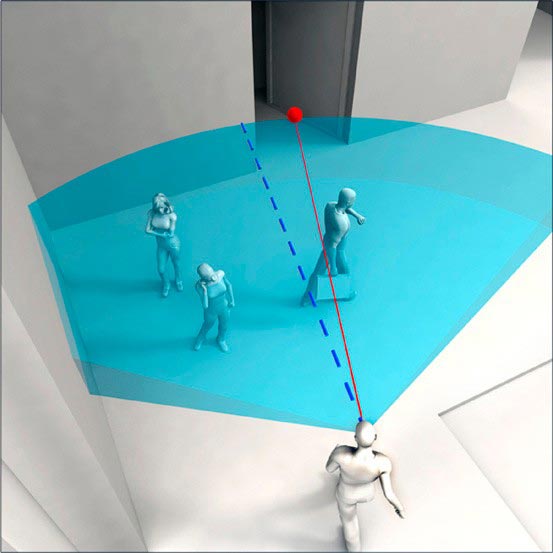
To try and understand these behaviours, scientists usually employ a physics-based approach. Pedestrians can be modelled as solid particles that experience an attractive force towards their destination and repulsive forces from other pedestrians and from walls. However, according to Mehdi Moussaïd of the CNRS research centre for animal cognition in Toulouse, France, such physics-based models have a number of shortcomings. These include the ever-increasing complexity of the interaction functions needed to satisfy new data on crowd behaviour, and the limitations imposed by only ever considering interactions between two particles at any one time.


Seeking out empty space

In the new approach, developed by Moussaïd, Guy Theraulaz, also at the CNRS centre in Toulouse, and Dirk Helbing of the Swiss Federal Institute of Technology in Zurich, pedestrians instead alter their motion deliberately, and do so on the basis of what they see. Individuals work out the relative position of surrounding obstacles as they walk and use this information to modify their movement according to two simple principles. The first of these is to walk in the direction that provides the most direct obstacle-free path to the destination, and the second is to walk at a speed that allows a certain minimum time to react to potential collisions. As Moussaïd puts it, "physics-based modelling represents the tendency to move away from others, while our cognitive model represents the tendency to seek out empty space".

To see how well their model stood up to empirical data, the researchers first tested it against laboratory observations of how two individual pedestrians avoid one another. They found that the predictions and data were in good agreement, both for the case in which the two pedestrians were moving in opposite directions and when one was stationary. Next, they tested the model against collective phenomena, and found that it correctly predicted the spontaneous dividing up of opposing flows. They also found that as they increased the density of pedestrians in their model, the resulting decline in the average speed of walkers was in line with real-life observations, carried out in Toulouse.

Increasing the density still further, Moussaïd and colleagues found that the model predicted the distinctive transitions to more disordered behaviour – stop-and-go waves and then turbulence. But because at these high densities people are in close contact with their neighbours and can be pushed and pulled about against their will, the researchers added a purely physical interaction term to their equations that kicked in once the density was high enough. With this extra term in place, the model was able to predict the extent of crushing around bottlenecks in passageways and the resulting stress releases that, say the researchers, can produce "earthquake-like" movements of many individuals in multiple directions. In particular, the researchers found that their results agreed closely with images of crowd turbulence that happened to be captured by a surveillance camera during the 2006 hajj pilgrimage to Mecca.

Foreseeing bottlenecks

According to Moussaïd, the new model could have a number of practical uses. One might be in the layout of sites for mass events, with the model predicting which bottlenecks, such as those around entrances and exits, could prove the most dangerous. Also, using the model to analyse real-time footage of crowd movements could give organizers vital minutes to try and restore order before the situation deteriorates. The researchers also point out that the visual basis of their model makes it particularly well suited to studying how people can be evacuated when there is reduced visibility, as would be the case in a smoke-filled room.

László Barabasi of Northeastern University in the US believes that the Franco-Swiss researchers "offer a compelling argument" that combining physical and cognitive elements within a single model "is an excellent new avenue to both individual and crowd modelling". He adds that it would be "particularly interesting to see if this paradigm can be extended to other aspects of human dynamics – from the timing of human interactions to large-scale travel patterns."


The research has been published online on the website of the

 Proceedings of the National Academy of Sciences

دانشمندان از پرجزییات ترین نقشه ی سه بعدی کیهان پرده برداشتند

دانشمندان با بررسی و مطالعه ی درخشان ترین اجرام آسمان، پیچیده ترین تصویری که تاکنون از کیهان تهیه شده بود را پدید آوردند. بنا به گفته ی کارشناسان، نگاه کردن به این عکس، مانند نگریستن به ماه از پشت ابرهاست. ولی از آن جایی که میلیون ها سال زمان می برد تا نور به زمین برسد، این تصویر می تواند همچون پنجره ای رو به گذشته، به 11 میلیارد سال پیش باشد، زمانی که کهکشان ها برای نخستین بار گرد هم آمده و خوشه های بزرگ را ساخته بودند. در تصاویر مشابه پیشین برای تهیه ی نقشه ی کیهان از کهکشان ها استفاده شده بود که تنها می توانستند تا 7 میلیارد سال پیش در زمان به عقب بازگردند.

این نقشه می تواند رازهای چگونگی گسترش و انبساط جهان را بگشاید و شاید بتواند به سرنخ هایی از چیستیِ انرژی تاریک که به این انبساط کمک می کند دست یابد. دانشمندان این نقشه را توسط «پیمایش دیجیتالی آسمان "اسلون"» که 14,000 اختروش (کوازار، چشمه های بسیار تابناک نور که از سیاهچاله ها نیرو می گیرند) را مورد بررسی قرار داده بود گرد آوردند.
نور در راه رسیدن از اختروش ها به زمین از ابرهای گاز هیدروژن میان کهکشانی می گذرد و این ابرها با جذب نور در طول موج هایی ویژه و معین، برافروخته و روشن می شوند. همین به تصویری محو و ناواضح با رنگ هایی جدا از هم می انجامد: سرخ نشان دهنده ی مناطقی با گاز بیشتر و آبی مناطقی با گاز کمتر.
این الگوی نامنظم از نور اختروش ها به نام "جنگل لیمن - آلفا" (Lyman-alpha) شناخته می شود.

فیزیکدان Anže Slosar از آزمایشگاه ملی بروکهاون در بخش انرژی U.S. می گوید: « ما در اینجا به گاز هیدروژن میان کهکشانی که جلوی نور را می گیرد نگاه می کنیم. مثل زمانی که از پشت ابرها به ماه نگاه می کنیم و می توانیم شکل ابرها را در اثر نور مهتابی که پشتشان است ببینیم.» وی همچنین آن را به نمونه ای از یخ قطب جنوب تشبیه کرد: با آزمایش تکه ای از آن، می‌شود به آن چه در گذشته روی داده پی برد.
بخشی از پیمایش دیجیتالی آسمان اسلون به ابزاری مربوط است به نام "بررسی طیف سنجی نوسانات باریون" یا BOSS که به پژوهشگران توانایی تولید تصاویر تازه را داده.

پاتریک مک دونالد، از آزمایشگاه های ملی لورنس برکلی و بروکهاون، می گوید: «در آینده به کمک تلسکوپ خواهند توانست سرعت گسترش جهان در 11 میلیارد سال پیش را با دقت 2 درصد اندازه بگیرند. و با توجه به این که تاکنون هیچ کس آهنگ گسترش و انبساط کیهان در زمان گذشته را اندازه نگرفته، این می تواند دورنمایی شگفت آور باشد.»
Slosar به Space.com می گوید که آن ها حتی توانستند دریابند که انرژی تاریک در واقع در 11 میلیارد سال پیش به وجود آمد نه 7 میلیارد سال پیش آن گونه که پیشتر به کمک ساده ترین مدل ها پیش بینی شده بود و این جدن افسون کننده است: «توان و امکان کشف ناهنجاری ها و واقعیت های غیرعادی بسیار بالاست.»

 این یافته ها در انجمن فیزیک آمریکا در کالیفرنیا مطرح شدند.

هجدهمین کنفرانس بهاره فیزیک

IPM School & Workshop on Applied AdS/CFT

Flowing electrons magnetize graphene

Physicists in the UK have discovered another useful property of graphene – the material can be magnetized by simply passing a current of electrons through it. The effect could prove useful in creating spintronic or quantum-information devices that use the spin of the electron.

Graphene is a honeycomb-like 2D sheet of carbon just one atom thick. It acts as a semi-metal and is often touted as a "wonder material" with the potential to make extremely small electronic devices of the future.

This latest work was done by Andre Geim and Konstantin Novoselov at the University of Manchester in the UK, who shared the 2010 Nobel Prize for Physics for creating the first sheets of graphene. The research also involved scientists in the US, Russia, Japan and the Netherlands.

Spin currents

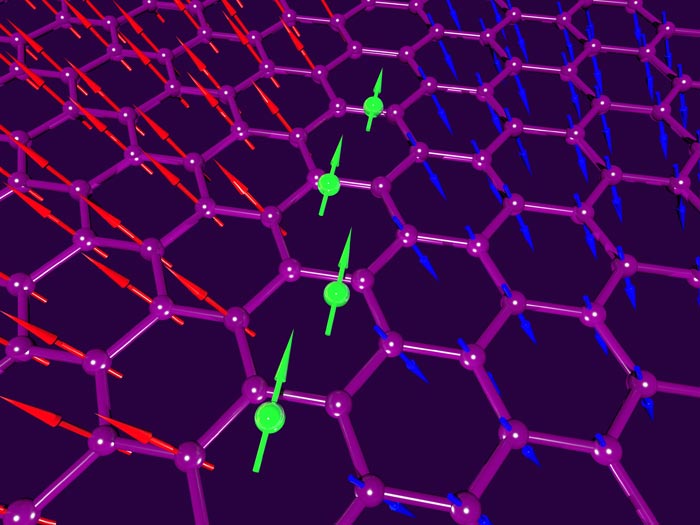
The researchers made their discovery by passing an electrical current along a piece of graphene in the presence of a small magnetic field. They found that spin-up and spin-down currents are produced in opposite directions, perpendicular to the direction of the electrical current. The effect is to magnetize the graphene sheet (see figure). The effect is important because it offers physicists a way of controlling spin using electrical current.

The researchers studied more than 20 devices, with two types of graphene – graphene grown on an oxidized silicon wafer and another system where crystals of hexagonal boron nitride were placed between the graphene and the silicon wafer.

While this is not the first time a form of graphene has been magnetized, it is the first time that net magnetization has been created in graphene using spin currents. The research also suggests that spins can be generated, even if graphene has no magnetic moment.

"The central [result] is that they can create large spin currents, which allow them to separate spatially the up and the down spins," says Markus Mueller, at the Abdus Salam International Centre for Theoretical Physics in Italy. Mueller believes that the experiment offers a way to produce simple and robust spin-current sources, which could have many applications.

Imbalance at the Dirac point

Mueller explains that the effect is related to an unusual property of graphene – a Dirac or "neutrality" point where the valence and conduction bands meet. Particles above the Dirac point and holes below the Dirac point react in opposite ways to a magnetic field. The result is an imbalance explains Mueller. "You have more 'up' spins so that their Fermi surface lies in the particle-like region; and fewer 'down' spins, which at their Fermi level are hole-like. That's all you need to create a strong spin current."

Another peculiarity of graphene is that even a very small concentration of charge carriers will hold the magnetization. This is unlike normal substances in which opposite spins can be induced, but a large number of charge carriers are required to maintain the magnetization. If the concentration of charge carriers is decreased, most materials begin to act as insulators and the magnetization is lost. But as Geim explains, in graphene "the dominant phenomenon [of magnetization] still occurs... it even increases as the concentration of charge carriers is reduced, as it is inversely related and this is a salient feature of graphene".

"Non-local quantum effect"

Another surprising finding is that the spins maintain their orientation for relatively long distances in the graphene – a property that is very desirable for spintronics and quantum-information applications. Antonio Castro Neto of Boston University believes that this "non-local quantum effect" is also related to the Dirac point. Writing in Science, he explains that "close to the Dirac point the charge of the electron behaves incoherently (and hence, classically) but its spin behaves coherently (and thus quantum mechanically)".

Francisco Guinea at the Instituto de Ciencia de Materiales de Madrid says the results are very important for spintronic applications, especially as spin currents can be used to retrieve information stored in magnetic devices. Mueller agrees: "It seems this is a quite interesting way to transfer information to spatially different locations via voltage signals, which are easy to process and detect."

The research is reported in Science 332 328 .

Physicists put a new twist on graphene

Physicists in the US and UK have worked out why different samples of multilayer graphene can have very different electronic properties. The answer, according to the team, lies in the relative rotation between layers and the discovery could lead to a new way of controlling the electronic properties of the material.

Graphene is a freestanding layer of carbon just one atom thick and thanks to its 2D nature has a host of unique electronic properties not seen in thicker carbon films. This includes conduction electrons that appear to travel near to the speed of light and have zero mass – so called Dirac fermions. These and other properties of graphene could make it very useful in making ultrafast electronic devices.

Theory suggests that graphene multilayers several atoms thick should not contain Dirac fermions because electron coupling between layers destroys its 2D nature. However, Dirac fermions have been spotted in some multilayers grown by depositing carbon atoms on surfaces, which has puzzled physicists.

A new angle

Now Eva Andrei and colleagues at Rutger's University, Massachusetts Institute of Technology and the University of Manchester have found that the relative angular orientation between successive layers plays a key role in whether or not a multilayer contains Dirac fermions.

The team creates its multilayer samples by depositing carbon onto a nickel surface. The graphene is then lifted off the surface using chemical and studied using a transmission electron microscope to work out the relative angle between the 2D lattices of each layer.

The presence of Dirac fermions was determined using Landau level spectroscopy, whereby a magnetic field is applied to the material. This causes the electrons in each layer to adopt quantized circular orbits – or Landau levels. The energies of these levels are measured using scanning tunnelling spectroscopy and are distinct for Dirac fermions.

Rotated stacks

The team looked at samples where the orientation of graphene layers was close to the most common stacking scheme (Bernal), whereby successive layers are rotated by 60° to each other. They found that when successive layers were offset by about 22° from Bernal stacking, the electrons behaved just like Dirac fermions found in single layers. However, at much smaller rotation angles of about 4°, the velocity of the electrons had dropped to about 80% of that in a single layer.

Also involved in the research is Andre Geim of the University of Manchester, who shared the 2010 Nobel Prize for Physics for his work on graphene. He speculates that the Dirac fermions are seen because the rotation breaks the spatial symmetry between the layers. This could reduce the coupling between layers, making each layer a 2D system.

A third sample was studied with a rotation angle of about 1.2° and this had no evidence of Dirac fermions.

Changing the angle at will

Andrei now plans to repeat the measurements at different twist angles. "New graphene transfer methods opened up possibilities for designing experiments in which we can change the angle at will and exploit these properties for device applications," she explained. Looking further into the future, Andrei speculates that graphene could be patterned with regions of different twist to create electronic devices.

Sankar Das Sarma of the University of Maryland, who was not involved in the research, described the work as "an important milestone in graphene research" that will encourage physicists to study various properties of twisted graphene. However, he pointed out that "much more experimental work on transport and optical properties would be necessary" before technological applications could be considered.

مدرسه و کارگاه تازه های پیشرفت در فیزیک ذرات

پژوهشگاه دانشهای بنیادی درنظر دارد مدرسه و کارگاه تازه های پیشرفت در فیزیک ذرات را 13 تا 16 شهریور ماه 1390 برگزار کند.

برای کسب اطلاعات بیشتر به نشانی زیر مراجعه کنید.

IPM school and workshop on recent developments in Particle Physic

Does dark matter link gamma rays to galactic haze?

Annihilating dark matter at the heart of the Milky Way could account for signals detected by two space telescopes, according to a pair of US physicists. If true, the theory provides a new indirect measurement of one of astronomy's most elusive entities. However, some physicists believe that we don't know enough about the galactic core – or dark matter – to come to this conclusion.

In recent years the Fermi Gamma-ray Space Telescope has detected a flux of gamma-rays from the centre of our galaxy and the Wilkinson Microwave Anisotropy Probe (WMAP) has revealed a "haze" that also seems to envelop the Milky Way's core. Now, Fermilab's Dan Hooper and Tim Linden believe that dark matter can tie these two observations together.

Although dark matter is thought to make up more than 80% of all matter in the universe, it does not interact with electromagnetic radiation and its existence has been inferred from its gravitational effects on visible matter. The precise nature of dark matter is unknown and over the years many contenders have been put forward to account for it. The option currently favoured by most physicists, including Hooper, is as yet undiscovered weakly interacting massive particles (WIMPs).

Annihilating WIMPs

"If you get two WIMPS in the same place at the same time they interact in such a way that both get destroyed and liberate normal energy," Hooper explains. He believes that this process supplies the gamma-rays observed by Fermi. The process would also create large numbers of electrons and positrons at the core of the Milky Way. Hooper and Linden believe that these particles interact with the galaxy's magnetic field to produce a haze of radiation – and have modelled what they expect this radiation profile to look like. "Our model falls right on top of the WMAP data; they are in remarkably good agreement," says Hooper.

Some researchers, however, believe it isn't quite that simple. "The galactic centre is very hard to model; we don't know much about it. There are also controversies about the nature of the Milky Way's magnetic field," explains Julien Lavalle, from the Institute of Theoretical Physics in Madrid. "This makes it very difficult to claim whether dark matter is responsible or not," he adds.

There might also be problems with the mass of WIMPs used by Hooper and Linden. Their WIMPs weigh in at 7–9 GeV, which is in line with possible dark-matter signals seen in the ground-based CoGeNT and DAMA/LIBRA detectors. However, a heated debate has been raging over the veracity of these detections, as physicsworld.com reported last year. Indeed, the debate's latest instalment has seen the CoGeNT and DAMA/LIBRA signals coming under increased fire from the XENON100 experiment.

Fighting his corner

However, Hooper is prepared to fight his corner. "I am still not entirely convinced by the XENON100 argument. There are reasons to think that due to the atomic properties of xenon [the element used in the detector], such a low energy WIMP interaction would leave no observable trace," he argues.

But recent work (arXiv:1104.0679) by Martin Winkler and Rolf Kappl of the Technical University of Munich has put the matter under further scrutiny. If Hooper's flavour of WIMPS exists then they should be efficiently captured by stars, including the Sun. Their annihilation in the Sun would produce energetic neutrinos detectable from Earth. Winkler and Kappl used the Super-Kamiokande neutrino detector to search for such high energy solar neutrinos. So far the search has yielded nothing. "We can constrain Hooper's model substantially, but not rule it out," Winkler told physicsworld.com.

Hooper still believes he is on the right track though. "Neither my paper nor anyone else's is claiming a smoking gun for dark matter. But certainly, of all the signals that have come and gone over the years, it is this collection [Fermi, WMAP, CoGeNT, DAMA/LIBRA] that I find by far the most compelling," he says.