وقتی دیوار صوتی در فضا می شکند

این تصویر تماشایی از رشته های درهم پیچیده ی کیهانی که در فضا پخش شده اند، می تواند به دانشمندان کمک کند از چگونگی زایش ستارگان دانسته های بیشتری به دست آورند. رصدخانه ی فضایی هرشل این رگه های گازی طلایی را در ابر میان‌ستاره‌ای IC 5146 به فاصله ی حدود 1,500 سال نوری از ما به تصویر کشیده. در سمت چپ تصویر، سحابی زیبا و آبی رنگ پیله ی ابریشم (کوکون) را می بینیم که به شبکه ای از رشته های گاز و غبار پیوسته شده.

ستارگان در بخش های چگال ترِ (فشرده ترِ) این رشته ها شکل می گیرند، ولی این که خود رشته ها چگونه پدید می آیند هنوز یک راز است. این گاز و غبار در نور دیدگانی (مریی)، شبیه رگه های مات و کدر دیده می شوند و تنها در محدوده ی فروسرخ است که می توان جزییات آن ها را هم دید.
وضوح تلسکوپ هرشل به ستاره شناسان اجازه می دهد پهنای این رشته ها را نیز اندازه بگیرند. شگفت این که به نظر می رسد پهنای همه ی آن ها تقریبن با هم برابر است: 0.3 سال نوری یا به عبارتی حدود 20,000 برابر فاصله ی زمین تا خورشید. دانشمندان انتظار داشتند در این رشته ها با پهناهای بسیار گوناگونی روبرو شوند ولی این واقعیت که همه یک اندازه اند می تواند سرنخی از چگونگی پدید آمدنشان به دست بدهد.
اخترشناسان با مقایسه ی آن ها به کمک شبیه سازی رایانه ای، به این نتیجه رسیدند که این رشته ها ممکن است در اثر پخش شدن امواج شوکِ کم سرعت در ابرهای میان ستاره ای به وجود آمده باشند. خود این امواج شوک در اثر انرژی تولید شده از انفجار ستارگان به وجود می آیند، انفجارهایی که نقشی بزرگ در آشفتگی و تلاطم مناطق اطرافشان دارند.
 
امواج در فضای کهکشان راه شیری ما حرکت می کنند، گاز و غبار را بالا و پایین می برند و رشته های فشرده ای که اکنون می‌بینیم را به وجود می آورند. از آنجایی که ابرهای میان ستاره ای بی نهایت سردند، در حدود 10 درجه بالاتر از صفر مطلق (یا -263 سانتیگراد)، سرعت صوت در آن ها به نسبت زمین پایین است، تنها 720 کیلومتر بر ساعت (سرعت صوت روی زمین در سطح دریا 1200 کیلومتر بر ساعت است).
این بدان معنیست که امواج کم سرعت شوک در فضای میان ستاره ای رفتاری هم ارز شکسته شدن دیوار صوتی دارند. زمانی که امواج صدا در میان ابرها انرژی از دست می دهند، این رشته های فشرده ی گاز و غبار را از خود به جا می گذارند.
این ناحیه در صورت فلکی ماکیان (دجاجه) قرار داشته و بخشی از کمربند Gould است، حلقه ای از مناطق همسان ستاره زایی دور تا دور آسمان.

کارگاه آموزشی پیشرفته محاسبات تمام الکترونی مبتنی بر نظریه تابعی چگالی

شاخه فيزيک محاسباتی انجمن فيزيک ايران با همکاری دانشگاه اصفهان کارگاه آموزشی پيشرفته محاسبات تمام الکترونی مبتنی بر نظريه تابعی چگالی (DFT) را ۱۲ الی ۱۳ خرداد ماه ۱۳۹۰ در دانشگاه اصفهان برگزار می‌کند. اين دوره که دومين دوره از سلسله کارگاه‌های شبيه‌سازی در مقياس نانو است، توسط شاخه فيزيک محاسباتی انجمن فيزيک ايران برنامه ريزی و در دانشگاه اصفهان اجرا می‌شود. مخاطبين دوره را اعضای هيات علمی و دانشجويان تحصيلات تکميلی رشته‌های فيزيک، شيمی، نانو فناوری و مهندسی تشکيل می‌دهند.
آخرین مهلت ثبت نام در کارگاه 15/2/1390 تعیین شده است.

علاقه مندان میتوانند برای کسب اطلاعات بیشتر و ثبت نام به نشانی الکتــرونیکی کارگاه مراجعه نمایند.

Mapping orbits within black holes

The words "black hole" generally bring to mind destruction and an end to all ends. No-one – in fact or fiction – has considered the possibility of stable habitats existing within black holes. But that is precisely what physicist Vyacheslav I Dokuchaev of the Russian Academy of Sciences, Moscow, is suggesting in his new paper, "Is there life in black holes?". Published in the Journal of Cosmology and Astroparticle Physics, Dokuchaev suggests that certain types of black hole contain stable orbits for photons within their interior that might even allow planets to survive.

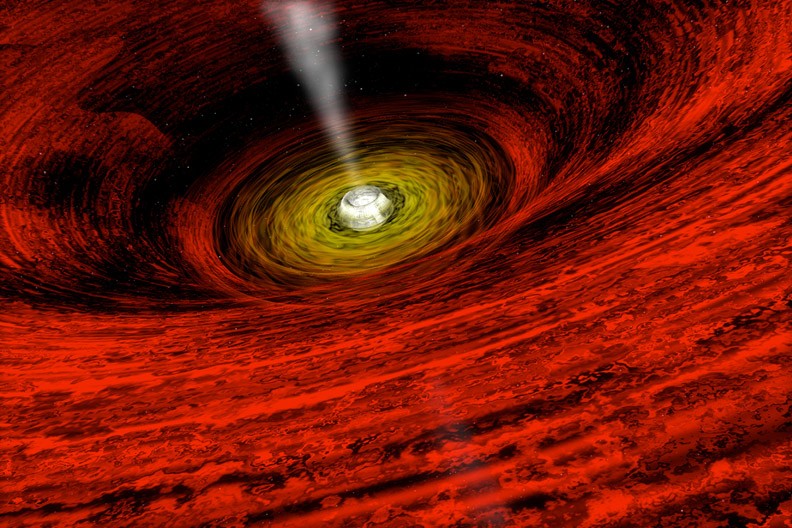
Essentially, a black hole is a place where gravitational forces are so extreme that everything is sucked into them – including light. They have outer boundaries, known as event horizons, beyond which nothing can escape because matter starts moving at faster-than-light speeds. But charged, rotating black holes – known as "Kerr–Newman black holes" – exhibit an unexpected twist. They have not only an outer event horizon but also an inner horizon, called a "Cauchy" horizon. At this Cauchy horizon, because of the centrifugal forces involved, particles slow down back to the speed of light.

The final frontier

Since the 1960s, researchers have determined stable orbits for photons inside these charged, rotating black holes. In his new paper, Dokuchaev has looked at stable circular orbits as well as spherical, non-equatorial orbits for photons at the inner boundary. He concludes that there is no reason that larger bodies, such as planets, could not do the same. He even suggests that entire advanced civilizations could live inside this particular subset of black holes, on planets that orbit stably inside the hole – using the naked singularity as a source of energy. They would forever be shielded from the outside and not sucked into the singularity itself, he says.

In theory it should be possible to use the singularity as an energy source explains Andrew Hamilton, an astrophysicist at the University of Colorado in the US who has also calculated the orbits at the inner horizon inside these black holes. "A rotating black hole acts like a giant flywheel. A civilization can tap the rotational energy of the black hole by playing clever games of orbital billiards, something first pointed out by Roger Penrose," he says.

However, Hamilton believes that, in reality, the situation is implausible. Inflation at the inner horizon would cause space–time to collapse, not to mention disturbances created by the high energy density at such a location, from massive amounts of matter falling into the black hole. On the whole, none of these circumstances would make for habitable conditions. Dokuchaev himself acknowledges these problems in his paper, but does not provide a solution.

Paradoxes and information losses

Even if a planet and then a civilization were to form inside these black holes, it would be almost impossible to discover them because all information is lost going into or coming out of a black hole. Although new theories state that information from the interior of black holes is encoded in the Hawking radiation emitted from them, this information could quite possibly be scrambled.

Arthur I Miller, a physicist and author of several popular-science books, believes that it is pointless to look at any possibility of life inside black holes, stable orbits notwithstanding. "It is, indeed, extreme science fiction to imagine the existence of worlds in them. Surely it would be a 'crushing experience' living inside a black hole?" he says.

So, while most scientists will agree that looking for life inside black holes is a futile venture, the sad truth is that we will never know if the real-estate market is missing out on a great new platform.

Heaviest ever antimatter discovered

Physicists at the Relativistic Heavy Ion Collider (RHIC) in New York say they have created nuclei of antihelium-4 for the first time – the heaviest antimatter particles ever seen on Earth.

Antimatter nuclei are built from antiprotons and antineutrons but of all the various two- and three-quark combinations that can arise in particle collisions, it is rare that multiple antiprotons and antineutrons appear near enough to one another that they bind into anti-nuclei. Although the first antiprotons and antineutrons were discovered in the 1950s, the construction of heavier nuclei has been extremely taxing as each additional anti-nucleon makes the anti-nucleus 1000 times less likely to appear in a particle collision. Up until now, the largest anti-nuclei observed were capped at three anti-nucleons.

But RHIC is an experiment that can generate the right conditions for the formation of antimatter by smashing gold ions together in an effort to simulate conditions shortly after the Big Bang. Two antihelium nuclei seemed to have turned up in this hot soup of particles in 2007, their signatures appearing in collisions recorded by RHIC's STAR detector at an energy of 62 giga-electron-volts (GeV) per nucleon pair. However, as Peter Braun-Munzinger of the GSI Helmholtz Centre for Heavy Ion Research in Germany, who was not involved in this latest research, points out: "If you have something very rare, you would like to measure it twice."

Last year, the STAR collaboration installed an advanced time-of-flight detector that can help to spot unconventional particles among all the debris. The STAR detector, sitting inside a solenoid magnet, enables researchers to determine the masses and charges of new particles by their speeds and deflections in the presence of the magnetic field. From a catalogue of about a billion of collisions at energies of 200 GeV and 62 GeV, a total of 18 revealed themselves as antihelium-4, with masses of 3.73 GeV. The researchers have published their findings on the arXiv preprint server but were unavailable to comment on the work.

250,000 times hotter than the Sun

The rate at which the antihelium-4 was produced at RHIC supports the view that there are two ways to think about how anti-nuclei form. On the system level, the mass of the nucleus is understood in terms of energy and its probability of showing up depends on the system's temperature – in RHIC, that's over 250,000 times the temperature of the Sun's core. But, on the level of individual particles, the formation of antihelium-4 relies on the odds that the right nucleons are created in the collision, near enough to one another so that they clump together as a nucleus.

According to the STAR collaboration, the amount of energy needed to add extra nucleons makes it unlikely that larger stable anti-nuclei will be found in the foreseeable future. No known 5-nucleon particle is stable, so experiments will need to jump to something like antilithium-6 – nearly a million times less likely to turn up than antihelium-4.

The low rate at which antihelium-4 is produced at RHIC makes it unlikely that the Alpha Magnetic Spectrometer (AMS), scheduled for launch to the International Space Station next month, will detect them – at least from ordinary nuclear reactions.. The AMS will measure cosmic rays in space, before they can get torn apart in Earth's atmosphere. From these interstellar and intergalactic particles, the AMS collaboration hopes to solve mysteries such as why antimatter appears to be largely missing in the universe. "If we find antihelium-4 in the cosmic rays, it is definitely coming from a fusion process inside an anti-star," says AMS deputy spokesperson Roberto Battiston. Currently, anti-stars aren't believed to exist.

Meanwhile, researchers at the ALICE experiment on CERN's Large Hadron Collider have revealed that they also detected antihelium-4 in collisions of lead ions last November. Braun-Munzinger, a member of the ALICE team, says that these results should appear on arXiv in a week or so. He says that he has not relinquished hope of finding heavier antimatter but whatever happens he is looking forward to finding new exotic anti-nuclei, in which the anti-up and anti-down quarks of the antiprotons and antineutrons are replaced by rarer antiquarks.

یادبودنامه آلبرت اینشتین؛ قسمت هفتم

راستی،این را نیز باید اضافه کنم که این فشار،فشاری که هر انگیزه واقعا علمی را از بین می برد،در سوئیس خیلی کمتر از بسیاری جاهای دیگر است.در آنجا فقط دوبار امتحان می شد.سوای این دو امتحان، آدمی تقریبا هر کاری را که دلش می خواست می کرد؛بخصوص اگر آدمی،مانند  من،دوستی می داشت که به طور مرتب در کلاسها حاضر می شد و از روی وجدان بر محتوای درسها تامل می کرد.این وضع،تا چند ماه پیش از امتحان،آدمی را در انتخاب علایق خود آزاد می گذاشت،آزادی ای که من تا حد زیادی از آن بهره مند شدم و با خشنودی تمام آن را به عنوان شر کوچکتر با عذاب وجدان ناشی از آن،معامله کردم.براستی کم از معجزه نیست که طناب روشهای جدید تعلیم تاکنون کنجکاوی مقدس تحقیق را خفه نکرده است؛زیرا این گیاه کوچک نازک،سوای انگیزه بیش از هر چیز نیازمند آزادی است و چون آزادی نباشد به یقین از بین می رود.این تصور که لذت دیدن و پژوهیدن را می توان از راه اجبار و احساس وظیفه برانگیخت،خطائی بزرگ است؛بر عکس به گمان من می توان حتی میل و حرص حیوانی وحشی را به غذا از بین برد،اگر بتوان او را پیوسته به ضرب شلاق،حتی وقتی گرسنه نیست مجبور به خوردن کرد؛خاصه اگر غذایی که به وی خورانده می شود به نحوی خاص نیز انتخاب شده باشد.


برای مطالعه متن کامل این یادبودنامه اینجا را کلیک کنید و همچنین جهت مشاهده قسمتهای گذشته این یادبودنامه اینجا را کلیک کنید.

به نقل از وبلاگ علمی و تحقیقی

Physicists create a quantum mirror image

Physicists in Germany and Austria have shown that individual atoms can move forwards and backwards at the same time, thanks to photon emission and a carefully placed mirror. They say that this result improves our understanding of quantum coherence and could perhaps help to build a workable quantum computer.

Lying at the heart of quantum mechanics, superposition is the idea that a particle can be in two states at the same time. A simple example of this occurs when single photons pass through a double slit and build up an interference pattern on a screen beyond the slits. This demonstrates that individual photons pass through both slits at the same time.

An analogous result can be achieved by splitting a beam of atoms such that each of the atoms travels in two directions at the same time. To date, such a superposition of atomic momentum states has needed a macroscopic beam splitter such as a solid diffraction grating. But now superposition using a scheme based on single photons has been achieved by Markus Oberthaler and colleagues at the University of Heidelberg along with physicists at the Technical University of Vienna, Technical University of Munich and the Ludwig Maximilians University.

Very slight kick

To do this, Oberthaler's group passes a slow-moving, narrow beam of argon atoms very close to a mirror and then excites the atoms with a laser beam. As each atom drops back down to a lower energy level it emits a photon – and some photons bounce off the mirror. Each departing photon provides a very slight kick to the atom in the opposite direction to which the photon is emitted. As a result the photon's trajectory reveals the direction of the atom's recoil.

However, for those photons emitted at right angles to the mirror's surface, it is impossible to tell the difference between a photon that travels away from the mirror as it leaves the atom and one that initially moves towards the mirror but then bounces off its surface. Quantum mechanics tell us that this indistinguishability places the atom into a superposition – it does not recoil either towards or away from the mirror but both towards and away from the mirror at the same time.

To prove that they created this superposition state, Oberthaler's team took advantage of the fact that a beam of atoms has wave-like properties. The physicists exposed the argon atoms to a second laser beam, which was bounced off a second mirror to create a standing light wave across the argon beam. This standing wave acted like a diffraction grating and meant that after the atoms had passed the first laser and had their trajectories simultaneously bent very slightly towards and away from the first mirror, the two atom-states were each split into an undisturbed forward-travelling wave and a diffracted wave.

Interference spotted

The researchers then used an atom detector to measure the interference of the undisturbed wave from the first atom-state with the diffracted wave from the second atom-state, and vice-versa in a second detector. They find that the counts in both detectors rise and fall in a regular sinusoidal-like way as they changed the position of the second mirror. This means that the waves are interfering with one another coherently and that therefore they are coming from a single source – in other words, that the atom is indeed in the two momentum states simultaneously.

This experiment is analogous to the quantum-mechanical double-slit experiment, since the two undistinguishable photon trajectories play the part of the two slits – the atom responding to both at the same time. And like the double-slit experiment, this latest work shows that by determining which paths the particle took you destroy the superposition. Oberthaler and team demonstrate this by moving the beam far enough away from the first mirror so that in effect the mirror isn't there. This means that the photons leaving the atom in opposite directions can be unambiguously distinguished. In this case the detectors no longer measured a series of peaks and troughs but rather a slightly noisy constant count rate. This indicates that the different atom waves arriving at the second laser are not coherent because they are associated with different atoms.

A path to stable qubits?

According to team member Jirí Tomkovic, physicists usually think of spontaneous emission from an atom as destroying coherence. This is because this emission acts like a measurement that tells you unambiguously what energy and momentum state the atom is currently in. But he says that the latest work shows how spontaneous emission of a single photon can create a superposition of states. By improving our understanding of quantum coherence, he believes this research may help in the creation of stable quantum-mechanical bits (qubits) for quantum computers. However, Tomkovic cautions that the work has more relevance for fundamental, rather than applied, physics.

Do spiral galaxies form from the inside out?

By exploiting a lucky accident, astronomers have for the first time measured a key property of a spiral galaxy located more than 9bn light-years away. The observations show that oxygen and iron abound at the centre of the galaxy but not at its edge, which suggests spiral galaxies – including Andromeda and our own Milky Way – formed their giant discs of stars from the inside out.

Spanning 120,000 light-years, our galaxy's disc outshines the rest of the Milky Way. The disc harbours the Sun and most of the galaxy's other stars, as well as the beautiful spiral arms. But exactly how the disc formed is unknown.

One clue comes from the metallicity of the disc’s constituent stars. Metallicity is a measure of the relative abundance in a star of elements other than hydrogen and helium. Stars create these elements and spew them into space. Because stars congregate at a galaxy's centre, the metallicity in most nearby spirals is greatest there and drops toward the edge. In the Milky Way's disc, for example, travel 10,000 light-years outward and the metallicity falls 35%.

Conflicting theories

Different theories predict how this metallicity gradient changes over billions of years. Some theories predict it starts steep and later flattens; other theories predict just the opposite. If astronomers could observe metallicity gradients in spiral galaxies billions of light-years away, we could see how steep the gradients were billions of years ago and thus how they change over time. Unfortunately, such distant spirals look so small and faint that no one has ever done so--until now.

Now, Tiantian Yuan and Lisa Kewley of the University of Hawaii in Honolulu and their colleagues at Durham University in the UK observed a spiral galaxy in the constellation Leo with a redshift of 1.49. This means that the universe's expansion has stretched the galaxy's light waves by 149% as they traveled to Earth. Such a high redshift indicates the galaxy is 9.3 billion light-years away, so we see it just 4.4 billion years after the Big Bang.

"This galaxy is just beautiful," says Yuan. "Normally, galaxies at that redshift appear as blobs." The galaxy looks so good because it lies behind a galaxy cluster. Named MACS J1149.5+2223, the cluster is massive and its gravity magnifies the distant galaxy. As a result, the galaxy appears 22 times brighter than it otherwise would be.

‘Very steep metallicity gradient’

Yuan and colleagues used the giant Keck II telescope atop Mauna Kea in Hawaii to measure the galaxy's metallicity at several different points. "The galaxy has a very, very steep metallicity gradient," she says. Travel 10,000 light-years outward in the galaxy's disc and the metallicity plummets 68%. Because we see the galaxy when it was young, this result suggests spiral discs start off with steep metallicity gradients.

"It's a fascinating piece of work," says Andrew Benson, an astronomer at the California Institute of Technology in Pasadena who was not connected with the new study. "It's sort of pioneering in many ways, because doing this kind of detailed study of a galaxy at a very high redshift is extremely difficult."

Benson says the steep metallicity gradient agrees with the long-standing but unconfirmed idea that spiral galaxies form their discs of stars from the inside out. In this model, a mass of gas collapses and creates lots of stars at the disc's centre, where the stars quickly boost the metallicity. However, because few stars form on the disc's outskirts, the metallicity there stays low. Thus, the disc begins its existence with a steep metallicity gradient, like the one in the distant galaxy in Leo. Then, over billions of years, stars develop in the outer regions, raising the metallicity there and flattening the gradient.

More galaxies needed

Yuan acknowledges one weakness: this is just one galaxy. "It looks like a pretty normal galaxy," she says. "From this point of view, we think it could be very representative." In addition, last year other astronomers reported a steep metallicity gradient in an even farther galaxy, but that galaxy is not a spiral, so its relevance to the Milky Way is less clear.

The next step for the astronomers is to study additional spiral galaxies at great distances. Says Yuan, "In fact, I'm going to observe another one this week."

Quantum probe beats Heisenberg limit

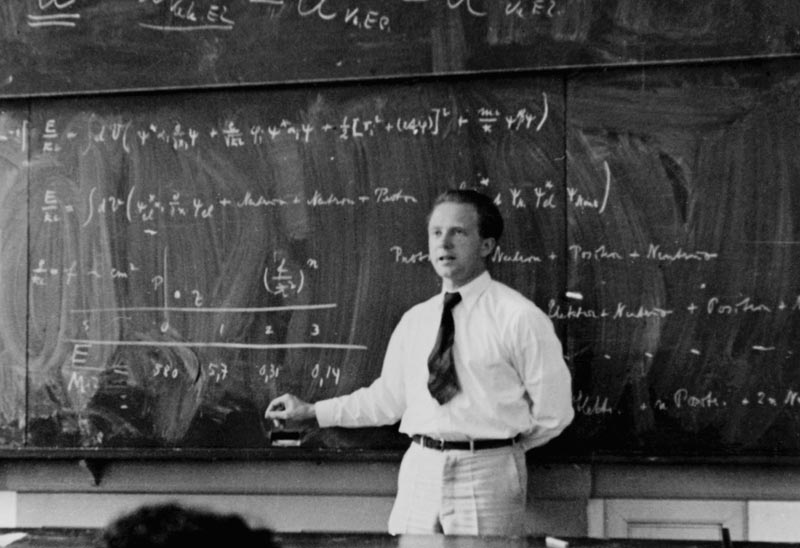
A group of physicists in Spain has shown how to make a quantum measurement that overcomes a limit related to Werner Heisenberg's uncertainty principle. The researchers confirmed a theoretical prediction of how to beat the Heisenberg limit by using interacting photons to measure atomic spin, and they say that their approach could lead to more sensitive searches for the ripples in space–time known as gravitational waves and perhaps also to improved brain imaging.

The standard limit on the precision with which a quantum measurement can be carried out is due to the statistical error associated with counting discrete particles rather than continuous quantities. So, for example, when measuring the phase difference between the waves sent down two arms of an interferometer, the error in this quantity will scale with the square root of the total number of photons measured, N. Since the signal scales with N, the signal-to-noise ratio also scales in the same way. Or, put another way, the sensitivity of the measurement, which is the minimum signal that can be measured with a given level of noise, will scale with 1/N1/2.

It is possible to improve on this scaling, however, by entangling the photons, because this correlates what would otherwise be independent sources of noise from the individual particles. Such entanglement allows measurements to approach the so-called Heisenberg limit, which means that sensitivity scales with 1/N. Until recently it was thought that this scaling represented an absolute limit on the sensitivity of quantum measurements.

Caught in a trap

However, in 2007 a group led by Carlton Caves at the University of New Mexico in the US predicted that the Heisenberg limit could be beaten by introducing nonlinear interactions between the measuring particles. That prediction has now been shown to be true, thanks to an experiment carried out by Morgan Mitchell and colleagues at the Institute of Photonic Sciences at Barcelona. Mitchell's group fired laser pulses into a sample of ultracold rubidium atoms held in an optical trap and measured how the atoms' spin angular momentum caused the polarization axis of the photons to rotate.

In a linear measurement, each photon would interact separately with the atoms, resulting in a relatively weak signal. But what the researchers did was to carry out nonlinear measurements, ramping up the intensity of the laser pulses enough so that each photon, as well as registering the magnetic state of an atom also altered the electronic structure of that atom. This in turn left its mark on the polarization of the next photon, so amplifying the signal. "We have a signal that is not dependent just on the thing we are aiming at, but also on what we send in," explains team member Mario Napolitano.

According to Napolitano, it wasn't clear that a signal could in practice be amplified in this way because it was reckoned that the nonlinearity would increase the noise as well as the signal. But his team was able to tailor the nonlinearity accordingly, by concentrating the interaction between atoms and photons to a very tiny region of space and by very precisely tuning the frequency of the laser so that it was very well matched to the atoms’ electronic structure. Then by measuring the rotation in the photons' polarization using an interferometer, measuring the noise and measuring the number of photons, then repeating this process for different photon numbers, the researchers were able to show that the sensitivity scales with photon number better than the scaling of the Heisenberg limit. In fact, they achieved a sensitivity that scaled with 1/N3/2.

Clocks and brains could benefit

Napolitano is keen to point out that this result does not imply that the Heisenberg uncertainty principle is wrong, but rather it shows that we do not properly understand how to scale that principle up to multiple-particle systems. He also believes that the work could ultimately have significant practical applications, such as improving atomic clocks, given that such devices rely on interferometers. What's more, several research groups are investigating the possibility of measuring electrical changes in the brain by using light to probe the magnetic properties of atoms placed close to the brain, and the lastest work could enhance this technique.

Jonathan Dowling, a theoretical physicist at Louisiana State University in the US, says that the latest work could also help in the search for gravitational waves. Researchers hope to register gravitational waves' distortion of space time by measuring the difference in path length experienced by laser beams travelling in the two orthogonal pipes of an interferometer. Dowling says that if the American LIGO detector could operate with a sensitivity that scales as 1/N3/2 rather than as 1/N1/2 then either its sensitivity could be greatly increased or its laser power enormously reduced, which would avoid potential heating and deformation of the facilities' optics. "This opens up a whole new ball game in nonlinear interferometry," he adds.

However, Barry Sanders, a quantum physicist at the University of Calgary in Canada, urges caution. "The experiment demonstrates that the Heisenberg limit can be beaten in the real world," he says. "But practical applications are not likely in the near future because of the technical challenges that need to be overcome, especially noise. We are still exploring the basic physics of using quantum resources for precise measurements."

Nuclear physicists protest at isotope facility closure

Physicists in the US have expressed dismay over the planned closure of the Holifield Radioactive Ion Beam Facility (HRIBF) at the Oak Ridge National Laboratory in Tennessee. Around 700 researchers have signed letters to William Brinkman, director of the Office of Science at the Department of Energy (DoE), warning that its closure will threaten the country's lead in ion-beam research.

The closure of HRIBF would save the DoE's Office of Science around $10.3m, with the money going instead towards two other projects. These are an upgrade of the Continuous Electron Beam Accelerator Facility at the Thomas Jefferson National Accelerator lab and HRIBF's successor – the Facility for Rare Isotope Beams (FRIB) at Michigan State University. FRIB is expected to begin operations in 2019.

HRIBF is only one of four facilities in the world to produce radioactive beams using the isotope separator on-line (ISOL) technique – the others being at TRIUMF in Canada, SPIRAL at Grand Accélérateur National d'Ions Lourds in France and the On-Line Isotope Mass Separator at the CERN particle-physics lab near Geneva.

ISOL involves firing a beam of ions at a hot target, such as uranium, and then bringing the reaction products to rest. The products are separated according to mass and reaccelerated to carry out further studies. These facilities can produce unstable nuclei that are rich in neutrons and are thought to have played a vital role in the synthesis of heavy elements in stars.

Wider concerns

Nuclear physicists protesting against HRIBF's closure have urged their colleagues to send a personalized letter to Brinkman as well as sign a letter of support for the facility. The letter has already been signed by some 700 physicists, including Nobel laureate Douglas Osheroff from Stanford University, who say they are "dismayed" to learn that the facility may close, claiming it would "represent a step backward" for US leadership in low-energy nuclear physics. "The logic behind the decision escapes us," they write. "We are deeply concerned about the process by which this decision was made. There was no direct input form the community."

FRIB chief scientist Bradley Sherrill from Michigan State University, who penned his own letter to Brinkman, says that losing HRIBF will hurt not only US scientists but also those around the world. "Research demand for rare isotopes is growing worldwide due to the exciting science it enables," he says. Indeed, Sherrill adds that the decision to close HRIBF will mean that the US is less prepared for FRIB and put a strain on already highly subscribed facilities worldwide as US researchers look to Canada or Europe to do experiments.

"To allow continuation, HRIBF should not really close before FRIB opens," says Peter Butler from Liverpool University in the UK, who is chair of the programme advisory committee at HRIBF. "We are all baffled by the logic of this decision."

There is still a possibility that the letters will have an impact as the 2012 funding proposal is only a request from the US administration and still has to go through Congress. Indeed, Sherrill is hopeful that the final budget can still include funding for HRIBF that does not affect either the Jefferson project or on FRIB. But he admits that if Congress did accept the proposal, then HRIBF would indeed close.

Life could exist around dying stars

Dim, dense and dying, white dwarf stars might seem an unlikely place to seek Earth's twin. But an astronomer in the US says that planets orbiting such stars could support life for billions of years. Furthermore, white dwarfs are as numerous as the Sun-like stars that searches for extraterrestrial life currently target, so this finding adds billions of potential abodes for life to the galaxy.

"I was just thinking, `What would be an easy way to detect an Earth-like planet?'" says Eric Agol of the University of Washington in Seattle, who notes that finding planets as small as Earth is normally so difficult it requires an expensive space-based telescope. "That's what led me to white dwarfs."

Conveniently, white dwarfs are small. Although a typical white dwarf has 60% of the Sun's mass, its diameter is little larger than Earth's. Thus, an Earth-sized planet can block nearly all the star's light, so even a 1 m ground-based telescope could detect the presence of a planet.

Offspring of red giants

White dwarfs form from stars like the Sun, whose cores use nuclear reactions to convert hydrogen into helium. When the core gets too full of helium, the star will begin burning hydrogen outside the core, causing the star to expand and its surface to cool and redden, until the star becomes a red giant. Then the red giant will cast off its outer atmosphere, exposing its hot core.

That hot core is a white dwarf, which starts life at a temperature exceeding 100,000 K. It shines not from nuclear reactions but from its leftover heat. As the white dwarf emits light into space, the star cools and fades.

Agol says the most promising white dwarfs for habitable planets have surface temperatures between 3000 and 9000 K – comparable to the Sun's temperature of 5780 K. Such white dwarfs are fading only slowly, so they may give an orbiting planet billions of years of mild temperatures. "If you're on the surface of that planet, your star would look about the same angular size and about the same colour as the Sun," says Agol.

Goldilocks zone

These white dwarfs emit 1/10,000 of the Sun's light, so a planet with terrestrial temperatures must be about 1/100 as far from its star as Earth is from the Sun. Unfortunately, a red giant would have engulfed such a close planet, but Agol says a planet could get kicked close to a white dwarf by the gravity of another planet – or even form there if gas encircled the white dwarf after its birth.

A habitable planet would eclipse its star for about two minutes, says Agol. He calculates that a white dwarf with 60% of the Sun's mass could have habitable planets that revolve every 4–32 hours. At shorter orbital periods, the planet is so close to the star that the star's tides tear the planet apart; at longer periods, the planet is too far from the star and too cold.

Whatever the period, a habitable planet around a white dwarf would have a permanent day side – where any life would presumably exist – and a permanent night side. That's because tides from the star would lock the planet so that the same side always faced the star, as with the Moon and the Earth.

No shortage of dwarfs

About 5% of all stars are white dwarfs. They are so common that two of them – Sirius B and Procyon B – reside within just a dozen light-years of the Sun. The chance that a planet in the habitable zone eclipses its star as seen from Earth is about 1%. Some 15,000 white dwarfs lie within 300 light-years of us, so if every star has one planet in the habitable zone, we should be able to detect 150 planets within that distance.

"It's a plausible idea, and it's very creative," says James Kasting of Pennsylvania State University in University Park. "I would never have thought about being able to detect habitable planets around white dwarfs."

"What's wonderful is if they're there, they're detectable," says Gregory Laughlin of the University of California at Santa Cruz. "It gives a plausible and completely new route to possibly looking at planets that might harbour Earth-like environments." Moreover, Laughlin says astronomers could easily study the planets' atmospheres, because the eclipses would be so deep.

Agol acknowledges trouble with one key ingredient for life – water. "This is one of the biggest problems: the planet starts out hot," he says, because the star did, and the heat may have driven away all the planet's water. "On the other hand, the Earth started out hot too." Water might reach the surface of the white dwarf planet through comet impacts and volcanic eruptions.

ساخت حافظه ی تک اتمی توسط فیزیکدانها

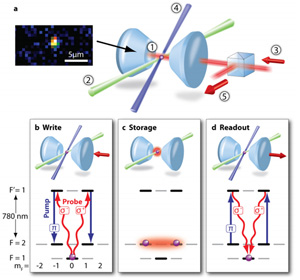
یک اتم روبیدیوم در مرکز یک دستگاه پیچیده ی حافظه ی کوانتومی:
یکی از عناصر مهم در نسل بعدی سیستمهای محاسبات و ارتباطات کوانتومی، به دست آوردن روشی برای ذخیره کردن و تولید مجدد کیوبیتهای فوتونی از طریق قطبش فوتونها است. پیش از این فیزیکدانها این کار را از طریق انتقال یک فوتون به یک آنسامبل ذرات کوانتومی مانند یک شبکه ی کریستالی یا یک ابر کوچک اتمی انجام داده اند. اخیراً هولگر اسپک (Holger Specht) و همکارانش در بخش کوانتوم اپتیک مؤسسه ی ماکس پلانک آلمان روشی بهتر به دست آورده اند. آنها راهی برای ذخیره کردن کیوبیت یک فوتون قطبیده در یک تک اتم روبیدیوم و رهاسازی دوباره ی آن یافته اند.
روش کار به این صورت است: ابتدا باید یک اتم دو ترازه که به روش مناسبی فوتون را جذب می کند یافت و سپس راهی پیدا کرد تا فوتون را مجبور کنیم کیوبیتش را به اتم باز گرداند. به نظر می آید که روبیدیوم تراز های انرژی دلخواه را دارد. اسپک و همکارانش با به دام انداختن فوتون در یک کاواک آینه ای (که فوتون به راحتی می تواند واردش شود اما نمی تواند به آسانی خارج گردد) مجبور به برهمکنش می کنند تا موجودی اش را بر اثر حرکت ارتجاعی به اتم بدهد.
برای آنکه اتم این کیوبیت را دریافت کند باید ابتدا توسط یک لیزر ضعیف در تراز مشخصی قرار بگیرد. سپس لیزر دیگری اتم را وادار می کند این کیوبیت را به شکل فوتونی با قطبش یکسان به بیرون بیاندازد. نتیجه، حافظه ی تک اتمی ای خواهد بود که قادر به ذخیره سازی، بازخوانی و درج اطلاعات کوانتومی است.
چنین وسیله ای بسیار مفید خواهد بود. برای مثال از این ابزار می توان برای ساخت "تکرار کننده ی کوانتومی" به عنوان پایه ای برای سیستم اینترنت کوانتومی با توانایی هایی بسیار بیشتر از آنچه امروزه با آن سر و کار داریم، استفاده کرد.
با وجود آنکه این دستگاه در حال حاضر قادر به ذخیره کردن اطلاعات برای تنها 180 میکروثانیه است، اسپک و همکارانش ادعا کرده اند که می دانند چگونه این زمان را افزایش دهند، "با دور نمایی به اندازه ی چند ثانیه".

ترجمه از arXiv

یادبودنامه آلبرت اینشتین؛ قسمت ششم

یک گزاره در صورتی درست است که بتوان آن را در چارچوب دستگاه منطقی،مطابق قواعد یک منطق پذیرفته شده،استنتاج کرد.بهره حقیقت یک دستگاه بسته به قطعیت و کمال آن دستگاه در هماهنگی با مجموعه تجربه هاست.یک گزاره درست،«حقیقت» خود را از بهره حقیقت دستگاهی کسب می کند که بدان تعلق دارد. اشاره ای به تحول تاریخی.هیوم به وضوح پی برد که برخی مفاهیم،مانند مفهوم علیت،را نمی توان به روشهای منطقی از داده های تجربی استنتاج کرد.کانت که کاملا به ضرورت بعضی مفاهیم عقیده داشت،آنها را – به همان صورتی که اختیار می شدند- فرضهای لازم هر نوع اندیشیدن بر شمرد و میان آنها و مفاهیمی که منشاء تجربی دارند تمایز نهاد.ولی من بر این عقیده ام که این تمایز نهادن،غلط است.بدین معنی که حق مطلب را بطرزی طبیعی ادا نمی کند.همه مفاهیم،حتی آنهایی که از همه به تجربه نزدیکترند،از دیدگاه منطق قراردادهایی بشمار می روند که آزادانه اختیار شده اند،درست مانند مفهوم علیت که این پروبلماتیک در آغاز بدان مربوط بود.

برای مطالعه متن کامل این یادبودنامه اینجا را کلیک کنید و همچنین جهت مشاهده قسمتهای گذشته این یادبودنامه اینجا را کلیک کنید.

به نقل از وبلاگ علمی و تحقیقی

یادبودنامه آلبرت اینشتین؛ قسمت پنجم

مثلا به یاد دارم که عمویم،پیش از آنکه کتابک مقدس هندسه بدست من افتد،قضیه فیثاغورث را برایم گفته بود.پس از کوشش بسیار موفق شدم که این قضیه را بر اساس تشابه مثلثها «ثابت» کنم.ضمن این کار برای من «بدیهی» بود که نسبت اضلاع مثلثهای قائم الزاویه را یکی از زوایای حاده آن کاملا معین می نماید.به نظر من،فقط چیزهایی که این قدر بدیهی نمی نمودند،نیاز به اثبات داشتند.بعلاوه،اشیایی که هندسه با آنها سرو کار دارد،نوعا تفاوتی با اشیاء محسوس «که می توانشان دید و لمس کرد»،ندارند.روشن است که این برداشت ابتدایی،که احتمالا اساس پروبلماتیک معروف کانت درباره امکان «داوریهای ترکیبی مقدم بر تجربه» نیز به شمار می رود،بر این نکته مبتنی است که مفاهیم هندسی و اشیاء مورد تجربه مستقیم(میله صلب،بازه متناهی و ...)بی آنکه بدانیم به هم مرتبط بودند.

برای مطالعه متن کامل این یادبودنامه اینجا را کلیک کنید و همچنین جهت مشاهده قسمتهای گذشته این یادبودنامه اینجا را کلیک کنید.

به نقل از وبلاگ علمی و تحقیقی

کنفرانس فیزیک ایران

نوروز نــود مبارک

صحرا هیاهوست

شایعه است شکوفه ها پوست ترکانده انـد

میگوینــد بهار می آید....

سال نو خورشیدی و آغاز بهار طبیعت؛ به تمامی دوستان عزیز و بازدید کنندگان محترم وبلاگ رو صمیمانه تبریک می گم. امید است سالی پر از موفقیت و بهروزی در پیش روی تمامی دوستان عزیز باشد.