Pulsed lasers could make proton therapy more accessible

A table-top proton accelerator for medical therapy could be one step closer thanks to work done by physicists in Germany. The team's system is based on a compact Ti:sapphire laser, which fires ultrashort light pulses at a diamond-like foil to produce bunches of protons with energies of around 5 MeV. The team has shown that its device delivers radiation doses to biological cells that are similar to doses created by much larger conventional proton-therapy systems. The researchers say that the technique could also be used to study ultrafast processes in biology and chemistry.

Accurate delivery

Protons – and other heavier ions such as carbon – show great promise for radiation therapy because when fired into living tissue, they deposit most of their energy at a very specific depth that depends on their initial energy. This is unlike X-rays and electrons, which tend to deposit energy over much larger regions of tissue. As a result, protons can be used to destroy tumours while leaving surrounding healthy tissue unharmed. The downside of proton therapy is that it requires the use of a large and expensive accelerator and can only be done at about 30 facilities worldwide. With the aim of offering proton therapy to more people, medical physicists are looking at how compact lasers could be used to create smaller and less costly proton sources. The basic idea is to fire short, intense laser pulses at a thin target, which liberates protons or other ions and accelerates them over distances as small as a few microns. Researchers have already shown that table-top femtosecond lasers with pulse energies of several joules can create proton beams with energies of up to 40 MeV.

Biological effectiveness

But before laser-driven ion beams can be used on patients, it is necessary to study how the proton pulses interact with living cells. In, particular scientists must compare the effectiveness of ultrashort-pulsed ion beams with that of continuous beams from conventional accelerators. With this aim, Jan Wilkens from the Technical University of Munich and colleagues have used a high-power table-top laser to generate nanosecond proton bunches that deliver single-shot doses of up to seven gray to living cells. This is equivalent to a peak dose rate of 79 Gy/s over a 1 ns interval, and such doses are sufficient for radiation therapy.

System set-up

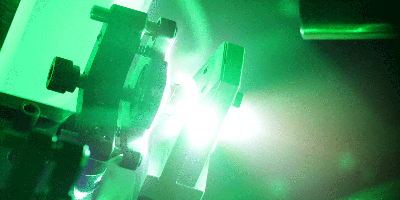
The researchers used the ATLAS laser – a table-top Ti:sapphire laser that delivers 30 fs pulses – at the Max Planck Institute of Quantum Optics near Munich. Laser pulses with 0.4 J energy were focused to a 3 μm spot, yielding a peak intensity of 8 × 1019 W/cm2. This beam was used to irradiate diamond-like carbon (DLC) foils with thicknesses of 20 and 40 nm.

"The nanometre foils enabled a hundred-fold higher [proton] luminosity as compared to [standard] micron-thick targets," explains Jörg Schreiber, from Ludwig Maximilian University of Munich, who was one of the team. "We have pioneered the application of nanometre DLC foils and it has paid off." The beamline included a miniature quadrupole doublet magnetic lens inserted behind the DLC foil to focus the protons at a distance of 1.2 m. A circular aperture is placed 810 mm from the target, in front of a dipole magnet that deflects the protons downwards. This avoids irradiation of the cells by X-rays created when the laser pulse slams into the target. The beamline is evacuated and to irradiate living cells, the proton bunch leaves the vacuum through a Kapton window and enters a customized cell holder.

Irradiating cancer cells

The researchers exposed single layers of human cervical cancer cells to protons generated in a single shot. The resulting dose distribution was measured using radiochromic film behind the cells. A microstructured grid on the cell holder enabled registration of the dose distribution with a spatial uncertainty of 21 μm. The team confirmed that cells were damaged by the protons using a chemical assay that detects the presence of broken strands of DNA.

Using these data, the team calculated the relative biological effectiveness (RBE) of the dose and found it to be similar to that of conventional proton beams at comparable energies. The researchers say that this work demonstrates the potential of small, high-repetition-rate lasers for creating intense pulse protons that are almost monoenergetic and contain relatively small amounts of background radiation.

Ultrafast studies

Beyond proton therapy, the researchers say that the proton source could be used for basic science: "The laser-driven beam could have impact as a tool in fast biological or chemical processes. Of special interest is the availability of other temporally synchronized laser-driven sources to perform pump probe experiments," they note. The team is now aiming to create beams with higher ion energies. "This requires more powerful lasers, which are currently under construction in our lab and elsewhere," Wilkens and Schreiber explain.
لینک مرجع

نگاهی به درون حفره‌های کهکشانی

هم‌گرایی گرانشی پدیده‌ای است که به علت خم شدن نور در عبور از نواحی پر جرم اتفاق می‌افتد. داده‌های اخیر نشان دادند که نواحی با جرم بسیار کم (مانند حفره‌های درون کهکشانی) هم می‌توانند سهم مهمی در هم‌گرایی نور داشته باشند.

جرم درون خوشه‌ی کهکشان‌ها باعث پیچش فضا-زمان اطراف خود می‌شود. این پدیده سبب می‌شود تا کهکشان‌های زمینه، روشن‌تر به نظر برسند و یا دچار اعوجاج شوند. گونه مشابه‌ای از  هم‌گرایی گرانشی (gravitational lensing) زمانی اتفاق می‌افتد که نور از درون حفره‌ای با چگالی کمتر از میانگین عبور می‌کند. یافته استاندارد پیش‌بینی می‌کند که این نواحی کم جرم٬ تاثیر کوچکی بر نور کهکشان‌ها دارند٬ اما محاسبات جدید در Physical Review Letters نشان داده که حفره کیهانی تاثیرات زیادی بر نور کهکشان‌ها می‌گذارد (آن‌ها را روشن‌تر می‌کند)٬ به طوری که سیگنال مربوط به هم‌گرایی استاندارد را تحت تاثیر قرار می‌دهد. این نتایج می‌تواند بر توصیف بررسی‌های نجومی بزرگ مقیاس تاثیر بگذارد.


منجم‌ها با اندازه‌گیری هم‌گرایی گرانشی٬ می‌توانند جرم جسم گرانشی را به‌دست ‌آورند و یا چگالی جرم را در یک مسیر مشخص تخمین بزنند. بیشترین علت این هم‌گرایی مربوط به نواحی با تمرکز بالای جرم بوده است٬ اما نور می‌تواند با عبور از حفره‌های کهکشان که تمرکز جرم در آن بسیار کم است نیز٬ تحت تاثیر قرار بگیرد. اندازه حفره‌ها‌ی بین کهکشانی بین ده تا صد سال نوری است٬ که جمعاً بیش از نیمی از حجم کیهان را اشغال می‌کنند. مدل‌های پیشین هم‌گرایی گرانشی٬ تنها جنبه‌ی خمیده شدن نور را تحت تاثیر حفره در نظر می‌گرفتند. که این پدیده باعث می‌شود تا جسم زمینه٬ کوچکتر (و تا حد کمی کم نورتر ) از مقدار واقعی به نظر آید.

زیستزو بولیکو (Krzysztof Bolejko) و هم‌کارانش از دانشگاه سیدنی در استرالیا  محاسبات دقیقی بر روی هم‌گرایی از حفره انجام دادند. در تجزیه تحلیل کامل نسبیتی٬ آن‌ها تاثیر افزایش طول موج را درنظر گرفتند. این پدیده به این علت اتفاق می‌افتد که حفره‌ها در کل سریع تر از جهان منبسط می‌شوند. انتقال به سرخ اضافی که در داده‌ها در نظر گرفته شده٬ منجر به تخمین فاصله‌ی اجسامی شده است که نزدیک به نواحی دور حفره قرار دارند. بنابراین آن‌ها روشن‌تر از حد انتظار به نظر می‌رسند. نویسندگان این مقاله فکر می‌کنند که تأثیرات حفره باعث می‌شود تا بتوان برخی از ناهمسانی‌های آماری را در یافته‌های مربوط ابرنواختر توضیح داد.

لینک منبع

لینک مرجع مقاله

Physicist homes in on universe's earliest magnetic fields

Scientists have long wondered where the observed magnetization of the interstellar medium came from, given that the fully ionized gas of the early universe contained no magnetic particles. According to new research by an astrophysicist in Germany, the answer lies in magnetic fluctuations within this plasma. Although these fluctuations initially summed to zero, he calculates, they would have left a positive excess of field once compressed by energetic phenomena such as supernovae explosions.

Permanent magnetism is a property of only a few materials, such as iron, in which the spins of individual electrons naturally line up in the same direction and create a residual magnetic field. In the early universe, before iron and other magnetic materials had been created inside stars, permanent magnetism did not exist. Nevertheless, the proto-interstellar medium, a plasma consisting of a few light nuclei along with free protons and electrons and which formed when the universe was less than a billion years old, did have a non-zero magnetic field.

Magnetic seeds

Astrophysicists believe that the explosive collapse of massive stars known as supernovae or the streams of charged particles referred to as galactic winds could have provided the energy needed to compress small and disordered, or "seed", magnetic fields so that they became unidirectional and as strong as the fields observed in the interstellar medium – that is, having an energy density roughly equal to that caused by the medium's thermal pressure. The question is: where did these seed fields come from?

To answer this question, Reinhard Schlickeiser of Ruhr University in Bochum considered the proto-interstellar plasma shortly after it came into being – an era known as "reionization" when something, probably the light from the first stars, provided the energy needed to break up the previously neutral gas that existed in the universe. The protons and electrons inside the plasma would have moved around continuously, simply by virtue of existing at a finite temperature. And, like any charged particles in random motion, they would have created random magnetic fields – which would have cancelled each other out. Nevertheless, it was the finite variance of the resulting magnetic "fluctuations", says Schlickeiser, that subsequently led to the creation of a permanent magnetism across the universe.

To work out the field-strength variance of the fluctuations, Schlickeiser used a theory he developed in 2012 with Peter Yoon of the University of Maryland. The fluctuations are "aperiodic", which means that, unlike the variations in magnetic and electric fields that give rise to electromagnetic radiation, they do not propagate as a wave. Indeed, their wavelength – the spatial distance over which the fluctuations occur – and their frequency – dictating how long these fluctuations last – are uncorrelated, in contrast to light, for which the values of wavelength and frequency are tied to one another via the wave's velocity.

Much weaker than a fridge magnet

Schlickeiser summed over all possible wavelengths and frequencies for the magnetic fluctuations in a gas at 10,000 K, which would have been roughly the temperature of the proto-interstellar medium at the time of reionization. The calculation revealed field strengths of about 10–12 G inside very early-stage galaxies and around 10–21 G in the void surrounding the galaxies. These values compare with the roughly 0.5 G of the Earth's magnetic field and the 100 G typical of a strong refrigerator magnet.

Schlickeiser points out that he is not the first person to put forward a seed mechanism for the interstellar magnetic field. Indeed, as far back as 1950 the German astronomer Ludwig Biermann proposed that the centrifugal force generated in a rotating plasma cloud will separate out heavier protons from lighter electrons, thereby creating a separation of charge that leads to tiny electric and magnetic fields. According to Schlickeiser, however, this scheme suffers from a lack of suitable rotating objects, meaning that it could only ever generate the magnetic fields in a small portion of the interstellar medium.

Observational evidence needed

Schlickeiser's next step is to find observational evidence to back up his idea. One option, he says, would be to look at the cosmic microwave background, the very faint long-wavelength radiation that fills the universe and which was emitted about 400,000 years after the Big Bang, when electrons and protons had cooled to the extent that they could combine via mutual attraction and leave photons to propagate freely through space. The idea would be to measure variations in the polarization of this radiation, which could be done using data from the European Space Agency's Planck satellite, given that magnetic fields rotate the plane of polarization of electromagnetic waves. "It is not clear at the moment whether these fluctuations would have measureable effects on the background radiation," he says. "But I think it would be worth finding out."

Massimo Stiavelli of the Space Telescope Science Institute in Maryland is positive about the latest work, arguing that "the mechanism described could indeed provide the seeds to primordial magnetic fields". And he suggests an alternative line of evidence, from before reionization – that any magnetic fluctuations would have tended to fragment the universe's second generation of stars as they formed. "Finding somewhere in the local universe a small-mass star with a magnetic field and primordial chemical composition would provide evidence that a mechanism like the one described was at play," he says.

اسرار جهان نخستین در دل کهکشان‌های دوردست

بررسی کهکشان‌های اولیه کیهان که در زمان کمی نسبت به دیگر کهکشان‌ها پس از انفجار بزرگ بوجود آمده‌اند، این امکان را به دانشمندان میدهد تا پرسش‌های راجع به جهان اولیه را پاسخ دهد. جدیداً گروهی از این دانشمندان موفق شدند که حدود هفت عدد از این کهکشان‌ها را کشف کنند.


منجم‌ها با دقت در یافته‌های کیهان دور٬ هفت کهکشان را مشخص کردند که فاصله‌ی بسیار دور آن‌ها نشان می‌دهد که در کمتر از ۶۰۰ میلیون سال پس از انفجار بزرگ بوجود آمده‌اند. کشف تعداد زیادی از این کهکشان‌های کهن این فرصت را به پژوهش‌گران می‌دهد تا پرسش‌های اساسی راجع به جهان تازه متولد شده مطرح کنند. به طور مثال٬ این پرسش که٬ چه زمانی نور از ستاره‌ها و کهکشان‌های اولیه به بخش‌های اولیه تاریک کیهان نفوذ کرده است. به گفته‌ی آوی لوئب(Avi Loeb)٬ منجم از دانشگاه هاروارد که مشارکتی در این پروژه نداشته است،«این یک مطالعه‌ی علمی در ارتباط با مسئله پیدایش است».

این یافته‌ها حاصل تلاش تلسکوپ فضایی هابل است که در ماه‌های سپتامبر و آگوست بیش از صد ساعت مشاهده عمیق در بخشی از آسمان انجام داده است. این ناحیه در جنوب صورت فلکی فورنکس(Fornax) قرار دارد. این پروژه مشابه آن چیزی است که در سال 2009 انجام شد. در آن پروژه یک هدف خاص تحت یک نوردهی طولانی مدت قرار گرفته بود که عنوان این پروژه میدان ماورای عمیق هابل بود.

گروهی از منجم‌ها به سرپرستی ریچارد الیس از کلتک مجدداً نگاهی به این ناحیه انداختند٬ اما این بار با زمان نور دهی بیشتر و همچنین با بهره‌گیری از فیلتر‌های اضافه که به نور ضعیف قرمزی که از کهکشان‌‌های دور دست می‌آید حساس است. سرشماری‌های جدید در مجله‌ی Astrophysical Journal Letters آورده می‌شود. این سرشماری شامل هفت کهکشان در فاصله‌های بسیار دور است. یکی از این هفت‌عدد در بین بقیه رکورد شکن می‌باشد؛ این کهکشان تنها 380 میلیون سال پس از انفجار بزرگ دیده شده است.

از آن‌جایی که کیهان پس از انفجار بزرگ در حال منبسط شدن می‌باشد، 13.7 میلیارد سال پیش، نوری که از این اجسام دور ساطع شده تازه هم اکنون به زمین رسیده است.  این به این معنا است که این اجسام  در طول نخستین دوره رشد کیهان پدیدار شده‌اند. مسافت این اجسام دور معمولاً بر حسب معیار انتقال به سرخ بیان می‌شود. هر میزان که مسافت یک جسم بیشتر باشد انتقال به سرخ آن نیز بیشتر است.

هفت کهکشانی که توسط  الیس و همکارانش معرفی شده است همگی انتقال به سرخ بیشتر از 8.5 را دارند. یکی از این کهکشان‌ها به عنوان یک جسم کم نور ضعیف٬ پیش‌تر توسط منجم‌ها مشخص شده بود، به گفته ی الیس ممکن است انتقال به سرخ این کهکشان 11.9 باشد. دیگر نقشه برداری(یافته‌های) اخیر هابل٬ تعداد پراکنده کمی از کهکشان‌های دوردست را پیدا کرده است که امکان انتقال به سرخ برای آن‌ها در بازه 8.5 تا 10 است. در آن یافته‌ها تاثیرات گرانشی کهکشان‌هایی که در میانه راه قرار دارند بر روی اعوجاج و بزرگ نمایی نوری که از کهکشان پشت سر آن‌ها می‌آید٬ دخیل شده است. با توجه به آن یافته‌ها (که به CLASH شناخته می‌شود)، منجم‌ها در ماه نوامبر خبر از کشف کهکشانی دادند که انتقال به سرخ آن 10.8 است. این کهکشان  در صورت فلکی ‌Camelopardalis قرار دارد.

به گفته جمز دانلپ٬ منجم در دانشگاه ادینبرگ که با الیس مشغول به کار هست: «اگر بخواهیم به طور کلی صحبت کنیم نتایج آن‌ها (CLASH) با نتایج ما سازگاری دارد». طبق گفته الیس چیزی که بیشتر از هر رکورد شکنی‌ا‌ی اهمیت دارد این است که از سرشماری این کهکشان‌های دور بتوان حرفی در ارتباط با یکی از مهمترین رخدادهای اولیه کیهان، یعنی بازیونیزه شدن کیهانی (cosmic reionization) زد. باز یونیزه شدن زمانی اتفاق می‌افتد که نوری که از ستاره‌ها و کهکشان‌های نخستین  به بخش تاریک کیهان نفوذ می‌کند اتم‌های هیدروژن را به الکترون‌ها و پروتون‌های مجزا تبدیل کند که موجب شود کیهان برای نور معمولی شفاف شود.

این فرایند 200 میلیون سال بعد از انفجار بزرگ آغاز شده است. این در حالی است که منجم‌ها دقیقاً مطمئن نیستند که این فرایند چگونه آغاز شده است. در برخی نقاط٬ ستاره‌های نخستین مشتعل‌تر می‌شدند و خود را داخل کهکشان‌ها به دام می انداختند، اما تنها زمانی که ستاره‌ها و کهکشان‌های کافی حضور داشتند این امکان برای آن‌ها وجود داشت تا نواحی تاریک را نورانی کنند. پی بردن به این که چه تعداد از این کهکشان‌ها در آن‌جا حضور داشتند و یا این‌که در چه زمانی می‌زیسته‌اند به دانشمندان کمک می‌کند تا بفهمند که باز یونش به سرعت رخ داده است و یا در طی زمان صورت گرفته است.

یافته‌های جدید نشان می‌دهد که ممکن است به مرور زمان این اتفاق افتاده باشد. تعدادی از این کهکشان‌های نخستین٬  انتقال به سرخ‌های متفاوت دارند. این موضع این پیشنهاد را مطرح می‌کند که این اتفاق امکان دارد در طول زمان رخ داده باشد٬ درست همان زمانی که ستاره‌ها به صورت توده‌ایی چگال و داغ اطراف کیهان اولیه را در بر گرفته‌اند. «سپیده‌دم کیهانی شاید تنها رخداد مهیج  نباشد» این حرف را الیس در 21 دسامبر در نشست خبری گفت. روگیرد وینهورست منجم در دانشگاه ایالتی آریزونا٬ در تمپ می‌گوید که از اینکه در جستجو‌های جدید تنها هفت کهکشان پیدا شده، تعجب کرده است. او پیشنهاد می‌کند که ممکن است تعداد بیشتری از این کهکشان‌ها در داده‌ها وجود داشته باشند که به خاطر نور دیگر کهکشان‌ها و یا کهکشان‌ها و ستاره‌های نزدیک دیده نشوند.

برای پاسخ به هر پرسش تردیدآمیز باید تا سال 2018 که تلسکوپ فضایی جمز وب به آسمان پرتاب می‌شود صبر کرد. نقطه قوت این تلسکوپ نسبت به تلسکوپ هابل این است که می‌تواند طول موج مادون قرمز مربوط به نور ضعیفی که از کهکشان‌های دور دست می‌آید را اندازه گیری کند. طبق گفته الیس:«پیش‌بینی ما این است که کهکشان‌های بیشتری وجود داشته باشند».

لینک منبع مقاله

Star seen whizzing around supermassive black hole

Astronomers using the Keck telescope have found a new star orbiting very near to the supermassive black hole believed to be at the centre of the Milky Way. This is only the second star that researchers have observed completing an entire orbit – and its discovery confirms the black hole's presence beyond reasonable doubt. Future observations of both orbiting stars could provide a unique test of general relativity.

The Keck telescope atop Mauna Kea in Hawaii has been used since the mid-1990s to systematically probe the area surrounding the centre of the Milky Way. In doing so, astronomers revealed several stars that appear to be orbiting a central object dubbed Sgr A* ("Sagittarius A Star"). From measurements of the stars' orbital characteristics, it was calculated that Sgr A* must weigh in at around four million times the mass of the Sun. The only known astrophysical object that could be so massive, yet exist in such a small space, is a black hole. However, only the orbit of one star – S0-2 – had data covering its entire 16.5 year journey around the centre. Data on the rest of the stars cover less than 40% of their orbits – the remainder has been projected using modelling. In order to characterize an orbit, astronomers believe that 50% of a star's orbit needs to be observed. With only S0-2 breaking this threshold, some sceptics questioned whether a central black hole existed at all.

Better adaptive optics

Now, astronomers, including Andrea Ghez at the University of California, Los Angeles, have revealed the discovery of a new star named S0-102. "The orbital period of this star is just 11.5 years – the shortest of any star known to orbit the black hole," Ghez told physicsworld.com. "Improvements in adaptive optics have allowed us to find fainter stars and measure them more acurately," she says. With adaptive optics, the telescope's mirror is not a single surface, rather a tiled surface made up of smaller mirrors. A laser guide is fired into the sky above the telescope and the distortion of the laser due to atmospheric turbulence is measured. The shape of the mirror can then be adapted by moving individual tiles in order to compensate for the distortion.

This technique will also allow the future observation of S0-102 at apoapsis – its furthest distance from the black hole. "This will reduce our uncertainties in parameters like the black hole's mass," says Ghez. Having a second star to observe will also allow astronomers to improve their understanding of S0-2's orbit. In particular, it will help provide a more precise measurement of S0-2's periapsis – its closest approach to the black hole – in 2018. During periapsis, the star experiences a stronger gravitational force, causing an additional redshift in its light. The precise amount of redshift is predicted by Einstein's general theory of relativity. The experiment can be repeated when S0-102 reaches its own periapsis in 2021.

General relativity also predicts the precession of a star's periapsis. "The fact that space is warped by the gravity of the black hole means that orbits overshoot each time. The point of periapsis moves on in the direction that the star is already orbiting," explains Ghez. This is similar to the precession of Mercury's orbit within our own solar system – a puzzle that, when explained by Einstein in 1915, provided an early endorsement of his ideas.

Unknown parameter

However, this particular test of relativity is not possible with a single star. "The situation isn't as simple as two stars orbiting a single black hole," says Ghez. "There are likely to be other things orbiting in there too, such as stellar-mass black holes and neutron stars," she adds. This means that the orbiting stars do not see a symmetrical distribution of mass as they pass through this crowded region. If general relativity is to be tested, it has to be treated as an unknown parameter. If the mass distribution is also unknown, you need two stars to solve the equations. "With future advances in adaptive optics, and the next generation of telescopes, we will now be able to see whether Einstein's relativity stands up in this extreme gravitational environment," Ghez hopes. "It is pretty spectacular that they've observed the whole orbit of a second star," Nils Andersson, head of the General Relativity Group, at the University of Southampton, UK, says. "It shows there has to be a black hole in the centre, and it helps pinpoint how massive it is," he adds. However, he believes there are stronger tests of general relativity. "I think the best test beyond the solar system is still two pulsars orbiting around each other. That sort of system puts more constraints on Einstein's theory," he explains.

سه مشکل کیهان‌شناسی

کیهانشناسان توانسته‌اند با پیشنهاد یک ذره‌ی فرضی بسیار سبک که حامل برهمکنش‌های بلندبرد بین ذرات ماده تاریک ونوترینوها هستند، سه مشکل حال حاضر کیهانشناسی را حل کنند.

به نظر می‌رسد اخترفیزیک‌دانان در تلاش برای درک 95% کائنات که از ماده معمولی ساخته نشده است، به مدلی از انرژی و جرم نامرئی به نام مدل لاندا سی دی ام (کوتاه شده عبارت ثابت کیهان شناسی به اضافه ماده تاریک سرد) روی آورده‌اند. این مدل در مقیاس‌های بالای کیهانی بسیار موفق عمل می‌کند، اما در مقیاس‌های کوچکتر دارای سه نقص اساسی است: نخست اینکه طبق مشاهدات انجام شده، تعداد نواحی کوچکی که در آن‌ها کهکشان‌ها در حال شکل‌گیری‌اند بسیار کمتر از چیزی است که مدل پیش‌بینی می‌کند. دوم اینکه مدل لاندا سی دی ام چگونگی توزیع ماده تاریک در نواحی بین کهکشانی را متفاوت با آنچه که مشاهده می‌کنیم پیش‌بینی می‌کند، و سوم اینکه بزرگترین و چگال‌ترین قمرهای راه شیری که توسط شبیه‌سازی‌ها پیش‌بینی شده‌اند تاکنون مشاهده نشده‌اند. لائورا وان دن آرسن (Laura van den Aarssen) و همکارانش از دانشگاه هامبورگ آلمان، به تازگی در مقاله‌ای که درمجله‌ی Physical Review Letters چاپ کرده‌اند، نوع جدیدی از برهمکنش‌های دور برد را میان ذرات ماده تاریک پیشنهاد می‌کنند که هر سه مشکل نام‌برده را حل می‌کند.

هسته‌ی اصلی فرضیه گروه آرسن، پیشنهاد یک ذره ناشناخته‌ی بسیار سبک به عنوان واسطه‌ی برهمکنش‌های دور برد است که می‌تواند هم با ذرات ماده تاریک و هم با نوترینوها جفت شود. در واقع آن‌طور که گروه آرسن می‌گوید، چنین ذراتی برهمکنش‌های وابسته به سرعتی را بین ذرات ماده تاریک القا می‌کنند که ماده‌ی تاریک بیشتری را از مرکز کهکشان خارج می‌کند. این پیشنهاد کاملا با مشاهدات ما سازگاری دارد و چگونگی شکل‌گیری کهکشان‌های کوچکتر را نیز به خوبی توضیح می‌دهد.

اگرچه تقویت این دیدگاه تلاش بیشتری را می‌طلبد، اما مطرح‌کنندگان آن معتقدند که ذرات فرضی مطرح شده ممکن است به نوترینوهایی با انرژی حدود 1 ترا الکترون ولت تبدیل شوند، و اگر این فرض درست باشد، ما قادر خواهیم بودیم ردپایی از این ذرات را در مشاهدات آینده‌مان از کهکشان راه شیری توسط آشکارساز نوترینوی آیس کیوب (IceCube) در قطب جنوب مشاهده کنیم.


لینک منبع مقاله

The hue of alien Earths

An international team of researchers claims that the link between the colour of a planet and its surface features can be used to prioritize which newly found exoplanets, especially rocky planets with clear atmospheres, should be studied in-depth for signs of life. The work provides an important link between Earth-based geomicrobiology and observational astronomy. A huge number of exoplanets have been discovered in recent times – just over 800 confirmed examples are known today, with more than 2000 candidates waiting to be confirmed. Of the candidate exoplanets, it is difficult to decide which ones are the most likely to harbour life.

Home sweet home?

"What is now observed is that smaller Neptune-sized planets are, in fact, far more abundant than larger Jupiter-sized ones. This is exciting and one feels that it is only a matter of time before the same can be said for Earth-sized planets around other stars. The question then naturally arises as to how one could characterize these rocky planets to check for their potentially habitability," explains Siddharth Hegde of the Max Planck Institute for Astronomy in Germany. He and colleague Lisa Kaltenegger from the Harvard-Smithsonian Center for Astrophysics in Cambridge, Massachusetts, in the US have explored how filter photometry can be used to pinpoint Earth-like exoplanets and study their atmospheric bio-signatures – whether they have aerobic or anaerobic atmospheres. Looking at the diversity of life on Earth, even under extreme conditions, the researchers wonder whether planets around other stars with extreme surroundings could also harbour some form of life.

In astronomy, photometry is a way of measuring the flux of the electromagnetic radiation of an astronomical object. "Filter photometry basically means that you split the collected light [from a celestial object] only into a few wavelength bins that are defined here by the commonly used filters in the visible called 'B, V, I Johnson–Cousins filters' [or blue, green and red colour bins]," explains Hegde. The advantage of this approach is that lots of photons are gathered per bin, meaning a good signal-to-noise ratio is achieved – which, in turn, means that it may be possible to characterize dimmer planets. The researchers use this method to identify planets that have surfaces similar to those on Earth that harbour life. This is done by plotting the blue–green versus blue–red bins using customized filters, creating what is known as a "colour–colour diagram". While the technique does not provide the finer details of a planet, it can very easily be used to put together a follow-up prioritized "target list" of planets that should be studied in detail with spectroscopy.

True colours

A way of looking for these extreme environments is to study the "albedo" of a planet – its reflectivity as a function of wavelength. For example, snow has a high albedo, meaning that it reflects well, while water has a low albedo and so does not reflect as well. A previous study, conducted in 2003, compared the colour–colour diagrams of rocky and Jupiter-like planets in our solar system to see whether they were the same – they were not. That study concluded that a colour–colour diagram can be used to make a first-order basic characterization of a planet's nature. Hegde and Kaltenegger extended this idea to rocky exoplanets based on the assumption that these habitats best determine the environmental limits for harbouring Earth-type extremophiles.

Going to extremes

An extremophile is an organism that exists in physically or geochemically extreme conditions – such as extreme temperature, radiation, pressure, dryness, salinity or pH – that are detrimental to most other life-forms on Earth. "By splitting the light from a hypothetical planet, with a surface covered with a material that can harbour extremophiles on Earth, into the three filter bins, we found that those planets fall into a tight band when plotting a colour–colour diagram," says Hegde.

The method is similar to another already used by exoplanet hunters who look for the "red-edge" – a telltale sign of vegetation – in the spectra of planets. This is a large and abrupt change in the absorption of light by plants that occurs at about 700 nm. At shorter wavelengths, chlorophyll absorbs very strongly and therefore plants reflect little light; above 700 nm, chlorophyll does not absorb light, which means that leaves are able to reflect much more sunlight back into space. Combining such spectral readings with colour–colour diagrams could clearly indicate if a planet has any Earth-like life, or is capable of harbouring it.

In the future, the researchers are keen to study possible changes in a planet's atmosphere caused by different kinds of extremophiles that might inhabit its surface – for the moment, their model assumes the extremophiles do not affect the atmosphere significantly. "Maybe, with the help of biologists who culture such extremophiles in the lab, we can find out if there are gases in the atmosphere that can tell us whether such surfaces really harbour life," muses Hegde.


لینک منبع مقاله 

Star seen whizzing around supermassive black hole

Astronomers using the Keck telescope have found a new star orbiting very near to the supermassive black hole believed to be at the centre of the Milky Way. This is only the second star that researchers have observed completing an entire orbit – and its discovery confirms the black hole's presence beyond reasonable doubt. Future observations of both orbiting stars could provide a unique test of general relativity.

The Keck telescope atop Mauna Kea in Hawaii has been used since the mid-1990s to systematically probe the area surrounding the centre of the Milky Way. In doing so, astronomers revealed several stars that appear to be orbiting a central object dubbed Sgr A* ("Sagittarius A Star"). From measurements of the stars' orbital characteristics, it was calculated that Sgr A* must weigh in at around four million times the mass of the Sun. The only known astrophysical object that could be so massive, yet exist in such a small space, is a black hole.

However, only the orbit of one star – S0-2 – had data covering its entire 16.5 year journey around the centre. Data on the rest of the stars cover less than 40% of their orbits – the remainder has been projected using modelling. In order to characterize an orbit, astronomers believe that 50% of a star's orbit needs to be observed. With only S0-2 breaking this threshold, some sceptics questioned whether a central black hole existed at all.

Better adaptive optics

Now, astronomers, including Andrea Ghez at the University of California, Los Angeles, have revealed the discovery of a new star named S0-102. "The orbital period of this star is just 11.5 years – the shortest of any star known to orbit the black hole," Ghez told physicsworld.com. "Improvements in adaptive optics have allowed us to find fainter stars and measure them more acurately," she says. With adaptive optics, the telescope's mirror is not a single surface, rather a tiled surface made up of smaller mirrors. A laser guide is fired into the sky above the telescope and the distortion of the laser due to atmospheric turbulence is measured. The shape of the mirror can then be adapted by moving individual tiles in order to compensate for the distortion.

This technique will also allow the future observation of S0-102 at apoapsis – its furthest distance from the black hole. "This will reduce our uncertainties in parameters like the black hole's mass," says Ghez. Having a second star to observe will also allow astronomers to improve their understanding of S0-2's orbit. In particular, it will help provide a more precise measurement of S0-2's periapsis – its closest approach to the black hole – in 2018. During periapsis, the star experiences a stronger gravitational force, causing an additional redshift in its light. The precise amount of redshift is predicted by Einstein's general theory of relativity. The experiment can be repeated when S0-102 reaches its own periapsis in 2021.

General relativity also predicts the precession of a star's periapsis. "The fact that space is warped by the gravity of the black hole means that orbits overshoot each time. The point of periapsis moves on in the direction that the star is already orbiting," explains Ghez. This is similar to the precession of Mercury's orbit within our own solar system – a puzzle that, when explained by Einstein in 1915, provided an early endorsement of his ideas.

Unknown parameter

However, this particular test of relativity is not possible with a single star. "The situation isn't as simple as two stars orbiting a single black hole," says Ghez. "There are likely to be other things orbiting in there too, such as stellar-mass black holes and neutron stars," she adds. This means that the orbiting stars do not see a symmetrical distribution of mass as they pass through this crowded region. If general relativity is to be tested, it has to be treated as an unknown parameter. If the mass distribution is also unknown, you need two stars to solve the equations. "With future advances in adaptive optics, and the next generation of telescopes, we will now be able to see whether Einstein's relativity stands up in this extreme gravitational environment," Ghez hopes.

"It is pretty spectacular that they've observed the whole orbit of a second star," Nils Andersson, head of the General Relativity Group, at the University of Southampton, UK, says. "It shows there has to be a black hole in the centre, and it helps pinpoint how massive it is," he adds. However, he believes there are stronger tests of general relativity. "I think the best test beyond the solar system is still two pulsars orbiting around each other. That sort of system puts more constraints on Einstein's theory," he explains.

لينك منبع مقاله

Dark-matter alternative tackles elliptical galaxies

An alternative theory to dark matter has successfully predicted the rotational properties of two elliptical galaxies. The work was done in Israel by Mordehai Milgrom using the modified Newtonian dynamics (MOND) theory that he first developed nearly 30 years ago. By showing that MOND can be used to explain the properties of complicated elliptical galaxies – as well the much simpler spiral galaxies – Milgrom argues that MOND offers a viable alternative to dark matter when it comes to explaining the bizarre properties of galaxies.

Dark matter was proposed in 1933 to explain why galaxies in certain clusters move faster than would be possible if they contained only the "baryonic" matter that we can see. A few decades later, similar behaviour was detected in individual galaxies, whereby the rotational velocity of the outermost stars was found not to "drop off" as a function of distance but instead remain flat. These observations directly contradicted Newtonian gravity, which should hold true in extragalactic regions just as it does on Earth and in the solar system. But by assuming there are "haloes" of invisible matter in and around galactic structures, Newton's familiar inverse square law is restored.

Since it was first invoked to explain these galactic irregularities, physicists have tried to make direct measurements on dark matter to try to work out exactly what it is – with very little success. As a result, there are some researchers who do not believe that dark matter exists and have proposed alternative explanations for the strange behaviour of galaxies.

Spectacular success

Now a new analysis suggests that one alternative theory called MOND describes the properties of two elliptical galaxies just as well as dark matter. MOND was originally formulated to describe spiral galaxies and has had spectacular success in predicting certain properties of these structures. Its extension to cover elliptical galaxies could strengthen the arguments in favour of this alternative theory. This is because elliptical galaxies are predicted to have formed by a different process from spiral galaxies and their properties are much more difficult to calculate.

MOND was first proposed in 1983 by the astrophysicist Mordehai Milgrom of the Weizman institute in Israel. The basic premise of the theory is that at extremely small accelerations of less than 10–10 m s–2 Newton's second law does not hold. Instead, Milgorm modified Newton's formula so that under certain circumstances the gravitational force between two bodies decays more gently than the inverse square of the distance between them.

Predictably, a theory that advocates changing Newton's laws is destined to meet with widespread scepticism, and MOND is no exception. Nevertheless, it also has undeniable attractions, such as the ease with which it makes testable predictions and the fact that it does not rely on an as-yet unseen dark matter. And, since a version of MOND consistent with Einstein's general theory of relativity was derived in 2004 by Jacob Bekenstein of the Hebrew University of Jerusalem, the wider physics community has begun to take notice.

No coincidence

In the new research, Milgrom analyses the hydrostatics of a spherical envelope of hot, X-ray emitting gas in two elliptical galaxies and shows the predictions of MOND are equally valid in these. This is important, Milgrom argues, because elliptical galaxies are thought to have evolved in a completely different way from spiral galaxies and other disc galaxies – they are thought to be formed by the collision and merging of two other galaxies. MOND's success, he argues, means that its predictive accuracy cannot simply be a coincidence and that it must hint at a deeper underlying truth.

He also suggests that the fact that the same mathematical law can be used to predict the rotation speeds of two different types of galaxies formed in two different ways significantly undermines the dark-matter hypothesis. "In the dark-matter picture" he says, "The galaxies we see today are the end result of very complicated and very haphazard formation processes. You start with small galaxies – they merge, they collide – there are explosions in the galaxies and so on and so forth. During this stormy evolution the dark matter and the normal matter are subject to these processes in very different ways and so you really do not expect to see any real correlations between the dark matter and the normal matter. This is a very weak point of the dark-matter picture."

Particle astrophysicist and dark-matter expert Dan Hooper of Fermilab in the US, argues that MOND will not win over sceptics by showing its applicability to galaxies, even if those galaxies are of types that have not been previously tested. "I have found it to be the case for quite some time now that MOND does a very good job of explaining the dynamics of galaxies," he says. "And this paper is yet another example of where MOND succeeds at the galactic scale. Where MOND fails is on larger scales such as in clusters of galaxies and on even larger cosmological scales." He cites the anisotropy of the cosmic-microwave background as one example of this.


لينك اصلي مقاله

Dark-matter hope fades in microwave haze

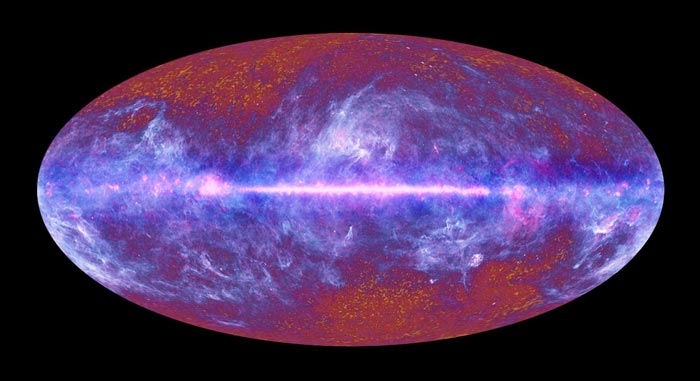
The latest results from the Planck space telescope have confirmed the presence of a microwave haze at the centre of the Milky Way. However, the haze appears to be more elongated than originally thought, which casts doubt over previous claims that annihilating dark matter is the cause of the emissions. A roughly spherical haze of radiation at the heart of our galaxy was identified as far back as 2004 by the Wilkinson Microwave Anisotropy Probe (WMAP). Since then, some astrophysicists have suggested that this haze is produced by annihilating dark-matter particles.

However, some researchers have questioned whether the haze actually exists at all, suggesting that it could be an artefact of how the WMAP data were analysed. Doubts were raised as to whether WMAP was capable of picking out this weak signal buried deep in emissions from galactic dust, the cosmic microwave background (CMB) and other noise from hectic regions of the galaxy.

It is definitely there

The argument now seems to have been settled by the latest results from Planck, a European Space Agency mission launched in May 2009. "Crudely speaking, we agree with all the WMAP results," explains Krzysztof Gorski of NASA's Jet Propulsion Laboratory in California, who is a member of the Planck team. "Planck is more sensitive, and has a greater frequency range, taking us into a realm that WMAP couldn't even see," he told physicsworld.com. One of the telescope's main objectives is to accurately map fluctuations in the CMB, so it is well suited to subtracting that radiation to reveal the haze.

With the presence of the haze independently verified, focus has returned to determining its origin. After its original discovery, some researchers, including Dan Hooper of Fermilab near Chicago, US, argued that annihilating dark matter could explain the galactic haze. Dark matter has long been thought to bind galaxies together, but detecting it directly has remained elusive. In Hooper's mechanism, dark-matter particles annihilate to produce conventional electrons and positrons. These particles then spiral around the Milky Way's magnetic field to produce the radiation we see as the microwave haze.

However, as well as confirming its existence, Planck was also able to reveal details of the shape of the haze. "The new results seem to suggest that the haze is elongated rather than spherical [as previously thought]," explains Hooper, who was not involved in the Planck research. "Simulations suggest that we would expect to find dark-matter halos that are roughly spherically symmetric," he adds. There might still be room for a partial dark-matter explanation, however. "Our opinion is that no single current model explains the haze's origin," admits Gorski. So Hooper is not giving up. "It still smells like dark matter to me," he says.

Related to Fermi bubbles?

The Planck observations also revealed a sharp southern edge to the haze. This implies that the formation mechanism is sporadic – if it were continuous, then the edges of the haze would appear diffuse. "The sharpness also implies that the haze might be related to the Fermi bubbles," says Hooper. The Fermi bubbles are two giant, gamma-ray-emitting structures extending 25,000 light-years above and below the centre of the galaxy. Spotted by the Fermi space telescope in November 2010, these bubbles also have sharp, defined edges pointing towards a rapid release of energy as their cause, rather than a continuous, steady process.

It is possible, then, that the two phenomena have a common origin. "There may be some mechanism crossover between the haze and the bubbles," says Andrew Pontzen, a theoretical cosmologist at the University of Oxford in the UK. "The next step would be to see exactly how much overlap there is in the data," he adds. Any areas where the two phenomena do not overlap still leaves the door open for dark matter to play a part. "Maybe the cause [of the haze] is a mixture of dark-matter annihilation and other mechanisms," Hooper adds.

Whichever explanation turns out to be correct, the Planck results have focused the argument. "Observationally, this is a great step forward," Pontzen says. "However, the centre of the galaxy remains an intrinsically complicated place where a plethora of strange things are going on," he adds. In the end, it might take Planck's successors to settle the debate.


لینک مقاله منتشر شده

Pulsar timekeepers measure up to atomic clocks

An international team of astronomers has come up with a new way of keeping track of time by observing a collection of pulsars – rapidly rotating stars that emit radio pulses at very regular intervals. Although the ultimate goal of the research is to use pulsar timing to detect gravitational waves, the group has shown that the pulsar-based timescale can also be used to reveal inconsistencies in timescales based on atomic clocks.

Pulsars are neutron stars that rotate at very high speeds and appear to emit radio pulses at extremely regular intervals. The pulses are actually all we see of a radio beam that is focused by the star's magnetic field and swept around like a lighthouse beacon. Using a radio telescope, astronomers can measure the arrival times of successive pulses to a precision of 100 ns over a measurement time of about an hour. While this level of precision is significantly less than that offered by an atomic clock, pulsars could in principle be used to create timescales that are stable for decades, centuries or longer. This could be useful for identifying fluctuations in Earth-based timekeepers such as atomic or optical clocks, which normally do not operate over such long periods.

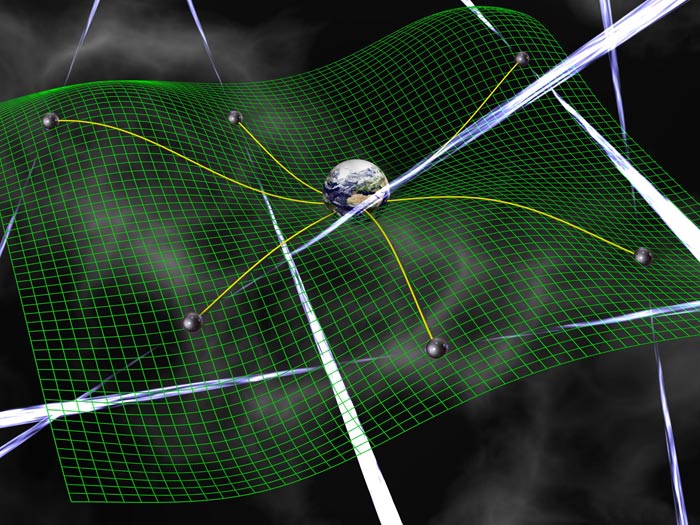
The team, which is led by George Hobbs at CSIRO Astronomy and Space Sciences in Australia, looked at data from the Parkes Pulsar Timing Array (PPTA) project. Using the Parkes radio telescope in Australia, the project aims to use a set of about 20 pulsars in different parts of the Milky Way to detect gravitational waves. The idea is that when a gravitational wave passes through our galaxy, its presence warps space/time such that the millisecond gaps between the pulses arriving from various pulsars are affected in a very specific way.

Extremely precise timescale

In developing the PPTA, Hobbs and colleagues in Australia, Germany, the US and China realized that the timing data from a number of pulsars could be combined to create an extremely precise timescale stretching back to the mid-1990s. A timescale is a sequence of marks in time, each separated by a defined time interval. The most precise timescales available today are generated by atomic or optical clocks, which operate using the frequencies of certain atomic transitions.

The team made a timescale based on 19 pulsars by first correcting the data from each pulsar for a number of different things that can affect the measurement of the gap between pulses. These include instrumental effects, the motion of the Earth within the solar system and the effects of interstellar plasma. Also, the frequency of a pulsar drops slowly with time as rotational energy is radiated away, and this must be corrected for.

The team then combined the data from the 19 pulsars to create the Terrestrial Time PPTA11 or TT(PPTA11) timescale, where 11 signifies that the most recent data used are from 2011. To show how their new timescale could be used to evaluate timescales generated by atomic clocks, the researchers compared it with Terrestrial Time (International Atomic Time) – TT(TAI). This is a timescale that is created by combining the results of several hundred atomic clocks worldwide. TT(TAI) is never revized, and therefore provides a historical record of the performance of atomic clocks. Instead, the atomic-clock timescale is gently "steered" towards better timekeeping through revision and reanalysis of the time standard.

Looking for deficiencies

If the new pulsar timescale is indeed precise, it should be able to reveal historical deficiencies in the atomic-clock timescale – and this is exactly what the team was able to do. The researchers compared the two timescales going back to about 1994 and found a distinct departure at around 1998. The team also did a similar comparison between the atomic-clock timescale and a corrected version of Terrestrial Time that is produced annually by the International Bureau of Weights and Measures – TT(BIPM11). The researchers saw the same distinct departure at around 1998, which suggested that, like TT(BIPM11), the pulsar-based timescale is capable of revealing inconsistencies in atomic-clock-based timescales.

The similarity between TT(PPTA11) and TT(BIPM11) also allowed the team to conclude that there are no large unexpected errors in TT(BIPM11). Furthermore, the results corroborate previous research, which concluded that the TT(TAI) timescale is not sufficiently precise to be used for pulsar-timing applications such as the detection of gravitational waves, and that TT(BIPM11) should always be used in such applications.

Team member David Champion at the Max Planck Institute for Radioastronomy in Bonn told physicsworld.com that the next step in developing the timescale is to incorporate pulsar data from other radio telescopes that were obtained over the same time period.

Proof of principle

Setnam Shemar of the Time and Frequency Group at the UK's National Physical Laboratory described the work as "proof of principle that PPTA data can be used to find anomalies in some present-day atomic timescales". While he thinks it is possible that a pulsar-based timescale could outperform the best present-day atomic timescale over long times, Shemar says that it is too early to tell. Indeed, he points out that if improvements in atomic and optical clock technologies outpace improvements in pulsar timing, as he expects to be the case, a pulsar-based timescale may in future be more useful in a search for gravitational waves than a means for checking atomic timescales.


لینک مقاله منتشر شده

Axions could solve lithium problem

For more than a decade, scientists have been aware that the theory used to explain how the lightest elements are created overestimates the overall amount of lithium-7 in the universe. Now, physicists in the US think the answer to this so-called lithium problem might lie in a hypothetical particle known as the axion – although many are not convinced.

The theory is called Big Bang nucleosynthesis and describes a stage early in the universe's evolution when, at temperatures of thousands of degrees, protons and neutrons began to assemble into atomic nuclei and form the first light elements: deuterium, along with isotopes of helium and lithium. As temperatures dropped, nucleosynthesis drew to a close, and eventually electrons began to add themselves to the nuclei during a period called recombination. At this time, photons stopped scattering off charged particles and the universe became transparent.

Cosmologists know this because they can detect the cosmic microwave background (CMB), which is a haze of radiation throughout the universe the temperature of which derives from that of the last photon scattering. From fluctuations in the CMB, cosmologists can calculate the ratio of baryons to photons. Baryons include the protons and neutrons that make up everyday matter. It is this baryon-to-photon ratio that predicts the abundances of the first light elements. But for lithium-7, the prediction appears to be some three times higher than the amount observed.

What happened to the lithium?

Several theories have been put forward to explain this lack of lithium, but none has won widespread acceptance. Now, particle physicists Pierre Sikivie and colleagues at the University of Florida in Gainesville think they have a straightforward solution. "What's nice about our proposal is that we don't have to assume anything new," says Sikivie. "We just take the axion, which has long been discussed, and point out some properties that have been overlooked."

Axions were first proposed in the late 1970s to solve a puzzle in particle physics known as the strong-CP problem, although more recently they have been proposed as candidates for dark matter, which is the mysterious substance thought to make up nearly a quarter of the mass/energy of the universe. If they exist, axions would be very light and interact very weakly with matter – properties that make them difficult to find. Indeed, no experiment on Earth has yet discovered any evidence of axions.

Sikivie and colleagues point out that axions can form a Bose–Einstein condensate (BEC). Such condensates contain particles that have all fallen into their lowest energy state, and are best known to occur in low-density gases at temperatures close to absolute zero. But since the critical temperature for transition to a BEC depends on density, say the Florida researchers, particles can form BECs at higher temperatures as long as they are dense enough. Even in the primordial heat of the Big Bang, the researchers say, axions would easily be dense enough to form a BEC.

Transferring heat

An axion condensate would have a marked effect on Big Bang nucleosynthesis. Passing photons would make waves in it, transferring heat and, ultimately, depleting in number. This means that the baryon-to-photon ratio would increase towards the time of recombination, giving cosmologists today a falsely high impression of the amount of lithium that should have been created.

At least, that is what Sikivie and colleagues think – others are not so sure. Kenneth Nollett of the Argonne National Laboratory in the US points out that, in alleviating the lithium problem, the Florida group's theory overestimates the amount of deuterium. What is more, the theory requires the effective number of neutrinos – an important value in cosmology – to increase from what has been calculated from the CMB. Whereas observations generally suggest the neutrino number to be between 3 and 4, Sikivie and colleagues expect it to be about 6.8.  "I guess the bottom line for me is that it is important that many possible explanations of the lithium problem are being pursued, but I am sceptical about the [Florida group's] proposal," says Nollett.

Sikivie admits the deuterium and neutrino overestimates are potential problems for the theory. Still, he is waiting for results from the European Space Agency's Planck space observatory, which will provide the most accurate measurement of the effective neutrino number in the next year. "Time will tell," he says.

جریان تاریک به چالش کشیده شد

پژوهشی جدید نشان داده است که جهان ما به احتمال زیاد، تحت تأثیر کشش گرانشی ساختارهای عظیم و نامرئی کیهانی که در آن‌سوی افق جهان رؤیت‌پذیر ما واقع شده‌اند، قرار "ندارد". دانشمندان در این بررسی، به کمک محاسبات به‌دست آمده از تحلیل انفجارهای ستاره‌ای و همچنین استفاده از قوانین فعلی علم فیزیک، دست به بازآزمایی تئوری معروف "جریان تاریک" زدند و در نهایت، اولین مدارک چالش‌برانگیز علیه این فرضیه را به‌دست آوردند.

در سال ۲۰۰۸ میلادی بود که رصدهای پیوسته اختر‌شناسان از حرکات دسته‌جمعی صد‌ها خوشه کهکشانی، نشان داد هرآن چیزی که در جهان رؤیت‌پذیر ما- و احتمالاً ماورای آن- واقع شده است، با سرعتی معادل ۳/۲ میلیون کیلومتر بر ساعت، در یک جهت مشترک حرکت می‌کنند. از آنجا که چنین پدیده‌ای را با نحوه توزیع فعلی ماده در جهان نمی‌توان توضیح داد، این دانشمندان مدعی وجود توده‌های عظیمی از ماده شدند که بلافاصله بعد از وقوع مهبانگ از مرز جهان رؤیت‌پذیر ما در رفتند و هم‌اکنون تمام ساختارهای کیهانی درون افق را به‌سوی خود می‌کشند.
 
در سال ۲۰۱۰ نیز همین تیم، به پشتوانه داده‌هایی که این‌بار فراوانی‌شان در حدود دو برابر از پژوهش پیشین بیشتر بود، پژوهشی تازه منتشر کرد. براساس این پژوهش، برد تأثیرات پدیده "جریان تاریک"، از برآوردهای گذشته هم بیشتر است و تا فاصله ۲/۵میلیارد سال نوری از زمین ادامه می‌یابد. الکساندر کاشلینسکی (Alexander Kashlinsky)، اخترفیزیکدان مرکز فضایی گادرد ناسا که پژوهش سال ۲۰۰۸ را سرپرستی می‌کرد، گفته بود اگر این یافته‌ها به تأیید قطعی برسند، پدیده جریان تاریک، درک فعلی از جایگاه کیهانی ما را متحول می‌کند؛ چراکه وجود ساختارهای عظیم‌الجثه در فراسوی مرزهای جهان رؤیت‌پذیر، حکایت از این می‌کند که جهان ما، ممکن است عضوی از یک "ابرجهان" باشد.
 
هیچ‌جا مثل خانه آدم نمی‌شود
 
پژوهشی تازه نیز که این‌بار به جای خوشه‌های کهکشانی، سراغ انفجارهای ستاره‌ای (موسوم به ابرنواختر‌ها) رفته است تا پی به ماهیت جریان تاریک ببرد، از وجود چنین جریانی خبر داده است، اما داده‌های ابرنواختری، سرعت این جریان را در فاصله ۲۴۰ میلیون کیلومتری از زمین، معادل ۹۰۰ هزار کیلومتر بر ساعت تخمین زده‌اند. این سرعت، اندکی بیشتر از آن‌ چیزی است که در مدل استاندارد علم کیهان‌شناسی انتظار می‌رود (و البته فوق‌العاده کمتر از آن چیزی است که تیم کاشلینسکی محاسبه کرده بود)، اما به‌گفته سرپرست این پژوهش، استفان ترنبول (Stephan Turnbull) از دانشگاه واترلوی کانادا، این سرعت، دیگر "آنقدرها مایه نگرانی‌مان نیست".
 
او می‌افزاید طبق مجموعه معادلات استانداردی که دانشمندان برای توصیف جهان هستی از آن‌ها بهره می‌گیرند، مشاهدات صورت‌پذیرفته "هنوز هم مطابق با فرضیات هستند و لذا همه چیز عادی است". در واقع این جریان، که معلوم شد سرعتش از محاسبات پیشین دانشمندان است، می‌تواند ناشی از عاملی متعارف‌تر همچون نیروهای کشندی یک یا چند "ابرخوشه" کهکشانی، و یا حتی یک ساختار کیهانی غول‌آسا در درون مرزهای جهان رؤیت‌پذیرمان باشد، که هنوز در دیدرس اخترشناسان واقع نشده است. اگر چنین باشد، دیگر این جریان را نمی‌توان "تاریک" نامید، چراکه در زبان فیزیک، واژه تاریک به چیزی اطلاق می‌شود که مدل‌های کنونی علم از توصیفش عاجزند.
 
وقتی‌که "شمع"های ابرنواختری، جریان تاریک را روشن می‌کنند
 
تیم کاشلینسکی که برای نخستین‌بار پی به وجود این پدیده برده بود، از طریق بررسی ناهمگنی‌های دمایی ِ پراکنده در پهنه تابش "میکروموجی پس‌زمینه کیهان" یا CMB، موفق به تعیین سرعت حرکت دسته‌جمعی خوشه‌های کهکشانی شد. گمان می‌رود این تابش، همان نوری باشد که در قالب مدل استاندارد علم کیهان‌شناسی، در حدود در حدود ۳۸۰ هزار سال پس از وقوع مهبانگ، آزاد شد و هم‌اکنون در تمام نقاط جهان رؤیت‌پذیرمان رخنه کرده است.
 
تیم کاشلینسکی، با بررسی تأثیراتی که نور گسیلی از گاز داغ میان‌کهکشانی بر تابش CMB اعمال کرده است، قادر به محاسبه سرعت و جهت خوشه‌های کهکشانی بودند، اما در پژوهشی که جدیداً انجام پذیرفته، تیم ترنبول دست به بررسی گونه‌ای خاص از انفجارهای ستاره‌ای، موسوم به "ابرنواخترهای نوع 1a" زدند. شدت درخشندگی این انفجارها همیشه یک مقدار ثابت است و لذا ستاره‌شناسان می‌توانند از این پدیده‌ها به‌عنوان "شمع‌های استاندارد" استفاده کنند و مثلاً به تعیین سرعت حرکت کهکشان‌ها بپردازند (اگر دقت کنید، درخشندگی یک شمع معمولی، همواره ثابت است و می‌توان از روی شدت نور ظاهری‌اش، فاصله آن را از چشم ما تخمین زد). اخترشناسان به کمک همین ابرنواخترهای نوع 1a موفق به تشخیص شتاب فزاینده انبساط کیهان شدند (رجوع کنید به مقاله "به افتخار تاریکی").
 
ترنبول و همکارانش، داده‌های حاصل از رصد ۲۴۵ مورد از این ابرنواختر‌ها را مورد بررسی قرار داده است و با روش‌های هوشمندانه ریاضی، موفق به یافتن ردپای جریان نامبرده شدند؛ جریانی که اثراتش، در یک کره فرضی به مرکزیت زمین و شعاع ۲۴۰ میلیون سال نوری، تازه به چشم می‌آمد. ترنبول می‌گوید: "بالاخره فهمیدم که این جریان، در یک جهت مشخص سرعتی معادل ۲۴۹، با خطای ۷۶ کیلومتر بر ثانیه دارد." این یافته‌ها چندی است که در نشریه علمی Monthly Notices of the Royal Astronomical Society به انتشار رسیده است.
 
کاشلینسکی، در واکنش به کشفیات جدید تیم ترنبول می‌گوید: "قبول دارم بین چیزی که ما محاسبه کرده‌ایم و چیزی که آن‌ها محاسبه می‌کنند، اختلافاتی وجود دارد، اما مهم این است که هیچگونه اختلاف نظری راجع به وجود این جریان، دیده نمی‌شود." در واقع جریانی که کاشلینسکی از آن حرف می‌زند، نه‌تنها نسبت به جریانی که ترنبول آن را یافته است، برد بیشتری دارد، بلکه شدتش هم چهار برابر است و رو به سوی جهتی متفاوت دارد.
 
زورآزمایی کیهانی
 
تا به اینجا، پژوهشگران چندان امیدی به آشتی دادن کشفیات تیم‌های کاشلینسکی و ترنبول نبسته‌اند، اما این دو تیم هر دو به خطاهایی در محاسبات خود معترف‌اند که در آینده می‌توان با ارتقای مجموعه‌داده‌های مربوط به رصد خوشه‌های کهکشانی و همچنین انفجارهای ابرنواختری، دست به اصلاح هرچه‌بهتر محاسبات فعلی زد و نتیجه این دو بررسی را بیش از پیش به هم نزدیک‌تر کرد. با این حال، احتمال می‌رود که فقط یکی از این دو فرضیه، پیروز این زورآزمایی شود.
 
کاشلینسکی، که خود اعتقاد دارد پژوهش‌های ترنبول دقیقاً همان چیزی است که بایستی برای آزمودن فرضیه جریان تاریک بدان‌ها ‌متوسل شد، می‌گوید: "امیدواریم که ظرف یک یا دو سال، این پرونده را به نفع یکی از این دو فرضیه ببندیم."
 
ترنبول اما می‌افزاید تنها یک احتمال وجود دارد که در آن، حق با هر دو فرضیه باشد. او می‌گوید: "فرض کنید یک قایق بسیار بزرگ داریم." کاشلینسکی، دست به محاسبه سرعت حرکت قایق زده- که همان جابه‌جایی دسته‌جمعی کهکشان‌ها باشد- و فهمیده که قایق در حال سرعت گرفتن بر پهنه اقیانوس است، اما ترنبول، با محاسبات ابرنواختری‌اش دست به تعیین جابه‌جایی‌های یکی از سرنشینان قایق زده است. "پس یک نفر روی قایق است و قایق هم در حال حرکت، اما ... محاسبات ما نشان از وجود حرکات اشخاص در درون قایق داده است."
 
اگر آن شخصی که ترنبول مثالش را می‌زند، در قایق ساکن نباشد و مثلاً به اطراف بدود، آن‌وقت هر دو حرکت، هم‌زمان در حال رخ دادن هستند و به‌گفته ترنبول، "نتیجه این دو پژوهش را می‌شود آشتی داد. احتمالش کم است، اما بعید هم نیست".

Early supermassive black holes could grow it alone

Astronomers know that supermassive black holes at the centres of galaxies existed in the early universe, but how these objects managed to accumulate such heft in a short cosmological timespan is a mystery. Now, a team of researchers in Germany and the US has used a humongous computer simulation to show that cold streams of gas from outside a young galaxy could have fed its central black hole fast enough for the hole to grow rapidly.

Supermassive black holes are furnaces at the centres of galaxies. They suck in vast amounts of matter – which releases energy that causes the gas that surrounds them to glow. Astronomers call these glowing galactic centres quasars, and the UK Infrared Telescope Deep Sky Survey (UKIDSS) has found light from a quasar that was emitted as little as 800 million years after the Big Bang. This quasar and several picked up by the Sloan Digital Sky Survey are considerably brighter than expected. Indeed, they emit so much light that the black holes at their centres must have been enormous, at least a billion times the mass of the Sun.

Assuming that a supermassive black hole begins life as a relatively small black hole at the collapsed core of a massive supernova, Volker Springel of the Heidelberg Institute of Theoretical Studies in Germany says that it would need to have fed at its maximum rate from birth onwards in order to reach a billion solar masses now. "It seems possible, but it's a bit contrived," he says. This is because the rate at which a black hole accumulates matter is proportional to its mass, and therefore small black holes grow very slowly.

Direct collapse

An alternative explanation is that a very large amount of gas – roughly 100,000 solar masses – may have collapsed directly into the black hole. Now, Springel and colleagues – including team leader Tiziana Di Matteo at Carnegie Mellon University in the US – have used a computer simulation to show that this scenario is possible.

The team modelled the universe in a virtual box 2.4 billion light-years to a side – a volume that is roughly 1% of the visible universe today. This size of simulation was chosen in order to increase the chances that extremely massive quasars would emerge from the model. Inside the box, gas and dark matter, a form of matter that interacts through gravity alone, were represented by 65.5 billion particles.

"It's a remarkable achievement to be able to simulate such a huge volume of space to the precision needed to say something about a single black hole," says Daniel Mortlock of Imperial College London. While the resolution of the study was good enough to look at individual black holes, it had to be coarse enough to make the simulation feasible. As a result, each gas "particle" had the mass of 57 million Suns, while dark matter weighed in at 280 million solar masses per particle.

Billion-year simulation

The simulation covered the timespan from 10 million years after the Big Bang to about 1.3 billion years later. As time progressed, gravity caused the particles to gradually clump together. Once a congregation of gas particles reached a density associated with black-hole formation, the program introduced a particle of 100,000 solar masses into the middle of the clump to represent a black hole. This "seed" could then begin accreting gas particles according to a model of black-hole growth.

After 800 million years, one black hole had reached 3 billion solar masses, while nine more were close to the billion-solar-mass mark. To find out how they had grown, the team zoomed in on them, finding that those growing the fastest appeared to be fed by dense streams of gas. This picture supports the idea of "cold gas flows" penetrating directly to the black hole without warming up through interactions with the hot gas already in the vicinity. Although black-hole mergers have been proposed as a route to supermassive black holes, merged black holes were not among the largest in the simulation.

"[The simulation] is the first to quantitatively estimate that cold gas flows can deposit large quantities of fresh 'fuel' to the centre of galaxies, possibly feeding supermassive black holes even in absence of mergers," says Lucio Mayer of the University of Zürich, Switzerland. "However, the resolution of the simulations is still too low to ascertain if such gas would directly feed the central black hole." He suspects that it would be more likely to settle into the disc of gas surrounding the black hole, feeding it more slowly, but this detailed behaviour must be explored with higher-resolution simulations

همایش ملی گرانش و کیهان شناسی

Three new maps shine light on dark matter

Three independent teams of astronomers have released new and improved maps of where dark matter is lurking in parts of the universe. All three groups have charted the mysterious substance by looking at how its presence distorts the images of distant galaxies as their light travels to Earth. As well as providing further insights into dark matter, the studies could provide crucial information about another mysterious substance – dark energy.

About 95% of the mass/energy content of the universe is believed to comprise dark matter and dark energy – two substances about which physicists know very little. Dark matter cannot be observed directly but is believed to make up about 23% of the mass/energy in the universe. Its existence has been inferred from the gravitational tug that it exerts on visible matter such as galaxies. Dark energy, which is also invisible, is thought to account for about 72% of the mass/energy and its existence is inferred from the accelerating expansion of the universe.

Gravitational lensing

One team has used data from the Canada–France–Hawaii (CFHT) telescope to map the location of dark matter in four regions of the sky. The survey, known as CFHTLenS, includes about 10 million galaxies, which are all about six million light-years away. As the light from these galaxies travels to Earth, it is affected by the gravitational field of the dark matter that it passes along the way – a phenomenon called gravitational lensing. This distorts both the shape of the galaxies and their relative orientations as we see them on Earth – deviations that can be used to map the density of dark matter.

Observed over a period of five years, the four different patches of the sky were studied – each about 1° by 1° – using the MegaCam camera on the CFHT. The images cover a much larger area of the universe than a previous map produced by the team – which only covered 0.25° by 0.25°. The maps reveal that dark matter tends to clump around large clusters of galaxies – something that astronomers had expected but are unable to confirm in vast sections of the universe.

The team is now applying its analysis technique to data from the Very Large Telescope in Chile, which should result in much more of the sky being mapped. "Over the next three years we will image more than 10 times the area mapped by CFHTLenS, bringing us ever closer to our goal of understanding the mysterious dark side of the universe," says team member Koen Kuijken of Leiden University in the Netherlands.

Shear brilliance

The other two dark-matter maps have been made by two independent groups, both of which claim to be the first to show that "cosmic shear" measurements can be unambiguously made by ground-based telescopes. Cosmic shear is a type of gravitational lensing that makes a distant object appear stretched – turning a circular image into an elliptical one, for example. By analysing the cosmic shear of images of distant galaxies collected over nine years by the Sloan Digital Sky Survey (SDSS), the teams were able to create dark-matter clumps.

The teams – one largely based at Fermilab and the other at the Lawrence Berkeley National Laboratory (LBNL) – have been able to improve their measurements by combining multiple snapshots of the same parts of the sky taken in the period 2000–2009. Known as "co-addition", this process helps to reduce the effects of atmospheric distortion on the shear measurements and enhance the strength of signals from very distant and very faint galaxies.

The resulting dark-matter maps could be used to gain further insights into dark energy because dark energy should have an important effect on how dark matter is distributed in the universe – in particular how it tends to clump together.

"The community has been building towards cosmic-shear measurements for a number of years now," says Eric Huff, who is a member of the LBNL team. "But there has also been some scepticism as to whether the measurements can be done accurately enough to constrain dark energy. Showing that we can achieve the required accuracy with these pathfinding studies is important for the next generation of large surveys."

Are pulsars giant 'neutromagnets'?

Pulsars are created when a star collapses to form a neutron star in which the magnetic moments of the neutrons are frozen in a particular direction – much like the atomic moments in a permanent magnetic. That is the claim of two physicists in Sweden, who believe that their theory can account for many of the unexplained properties of these astronomical oddities.

First discovered in 1967, pulsars are astronomical objects that emit radiation pulses with astonishing regularity. Astronomers believe pulsars are rapidly rotating neutron stars that have very large magnetic fields. Just like the Earth, the magnetic dipole moment of the star is believed to be offset from its rotational axis. Jets of radiation are emitted from the star along its magnetic poles. Because the star is rotating about a different axis, the jet sweeps round like a lighthouse beam that appears as a regular pulse if it happens to strike Earth.

Beyond this basic description, however, little is known about the physics of pulsars and how they formed. One important question is the origin of the magnetic field, which can range from about 104 to 1011 T. That is huge compared with the Sun's magnetic field, which is about 100 µT. Furthermore, the regular nature of the pulses suggests that a pulsar's magnetic field must be extremely stable. In contrast, the Sun's magnetic field is notoriously unstable because it is generated by the rotation of the star's plasma, which is prone to instabilities.

Nuclear force favours alignment

"There is no good explanation for how the magnetic field is generated," explains Johan Hansson of Lulea University of Technology, who put forward this latest theory with colleague Anna Ponga. Hansson and Ponga suggest that the magnetic moments of all the neutrons in the star point in the same direction in a state of matter called a "neutromagnet". This is similar to the alignment of atomic magnetic moments in a ferromagnetic material. The researchers point out that the nuclear force that binds protons and neutrons together in nuclei favours the alignment of spins – an effect that they say could be enhanced in neutron stars, where neutrons are packed even more tightly together.

Hansson and Ponga assumed that the energy gained by two neutrons by aligning their spins in the same direction is about 10% of the total nuclear binding energy of the pair. This gives a Curie temperature – below which all the neutrons in the star align to become a giant magnet – of about 1010 K.

Because neutron stars all seem to have about the same mass, the maximum magnetic field that could result is about 1012 T. This would occur when all the neutrons are aligned in the same direction. However, just like everyday magnets, it is possible that different regions of the star have domains of neutrons – with each domain pointing in a different direction. This would reduce the overall magnetic field and could explain why some neutron stars have much smaller magnetic fields. According to Hansson, this maximum value of the magnetic field provides astronomers with a simple way of falsifying the theory.

Moment is frozen in

Hansson told physicsworld.com that their model also explains the fixed misalignment between the magnetic moment and the rotational axis of a pulsar. "The orientation of the magnetic field is set by the direction of the star's magnetic field at the moment it collapses to form the neutron star," he explains. "The direction is then 'frozen in' by the nuclear force".

However, not all astronomers are convinced. "I don't claim that the current 'understanding' is complete or free of contradiction – the problem is very hard – but I believe that the concept presented in this paper is not nearly as good as the standard models," says Michael Kramer of the University of Manchester in the UK.

Mysterious Christmas star explosion

Christmas Day 2010 the Swift satellite observed a very strange gamma-ray burst in the distant universe. Gamma-ray bursts are extremely powerful bursts of radiation predominantly associated with massive stars that die in a violent supernova explosion, and researchers thought that they had a handle on the different types of gamma-ray bursts. The new gamma-ray burst was very different and now researchers, including members from the Niels Bohr Institute, have observed a new variant, which apparently ‘only’ produce thermal radiation. The results are published in the prestigious scientific journal, Nature. 

Gamma-ray bursts are the most powerful explosions in the universe. They result from a stellar explosion where a portion of the stellar material collapses into a black hole, while the remainder is shot out into the universe. In the process, the dying star rotates very quickly and a disc of incidental material forms around the newly formed black hole. Perpendicular to the rotating disc of matter there is a compression of magnetic fields and when new matter is pulled towards the black hole, some of it is shot out into space as two powerful jets. The gamma-ray bursts are believed to come from these jets. These two jets are discharged in opposite directions at a rate approaching the speed of light.

Strange death of a star

The gamma-ray outburst typically lasts only a few minutes. The gamma-ray burst that was observed on the 25th of December 2010 lasted more than half an hour. This is longer than most gamma-ray bursts previously observed and at the same time behaved very strangely. It was also impossible to measure the precise distance. This gave rise to several different explanations, for example, that it could be the case of a comet that had fallen into a neutron star in our own galaxy.

“In our analysis we discovered that it had to be an entirely new kind of stellar death”, explains Christina Thöne, who received her PhD in 2008 from the Dark Centre at the Niels Bohr Institute at the University of Copenhagen and who was a guest researcher at the Niels Bohr International Academy this year. She led the research of the unknown type of gamma-ray burst with Antonio de Ugarte Postigo, who until September this year worked as a postdoc at the Dark Cosmology Centre They are both now affiliated with IAA in Granada, Spain.

Gamma-ray bursts are detected by satellites, which transmit information about the position of the gamma-ray bursts to Earth where the afterglow is observed using a series of telescopes. The afterglow occurs when the jets hit the thin, interstellar material and gives rise to a glow of light, which is observed from X-ray to radio wavelengths.

The first special feature of the afterglow was its very long duration gamma radiation, which lasted for more than half and hour. A series of observations quickly made it clear to the researchers that the afterglow was produced by two terminal sources, which in the language of physics, emit ‘blackbody’ radiation. While one of the sources had a stable temperature, the other grew and then cooled down. So the researchers worked out a model that could explain this phenomenon.

Collisions of binary stars

“We think that we are dealing with a binary star system. Our model shows that it is a neutron star that is about to collide with its companion, which is an ordinary star late in its life and is burning helium in its core and is surrounded by a hydrogen rich atmosphere. When the neutron star slams into the atmosphere of the helium star a large portion of the atmosphere is cast out into space. Finally, the neutron star fuses with what remains of the helium star and forms a kind of gamma-ray burst. The interaction of the discharged jet from the explosion with the atmosphere of the former helium star causes this jet to slow down so that the radiation is no longer relativistic, that is to say, that the jet is no longer moving close to the speed of light. This is also called ‘thermalizing’ of the jet, i.e. that there was a uniform heat in the jet. What was observed was precisely this hot material – a mixture of jet and the discharged atmosphere. Eventually this leads to these unusual gamma-ray bursts as well as a weak supernova, just as astronomers measured, explains Christina Thöne.

She points out that gamma-ray bursts can apparently originate from more processes and stellar explosions than previously thought. A gamma-ray burst like the ‘Christmas burst’ has not been observed before, perhaps because the thermal radiation can only be detected in relatively nearby gamma-ray bursts. And nearly 15 years after it was discovered that gamma-ray bursts come from cosmic explosions, new surprises still await us.

کهکشان‌ها هم بازیافت می‌شوند

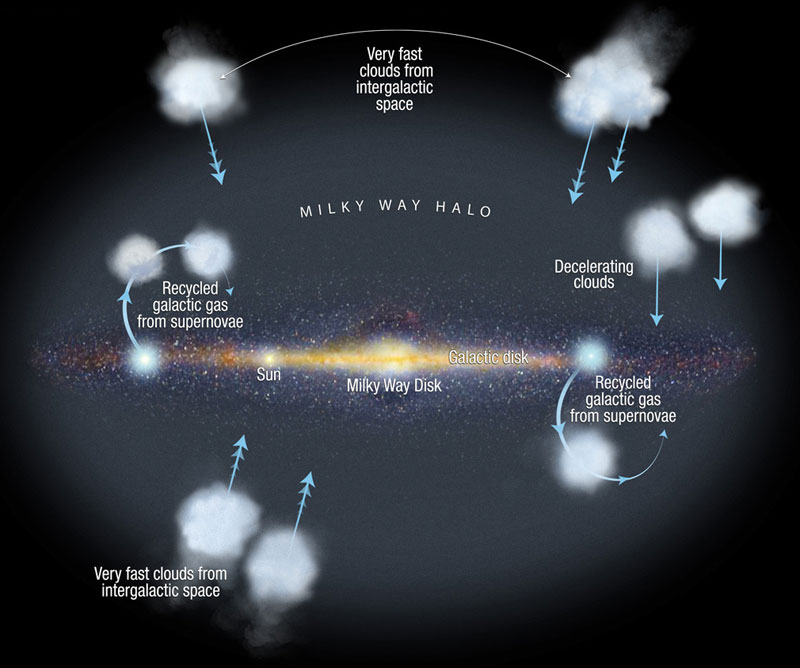
راز طول عمر، در بازیافت نهفته است. دست کم برای کهکشان‌ها که اینگونه است. این را دانشمندانی می‌گویند که اخیراً از طریق سه‌گانه‌ای از تلسکوپ‌های برجسته دنیا، دست به بررسی فضای نامکشوف پیرامون کهکشان‌های جوان و ستاره‌ساز و نیز عموزاده‌های نه‌چندان جوانشان زده‌اند.

کهکشان‌ها از‌‌ همان ابتدای تاریخ هستی آموخته‌اند که زندگی سبزی داشته باشند و پیوسته حجم سرسام‌آور گاز هیدروژن و نیز عناصر سنگینشان را برای تولید چندین نسل متوالی از ستارگان، در بازه‌ای بالغ بر چندین میلیارد سال به خدمت بگیرند. این فرآیند بازیافتی، کهکشان‌ها را از تحلیل رفتن مخازن سوختیشان (که‌‌ همان گاز هیدروژن اتمی باشد) ایمن نگه می‌دارد و لذا مدت‌زمان ستاره‌سازیشان را به بیش از ۱۰ میلیارد سال متوالی ارتقا می‌بخشد. این درحالی است که کهکشان‌هایی که توفانی از ستاره‌سازی را در درونشان به‌راه می‌اندازند (و به کهکشان‌های «ابرستاره‌ساز» معروفند)،‌‌ همان سوخت اضافیشان را هم به فضا می‌ریزند و اساساً خط تولید ستاره‌های تازه را زود‌تر متوقف می‌کنند. این فرضیه چندی پیش توسط مجموعه‌ای متشکل از رصدخانه ۱۰ متری کک-۱، ماژلان و تلسکوپ فضایی هابل به تأیید تجربی رسید.
 
تلسکوپ هابل، با «طیف‌نگار خاستگاه‌های کیهانی»‌اش (که به‌طور مختصر ابزار COS نامیده می‌شود)، از طریق نور فرابنفش کهکشان‌های دوردستی که از میان گاز پراکنده در گرداگرد کهشان‌های نزدیک‌تر و مورد مطالعه می‌تابند، اطلاعاتی را راجع به این هاله‌های گازی به‌دست آورد. روی زمین از طرفی، ابزارهای LRIS تلسکوپ غول‌آسای کک-۱ (مخفف «طیف‌نگار فروسرخ با رزولوشن پایین») و نیز ابزار MagE تلسکوپ ماژلان، دست به تعیین فاصله تا کهکشان‌های مزبور، محاسبه جرم ستارگان سازنده‌شان و حتی تعیین آهنگ ستاره‌سازی برخی از آن‌ها زدند. نتیجه این نقشه‌برداری، کشف رابطه مهمی مابین کهکشان‌ها و گازهای گرداگردشان شد که طی سه مقاله در شماره ۱۸ نوامبر نشریه علمی Science انتشار یافته است. «دسترسی به هردوی مجموعه‌داده‌ها (هم از زمین و هم از فضا)، به ما امکان استنباط رابطه فوق‌العاده مهم مابین ستاره‌های درون کهکشان‌های مزبور، با توده‌های گازی بسط یافته در گرداگرد‌‌ همان کهکشان‌ها را داد»، این را جسیکا ورک (Jessica Werk) از رصدخانه لیک دانشگاه کالیفرنیا- سانتاکروز می‌گوید. او نویسنده همکار هر سه مقاله‌ای بوده که در Science انتشار یافته‌اند و همچنین نویسنده ارشد مقاله پشتیبان دیگری که ماه ژانویه آتی در نشریه علمی Astrophysical Journal انتشار داده خواهد شد. وی می‌افزاید: «با این کشف، از این پس می‌توان گفت که جذب نور فرابنفشی که با طیف‌نگار COS هابل تشخیص داده شده، در‌‌ همان فاصله‌ای از ما رخ داده که با تلسکوپ کک و در نور مرئی آن را محاسبه کرده‌ایم.»
 
این روابط نامنتظره مابین کهکشان‌ها و گاز پیرامونیشان، حین مقایسه داده‌های مرتبط با ستاره‌های درون کهکشان و گازهای پیرامونی‌اش کشف شد. ورک می‌گوید: «چیزی که در ‌‌نهایت یافتیم، حیرتمان را برانگیخت. کهکشان‌هایی که فرآیند ستاره‌سازیشان فوق‌العاده فعال است، همیشه با هاله‌های غول‌آسا و سنگینی از گاز اکسیژنه احاطه شده‌اند و اگر نه به‌قدر تمامی گاز موجود در درون کهکشان، اما دست‌کم به‌‌ همان اندازه گاز را در درون خودشان جا داده‌اند.» عجیب اینجاست که این نوع از ذخایر گازی، ظاهراً در اطراف کهکشان‌هایی که آهنگ ستاره‌سازیشان آهسته‌تر است، اصلاً دیده نمی‌شود. ورک در ادامه می‌گوید: «یک فرد عادی، شاید با شنیدن نام کهکشان، به یاد سازه منظم و زیبا و مارپیچی که مملو از گاز و ستاره است، بیفتد. اما هم‌اکنون ما جزئی قابل توجه از کهکشان‌ها را مشاهده می‌کنیم که تا پیش‌تر تشخیص داده نشده بود: هاله‌ای سنگین و اشباع از اکسیژن که تا فواصل فوق‌العاده دوردستی از بخش مرئی و مارپیچ کهکشان امتداد پیدا کرده و دیدگاه‌مان را راجع به سیر تکاملی کهکشان‌ها دگرگون کرده است.»
 
در میان کشفیات کلیدی این بررسی، می‌توان به رنگ و شکل کهکشانی اشاره کرد که تا حد زیادی تابع جریان گاز بسط یافته به هاله پیرامونی‌اش بوده است. هیچ‌یک از شبیه‌سازی‌های نوین فرآیند تشکیل کهکشان‌ها، قادر به توضیح ویژگی‌های دیده شده در آن‌ها، بدون در نظرگرفتن فرآیندهای پیچیده و به‌هم‌پیوسته‌ای نیستند که در جریان‌شان، کهکشان، مقادیر عظیمی گاز را به‌دست آورده و بعد از تولید ستارگان آن را به پس می‌راند. هر سه این بررسی‌ها (که در سه مقاله پیاده شده‌اند)، جوانب مختلفی از پدیده بازیافت این گاز را به نمایش گذاشته‌اند.
 
جیسون توملینسون (Jason Tumlinson) از «مؤسسه علمی تلسکوپ فضایی» (STScI- متولی علمی تلسکوپ فضایی هابل) در شهر بالتیمور مریلند که از کمک‌نویسندگان یکی از این سه پژوهش نیز بوده می‌گوید: «نتایجمان نه‌تن‌ها نشان از صحت حدسیاتی می‌دهد که بر اساسشان کهکشان‌ها قادر به بازیافت گاز درونیشان هستند، بلکه چالش نوینی را هم پیش روی مدل‌های نظری مربوط به درک فرآیندهای حاکم بر جریان این گاز‌ها قرار داده و چنین سئوالاتی را به پس‌زمینه تصویر کلیمان سیر تکاملی کهکشان‌ها سنجاق کرده است.»


Pristine relics of the Big Bang spotted

For the first time, astronomers have discovered two distant clouds of gas that seem to be pure relics from the Big Bang. Neither cloud contains any detectable elements forged by stars; instead, each consists only of the light elements that arose in the Big Bang some 14 billion years ago. Furthermore, the relatively high abundance of deuterium seen in one of the clouds agrees with predictions of Big Bang theory. Just after the Big Bang, nuclear reactions created the three lightest elements – hydrogen, helium, and a tiny bit of lithium. Stars then converted some of this material into the heavy elements such as carbon and oxygen that pepper the cosmos today.

But no-one has ever seen a star or gas cloud made solely of these three Big Bang elements. Instead, all known stars and gas clouds harbour at least some "metals", the term astronomers use to describe any element, even carbon and oxygen, that is heavier than helium.

Minutes after the Big Bang

Now, Michele Fumagalli and Xavier Prochaska of the University of California, Santa Cruz and John O'Meara of Saint Michael's College in Vermont, have found two pristine gas clouds. "Their chemical composition is unusual," says Fumagalli. "This gas is of primordial composition, as it was produced during the first few minutes after the Big Bang."

One gas cloud resides in the constellation Leo, the other in Ursa Major. The Leo cloud has a redshift – a measure of its distance – of 3.10, which means it is 11.6 billion light-years from Earth. The Ursa Major cloud is slightly farther away, with a redshift of 3.41 and at a distance of 11.9 billion light-years. We therefore see both clouds as they were about two billion years after the Big Bang. The clouds are far too faint to observe directly. Fumagalli and colleagues discovered them only because the clouds happen to lie in front of even more distant quasars, which are luminous galaxies that were much more common long ago. Atoms in the gas clouds absorb some of the light from the background quasars, and the wavelengths at which absorption is evident reveals important information about the composition of the clouds.

Hydrogen only

Despite using the mammoth Keck I telescope atop Mauna Kea in Hawaii, the astronomers failed to find any element except hydrogen in the two clouds. While the researchers also expect helium and lithium to be present, their technique is not sensitive to those elements. However, if oxygen, carbon or silicon were present, it should have been easy to spot. From this, the researchers deduce that the metal-to-hydrogen ratio (or metallicity) in the Leo cloud is less than 1/6000th of that of the Sun and in the Ursa Major cloud is less than 1/16,000th of the Sun's metallicity.

In comparison, ancient stars in the Milky Way's most primitive population – the stellar halo – typically have metallicities that are 1/50th of that of the Sun. The most metal-poor halo star known has a metallicity 1/22,000th that of the Sun, which is similar to the upper limit of the two gas clouds.  "It's a very interesting discovery," says Nick Gnedin, an astronomer at Fermilab in the US, who is unaffiliated with the discovery team. Gnedin says it has been very difficult to understand why all other gas clouds – even those at greater distances – contain metals. These newfound exceptions should help astronomers understand why all other gas clouds contain metals, he says.

Agrees with Big Bang predictions

In addition to ordinary hydrogen, Fumagalli and colleagues detected the hydrogen isotope deuterium in the Ursa Major cloud. Physicists believe that the Big Bang produced deuterium but that stars then destroyed it – so the universe once had more deuterium than it does today.  The high deuterium-to-hydrogen ratio in the gas matches Big Bang predictions. "The fact that we see deuterium that is comparable to what is expected from theory is giving us more confidence that this gas is actually primordial in its composition," says Fumagalli.

"Nice connection"

Rob Simcoe of the Massachusetts Institute of Technology says that the two clouds show that pockets of the universe remained free of stars and their ejecta for some two billion years after the Big Bang. "This is a nice connection between work that is being done on the early universe using these gas clouds and work that is being done in our backyard, in the stellar halo of the Milky Way, where people have discovered stars that have comparably low chemical abundances," he says.

Each gas cloud has only about a millionth of the Milky Way's mass. Simcoe suspects that each will eventually fall onto a galaxy and form stars. If one of those galaxies now has astronomers, they may be peering at the nascent Milky Way and seeing primitive gas clouds that spawned stars in our own galaxy's stellar halo.

کشف قوی‌ترین تپ‌اختر پرتو گاما

کشف یک میدان مغناطیسی فوق‌العاده قدرتمند در گستره یک خوشه کروی از ستارگان، وجود تپ‌اخترهای پرتو گامای شدیداً پرقدرتی که وجودشان تا پیشتر حتی تصور هم نمی‌شد، به تأیید تجربی رسید.

طبق اظهارات پژوهشگرانی که مقاله خود را امروز جمعه، در نشریه علمی Science انتشار داده‌اند، آن‌ها با کمک تلسکوپ مستقر بر رصدخانه فضایی پرتو گامای فرمی، موفق به تشخیص این تپ‌اخترهای میلی‌ثانیه‌ای (یا به اختصار MSP) شده‌اند که در هر دقیقه حدود 43 هزاربار به گرد خود می‌چرخند. این کشف، درک کنونی‌مان از فیزیک حاکم بر مواد فوق چگال و نیروهای مغناطیسی پراکنده در پهنه کهکشان را ارتقا خواهد بخشید. این تپ‌اختر شگفت‌انگیز، هم‌اکنون PSR J1823-3021A نام دارد.
 
"نور خوشه‌های کروی، مثل آواز نغمه‌سرایان فراوانی‌ست که هرکدام‌شان صدای متفاوتی با ویژگی‌های مختص به خودشان را سر می‌دهند و ما قادر به تمایز صداهای منفرد از یکدیگر نیستیم. اما PSR J1823-3021A فرق می‌کند: کار این تپ‌اختر شبیه به یک تک‌نوازی است که تمامی آهنگ‌های پرتو گامای خوشه میزبانش را خودش تولید می‌کند. اینکه می‌شود از چنین فاصله دوردستی این صدا را شنید، حقیقت شگفت‌انگیزی‌ست." این را تایرل جانسون (Tyrel Johnson) پژوهشگر همکار بنیاد ملی علوم ایالات متحده و شاغل در پژوهشگاه نیروی دریایی در واشنگتن، که از نویسندگان مقاله مزبور هم بوده است می‌گوید و می‌افزاید: "درک اینکه چگونه این MSP که میدان مغناطیسی نامتعارف‌گونه و نوسانات پرتو گامای درخشان‌اش آن را سردسته این نغمه‌سرایان کیهانی کرده، ایجاد شده است به ارتقای دانسته‌هایمان در خصوص فیزیک حاکم بر میدان‌های مغناطیسی نامتعارفی که نمی‌توانیم آن‌ها را در آزمایشگاه‌های زمینی بازسازی کنیم، کمک شایان توجهی خواهد کرد."
 
تپ‌اخترها، فانوس‌های دریایی کیهان
یک تپ‌اختر (یا ستاره‌ای که نورش تپش می‌کند)، در حقیقت ستاره نوترونی فوق فشرده‌ای با میدان مغناطیسی شدیداً قوی است که در جریان چرخش‌های دوره‌ای‌اش، از خود تابش الکترومغناطیسی گسیل می‌کند. کشف تپ‌اختر میلی‌ثانیه‌ای J1823-3021A در خوشه کروی NGC6624، و تأییدش به‌عنوان یک منبع درخشان گسیل پرتوهای گاما، مهم‌ترین کشف تلسکوپ پرتو گامای فرمی، از زمان پرتابش به فضا در سال 2008 میلادی به‌شمار می‌رود.
 
خوشه‌های کروی، به‌نظر حاوی برخی از سالخورده‌ترین ستاره‌های کهکشان هستند، هرچند که منشاءشان هنوز مشخص نیست. تپ‌اخترهای پرتو گاما، پیشتر هم مشاهده بودند و گاه حتی تاریخچه‌شان به سال 1665 میلادی هم قد می‌داد، اما تا به امروز، صرفاً تشخیص پرتوهای گامای گسیلی از آن‌ها نقشی در کشف‌شان نداشته است، چراکه این پرتوها تاحدودی مؤلفه‌ای فرعی محسوب می‌شده‌اند.
 
دوره چرخش تپ‌اخترهای میلی‌ثانیه‌ای، در بازه یک تا 10 میلی‌ثانیه قرار دارد و به علت همین فرکانس بالای تپش‌های‌شان، از دید تلسکوپ فرمی، به شکل منابعی با پرتوهای ممتد گاما دیده می‌شوند. البته تنها در صورتی‌که مسیر پرتوها هم رو به سوی زمین داشته باشد و همین محدودیت، که به "اثر فانوس دریایی" معروف است، باعث شده تا با چرخش تپ‌اختر و خروج متناوب مسیر پرتوهایش از دیدرس ما، نورش با تپش‌های متوالی به ما برسد.
 
اجساد رقصان و آوازه‌خوان
اکثر تپ‌اخترهای میلی‌ثانیه، در خوشه‌های کروی پیدا می‌شوند، اجتماعاتی کروی‌شکل و فوق فشرده از صدها هزار ستاره که با نیروی گرانشی‌شان محکم همدیگر را گرفته‌اند و همگی در مداری به گرد هسته کهکشان می‌چرخند. این خوشه‌ها را همیشه در نواحی پیرامون مرکز کهکشان می‌توان مشاهده کرد و سن ستاره‌های‌شان، اغلب از 10 میلیارد سال تجاوز می‌کند. تابه‌حال، در حدود 158 خوشه کروی در گراگرد مرکز کهکشان راه شیری پیدا شده است.
 
تپ‌اختر J1823-3021A، جوان‌ترین MSP رصدشده تا به امروز است و به‌گفته بروس آلن (Bruce Allen)، مدیر مؤسسه پژوهش‌های فیزیک گرانشی ماکس پلانک آلمان که در این پژوهش دستی نداشته، از اهمیت زیادی هم برخوردار است، چراکه "خوشه‌های کروی، گورستان تپ‌اخترهای پیر و مرده‌اند. فقط تصورش را بکنید که حین قدم زدن در یک قبرستان، به‌جای تماشای استخوان‌های خاک‌گرفته، جسدی را می‌بینید که می‌رقصد و آواز سر می‌دهد".
 
منابع پرقدرت پرتوهای گاما را معمولاً از روی تپش‌های طولانی‌مدت نور ضعیف‌شان که با دوره‌های تناوب 1.4 تا 8.5 میلی‌ثانیه رخ می‌دهند، تشخیص می‌دهند. نوری چنان ضعیف که تا پیش از پرتاب تلسکوپ فرمی، به‌شکل منفرد اصلاً تشخیص داده نشده بودند.
 
تأیید این‌که خوشه کروی NGC6624، از یک MSP واضح و مشخص میزبانی می‌کند، در محاسبه مؤلفه‌های مداری و جرم این تپ‌اختر به دانشمندان کمک شایان توجهی خواهد کرد، چراکه بازسازی چنین شرایطی در آزمایشگاه‌های زمینی تقریباً غیرممکن است. جانسون می‌گوید: "تا پیش از پرتاب فرمی، اصلاً معلوم نبود که آیا MSPها را می‌شود به‌عنوان منابع پرقدرت پرتو گاما هم محسوب کرد، یا نه." آلن نیز می‌گوید: "کشف این تپ‌اختر میلی‌ثانیه‌ای، کشفی فوق‌العاده شگفت‌انگیز است و مقاله مزبور، به‌‌شکلی متقاعدکننده مدعی است که باید اجرام بیشتری از نوع را بتوان در آینده یافت. این [کشف]، دیدگاه‌مان را نسبت به ماهیت حیواناتی که در باغ وحش تپ‌اخترهای کیهان پرسه می‌زنند، تغییر می‌دهد." با وجود همیاری‌های موجود در بین جامعه دانشمندانی که بر داده‌های خام تلسکوپ فرمی کار می‌کنند، طبعاً پژوهشگرانی هستند که خواهان بازبینی در فرضیات گاه متناقض موجود در خصوص منشأ و سیر تحول خوشه‌های کروی هم باشند.
 
جانسون می‌گوید: "سن و انرژی تپ‌اخترها را می‌توان از روی زمان‌سنجی‌های رادیویی و سپس چندین معادله ساده و استاندارد به‌دست آورد و همین‌ داده‌ها هم به ما گفته بودند که این تپ‌اختر، به‌طرز شگفت‌انگیز جوان و پرانرژی است. با این‌حال گمان می‌کردیم که این زمان‌سنجی‌های رادیویی، به تبع میدان گرانشی فوق‌العاده پرقدرت خوشه، دچار تغییراتی شده است، اما محاسبات فرمی از تابش شدید پرتوهای گاما توسط این تپ‌اختر به ما نشان داد که اعداد، هیچ عیبی ندارند. لذا J1823-3021A، یک تپ‌اختر نوزاد است که در فرآیندی مرموز به وجود آمده و خود را در میان یک قوم سالخوره پنهان کرده است."


Asteroid has primordial core

The latest results from the Rosetta space probe reveal that asteroid 21 Lutetia might have a dense metal-rich core that formed at the very start of the solar system. The fact that such a primordial core lies beneath layers of rock challenges our understanding of what the solar system was like before the planets formed.

Rosetta was launched by the European Space Agency in 2004 and its final destination is the comet 67P/Churyumov–Gerasimenko in 2014. So far on its decade-long journey, it has also encountered two asteroids – 2867 Ṧteins and 21 Lutetia – in the main asteroid belt between Mars and Jupiter. Rosetta came to within 3200 km of 21 Lutetia in July 2010 and made detailed measurements of the asteroid. Today, astronomers have published three scientific papers based on those measurements of volume, mass and spectral features – with unexpected findings.

During the fly-by, 60 images from Rosetta's Optical, Spectroscopic and Infrared Remote Imaging System (OSIRIS) instrument were used to determine that the asteroid measures about 121 × 101 × 75 km, an overall volume only 5% different from that predicted by ground-based observations. "I was very surprised by how well the two techniques matched," explains Holger Sierks, from the Max Planck Institute for Solar System Research, Germany, and lead-author of one of the papers.

Feeling gravity's tug

A second paper reports on 21 Lutetia's mass, which is inferred from the gravitational influence the asteroid had on the approaching spacecraft. The velocity of Rosetta was altered by the asteroid's tug and this manifested itself in Doppler shifts in the radio signals it returned to Earth. After taking the gravitational influence of other solar system bodies into account, 21 Lutetia changed the frequency of Rosetta's signals by 36.2 mHz, which translates to a mass of 1.7 × 10¹⁸ kg.

Armed with the mass and volume of the asteroid, the researchers were able to calculate its density. What they found surprised them. "It turns out that 21 Lutetia is one of the densest known asteroids," explains Sierks. With a bulk density of 3.4 g/cm3, it is denser than most meteorite samples. Most previously observed asteroids vary in density between 1.2 and 2.7 g/cm3. This is because most are "Humpty-Dumpty" asteroids: those that have been smashed apart by collisions before slowly being put back together again by gravity. The gaps between the recombined rocks cause these asteroids to have low densities – but the Rosetta results suggest that 21 Lutetia cannot be such an asteroid.

Researchers also used Rosetta's Visible, Infrared and Thermal Imaging Spectrometer (VIRTIS) instrument to work out the asteroid's composition, reporting the results in the final paper of the trio. They concluded that 21 Lutetia's regolith – the layer of dust and soil that sits atop the underlying rock – shows similar thermal properties to the powder found on the Moon. Therefore, the asteroid's regolith is likely to have a similar density of about 1.3 g cm–3. This means that the interior of the asteroid must be even denser than the overall figure of 3.4 g cm–3. VIRTIS also failed to find signatures of metal minerals on 21 Lutetia's surface, which provides an important clue as to the origin of the asteroid.

Primordial core is intact

Sierks believes that the Rosetta results suggest that 21 Lutetia has a primordial origin. "A metal-rich core, formed just 1–2 million years after the formation of the solar system, would account for the high density and perhaps also explain why we don't see metals on the surface," he said. It would have to have formed that early in order for fast-decaying radioactive isotopes to keep the fledging asteroid molten, allowing the heaviest materials [metals] to sink toward the centre. "That would make 21 Lutetia a planetesimal [a building block of planets] and it would have initially been spherical," he added. Billions of years of collisions with other bodies would have slowly chiselled 21 Lutetia into the gnarled body that it is today, leaving its primordial core remaining intact.

However, not everyone agrees with the dense-core explanation. "The data are great, but the interpretation is flawed," warns Denton Ebel, meteorite researcher at the American Museum of Natural History in New York. "The inference of a metal-rich bulk planetesimal composition is a stretch," he says.
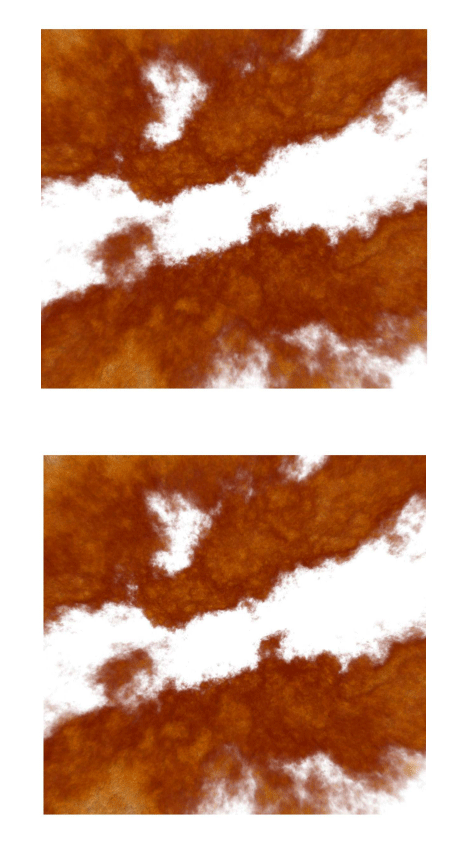
However, if true, Erik Asphaug, of University of California, Santa Cruz, thinks the finding still causes problems. "The concept of having a highly differentiated body, that is at the same time covered in rock, doesn't fit with our previous understanding of how the solar system was formed," he says. "It seems Lutetia violates some of the holy precepts of solar system origins."

The accelerating expansion of the Universe

The Nobel Prize in Physics 2011 honoured revolutionary, completely unexpected observations of the inflation of our Universe.

The Award was divided: One half was awarded to Saul Perlmutter and the other half jointly to Brian Schmidt and Adam Riess "for the discovery of the accelerating expansion of the Universe through observations of distant supernovae."

The discovery of the expansion of our Universe was already noticed by astronomer Hubble a long time ago in 1929, forcing Einstein to revise his famous equations about space, time and masses. So what made these new observations so special for the Scandinavian Award Committees? It was actually not the discovery that something inflates the Universe, but that it expands with an increasing speed.

The scientists' approach to evaluate this expansion was very smart; the science teams observed special types of so-called Ia supernovae - explosions of aged stars that are as heavy as our sun, but with a size of Earth. They did a great job to discover more than 50 distant supernovae and to register that their light intensity was surprisingly less than expected, drawing thereof the conclusion that the expansion of the Universe was accelerating. Einstein's formulas have been already revised a second time to cope with this new situation.

Two exciting, yet unsolved questions came up: What type of super force or super energy could be capable of pushing entire galaxies away from each other, revolting against the strong and far reaching gravitational forces of huge galactic mass clusters; and what stabilises these galaxies on top in a way that the outer stars move much faster on stable orbits than Newton's and Einstein's formulas allow?

Some years ago, scientists introduced the term "dark energy" to describe the accelerating expansion and the term "dark matter" to grasp the phenomenon of stable galaxies despite very fast moving remote stars. Dark energy and dark matter add up to an astonishing 96 per cent of total energies of our Universe, in case the new pictures are balanced against the earlier views of theoretical physicists and subsequent historical discoveries of astrophysicists.

This brings us right back to Einstein's imaginations of space and time, 100 years ago: Is it possible to enrich his formulations of space, time and masses for the third time to cover the new discoveries as well? Might this revision navigate science finally towards a first solution to combine Heisenberg's and Planck's quantum physics with Einstein's space-time continuum? The answer seems to be yes, because there is still one peculiarity in Einstein's formulations that has not yet been used in the reflections about an accelerating expansion of the Universe, extensively: Einstein's equating of length and time. Einstein introduced time as an equal fourth dimension to the three space dimensions length, width and height. Let us now theoretically suppose there are two or more Universes overlapping in a simple way that one spatial dimension coincides with Einstein's time dimension of all others, respectively.

The result is as astonishing as it is exciting, because what we get are flat, overlapping 2-D-spaces around us, utmost difficult to detect, since they have only two spatial dimensions. We could try to assign such flat spaces around us, for example to electromagnetism, in case electromagnetic waves turn out to be flat – and they are in fact flat, as everybody can prove it simply with horizontally and vertically polarised 3-D-glasses for 3-D-movies. These glasses use the flat 2-D-nature of these waves to filter light and to differentiate between information for the right eye and for the left eye. This example proves that such flat spaces around us in fact exist and that they become visible by electromagnetism, just generating turbulences on these coinciding dimensions.

What would happen if the coincidence of Einstein's time progress axis with one spatial dimension of these flat 2-D-spaces around us would get slowly lost? The answer is simple: Space of an observer expands with increasing speed at the expense of remaining time reserves for the future. From this point of view these flat spaces around us turn out to be one possible source of dark energy for the accelerating expansion of the Universe. Serial space points in time leap into simultaneous points in space. This is sort of a leakage from a potential future time span to space expansion towards a lower energy state, as the storage of events in time needs additional energy, just like battery charging. Finally, we could rotate two overlapping flat space dimensions further against each other, until they oppose each other's time progress and space dimensions. We can do this without conflict to any of Einstein's descriptions only if we introduce Planck's proven quantisation scheme for length minima and time minima. Below these Planck units time and length do not anymore appear as such. This way we derive a remarkable dark matter effect, accumulating as halos below undisputed Planck units and structuring together with dark energy NASA's confirmed 96 per cent of energy processes throughout the Universe.

به افتخار تاریکی

چیزی را که به هوا پرتاب می‌کنیم، بایستی به سمت زمین برگردد. اصلاً بحث و جدل چندانی راجع به قوانین حاکم بر نیروی بنیادین گرانش در جریان نیست، اما نوبل فیزیک ۲۰۱۱، به دانشمندانی اعطا شد که پرده از وجه تاریک چنین نیروی مطمئنی برکشیدند.
 
برندگان نوبل فیزیک امسال، شامل سائول پرلماتر(Saul Perlmutter) و آدام ریس (Adam Riess) از ایالات متحده و برایان اشمیت (Brian Schmidt) از استرالیا، در کشف این‌که جهان‌مان نه‌تنها منبسط می‌شود، که با شتاب فزاینده‌ای چنین می‌کند، سهیم بودند. این کشف امروزه به تئوری مقبول "انرژی تاریک" انجامیده است، نیروی سراسر اسرارآمیزی که برخلاف گرانش عمل می‌کند. بررسی‌ها نشان از این داده‌اند که انرژی تاریک، حدود ۷۴درصد از حجم هستی را به خود اختصاص داده است، اما بالغ بر یک دهه بعد از این کشف دوران‌ساز، دانشمندان هنوز هم درصدد کشف ماهیت انرژی تاریک‌ و لذا حل معمایی هستند که به‌قول برخی متخصصان، ریشه‌ای‌ترین معضل پیش روی فیزیک جدید است.
 
 
آیا جاذبه به طریق دیگری رفتار می‌کند؟
تا زمان کشف انرژی تاریک، فیزیکدانان ملزم به قبول این قاعده شده بودند که نیروی گرانش مابین اجزای ساختاری کیهان، باید انبساط جهان را به تناوب آهسته‌تر سازد: "هنگامی‌که دسته کلیدم را به هوا پرتاب می‌کنم، نیروی جاذبه زمین از سرعت آن می‌کاهد و آن را به من بازمی‌گرداند." این نکته بدیهی را ماریو لیویو (Mario Livio)، فیزیکدان نظری مؤسسه علمی تلسکوپ فضایی (STScI) در شهر بالتیمور ایالت مریلند، در جریان سمپوزیوم "ده سال انرژی تاریک"، در سال ۲۰۰۸ میلادی گفت.
 
اما ستاره‌شناسان با بررسی نور انفجارهای دوردست ستاره‌ای به عینه دیدند که کهکشان‌های میزبان این انفجارها با سرعتی فزاینده در حال دور شدن از هم هستند. به‌گفته لیویو، تماشای دورشدن شتاب‌گیرنده این کهکشان‌ها درست به این می‌ماند که دسته‌کلیدمان به‌طور مستقیم به سقف اتاق بچسبد. آشتی دادن این دیده‌ها با فرضیه‌های کنونی، یکی از بزرگ‌ترین چالش‌های پیش روی پژوهشگران حوزه فیزیک نظری است. مایکل ترنر (Michael Turner)، کیهان‌شناسی از دانشگاه شیکاگو می‌گوید: "ما تاکنون دو توجیه کاملاً ناخرسندکننده برای این مشاهدات داشته‌ایم."
 
براساس یک احتمال، اصلاً انرژی تاریکی وجود ندارد و تنها نیروی جاذبه در چنین مقیاس‌های عظیم رفتاری متفاوت از خود بروز می‌دهد، اما "فیزیکدانان محافظه‌کارند. ما تمایلی به ترک تئوری فعلی گرانش، آن‌هم هنگامی که می‌شود از دوباره به هم جوش‌اش داد و به احیایش پرداخت، نداریم." این را آدام ریس، کیهان‌شناس مؤسسه STScI و از برندگان نوبل فیزیک امسال به نشنال جئوگرافیک می‌گوید و می‌افزاید: "اساساً این‌ها همه به این واقعیت ختم می‌شود که فرمولی به نسبت ساده برای توصیف رفتارهای جهان وجود دارد و ما نیز از همان فرمول استفاده می‌کنیم. از حال که توانسته‌ایم این وجه نامتعارف نیروی جاذبه را ببینیم، یا می‌توانیم آن را به گردن سمت چپ معادله بیندازیم و بگوییم اصلاً از گرانش هیچ نفهمیده‌ایم و یا مشاهدات‌مان را به سمت راست معادله نسبت داده و بگوییم حقیقتاً این وجه خارق‌العاده وجود خارجی دارد." 
 
انرژی تاریک، دستاورد خلاء کوانتومی است؟
این موجودیت نامتعارف- و قهرمان احتمالی داستان کشف ماهیت انرژی تاریک- همان انرژی خلاء کوانتومی است. فقط نکته کار اینجاست که هیچکس هنوز نتوانسته ریاضیات حاکم بر مکانیک کوانتومی را که به توصیف مقیاس‌های فوق‌العاده ریز طبیعت می‌پردازد، با ریاضیات حاکم بر معادلات نسبیت عام آشتی دهد؛ معادلاتی که به توصیف فعل‌ و انفعالات بزرگ‌مقیاس طبیعت می‌پردازند. ریس می‌گوید: "این دو نظریه، از دو اساسنامه متفاوت پیروی می‌کنند و ما همیشه می‌دانسته‌ایم که این دو اساسنامه با هم متفاوتند، اما متأسفانه انرژی تاریک از معدود مواردی در طبیعت است که توصیف آن مستلزم کاربرد هر دو نوع از این قوانین است."
 
ناسا و وزارت انرژی ایالات متحده به‌منظور حل این چیستان، درصدد راه‌اندازی پروژه‌ای موسوم به "مأموریت مشترک انرژی تاریک" (JDEM) هستند، نخستین پروژه مختص پژوهش در حوزه انرژی تاریک. اما بر اساس چشم‌انداز ده‌ساله انجمن پژوهش‌های ملی آمریکا (NSC)، درخواستی مبنی بر تأمین بودجه برای راه‌اندازی پروژه JDEM پیشنهاد نشده است و به جای آن، "تلسکوپ مساحی فروسرخ میدان باز" (WFIRST)- که قرار شده در سال ۲۰۲۰ عازم فضا شود- به‌عنوان بهترین مأموریت علمی مرتبط با پاسخگویی به سئوالات بنیادین حوزه انرژی تاریک و همچنین سیارات فراخورشیدی درنظر گرفته شده است. در همین اثنا هم به‌گفته مایکل سالامون (Michael Salamon)، سرپرست دانشمندان پروژه "فیزیک کیهانی" ناسا، برخی از مأموریت‌های فعال این سازمان، تاکنون نقش بسزایی را در کمک به درک ماهیت انرژی تاریک کرده‌اند. او می‌گوید: "یک نمونه‌اش همین تلسکوپ فضایی هابل است که با برتری خود در انجام محاسبات مربوط به ابرنواخترها (که همان انفجارهای ستاره‌ای دوردست کیهان باشند) کمک شایان توجهی به تئوری انرژی تاریک کرده است."
 
انبساط شتاب‌گیرنده کیهان را پژوهشگران برای نخستین دفعه از طریق بررسی ابرنواخترهای نوع ۱a که نقطه پایان حیات کوتوله‌های سفیدی محسوب می‌شوند که خود نقطه پایان ستاره‌های سبک‌وزن هستند- متوجه شدند. ستاره‌شناسان می‌دانند که هریک از ابرنواخترهای نوع 1a، درخشندگی ثابتی دارند (همانند یک لامپ ۱۰۰ وات). مادامی که نور ناشی از دورترین انفجارهای کیهانی رهسپار زمین می‌شود، تحت تأثیر انبساط جهان چنان کش می‌آید که به رنگ سرخ دیده می‌شود و این پدیده به قرمزشدگی (یا همان "انتقال به سرخ"- Redshift) معروف است. هرچه این قرمزشدگی شدیدتر باشد، این نور مسافت بیشتری را طی کرده و از منشا قدیمی‌تری سرچشمه گرفته‌اند. مقایسه بیشترین آمار ممکن ابرنواخترهای دوردست نوع ۱a، به دانشمندان در تعیین سرعت دور شدن کهکشان‌ها از همدیگر کمک می‌کند.
 
مطالعات صورت‌پذیرفته پیرامون این ابرنواخترها به دانشمندان امکان تماشای تأثیر انرژی تاریک بر سرعت کهکشان‌ها را تا نه میلیارد سال نوری آن‌طرف‌تر داده است. بعضی از محققین حتی درصدد کشف مدارک کهن‌تری از حضور انرژی تاریک در پهنه "تابش میکروموج پس‌زمینه کیهانی" (CMB) برآمده‌اند، بازمانده‌ای مستقیم از انفجار بزرگی که گمان می‌رود حدود ۱۳/۷ میلیارد سال پیش به‌وقوع پیوسته است.
 
در سال ۲۰۰۳ میلادی، کاوشگر "ناهمسانگردی میکروموجی ویلکینسون" (WMAP) وابسته به ناسا، نخستین نقشه دقیق و سراسری از این نور همه‌جا حاضر را به‌دست آورد و با به تماشا نشستن دوران نوباوگی کیهان، موفق به کشف افت و خیزهای ناچیزی در پهنه این نور شد که به‌عنوان بذر کهکشان‌های نخستین تلقی می‌شوند. این را لیسیا ورده (Licia Verde) از اخترفیزیکدانان موسسه علوم فضایی "بلاترا"ی اسپانیا طی سمپوزیوم سال ۲۰۰۸ اظهار کرد و افزود: "این یک سمفونی کیهانی است. شما واقعاً به تماشای صدا نشسته‌اید و همین صدا هم به شما در درک ساختار ساز کمک می‌کند" و در سال ۲۰۰۵ بود که ستاره‌شناسان فهمیدند امواج صوتی پراکنده در پهنه پلاسمای اولیه کیهانی در حدود ۴۰۰ هزارسال پس از وقوع انفجار بزرگ، ردپایی از کهکشان‌های نوظهور و کنونی را نیز در درون خودشان پنهان کرده‌اند. این افت و خیزهایی که به اصطلاح نوسانات "صوتی باریونی" نامیده می‌شوند، شاخص دقیق دیگری را برای تعیین نرخ انبساط جهان در طول زمان به دست داده‌اند و محدوده حکمرانی انرژی تاریک را مشخص کرده‌اند.
 
رازی که همچنان باقیست
به‌گفته متخصصان اما هنوز طول می‌کشد تا دست به یگانگی متدهای گوناگون بزنیم و پرده از این راز دیرپا برکشیم. ریس می‌گوید: "زیبایی این بازی به این است که محاسبات بیشتری در پهنه تاریخ انبساط کیهان صورت دهیم، آن‌ها را دقیق‌تر از گذشته کنیم و پایه‌های مدل توصیف‌‌گر ماهیت انرژی تاریک را محکم کنیم."
یکی از اهداف اصلی این آزمایشات، محاسبه نسبت چگالی انرژی به فشار موجود در پهنه کیهان است که با حرف w نمایش داده می‌شود. به‌گفته ریس، این کمیت به فیزیکدانان می‌گوید که "کدامین نوع از گرانش- از قبیل جاذب و یا دافع- را برای یک جسم می‌توان درنظر گرفت و به محاسبه قدرتش پرداخت. اگر انرژی تاریک همان انرژی خلأ باشد، آنگاه w همیشه و دقیقاً معادل -1 خواهد بود"؛ کشفی که پیش‌بینی‌های کوانتومی را در انطباق با نسبت عام درخواهد آورد. درغیر این‌صورت، بایستی زمان صرف کرد و به بازنویسی این قوانین پرداخت.
 
لارنس کرانس (Lawrence Krauss) فیزیکدان نظری دانشگاه ایالتی آریزونا در همان سمپوزیوم STScI خاطرنشان ساخت که اکثریت رصدهای کنونی، حاکی از مقدار عددی فوق‌العاده نزدیک به -۱ برای w هستند. لذا برای فیزیکدانان نظری، "محاسبه w ... چیزهایی که تا پیش‌تر نمی‌دانستیم را برملا نخواهد کرد"، اما "پنجره‌های جدید، میزبان شگفتی‌های جدیدند. شما باید هرآنچه را که می‌توانید، انجام دهید، چراکه نمی‌دانید پاسخ از کدامین‌سو به سراغ‌تان خواهد آمد.
 

افق‌های تازه فراروی تلسکوپ غول‌آسای اروپا

طی نشستی که در اواسط هفته گذشته در شهر سانتیاگوی شیلی برگزار شد، آلفردو مورنو (Alfredo Moreno)، وزیر امور خارجه این کشور و تیم دو‌زیو (Tim de Zeeuw)، دبیرکل رصدخانه‌های جنوبی اروپا (ESO)، توافق‌نامه‌ای را در خصوص احداث «تلسکوپ بی‌اندازه بزرگ اروپایی» (E-ELT) امضا کردند. این توافقنامه مشتمل بر تخصیص مکانی برای استقرار رصدخانه و نیز اعطای امتیاز درازمدتی به‌منظور تأسیس منطقه حفاظت‌شده‌ای در اطراف مکان مزبور همراه با حمایت دولت شیلی برای ساخت بزرگ‌ترین تلسکوپ دوران ماست.

تلسکوپ E-ELT، با آینه‌ای به قطر تقریبی ۴۰ متر، بزرگ‌ترین چشم بشر خواهد بود که به آسمان خواهد نگریست. در ماه مارس۲۰۱۰، کوه آرمازونس در منطقه آنتوفاگاستای صحرای آتاکامای شیلی، توسط متخصصین ESO به‌عنوان مکان آتی استقرار این تلسکوپ انتخاب شد. E-ELT، به‌زودی به شبکه تلسکوپ‌های رصدخانه پارانال خواهد پیوست که میزبان بزرگ‌ترین آرایه تلسکوپ‌های نور مرئی فعلی جهان (موسوم به VLT) است. کوه پارانال، در فاصله تنها ۲۰ کیلومتری از آرمازونس واقع شده است و اکثر زیرساخت‌های دو رصدخانه هم مابین تکنسین‌هایشان (که یک شهر کامل را تشکیل داده‌اند) به اشتراک گذاشته خواهد شد.
 
این توافقنامه دوجانبه، گام بلند دیگری در راستای همکاری‌های علمی و فناورانه کشور شیلی و سازمان ESO محسوب می‌شود که به‌طور رسمی از سال ۱۹۶۳ و با امضای نخستین توافقنامه آغاز شد. شیلی و ESO در این چندین دهه، در پروژه‌های اختر‌شناختی فراوانی، در زمینه تأمین تجهیزات و فناوری و نیز آموزش دانشمندان، مهندسین و تکنیسین‌ها با هدف پیشبرد جایگاه و آگاهی جمعیت کشور شیلی در زمینه دانش اختر‌شناسی که خود یکی از پیشرو‌ترین مناطق میزبان تحقیقات مرتبط با این حوزه در سرتاسر جهان به شمار می‌رود، با هم مشارکت کرده‌اند.
 
تیم دوزیو، دبیرکل ESO، در این‌ زمینه می‌گوید: «این توافقنامه، امکان ساخت تلسکوپ E-ELT، به عنوان یکی از اعضای شبکه VLT را به ما می‌دهد و تا حد زیادی به ارتقای حضور و همکاری ما در کنار جامعه شیلی کمک کرده و افق‌های گسترده‌تری را برای کشفیات بیشتر و پیشرفت فناورانه در فرارویمان گشوده است.» طبق این توافقنامه، ۱۸۹ کیلومتر مربع از اراضی کوهستان آرمازونس، به‌منظور استقرار تأسیسات E-ELT، و همچنین حق بهره‌برداری ۵۰ ساله از نواحی پیرامونی آنکه روی‌هم‌رفته ۳۶۲ کیلومتر مربع دیگر را هم به وسعت اراضی اولیه می‌افزاید و به دانشمندان، امکان کنترل آلودگی نوری و همچنین فعالیت‌های معدنی منطقه را هم می‌دهد، به سازمان ESO واگذار شد. با احتساب حوزه ۷۱۹ کیلومتر مربعی گرداگرد رصدخانه پارانال، منطقه علمی حفاظت‌شده پارانال-آرمازونس به ۱۲۷۰ کیلومتر مربع از صحرای آتاکاما خواهد رسید.
 
وزیر امور خارجه کشور شیلی، آلفردو مورنو نیز در این زمینه می‌گوید: «شیلی، پاک‌ترین آسمان‌های روی زمین را دارد و میزبان مهم‌ترین مراکز انجام رصدهای اختر‌شناختی است. این، جزئی از دارایی‌های ما و همچنین جزئی از خدمت ما به بشریت است. حضور ESO و E-ELT در کشور ما، نشانگر اشتیاق شیلی به ترویج علم و فناوری است.»
 
دولت شیلی نیز مراتب تعهد خود به تأمین زیرساخت‌هایی نظیر راه ارتباطی رصدخانه‌ها به شهر آنتوفاگاستا، اتصال رصدخانه پارانال به شبکه برق ملی و نیز همیاری در پژوهش‌های مرتبط با تحقق احتمال بهره‌برداری از انرژی‌های پاک در منطقه را بیان داشته است. از طرفی ESO نیز سهم ده‌درصدی اختر‌شناسان شیلیایی در استفاده از E-ELT را افزایش داده است که در این بین، سه‌چهارم فرصت‌ها به آن دسته از اختر‌شناسان بومی‌ای تخصیص داده خواهد شد که کارشان را با همیاری اختر‌شناسان بین‌المللی کشورهای عضو ESO پی خواهند گرفت. این تصمیم، کمک شایان توجهی به رشد همکاری‌های بین‌المللی خواهد کرد که از نیازهای اصلی این پروژه علمی، آن‌هم با چنین ابعادی تلقی می‌شود.
 
تلسکوپ E-ELT، جاه‌طلبانه‌ترین پروژه ESO تا به امروز است. با شروع عملیات علمی این رصدخانه تا اوایل دهه آتی، E-ELT با گسترده‌ترین چالش‌های علمی دوران ما دست به گریبان خواهد شد و قدم در راه شکستن پیوسته رکوردهایی، خصوصاً در زمینه کشف سیارات زمین‌مانند و سکنی‌پذیر فراخورشیدی خواهد نهاد.

Space missions look from the dark into the light

Hot on the heels of this week's announcement of the physics Nobel prize "for the discovery of the accelerating expansion of the universe through observations of distant supernovae", the European Space Agency (ESA) has chosen its next two science missions, one of which will explore the nature of dark energy – which many physicists believe is the cause of the accelerating expansion. Called Euclid, this mission will study the large-scale structure of the universe with the aim of understanding how it evolved following the Big Bang. The other mission is named Solar Orbiter and will gauge the influence of the Sun on the rest of the solar system, with a special focus on the effects of the solar wind. The projects are the first in ESA's Cosmic Vision 2015–2025 plan and fall into the category of medium-class missions. There are three such missions planned for launch in 2017–2022, but the third has yet to be chosen.

The dark side

In 1998 physicists were astounded by the discovery that the rate of expansion of the universe was increasing – not decreasing as had been previously thought. The cause of the acceleration remains one of the most enduring mysteries in cosmology. Euclid is a space-based telescope that aims to create the most accurate map yet of the large-scale structure of the universe. According to ESA's mission objectives, this will enable astronomers "To understand the nature of dark energy and dark matter by accurate measurement of the accelerated expansion of the universe through different independent methods."

Euclid will observe galaxies and clusters of galaxies out to redshifts of z ~ 2 at visible and near-infrared wavelengths. Its view will stretch across 10 billion light-years, revealing details of the universe’s expansion and how its structure has developed over the last three-quarters of its history. Euclid's launch, on a Soyuz launch vehicle, is planned for 2019 at Europe's Spaceport in Kourou, French Guiana.

Here comes the Sun

While the Euclid mission will probe the furthest corners of the universe, the other Cosmic Vision mission will be looking at something rather closer to home. The Solar Orbiter will investigate how the Sun creates and controls the heliosphere – the bubble in space that is "blown" by the Sun and engulfs the solar system. The mission is designed to better our understanding of the influences our Sun has on its neighbourhood. In particular, it will study how the Sun generates and propels the solar wind, which is the flow of particles in which the planets are bathed. Solar activity, such as solar flares, affects the solar wind, creating strong perturbations and making it turbulent. This can have dire consequences for radio communications, satellites and space missions, as well as triggering spectacular auroral displays visible from Earth and other planets.

The Solar Orbiter will maintain an elliptical orbit around the Sun and will venture closer to it than any previous mission. This will allow the mission to measure how the solar wind accelerates over the Sun's surface and to sample this solar wind shortly after it has been ejected. The mission's launch is planned for 2017 from Cape Canaveral using a NASA-provided Atlas launch vehicle.

Asking the right questions

Early in 2004, the Cosmic Vision 2015–2025 plan identified four scientific aims: What are the conditions for life and planetary formation? How does the solar system work? What are the fundamental laws of the universe? How did the universe begin and what is it made of? A "call for missions" around these aims was issued in 2007, with Euclid and the Solar Orbiter chosen this year. ESA is now evaluating five other medium-sized missions for the final launch slot in 2022. This includes the PLATO mission, which would look at nearby stars to study the conditions required for planet formation and the emergence of life, that narrowly missed out in this latest round.

"It was an arduous task for the Science Programme Committee to choose two from the three excellent candidates. All of them would produce world-class science and would put Europe at the forefront in the respective fields. Their quality goes to show the creativity and resources of the European scientific community," says Fabio Favata, head of the Science Programme's planning office.

Active galactic nuclei measure the universe

A common type of active galactic nuclei (AGN) could be used as an accurate "standard candle" for measuring cosmic distances – according to astronomers in Denmark and Australia. AGNs are some of the brightest objects in the visible universe and the technique could allow astronomers to determine much larger distances than is possible with current techniques, the scientists say.

Standard candles are distant objects with known brightness that give astronomers a very accurate measure of cosmic distances – the dimmer the candle appears to us, the farther away it must be. Studying these candles is crucial to our understanding of the age and energy density of the universe. Indeed, the use of supernovae and Cepheids as standard candles turned our understanding of the cosmos on its head through the discovery of the acceleration of the expansion of the universe and the introduction of dark energy.

'Reverberation mapping'

However, reliable measurements of distances greater than redshift of about 1.7 are beyond the current capabilities of known standard candles. Now, Darach Watson and colleagues at the University of Copenhagen and the University of Queensland have shown that a tight relationship between the luminosity of an AGN and the radius of its "broad-line region" can be used to measure cosmic distances. The radius is found using "reverberation mapping", an established technique for studying the inner structure of AGNs, to gauge their mass. However, until this latest work, the method had not been considered in the search for new standard candles.

According to Copenhagen astronomer Kelly Denney, the approach works using type-1 AGNs – those with broad-line emissions in the visible spectrum. These objects have a dense area of gas and dust surrounding the black hole called the broad-line region. The region is so-called because light emitted by the gas has much broader line widths than light from most other astronomical sources.

Heart of the matter

Much closer to the black hole is the accretion disc where matter falling into the black hole collects, causing a great deal of light to be produced. As this light travels outwards, it ionizes gas in the broad-line region, causing it to emit light with the distinct broad line widths because the gas is moving at many thousands of kilometres per second due to the gravity of the black hole, and the Doppler shifts associated with this motion causes the broadening. However, the amount of light produced in the accretion disc is not constant. By carefully comparing the time at which the light is emitted from the accretion disc and the time at which the ionized light is re-emitted from the broad-line region, astronomers can measure a time lag between the light arriving from the two sources. This delay is proportional to the radius of the broad-line region divided by the speed of light. This radius correlates tightly with the luminosity of the AGN. The luminosity in turn is used to calculate the distance because they are inversely related.

The technique, however, is difficult and it wasn't until 2009 that Denney – then working with Bradley Peterson's group at Ohio State University – vastly improved the accuracy of the data from the radius-luminosity relationship such that it would allow a precise distance to be calculated. When Darach Watson came across the result, he wondered why this was not being used as a distance indicator already. "The simple answer was 'Huh, well, I don't know!' Everyone in the AGN community typically wants to know why no-one has thought of this before!" said Denney.

Candle in the wind

To confirm the technique's ability to give the distance of an AGN, Watson and colleagues looked at a sample of 38 AGNs at known distances. They found that reverberation mapping gave a reasonable estimate of the distance to the AGNs. Kenney quipped, "This almost makes the notion of AGNs as standard candles an oxymoron, since it's their variability that makes the method work!"

Currently, the AGN technique is not as reliable as those based on Cepheids or supernovae. However, unlike a supernova – which lasts for a relatively short time – an AGN can be observed over long periods, reducing observational uncertainties. Also, AGNs exist at all redshifts, so astronomers can pick and choose which ones to study. In the coming months, the researchers aim to reduce the scatter in their current data and work on higher redshift reverberation mapping experiments. "One drawback of the method is that, due to time-dilation effects, the monitoring time required to measure time delays can become very long, especially for high-redshift sources. We are investigating ways to reduce this time, such as working in the UV, where the time delays are shorter." says Denney.

Dark-energy pioneers scoop Nobel prize

The 2011 Nobel Prize for Physics has been awarded to Saul Perlmutter from the Lawrence Berkeley National Laboratory, US, Adam Riess at Johns Hopkins University, in Baltimore, and Brian Schmidt from the Australian National University, Weston Creek, "for the discovery of the accelerating expansion of the universe through observations of distant supernovae".

Perlmutter has been awarded a half of the SEK10m (£934,000) prize, with Riess and Schmidt sharing the other half. In a statement, the Royal Swedish Academy of Sciences said "For almost a century, the universe has been known to be expanding as a consequence of the Big Bang about 14 billion years ago. However, the discovery that this expansion is accelerating is astounding. If the expansion will continue to speed up the universe will end in ice."

Going against gravity

Only 25 years ago most scientists believed that the universe could be described by Albert Einstein and Willem de Sitter’s simple and elegant model from 1932 in which gravity is gradually slowing down the expansion of space. From the mid-1980s, however, a remarkable series of observations was made that did not seem to fit the standard theory, leading some people to suggest that an old and discredited term from Einstein’s general theory of relativity – the "cosmological constant" or "lambda" – should be brought back to explain the data.

This constant had originally been introduced by Einstein in 1917 to counteract the attractive pull of gravity, because he believed the universe to be static. He considered it a property of space itself, but it can also be interpreted as a form of energy that uniformly fills all of space; if lambda is greater than zero, the uniform energy has negative pressure and creates a bizarre, repulsive form of gravity. However, Einstein grew disillusioned with the term and finally abandoned it in 1931 after Edwin Hubble and Milton Humason discovered that the universe is expanding.

In 1987 physicists at the Lawrence Berkeley National Laboratory and the University of California at Berkeley initiated the Supernova Cosmology Project (SCP) to hunt for certain distant exploding stars, known as type Ia supernovae. They hoped to use these stars to calculate, among other things, the rate at which the expansion of the universe was slowing down. Deceleration was expected because in the absence of lambda, many people thought that "ΩM", which is the amount of observable matter in the universe today as a fraction of the critical density, was sufficient to slow the universe's expansion forever, if not to bring it to an eventual halt.

In 1998, after years of observations, two rival groups of supernova hunters – the High-Z Supernovae Search Team led by Schmidt and Riess and the SCP led by Perlmutter – came to the conclusion that the cosmic expansion is actually accelerating and not slowing under the influence of gravity as might be expected. The two teams came to this conclusion by studying type Ia supernova where they found that the light from over 50 distant supernovae was weaker than expected. This was a sign that the expansion of the universe was accelerating.

In order to account for the acceleration, about 75% of the mass-energy content of the universe had to be made up of some gravitationally repulsive substance that nobody had ever seen before. This substance, which would determine the fate of the universe, was dubbed dark energy. It is now thought that dark energy constitutes around 75% of the current universe, with around 21% being dark matter and the rest ordinary matter and energy making up the Earth, planets and stars. "The findings of the 2011 Nobel Laureates in Physics have helped to unveil a universe that to a large extent is unknown to science," stated the Academy. "And everything is possible again."

"My involvement in the discovery of the accelerating universe and its implications for the presence of dark energy has been an incredibly exciting adventure," says Riess. "I have also been fortunate to work with tremendous colleagues and powerful facilities. I am deeply honored that this work has been recognized."

New problems

Cosmologist Michael Turner from the University of Chicago says that the award to Perlmutter, Riess and Schmidt is "well deserved". "The two competing teams is a wonderful story in science – the physicists vs the astronomers," says Turner. "The biggest surprise to both teams was that the other team got the same answer. Each team believed the other didn't know what they were doing." Turner adds that before the discovery, cosmology was in some disarray with astronomers having a model of the universe based on cold dark matter and inflation, but with not enough matter to make the universe flat – a key prediction of inflation.

"Dark energy and cosmic acceleration was the missing piece of the puzzle," says Turner. "Moreover, in solving one problem, it gave us a new problem – what is dark energy? I think that is the most profound mystery in all of science." Robert Kirshner from Harvard University who supervised both Schmidt and Riess when they were PhD students says the decision by the Nobel committee is "great" as it will mean "no more waiting". "We did a lot of foundational work at Harvard and my postdocs and students made up a hefty chunk of the High-Z Team," says Kirshner. "[Riess] did a lot after the initial result to show that there was no sneaky effect due to dust absorption and that, if you look far enough into the past, you could see that the universe was slowing down before the dark energy got the upper hand, about five billion years ago."

Kirshner adds that Perlmutter is also "very deserving" of the prize. "[Perlmutter] was persistent even when his programme was moving slowly and, despite getting a contrary result in 1997, was convinced of cosmic acceleration during 1998 by comparing his own extensive data set of distant supernovae with the nearby supernovae measured by the group in Chile." Peter Knight, president of the Institute of Physics, which publishes physicsworld.com says the work has "triggered an enormous amount of research" on the nature of dark energy. "These researchers have opened our eyes to the true nature of our universe. They are very well-deserved recipients," says Knight.

Leading lights

Born in Champaign-Urbana, Illinois, in 1959, Perlmutter graduated from Harvard University in 1981 receiving his PhD from the University of California, Berkeley in 1986 where he worked on robotic methods of searching nearby supernovae. He then moved to the Lawrence Berkeley National Laboratory and the University of California, Berkeley. Perlmutter now heads the SCP based at Lawrence Berkeley National Laboratory.

Schmidt was born in Missoula, Montana, in 1967. He graduated from the University of Arizona in 1989 and received his PhD from Harvard University in 1993 on using type II Supernovae to measure the Hubble Constant. During postdocs at Harvard, Schmidt, together with Nicholas Suntzeff from the Cerro Tololo Inter-American Observatory in Chile, formed the High-Z Supernovae Search Team. In 1993 Schmidt then went to the Harvard-Smithsonian Center for Astrophysics for a year before moving to the Australian National University where he is currently based.

Riess is also a former member of the High-Z Supernovae Search Team where he lead the 1998 study that reported evidence that the universe's expansion rate is now accelerating. He was born in Washington, D.C in 1969 and graduated from The Massachusetts Institute of Technology in 1992. Riess received his PhD from Harvard University in 1996 researching ways to make type Ia supernovae into accurate distance indicators. In 1999 he moved to the Space Telescope Science Institute at Johns Hopkins University.

حل معمای یک حباب کیهانی

مشاهدات مجموعه تلسکوپ‌های غول‌پیکر VLT، وابسته به رصدخانه جنوبی اروپا (ESO)، شواهدی حاکی از ماهیت عامل انرژی‌بخش ابر مرموز و درخشانی در ژرفای دوردست جهان هستی می‌دهند. این مشاهدات برای نخستینبار نشان داده که انرژی این جرم‌ کیهانی غول‌آسا– موسوم به «حباب لیمان آلفا» که یکی از گستره‌ترین ساختارهای منفرد جهان هستی هم به شمار می‌رود باید از کهکشان‌هایی که در آن به دام افتاده‌اند تأمین شده باشد.  

گروهی از ستاره‌شناسان، با کمک تأسیسات تلسکوپی VLT بر فراز کوه پارانال شیلی، دست به بررسی جرم کیهانی نامتعارفی موسوم به «حباب لیمان آلفا» زدند. این نام اشاره به خط طیفی ویژه‌ای موسوم به «لیمان-آلفا» دارد که در جریان برانگیختگی الکترون‌های اتم هیدروژن ایجاد می‌شود و در طیف این اجرام به چشم می‌خورد. این ساختارهای عظیم‌الجثه و فوق درخشان کیهانی که بسیار هم نادر هستند را غالباً در مناطقی از جهان نخستین می‌توان مشاهده کرد که تجمع بارز ماده در آن‌ها به چشم می‌خورد (یادتان باشد که هرچه فواصل دورتری از جهان هستی را کاوش کنیم، به پیشینه بیشتری از تاریخ جهان نفوذ کرده‌ایم). این تیم متوجه شد که نور یکی از این اجرام، قطبیده است. نور قطبیده را مثلاً در زندگی روزمره برای تولید افکت‌های سه‌بعدی سینمایی به کار می‌بندند. این پدیده به واسطه جهت‌گیری خاص مؤلفه‌های مغناطیسی یا الکتریکی سازنده نور رخ می‌دهد. حال‌آن‌که در نور غیر قطبیده، این مؤلفه‌ها به‌شکل تصادفی آرایش یافته‌اند. به‌هر ترتیب این نخستین باری بود که نور قطبیده در یک حباب لیمان آلفا تشخیص داده می‌شد و این مشاهدات، به پرده‌برداری از راز نحوه درخشش این حباب‌ها، کمک شایان توجهی خواهد کرد.
 
«متیو هایس» (Mathew Hayes) از دانشگاه تولوس فرانسه و سرپرست نویسندگان مقاله مزبور می‌گوید: «ما برای اولین دفعه نشان داده‌ایم که درخشش این جسم اسرارآمیز، به‌جای این‌که از گاز پراکنده در سرتاسر حباب تأمین شود، ناشی از نور پخشیده کهکشان‌های درخشانی‌ست که در آن پنهان شده‌اند.»
 
حباب‌های لیمان آلفا در ردیف بزرگ‌ترین ساختارهای منفرد جهان هستی قرار می‌گیرند: ابرهای عظیمی از گاز هیدروژن که شعاع‌شان به چند ده‌هزار سال نوری می‌رسد (یعنی کمی بیشتر از ابعاد کهکشان راه شیری ما) و انرژی‌شان معادل درخشنده‌ترین کهکشان‌های کیهان است. به‌همین واسطه، نقش حایز اهمیتی را در درک نحوه تشکیل و تحول کهکشان‌ها در سنوات نخستین عمر هستی بازی می‌کنند، اما منبع این درخشندگی چشمگیرشان تاکنون در هاله‌ای از ابهام مانده بود.
 
این گروه از ستاره‌شناسان، تصمیم به بررسی یکی از اولین و درخشنده‌ترین حباب‌های پیداشده تا به امروز گرفتند. این حباب، با نام علمی LAB-1 در سال 2000 میلادی کشف شده بود و چنان از ما دور است که 11.5 میلیارد سال به درازا می‌کشد تا نور آن به زمین برسد. این حباب با شعاع تقریبی 300 هزار سال نوری، همچنین یکی از گسترده‌ترین‌ها در نوع خود است و چندین پیش‌کهکشان، شامل یک کهکشان فعال را هم درون خود جا داده است. کهکشان‌های فعال، آن دسته از کهکشان‌هایی هستند که هسته‌شان فوق‌العاده درخشان‌اند و گویا سیاهچاله‌ پرجرمی را درون خود جا داده‌اند که این درخشندگی محصول افزایش دمای موادی‌ست که به درون این سیاهچاله سرازیر می‌شود. فرضیه‌های متفاوتی تاکنون در تلاش برای توصیف ماهیت حباب‌های لیمان آلفا ارائه شده است. یکی‌شان می‌گوید که این اجرام، در جریان حرکت سریع گاز، به‌سمت مرکز ثقل حباب از بابت نیروی جاذبه بالایش، برانگیخته می‌شوند و شروع به درخشش می‌کنند. براساس فرضیه‌ای دیگر اما نور شدید این اجرام، از ساختارهای درونی‌شان نشئت می‌گیرد: یعنی کهکشان‌هایی که میزبان چندین فاز فعال ستاره‌سازی هستند و یا از سیاهچاله‌های غول‌آسایی که انبوهی از ماده در گرداگرشان حلقه بسته میزبانی می‌کنند. رصدهای جدید، از فرضیه دوم پشتیبانی می‌کند.
 
این گروه، با محاسبه قطبیدگی نور دریافتی از LAB-1 اقدام به تعیین سازوکار درخشش این جرم کرد. ستاره‌شناسان از طریق بررسی نحوه فطبیدگی نور، قادر به کسب اطلاعات مهمی از فرآیندهای فیزیکی زاینده آن هستند و همچنین می‌توانند هر اتفاقی که برای این نور، در مسیر عبورش از مبدآ آن تا زمین رخ داده را ردیابی کنند. اگر از جایی بازتاب یافته باشد، قطبیده می‌شود و این خصوصیت ظریف نور را هم با حس‌گرهای دقیق زمینی می‌توان مشخص ساخت. با این ‌وجود تعیین قطبیدگی نور یک حباب لیمان آلفا، کار سختی خواهد بود چراکه فاصله‌اش تا ما فوق‌العاده زیاد است.
 
«کلادیا اسکارلاتا» (Claudia Scarlata) از دانشگاه مینه‌سوتای ایالات متحده و کمک‌نویسنده این پژوهش، می‌افزاید: «این رصدها را فقط از طریق تلسکوپ‌های VLT و ابزار FORS که بر آن مستقر شده است می‌توان به ثمر رساند. ما مشخصاً به دو چیز نیاز داشتیم: تلسکوپی با آینه‌ای به قطر دست‌کم هشت متر تا نور کافی را جمع آورد و دوربینی که توانایی تعیین قطبیدگی نور را داشته باشد. رصدخانه‌های زیادی را با حضور توأمان این دو ویژگی نمی‌توان در جهان پیدا کرد.»
 
این گروه، با رصد 15ساعته جرم هدف‌شان از دریچه تلسکوپ VLT متوجه شد که نور دریافتی از LAB-1 در راستای حلقه‌ای به گرد ناحیه مرکزی حباب، قطبیده شده است و در مرکز آن هیچ نشانی از قطبیدگی دیده نمی‌شد. اگر نور صرفاً از برانگیختگی گاز موجود در حباب، حین واکنش به گرانش بالای آن ایجاد شده باشد، هرگز این خصیصه را از خود بروز نمی‌دهد، اما آنچه دیده شد، درست همان وضعیتی بود که در صورت نشر نور حباب از جانب کهکشان‌های محصور در نواحی مرکزی آن انتظار مشاهده‌اش می‌رفت.
این ستاره‌شناسان هم‌اکنون درصدد انجام رصدهای بیشتری از این اجرام دوردست کیهانی هستند تا ببینند آیا نتایج بررسی‌شان بر LAB-1، برای سایر حباب‌ها هم صدق می‌کند یا نه.
 

ماده تاریک، آیا واقعاً وجود دارد؟

براساس پژوهشی جدید، احتمال دارد اصلاً ماده‌ مرموزی که به‌عنوان «ماده تاریک» شناخته می‌شود، در واقع یک فریب فیزیکی حاصل از فعل و انفعالات گرانشی مابین جفت‌های ناپایدار ماده/ پادماده باشد.
 
تصور معمول بر این بوده و هست که ماده تاریک، حدود یک‌چهارم از جرم جهان هستی را به خود اختصاص داده است. این فرضیه نخستین‌بار در سال 1933 میلادی، به‌منظور توضیح سرعت بالای کهکشان‌های واقع در نواحی بیرونی خوشه‌های کهکشانی ارائه شد. چراکه با درنظرگرفتن جرم مرئی آن‌ها، چنین رفتاری برای این کهکشان‌ها دور از انتظار می‌نمود. ضمناً از آنجا که جرم ظاهری این خوشه‌ها برای حفظ مدار کهکشان‌های بیرونی‌شان کفایت نمی‌کرد، با توجه به چنین سرعت‌هایی، انتظار می‌رفت این کهکشان‌های بخت‌برگشته تاکنون از قلمرو خوشه به بیرون پرتاب شده باشند، حال‌آن که چنین نیست. از این‌رو فیزیکدانان گفتند امکان دارد این هیولاهای کیهانی، با هاله‌ای از ماده‌ای نامرئی (اما سنگین) احاطه شده باشند. ماده تاریک، نیاز به این جرم اضافی را برطرف می‌کرد که میدان گرانشی‌اش برای نگهداری از این کهکشان‌ها کفایت می‌کرد.
 
در پژوهشی که به‌تازگی صورت گرفته، فیزیکدانی به‌نام «دراگان هاجوکوویک» (Dragan Hajdukovic) از مرکز تحقیقات هسته‌ای اروپا (CERN) در کشور سوئیس، توجیهی کاملاً متفاوت از رفتارهای نامتعارف کیهانی را پیشنهاد کرده که به قول خود هاجوکوویک، اساس این فرضیه بر پدیده «قطبیدگی گرانشی خلأ کوانتومی» استوار است.
 
خلائی که پر از ذرات مجازی است
 
خلاء کوانتومی، نامی است که فیزیکدانان به همان خلائی که ما می‌شناسیم اطلاق می‌کنند. در چهارچوب قوانین کوانتومی، فضای خلاء آنقدرها هم از همه‌چیز خالی نیست، بلکه در واقع این پیوستار تهی، دریای پرجوش و خروشی از «ماده/ پادماده‌های مجازی» است که دائماً از «هیچ» بیرون می‌جهند و دوباره در آن شیرجه می‌زنند و «نابود» می‌شوند. پادماده، ذره‌ای انعکاسی از ماده معمولی است. مثلاً یک پادپروتون، نسخه‌ای مشابه اما با بار منفی از پروتون است که یکی از بنیان‌های سازنده اتم محسوب می‌شود. وقتی‌که ماده و پادماده به‌هم برمی‌خورند، طی یک گسیل آنی انرژی، همدیگر را نابود می‌کنند. ذرات مجازی، بی‌اختیار از خلاء کوانتومی متولد می‌شوند و چنان سریع همدیگر را نابود می‌کنند که امکان مشاهده مستقیم‌شان هرگز فراهم نمی‌شود.
 
در مدل پیشنهادی هاجوکوویک، این احتمال مطرح می‌شود که چه می‌شد اگر جفت‌های ماده/ پادماده، نه‌تنها در بار الکتریکی که در خواص گرانشی‌شان هم رفتاری مخالف باهم از خود نشان دهند؛ احتمالی که در گذشته هم البته مطرح شده بود. او می‌گوید: «اکثر نظریات فیزیکی، تنها یک بار گرانشی را در نظر می‌گیرند، حال‌آنکه من فرض را بر این می‌گیرم که دو نوع بار گرانشی وجود دارد.»
 
بر اساس این ایده که به تفصیل در شماره فعلی نشریه علمی Astrophysics and Space Science انتشار یافته، ماده دارای بار مثبت گرانشی و پادماده برعکس، دارای بار منفی گرانشی است. این بدین‌معناست که ماده و پادماده از حیث گرانشی همدیگر را دفع می‌کنند، به‌گونه‌ای‌که یک جسم متشکل از پادماده، در مواجهه با میدان گرانشی زمین- که جسمی متشکل از ماده محسوب می‌شود- خواهد گریخت. البته از آنجا که دافعه گرانشی به مراتب از دافعه الکتریکی ضعیف‌تر است، امکان برخورد ماده- پادماده در این فرضیه رد نمی‌شود.
 
چگونه کهکشان‌ها با نیروی جاذبه همدیگر را دفع می‌کنند؟
 
هرچند که فرضیه رفتارهای پادگرانشی یک ذره شاید عجیب به‌نظر آید، اما به‌گفته‌هاجوکوویک این فرضیه ریشه‌های محکمی در جای‌جای فیزیک کوانتوم دوانده است. مثلاً مدت‌هاست مشخص شده که ذرات می‌توانند آنچنان در اطراف هم تجمع کنند که یک «دوقطبی الکتریکی» را تشکیل دهند؛ ماده‌ای که یک طرفش را ذرات مثبت و طرف دیگرش را ذرات منفی تشکیل داده است. طبق این فرضیه بایستی شمار فراوانی از این دوقطبی‌های الکتریکی، توسط ذرات مجازی در هر حجم مشخصی از خلاّء ایجاد شوند. جهت‌گیری کلیه این دوقطبی‌ها کاملاً تصادفی است؛ درست مثل دریایی از عقربه‌های قطب‌نمای سرگردان، اما اگرچنان‌چه دوقطبی‌ها در حضور یک میدان الکتریکی به‌وجود آیند، بی‌معطلی هم‌جهت با میدان مزبور می‌شوند.
 
طبق نظریه میدان کوانتومی، این جهت‌گیری پرسرعت دوقطبی‌های الکتریکی که به «قطبیدگی» مشهور است، خودش میدان الکتریکی ثانویه‌ای تولید می‌کند که با میدان اولیه درهم‌آمیخته است و تقویتش می‌کند. اجوجوویک معتقد است اتفاق مشابهی هم دقیقاً برای نیروی گرانش رخ می‌دهد. یعنی واقعاً اگر ذرات مجازی ماده و پادماده دارای بار مخالف گرانشی باشند، آنگاه حضور دوقطبی‌های گرانشی تصادفی را هم در فضا باید انتظار داشت. اگرچنان‌چه این دوقطبی‌های گرانشی در نزدیکی یک کهکشان- و عموماً جسم سنگینی که میدان گرانشی وسیعی را تحت سلطه خود دارد- ایجاد شوند، انتظار می‌رود همگی‌شان قطبیده شوند.
 
قطبیدگی گرانشی، منجر به تولید میدان گرانشی ثانویه‌ای خواهد شد که پس از ادغام با میدان اولیه، بر نیروی جاذبه آن کهکشان می‌افزاید. هاجوکوویک می‌گوید: «فرضیه من، میدان گرانشی کهکشان‌ها را قوی‌تر [از آن‌چه هستند] در نظر می‌گیرد، آن‌هم بدون نیاز به ماده تاریک.»
 
مدارکی برای وجود ماده تاریک
 
«دیوید ایوانز» (David Evans) از دانشگاه بیرمنگام، فیزیکدانی است که فرضیه هاجوکوویک را «مشق نظری جذابی» می‌نامد، اما می‌گوید هنوز حاضر به انکار ماده تاریک نیست. او که رهبر یک تیم انگلیسی فعال در حس‌گر ALICE، واقع در شتاب‌دهنده LHC است. او می‌گوید: «مدارک وجود ماده تاریک هم‌اکنون فوق‌العاده متقاعدکننده‌اند.» مثلاً در سال 2006، ستاره‌شناسان موفق به تهیه تصویری از دو خوشه برخوردی از کهکشان‌ها موسوم به «خوشه بولت» شدند که به‌روشنی نشان از تفکیک ماده معمولی و ماده تاریک می‌دهد. پدیده‌ای مشابه همچنین طی تابستان سال جاری در «خوشه کهکشانی پاندورا» گزارش شد.
 
هاجوکوویک هم‌اکنون مشغول کار روی فرضیه خود است تا موفق به توجیه مشاهدات این‌چنینی بشود. به‌گفته خود او، محاسبات اولیه‌اش نشان می‌دهند که «آن‌چه در خوشه بولت و اخیراً در خوشه پاندورا دیده شده را شاید بتوان در چارچوب فرضیه قطبیدگی گرانشی خلأ کوانتومی توجیه کرد». «مایکل دوزر» (Michael Doser)، از فیزیکدانان CERN، هرچند قبول دارد که فرضیه هاجوکوویک اندکی خارج از عرف معمول است، اما بلافاصله هم آن را رد نمی‌کند و می‌گوید: «عقیده مرسوم، هنوز موفق به اثبات ذرات احتمالی سازنده ماده تاریک نشده است و لذا در این بین، بررسی گستره وسیعی از فرضیاتی که با داده‌های موجود هماهنگی دارند، امری کاملاً رواست.»
 
دوزر از اعضای آزمایش AEgIS وابسته به CERN است؛ آزمایشی که هدف از انجام آن، محاسبه بار گرانشی اتم پادهیدروژن است و از این‌رو در نهایت معلوم می‌کند آیا ماده و پادماده باید اصولاً از حیث گرانشی همدیگر را دفع کنند یا نه. وی می‌گوید: «در این چند ساله قطعاً بایستی تکلیف خودمان را مشخص کرده و در موضع انکار یا قبول فرضیه هاجوکوویک قرار گیریم.»

Black holes act as galactic thermostats

The supermassive black hole at the centre of a massive galaxy or galaxy cluster acts as a furnace, pumping heat into its surroundings. But astronomers have struggled to understand how a steady temperature is maintained throughout the whole galaxy when the black hole only appears to interact with nearby gas. Now, researchers in Canada and Australia believe the answer could be a feedback loop in which gravity causes gas to accumulate around the black hole until its density reaches a tipping point. Then, the gas rushes into the black hole, temporarily turning up the heat.

Galaxies emit X-rays and this ongoing loss of energy should cool their gas so that it coalesces into stars. However, astronomers only see a fraction of the expected star formation in massive elliptical galaxies and galaxy clusters, which means that something must be heating the gas. The only major heat source is the supermassive black hole at the centre of the galaxy or cluster – also known as the active galactic nucleus (AGN). But such AGNs do not get feedback from most of the gas in a galaxy, which can be as far as 330,000 light-years from the AGN. So how does the AGN maintain the temperature of the whole galaxy?

Pressure drop

Edward Pope and Trevor Mendel, both of the University of Victoria in British Columbia, together with Stanislav Shabala of the University of Tasmania in Australia think they know how this feedback occurs. They argue that as the gas in the centre of the massive galaxy or galaxy cluster cools by emitting X-rays, it loses pressure, thereby allowing more gas from further out in the cluster to flow inwards. Eventually, the gas becomes so dense that it cannot support its own weight and it collapses suddenly, rushing in towards the black hole. The black hole swallows some of the gas and uses this energy to hurl the remaining gas outwards. The researchers believe that this outburst could be so energetic that some gas could even be ejected from an elliptical galaxy – but it is not energetic enough to evict gas from a cluster of galaxies.

The outburst would contain particles travelling at near the speed of light and would extend beyond the furthest reaches of even a massive galaxy. "Even though it is fuelled only by the central gas, the black hole can actually heat all of the gas in the galaxy," says Pope. Such outbursts from an AGN can continue for 10 to 100 million years according to the researchers’ calculations, which they say match observations of giant bubbles of gas blown by AGN jets over similar timescales. Once the AGN settles down, the gas begins to cool once more, flowing toward the centre of the galaxy or cluster again.

The average rate at which the gas builds up is the key connection between the AGN outbursts and the temperature of the galaxy at large, Pope explains. It depends on the difference between the cooling rate of the whole galaxy plus the average heating rate by the AGN. Gas accumulates more quickly when cooling dominates, and more slowly when heating is stronger. "Consequently, you can see that this is a self-regulating loop – just like a thermostat," says Pope.

Promising explanation

Andrew Benson of the California Institute of Technology in Pasadena says that the inclusion of periodic AGN outbursts in this explanation of how galaxies and clusters regulate their temperatures is promising "since we observe that AGN are 'on' for only a short time, followed by long periods of being 'off' ". The amount of "on" time for an AGN depends on the amount of cooling it has to counteract, and the researchers say that observations bear this idea out: clusters that are brighter in X-rays are more likely to contain a jet-producing AGN than dimmer clusters. David Rafferty of Leiden Observatory in the Netherlands says the idea is "quite appealing and could well be correct". However, he cautions that "Its importance can only be judged after its predictions have been carefully tested."

Benson is not entirely convinced that the inflow of gas to the black hole is truly periodic – for example, he says it is possible that gas could flow inwards along one direction while flowing outwards in another. However, he agrees that the researchers' predictions, such as how the "on" time of the AGN scales with the mass of the black hole, make the theory testable "which is always the most important thing".

مدرکی برای وجود جهت ارجح در فضازمان

یکی از بنیادهای اخترفیزیک نوین، اصل کیهانشناسی است که بیان می کند ناظران روی زمین، هیچ دید ارجحی به جهان ندارند و قوانین فیزیک باید در همه جا یکسان باشد. بسیاری از مشاهدات از این ایده پشتیبانی می کنند. برای مثال، جهان در همه جهات کم و بیش، به یک شکل به نظر می رسد و در جاهایی که ما می بینیم، همان توزیع کهکشان ها را دارد.


اگرچه، در سال های اخیر، برخی از کیهانشناسان در درستی این اصل تردید کرده اند. آن ها به شواهدی از مطالعه ابرنواختر نوع 1 اشاره دارند که این ابرنواخترها در حال شتاب گیری از ما هستند؛ این یعنی نه تنها جهان منبسط می شود بلکه به شکل شتابدار از ما دور می شود. اما این مدرک چقدر خوب است؟ آیا ممکن است جهت ارجح سرابی آماری باشد که با تحلیل درست داده ها ناپدید گردد؟

رانگ-جن کای (Rong-Gen Cai) و ژونگ-لیانگ تائو (Zhong-Liang Tuo) در آزمایشگاه کلیدی پیشگامان فیزیک نظری در فرهنگستان علوم چین در بیجینگ، داده های 557 ابرنواختر در جهان را دوباره بررسی کردند. آن ها تایید کرده اند که «محور ارجح» واقعیت دارد. بر اساس محاسبات آن ها، بیشترین شتاب در جهت صورت فلکی روباهک (Vulpecula) در نیمکره شمالی است. این نتیجه با دیگر تحلیل ها سازگار است. همچنین مدارک دیگری وجود دارد که جهت ارجحی را در تابش زمینه کیهان نشان می دهد.

در صورت صحت، این موضوع کیهانشناسان را به نتیجه گیری ناخوشایندی وادار می کند: اصل کیهانشناسی نادرست است. اما سوالات جذابی را پیش می کشد: چرا جهان جهت ارجح دارد و ما چگونه باید آن را در مدل های خود به حساب آوریم؟

Galaxy classification is out of tune, say astronomers

The way galaxies have been classified for decades has been questioned by an international team of astronomers. After revealing that two-thirds of local elliptical galaxies are actually fast-spinning discs, the team has suggested that the Hubble "tuning fork" – the long-standing method for classifying galaxies – may need retuning. Galaxies come in all shapes and sizes: from flat spinning discs to almost-stationary blob-like elliptical galaxies. However, accurately classifying these huge objects can sometimes be tricky due to the angle from which they are observed. When seen face-on, older disc galaxies that have lost their distinctive dust lanes and spirals can masquerade as equally featureless, but spherical, elliptical galaxies. Elliptical galaxies are thought to have very little net rotation whereas disc galaxies rotate much faster. Measuring their rotation speed can therefore help distinguish between them.

Such a test has been performed using the ATLAS3D survey, led by Michele Cappellari at the University of Oxford, UK. The survey consists of 260 non-spiral galaxies in the nearby universe. "We divided each galaxy up into a grid and took spectra for each individual section," Cappellari told physicsworld.com. "By analysing these spectra we could measure the red-shift, or the blue-shift, of each section," he adds. If an area shows a red-shift, it is moving away from us; if it shows a blue-shift, it is coming towards us. If one limb of a galaxy is red-shifted and the opposite limb is blue-shifted then the galaxy must be rotating, and you can measure how fast.

More rotating discs

What surprised Cappellari and his colleagues was that 66% of the galaxies previously classified as elliptical were now shown by ATLAS3D to be fast-rotating discs. "Two-thirds of these galaxies are essentially no different from spirals that have had the gas and dust removed – they are 'naked' spirals," Cappellari explains. "Such a large fraction is not something one can ignore; it brings a significant change to our understanding of galaxy formation," he continues. This had led the team to make a distinction between non-spiral galaxies: the conventional ellipticals are "slow rotators" and the naked spirals are "fast rotators".

The result is threatening to overturn more than 80 years of conventional wisdom. Astronomers currently classify galaxies using a "tuning fork" diagram constructed by Edwin Hubble in the mid-1920s. His fork has non-spiral galaxies forming the handle, with the two different flavours of spiral galaxies – those with and those without barred centres – constituting the prongs. However, Cappellari's result shows that fast rotators may be more closely related to spirals than previously thought. "We feel our result could re-write the way textbooks on galaxy structure are written," he says. The iconic Hubble tuning fork image could be replaced by the ATLAS3D "comb". The handle of the comb is formed by non-spiral galaxies in the order of their rotation speed, from slowest to fastest. The spiral galaxies then form three teeth, which attach to the handle at the end containing their fast-rotating, but naked, cousins. "In future when classifying galaxies in projects such as Galaxy Zoo, this is the picture that needs to be kept in mind," explains Cappellari.

Extending the survey

"It is an important result," says Karen Masters of the University of Portsmouth, UK, who uses data from Galaxy Zoo in her research. "Currently these fast rotators would likely be classified on Galaxy Zoo as non-disc galaxies because they are smooth and featureless. This research is showing that a large fraction of these galaxies do have a spinning disc, just one that can't be seen from the image. You have to go in and look at the dynamics," she told physicsworld.com. "It is a beautiful data set and it will be very interesting to see what happens if the survey is extended to include a larger sample," she adds. Cappellari is planning just that. "I am involved in a proposal to increase our sample size by a factor of 100," he explains. But he is keen to stress that future results should not distract from these current findings. "No matter what we find in the future, we already have a major reinterpretation of the structure of local galaxies," he says.

Famous black hole confirmed after 40 years

Using a vast array of radio telescopes, astronomers in North America are the first to make a direct measurement of the distance to Cygnus X-1, allowing them to conclude that the mass of its dark star is so great it can only be a black hole. They have also discovered that the black hole spins faster than most of its peers. "There's no doubt about its distance now, and there's not much uncertainty anymore about its mass," says Mark Reid of the Harvard-Smithsonian Center for Astrophysics in Cambridge, Massachusetts. "It's definitely a black hole."

A black hole is a star that has run out of fuel and died, collapsing into a small body with such enormous gravity that nothing escapes its grip. First identified as harbouring a possible black hole in 1971, Cygnus X-1 was one of the first sources of X-rays discovered by astronomers. It is found in the constellation Cygnus the Swan, also known as the Northern Cross, and is one of the most studied objects in the sky. It even inspired a 10-minute song by the Canadian rock band Rush about how the stars of the Northern Cross were "in mourning for their sister's loss".

A neutron star instead?

However, some scientists were sceptical of its black hole and in 1974 Stephen Hawking bet Caltech's Kip Thorne that Cygnus X-1 did not have a black hole. Instead, the dark object might be a neutron star, a less extreme type of dead star. The key to the controversy involved a mundane fact: its distance from Earth.

The dark star in Cygnus X-1 orbits a hot blue star every 5.6 days. But without knowing its distance from us, no-one could say how much light the blue star emits. The closer Cygnus X-1 is to us, the less powerful this star must be, therefore the less mass it must have. And the less massive this star, the less mass the dark star whose gravity tugs the bright one has. If the dark star has less than three times the Sun's mass, it could be a neutron star rather than a black hole.

Recent distance estimates have favoured a higher mass – Hawking conceded defeat two decades ago – but these have been indirect. The best way to measure distance is through parallax – the small shift in a star's apparent position that results as we view it from different perspectives while Earth goes around the Sun. But Cygnus X-1 is so distant that optical astronomers can't measure its tiny parallax.

Huge array of telescopes

Fortunately, Cygnus X-1 emits radio waves, so Reid and his colleagues took aim at the object with the Very Long Baseline Array (VLBA), which consists of ten 25 m radio telescopes scattered from New England and the Virgin Islands to California and Hawaii. This huge array measures positions 100 times better than the Hubble Space Telescope.

"Cygnus X-1 produced beautiful data," says Reid, "and we were able to get a very accurate distance." The parallax indicates that Cygnus X-1 is 6050 light-years from Earth, with an uncertainty of just 400 light-years. From this the astronomers deduce that the dark star is 14.8 times more massive than the Sun; the uncertainty is just one solar mass, so the object is far above the dividing line between neutron stars and black holes. The blue star it orbits is even more massive, at about 19 solar masses.

"The radio estimate of the parallax is a wonderful achievement," says Douglas Gies, an astronomer at Georgia State University in Atlanta who is not affiliated with the research team. "It is an extraordinary result."

Spinning rapidly

The researchers also found that the black hole spins at 97% of its maximum possible speed. They deduce this by observing X-rays from a disc of hot gas that whirls around the black hole – gas that the black hole has torn from its unfortunate partner. The general theory of relativity says that the faster a black hole spins, the closer an object can circle it on a stable orbit. The part of the gaseous disc closest to the black hole is the hottest. For Cygnus X-1, the inner edge is so hot that it must be very close to the black hole, thus the black hole spins fast. The gas at the disc's inner edge revolves at half the speed of light, completing 670 orbits every second.

Milky Way stars born from intergalactic gas

Astronomers using the Hubble Space Telescope may have solved the mystery of how the Milky Way continues to spawn new stars at a consistent rate despite its diminishing gas reserves. They say the galaxy is being supplied by clouds of gas originating from outside of the Milky Way, and that these findings could help refine our knowledge of galaxy evolution.

The Milky Way currently converts 0.6–1.45 solar masses' worth of gas into new stars every year, depleting the galaxy's gas reserves. Yet the star formation rate doesn't seem to be dropping, which suggests that something must be replenishing the supply. Ionized High Velocity Clouds (iHVCs), fast-moving conglomerations that move with a haste that cannot be explained by the rotating disc of the galaxy, are a proposed culprit. One suggestion is that they could be remnants from the formation of the 30+ galaxies in the Local Group, drawn in by the Milky Way's gravity. If they do originate beyond the galactic disc, and then fall onto it, they could be bolstering the amount of gas in the galaxy.

It is not clear how large these clouds are but they were first found when astronomers noted that some of the light from distant quasars was being absorbed by objects near the edge of the galaxy. However, the huge distances involved meant it was unclear whether the iHVCs were directly associated with the Milky Way's halo – the diffuse sphere that surrounds the galaxy – or existed beyond it. In order to solve this problem, Nicholas Lehner and Jay Christopher Howk, of the University of Notre Dame, US, adapted the quasar technique.

"Instead of observing quasars, we observed stars within the Milky Way's halo", Lehner told physicsworld.com. The pair observed 28 halo stars with the Hubble Space Telescope, 14 of which showed similar absorption lines in their spectra to the original quasars observations – the presence of an iHVC was revealed. The distance to these stars is well known, and so gives the maximum possible distance of the iHVC that has now been incorporated into the galaxy.

Why doesn't the galaxy run out of gas?

Knowing the distance is the first piece in a jigsaw. "The mass of the iHVC is proportional to the distance squared," explains Lehner. Lehner and Howk then used the original quasar observations to model the likely distribution of these iHVCs across the sky. Knowing where they are, how much gas they contain and how fast they are moving allowed the pair to estimate how much gas should fall on the Milky Way per year. "We predict that between 0.8 and 1.4 solar masses of material from iHVCs falls onto the Milky Way annually," says Lehner. Compare that to the 0.6–1.45 solar masses consumed in star formation every year, and there is a potential answer to why the galaxy doesn't run out of gas: it is commandeering it from intergalactic space.

"They found the magic number," Filippo Fraternali, who researches iHVCs at the University of Bologna, Italy, told physicsworld.com. "It is not 0.1 or 100 solar masses in-filling each year, but very close to one – this is an important result," he adds. However, the result isn't water-tight. "It is the right approach, but there are big assumptions that may change that final number quite a bit," Fraternali explains. He would like to see a much bigger sample than the original 28. "It is hard to get good statistics on a sample of that size," he says.

Now that they are confirmed halo objects, Lehner is planning just that. "We're going to go back to the quasar database, which is much larger than our stellar sample," he explains. "If we want to understand how galaxies evolve then we need to understand how this gas gets in and out of them," he adds.

مفهوم ماده تاریک شاید فقط توهمی است که برای قطبیدگی گرانشی خلا کوانتومی به وجود آمده باشد

یکی از بزرگترین مسائل حل نشده در اخترفیزیک این است که با توجه به میزان مقدار ماده باریونی موجود در جهان، کهکشانها و خوشه های کهکشانی سریعتر از آنچه انتظار می رود می چرخند. رخ دادن چرخشهای سریعتر مستلزم آن است که جرم ناحیه مرکزی بیشتر از جرم ستاره ها، گرد و غبار و سایر اجسام باریونی درون آن باشد و این موضوع باعث شده دانشمندان به این فکر کنند که احتمالا هر کهکشان داخل یک حلقه از ماده تاریک که از ذرات غیرباریونی تشکیل شده قرار گرفته است.

دراگان اسلاوکو هاجداکویک (Dragan Slavkov Hajdukovic) که در سرن مشغول به کار است یکی از کسانی است که به مفهوم ماده تاریک مشکوک است. او اعتقاد دارد احتمالا مفهوم ماده تاریک فقط توهمی است که به خاطر قطبیدگی گرانشی خلا کوانتومی به وجود آمده است.

او می‌گوید: "اصلی ترین پیامی که می توان از مقاله من دریافت کرد این است که احتمالا ماده تاریک وجود ندارد و این پدیده که به عنوان ماده تاریک تا به حال در نظر گرفته می شده را احتمالا می توان به کمک قطبیدگی گرانشی خلا کوانتومی توجیه کرد. آزمایش ها و مشاهدات آینده این موضوع را روشن می کنند که آیا نتایجی که من به دست آوردم فقط عددهای تصادفی هستند یا اینکه آغاز یک انقلاب در دانش امروز خواهند بود."

مقاله هاجدوکویک در مورد جایگزین ماده تاریک، تلاشی است برای فهمیدن پدیده های کیهانشناسی بدون وارد کردن شکل های ناشناخته از ماده و انرژی و یا مکانیزم های ناشناخته‌ی تورم (inflation) و تقارن بین ماده و پادماده. همانطور که هاجدوکویک می گوید "دو مکتب در مورد پدیده چرخش سریع کهکشانها وجود دارد. مکتب اول وجود ماده تاریک را فرض میکند در حالی که در مکتب دوم افراد اعتقاد دارند که باید شکل کنونی قانون گرانش تغییر کند. اما من راه سومی را برای توجیه این موضوع پیشنهاد می کنم، توجیهی که نیازی به وجود ماده تاریک یا تغییر قانون گرانش ندارد. "

در فرضیه‌ی او ماده و پادماده دارای بار گرانشی مخالف هم هستند و مواد با بار گرانشی مخالف دافع هم هستند (مواد همدیگر را جذب می کنند و پادمواد هم جاذب خودشان هستند) .در حال حاضر این قضیه که ماده و پادماده از لحاظ گرانشی دافع هم هستند هنوز به اثبات نرسیده است اگرچه آزمایش های معدودی (شناخته شده ترین شان AEGIS در سرن است) در حال بررسی این فرضیه هستند. 

"عقیده قالب در فیزیک امروز این است که تنها یک نوع بار گرانشی (که به عنوان جرم اینرسی شناخته می شود) وجود دارد در حالی که اگر شباهت های احتمالی را با برهم کنش های الکترومغناطیسی در نظر بگیریم می توان فرض کرد که دو نوع بار گرانشی وجود داشته باشد: بار مثبت گرانشی برای ماده و بار منفی گرانشی برای پاد ماده. اگر ماده و پادماده از لحاظ گرانشی دافع باشند آنگاه این می تواند به این معنا باشد که جفتهای ذره و پادذره که برای مدت زمان محدودی در خلا کوانتومی وجود دارند همان "دو قطبی های گرانشی" هستند. هر جفت در حقیقت یک سیستمی است که در آن ذره مجازی بار مثبت گرانشی و پادذره مجازی بار گرانشی منفی دارد و خلا کوانتومی شامل دوقطبی های گرانشی مجازی است که مانند مایعات قطبی در می آید.

جهان ما از دو بخش بر هم کنشی تشکیل شده است. اولین بخش همان مواد معمولی هستند (این قضیه را بدون در نظر گرفتن ماده تاریک و انرژی تاریک بررسی می کنیم) و بخش دوم همان خلا کوانتومی است که به نوعی دریایی از دوقطبی‌های مجازی مختلف و در میان آنها دو قطبی های گرانشی می باشد." او در ادامه توضیحاتش می گوید که دو قطبی های گرانشی مجازی در داخل خلا کوانتومی می تواند توسط مواد باریونی موجود در ستاره های سنگین و کهکشانهای سنگین اطراف قطبیده شوند. وقتی دوقطبی های مجازی هم جهت می شوند یک میدان گرانشی اضافی تولید می کنند که می تواند با میدان گرانشی ناشی از ستارگان و کهکشان ها جمع شود. چنین خلا کوانتومی قطبیده‌ی گرانشی میتواند مانند ماده تاریک یا قانون گرانش اصلاح شده چرخش های پر سرعت کهکشانی را توجیه کند.

همانطور که هاجدوکویک توضیح می دهد، پدیده قوی تر شدن میدان گرانشی را می توان با مشابهت با اتفاقی که در میدان های الکتریکی می افتد درک کرد. وقتی دی الکتریکی که به صفحات موازی خازنی وصل شود باعث کاهش میدان الکتریکی بین صفحات می شود. این کاهش به دلیل جاذبه بین بارهای مخالف به وجود می آید. اما اگر بار های مخالف دافع همدیگر باشند (مثل اتفاقی که در بارهای گرانشی می افتد) آنگاه میدان الکتریکی افزایش خواهد یافت و از آنجایی که بارهای مخالف در خلا کوانتومی دافع هستند اندازه میدان گرانشی افزایش می یابد. نکته مهم در کار هاجدوکویک این است که او داستان پردازی نمیکند. او در مقاله اش محاسباتی را ارائه داده است که می توان به کمک آنها تاثیرات قطبیدگی گرانشی را در فواصل مختلف از مرکز یک کهکشان را بدست آورد و نتایج حاصل از آن با مشاهدات به خوبی توافق دارند. در ضمن او به کمک مفهوم دافعه گرانشی بین ماده و پادماده معادله مشهور تولی-فیشر (Tully-Fisher) را به دست آورده است.

تولی – فیشر رابطه ای تجربی است که بر اساس مشاهدات زیاد از کهکشان ها و خوشه های کهکشانی به دست آمده و نکته جالب در این است که این رابطه هنوز به کمک ماده تاریک قابل توجیه نیست. به عقیده هاجدوکویک هنوز باید روی این فرضیه کارهای زیادی انجام شود تا بتوان ادعا کرد این فرضیه درست است. به عبارتی تنها چیزی که با ماده تاریک توجیه می شود چرخش منحنی های گرانشی کهکشانها نیست بلکه مشاهداتی مثل تابش زمینه کیهانی ابر عدسی های گرانشی ابرنواختر و خیلی داده های دیگر با در نظر گرفتن وجود ماده تاریک بهتر توجیه می شوند تا بدون در نظر گرفتن آنها. در نهایت امروزه خیلی از دانشمندان در حال بررسی و تحقیق بر ماده تاریک و گزینه های جایگزین برای آن هستند و هاجدوکویک امیدوار است که به کمک این فرضیه بتوان جواب هایی برای این موضوعات پیدا کرد.

برخورد زمین و مریخ شاید در منظومه دیگری اتفاق افتاده باشد

سیاره ای به اندازه مریخ به سمت سیاره ای شبیه زمین حرکت می کند، به غشاء و جبه ی آن برخورد می کند، و خرده سنگ هایی که از این برخورد به بیرون پرتاب می شوند تشکیل یک ماه بزرگ را می دهند. این قصه آشنا نیست؟ این چیزیست که دانشمندان گمان می کنند میلیارد ها سال پیش برای زمین رخ داده است. اما ممکن است داستانی مشابه در سال هایی بسیار نزدیکتر به امروز در نزدیکی ستاره ای در صور فلکی هرکول دیده شده باشد.


ستاره ی اِن اِل تی تی 43806، یک کوتوله ی سفید است که در فاصله 50 سال نوری از زمین قرار دارد. بگفته ی بنجامین زوکرمن، ستاره شناس از دانشگاه کالیفرنیا در لوس آنجلس، این ستاره در میان کوتوله های سفید منحصر بفرد است. سطح آن دارای توده ی بزرگ آلومینیوم و توده ی نسبتا کم آهن است. این پدیده عجیب است، زیرا در بیشتر ستارگان برعکس این ستاره، بیشتر آهن یافت می شود و کمتر آلومینیوم. در سراسر عمر جهان ستارگان بیشتر از آهن ساخته شده اند تا آلومینیوم، و تعداد هسته های آلومینیوم به آهن معمولا 1 به 10 است.

جایی که در آن آلومینیوم به فراوانی یافت می شود لایه های خارجی سیاره های شبیه زمین است. در واقع آلومینیوم پس از اکسیژن و سیلیکون، سومین عنصر در پوسته ی زمین است. آهن نیز بخش اصلی هسته زمین را تشکیل می دهد. گروه آقای زوکرمن علاوه بر آلومینیوم و آهن، هفت عنصر دیگر که در سیاره های مشابه زمین وجود دارد را در ستاره اِن اِل تی تی 43806 کشف کرده اند. این پژوهشگران فراوانیِ نسبیِ همه ی این 9 عنصر را محاسبه کرده اند و دریافته اند که با مخلوطی از 30 درصد غشاء خاکی و 70 درصد جبه بالایی همخوانی دارد.

زوکرمن باور دارد محتمل ترین گمانه زنی اینست که برخوردی میان دو جسم صخره ای در مدار نزدیکِ ستاره اِن اِل تی تی 43806 رخ داده است. بر اساس آنچه زوکرمن و همکارانش در شماره آینده نشریه اَستروفیزیکال گزارش خواهند کرد، چیزی با سیاره ای برخورد کرده است و بخشی از پوسته و جبه بیرونی را از بین برده است. سپس مواد ناشی از این تصادف در فضا پخش شده اند، برخی از آنها به سمت ستاره ی اِن اِل تی تی پرتاب شده اند و میزان آلومینیوم و دیگر عناصر جدا شده از پوسته و جبه ی سیاره را در سطح ستاره افزایش داده اند. علاوه بر این، این برخورد احتمالا در زمانی کمتر از 50 میلیون سال پیش رخ داده است که در مقیاس رخداد های ستاره شناسی در حد یک چشم بر هم زدن است. این را از روی زمانی که بارش مواد ناشی از چنین برخورد عظیمی روی ستاره ادامه می یابد و با توجه به گرانش قوی که این مواد را به سرعت به سمت خود کشیده و به زیر سطح خود می بلعد و از چشم پنهان می کند، تخمین می زنند. به گفته ی جِی هولبرگِ ستاره شناس از دانشگاه آریزونا این مشاهدات دقیق هستند و داستان که آنها روایت می کنند نیز جذاب است، اما ما واقعا نمی دانیم که منبعِ اصلی این مواد چیست. این امکان وجود دارد که این مواد خرده های حاصل از برخوردی با سیاره ی زمین گونه باشد که منجر به تشکیل ماه می شود. ولی داستانهای کم هیجان تری مانند برخورد سیارکی به این ستاره نیز ممکن هستند.

اگر این برخورد کیهانی همانگونه که زوکرمن و همکارانش حدس می زنند رخ داده باشد، در میان دو سیاره مورد بحث، آنکه بزرگتر است باید همچنان بدور ستاره اش بچرخد. متاسفانه امید چندانی به دیدن این سیاره یا رَدیابی اثرِ گرانشی آن بر روی ستاره اِن اِل تی تی 43806 وجود ندارد، چه رسد به فهمیدن اینکه آیا این دنیای پُر برخورد، ماه تازه متولد شده ای دارد. با این وجود، زوکرمن معتقد است این نظریه قابل آزمایش است زیرا پیش بینی می کند چه میزان پتاسیم و منگنز در سطح ستاره موجود است، چیزی که باید در رصد های دقیق تر آینده روشن شود.

Astronomers discover planet made of diamond

Astronomers have spotted an exotic planet that seems to be made of diamond racing around a tiny star in our galactic backyard. The new planet is far denser than any other known so far and consists largely of carbon. Because it is so dense, scientists calculate the carbon must be crystalline, so a large part of this strange world will effectively be diamond.

"The evolutionary history and amazing density of the planet all suggest it is comprised of carbon -- i.e. a massive diamond orbiting a neutron star every two hours in an orbit so tight it would fit inside our own Sun," said Matthew Bailes of Swinburne University of Technology in Melbourne.

Lying 4,000 light years away, or around an eighth of the way toward the center of the Milky Way from the Earth, the planet is probably the remnant of a once-massive star that has lost its outer layers to the so-called pulsar star it orbits. Pulsars are tiny, dead neutron stars that are only around 20 kilometers (12.4 miles) in diameter and spin hundreds of times a second, emitting beams of radiation.

In the case of pulsar J1719-1438, the beams regularly sweep the Earth and have been monitored by telescopes in Australia, Britain and Hawaii, allowing astronomers to detect modulations due to the gravitational pull of its unseen companion planet. The measurements suggest the planet, which orbits its star every two hours and 10 minutes, has slightly more mass than Jupiter but is 20 times as dense, Bailes and colleagues reported in the journal Science on Thursday.

In addition to carbon, the new planet is also likely to contain oxygen, which may be more prevalent at the surface and is probably increasingly rare toward the carbon-rich center. Its high density suggests the lighter elements of hydrogen and helium, which are the main constituents of gas giants like Jupiter, are not present. Just what this weird diamond world is actually like close up, however, is a mystery.

"In terms of what it would look like, I don't know I could even speculate," said Ben Stappers of the University of Manchester. "I don't imagine that a picture of a very shiny object is what we're looking at here."

به نقل از رویترز

Information paradox simplified

A black hole's event horizon is the ultimate last-chance saloon: beyond this boundary nothing, not even light, can escape. But does this "anything" include information itself? Physicists have spent the best part of four decades grappling with the "information paradox", but now a group of researchers from the UK thinks it can offer a solution. The researchers have created a theoretical model for the event horizon of a black hole that eschews space–time altogether. Their work also supports a controversial theory proposed last year that suggests that gravity is an emergent force rather than a universal fundamental interaction.

Paradoxical history

The information paradox first surfaced in the early 1970s when Stephen Hawking of Cambridge University, building on earlier work by Jacob Bekenstein at the Hebrew University of Jerusalem, suggested that black holes are not totally black. Hawking showed that particle–antiparticle pairs generated at the event horizon – the outer periphery of a black hole – would be separated. One particle would fall into the black hole while the other would escape, making the black hole a radiating body.

Hawking's theory implied that, over time, a black hole would eventually evaporate away, leaving nothing but an impenetrable, infinite-mass singularity at the centre. This presented a problem for quantum mechanics, which dictates that nothing, including information, can ever be lost. If black holes withheld information forever in their singularities, there would be a fundamental flaw with quantum mechanics.

The significance of the information paradox came to a head in 1997 when Hawking, together with Kip Thorne of the California Institute of Technology (Caltech) in the US, placed a bet with John Preskill, also of Caltech. At the time, Hawking and Thorne both believed that information was lost in black holes, while Preskill thought that it was impossible. Later, however, Hawking conceded the bet, saying he believed that information is returned – albeit in a disguised state. At the turn of this century, Maulik Parikh of the University of Utrecht in the Netherlands, together with Frank Wilczek of the Institute of Advanced Study in Princeton, US, showed how information could leak away from a black hole. In their theory, information-carrying particles just within the event horizon could tunnel through the barrier, following the principles of quantum mechanics. But this solution, too, remained debatable.

Tunnelling through the event horizon

Now, Samuel Braunstein and Manas Patra of the University of York in the UK think they have formulated a tunnelling theory that looks rather more attractive than Parikh and Wilczek's theory. "We cannot claim to have proven that escape from a black hole is truly possible," they explain, "but that is the most straightforward interpretation of our results." Normally, theorists dealing with black holes have to wrestle with the complex geometries of space–time arising from Einstein's theory of gravitation – the theory of general relativity. In their model, Braunstein and Patra say that the event horizon is purely quantum mechanical in nature, with bits of quantum "Hilbert" space tunnelling through the barrier.

The theorists find that even such a heavily simplified tunnelling model can reconstruct the spectrum of radiation that is thought to emanate from black holes. This is unlike Hawking's pair-creation model, which leads to the information loss and has always required many more theoretical details to work. Put simply, Braunstein and Patra say that tunnelling seems far more likely to be an intrinsic feature of black holes – so, probably, information is not lost after all. Their findings are published in the latest issue of Physical Review Letters.

Gravity's depth

There is yet another twist to the researchers' work. Last year, string theorist Erik Verlinde of the University of Amsterdam, building on work by Ted Jacobsen of the University of Maryland in the US, put forward a speculative idea for the origin of gravity. Under Verlinde's proposal, gravity is not a fundamental interaction, but emerges from the universe trying to maximize disorder. Gravity is therefore an "entropic force" – a natural consequence of thermodynamics – much as one feels a force on a stretched rubber band as the molecules attempt to squiggle up into disordered states. Braunstein and Patra believe that their black-hole model goes in favour of Verlinde's proposal. If gravity – not to mention inertia or space–time – is an emergent force, then it would not be utilized to unravel the basic information-loss mechanism of black holes, which is what the York researchers have shown. "This doesn't prove that Verlinde is correct, but that his proposal 'has legs'," Braunstein tells physicsworld.com.

Steve Giddings, a physicist specializing in quantum gravity at the University of California, Santa Barbara, does not think that Braunstein and Patra have addressed "the most central questions" of Verlinde's proposal. However, he says they have put forward another hint of an important link between quantum information and gravity. "An important challenge is to figure out whether the ideas enunciated by Verlinde and others can be given a more concrete foundation," he adds. "This may be one more piece of that puzzle, but we're not there yet."

انقلاب سه بعدی در ستاره شناسی

ابزارهای ساده سه بعدی می توانند حیات بخش علم ستاره شناسی برای دانشمندان و عموم مردم باشند. اما دو ستاره شناس معتقدند که این ابزار بسیار کمتر از آنچه باید، بکار گرفته شده اند.

بیوشیمی دانها قهرمانان بلامنازع تصویر سازی سه بعدی علمی هستند. آنها بودند که در آغاز عصر کامپیوتر از روش سه بعدی برای نمایش مولکولها استفاده کردند. این روش تحول عظیمی در نحوه فهم و درک دانشمندان از کارهای یکدیگر ایجاد کرد. منصفانه است که بگوییم بدون ابزار های تصویر سازی سه بعدی دانش بیوشیمی ضعیف تر از این بود.

حالا فردریک فوگت و الکساندر واگنر در دانشگاه ملی استرالیا معتقدند که ستاره شناسی هم می تواند بطور مشابهی از ابزار های ساده سه بعدی سود ببرد. آنها معتقدند: "تصاویراستریو تنها روشی نمایشی برای ارائه داده ها نیست، بلکه بدلیل دیدی واقعی که از داده های چند بعدی چه از نظر طبیعت شهودی و چه نظری برای خوانندگان فراهم می آورد، پیشرفتی در برقراری ارتباط میان نتایج علمی در نشریات است."

البته این ستاره شناسان تلاش های قبلی در بکارگیری روش های سه بعدی را کاملا نادیده نگرفته‌اند. ماموریت های مختلف مریخ مانند فونیکس و کاوشگر های مسیریاب همانند مدارگَردِ سریع مریخ، همه قابلیت عکسبرداری برجسته را داشته اند و بسیاری از کیهان شناسان از ابزارهای تصویر سازی سه بعدی موثر برای نمایش شبیه سازی و اندازه گیری هایشان از جهان در بزرگترین مقیاس ها استفاده کرده اند. با این حال، ووگت و واگنر معتقدند که این روش ها باید بشکل گسترده تری مورد استفاده قرار گیرد. فراوانی و سهولت روش های انتشار و نمایش الکترونیکی که ساختن، فرستادن و تماشای تصاویر سه بعدی را بسیار آسان تر کرده است، برنامه ریزی برای استفاده بیشتر از آن را به هدفی ارزشمند تبدیل می کند.

ستاره شناسی مطالعه ساختارها در مقیاس بزرگ است، اما ما عموما نتایج را در غالب تصاویر تخت نمایش می دهیم. بنابراین روش های سه بعدی توانایی زنده کردن این ساختار ها را دارند، نه تنها برای متخصصان فیزیک نجوم، بلکه برای طیف وسیعی از عموم جامعه. ووگت و واگنر تصاویراستریو را به عنوان ابزارهای سه بعدی مورد نظر خود انتخاب کردند و در مقاله شان مثال هایی از آن را ارائه کردند. در اینجا دو نمونه از تصاویر آنها بازسازی شده اند. شکل بالا نمونه ای از جت نسبیتی از یک هسته فعال کهکشانی است و تصویر پایین نمایی از درون یک اَبر شبیه سازی شده است.

ضمنا واگت و واگنر طرفدار روشی هستند که به اصطلاح روشِ نمای آزادِ تصاویراستریو نامیده می شود. نمای آزاد به این صورت است که هر دو تصویر راست و چپ در کنار هم گذاشته میشود و این هنر بیننده است که به تواند به طور همزمان با نگاه کردن به هر عکس تنها با یکی از چشمهایش، درکی سه بعدی از تصویر داشته باشد. این روش با مزه ایی است. اگر چپ شدن چشم هایتان و تاری دید و سردرد برایتان مهم نیست، این ایده را دوست خواهید داشت، در غیر اینصورت شانسی برای پیروزی در میان روش های جایگزینِ دیگر ندارد!

در اینجا با ترکیب تصاویراستریو، انیمیشین کوتاهی ساخته ایم. این روش ساده برای بکار گرفتن قابلیت قدرتمند پردازش تصویری مغز است. اگر روش نمایِ آزاد را ترجیح می دهید، تصاویراستریوی اصلی در مقاله‌ی مرجع زیر موجودند. می‌توانید به آن مراجعه کنید.

لینک منبع

کشف دورترین کوازار از زمین

اختر شناسان توانستند مکان چراغی دور دست را مشخص کنند که متعلق به زمانی است که جهان هنوز در مراحل ابتدایی اش بود. این چراغ، یک شی نورانی است که کوازار نامیده می شود وبا روشنایی 63 تریلیون بار بیشتر از خورشید به دلیل فرو ریزش در درون یک سیاهچاله ابر پرجرم که منجر به گرم شدن و گسیل نور می شود ایجاد شده است. این کوازار، از هر کوازار تا کنون شناخته شده ای از زمین دور تر است و نور ساطع شده از آن متعلق به 13 میلیارد سال قبل است. این کوازار به خاطر درخشندگی بسیار زیادش و رکورد فاصله از زمین، فرصت مطالعاتی بی نظیری را به منظور مطالعه شرایطی از جهان که تحت آن قرار داشته است، بدست می دهد.

در زمانی که عالم یک میلیارد سال عمر داشت، اتم های گازهیدروژن که فضای بین کهکشان را پر کرده بودند در اثر تابش پر انرژی ستارگان پرجرم تقریبا یونیزه شده بودند. این دوره به عنوان عصر بازیونیزیدگی شناخته میشود و اعتقاد بر این است که از زمانی حدود 380 هزار سال بعد از انفجار بزرگ آغاز شده است.

کوازارها با درخشندگی چشمگیر ذاتی خود ابزار فوق العاده ای برای بررسی روند بازیونیزیدگی هستند و مثل چراغ قوه ای برای روشن کردن فواصل کهکشانی عمل می کنند. ولی کوازارهایی که با تلسکوپ های نوری شکار شده اند فقط می‌توانستند تا 870 میلیون سال بعد از انفجار بزرگ را ببیند که مربوط به زمانی است که فرایند یونیزه شدن ماده بین کهکشانی تقریبا کامل شده بود. نور کوازارهای که خارج از این بازه زمانی به زمین میرسند بدلیل انبساط جهان و انتقال به سرخ بسیار که ناشی از اثر دوپلر است، خارج از محدوده نور مرئی قرار میگیرند و در ناحیه فرو سرخ دورقرار میگیرد.

به تازگی پژوهشگرانی از کالج سلطنتی لندن با بررسی اشیا درخشان در ناحیه فرو سرخ موفق شدند یک کوازار (که به ULAS J1120+0641 نام گذاری شده است) متعلق به 770 میلیون سال بعد از انفجار بزرگ را کشف کنند. این کوازار جدید در حدود 100 میلیون سال پیرتر از پیرترین کوازاری است که قبلا با تلسکوپ های نوری کشف شده بود.

این کوازار باستانی در مطالعات فروسرخ اعماق آسمان در بریتانیا حین انجام یک پروژه هفت ساله کشف شد. چیزی که این کوازار به محققان نشان داده این است که حداقل در مقابل این کوازار در راستای خط دید آن و در آن برحه از تاریخ کیهان 10 درصد یا حتی شاید 50 درصد عالم را اتمهای هیدروژن خنثی تشکیل می‌داده. با رصد بیشتر این کوازار و شاید با کشف کوازارهای بیشتری با فاصله قابل مقایسه با این کوازار ستاره شناسان و کیهان شناسان بهتر می توانند از راز بازیونیزیدگی در تاریخ کیهان پرده بردارند.

برای اینکه این کوازار به این صورت بدرخشد، آن هم در دوران آغازین کیهان، بایستی تحت تاثیر سیاه چاله‌ای تقریبا دومیلیارد بار سنگین تر از خورشید یا 500 بار سنگین تر از سیاهچاله مرکز کهکشان ما بوده باشد. هیچ کس نمی داند چنین سیاه چاله پرجرمی چه گونه در زمانی نسبتا کوتاه و در آن شرایط کیهان شناختی پدید امده است. به عبارت دیگر اختر فیزیک دانان با جسمی کیهانی مواجهند که مثل کودکی تازه متولد ولی با قامت بزرگسالان است.

دنیل مارتلاک1 (اختر فیزیک دان در امپریال کالج لندن) معتقد است که توجیه شکل گیری این جسم در ابتدای تاریخ عالم مشکلترین مسئله فرآیند شکل گیری است که تا به حال اختر فیزیک دانان با آن روبرو بوده اند. وجود این سیاه چاله غول پیکر، هم اکنون تبدیل به چالشی برای نظریه پردازان شده است.

لینک منبع 

Dark energy spotted in the cosmic microwave background

Astronomers studying the cosmic microwave background (CMB) have uncovered new direct evidence for dark energy – the mysterious substance that appears to be accelerating the expansion of the universe. Their findings could also help map the structure of dark matter on the universe's largest length scales.

The CMB is the faint afterglow of the universe's birth in the Big Bang. Around 400,000 years after its creation, the universe had cooled sufficiently to allow electrons to bind to atomic nuclei. This "recombination" set the CMB radiation free from the dense fog of plasma that was containing it. Space telescopes such as WMAP and Planck have charted the CMB and found its presence in all parts of the sky, with a temperature of 2.7 K. However, measurements also show tiny fluctuations in this temperature on the scale of one part in a million. These fluctuations follow a Gaussian distribution.

In the first of two papers, a team of astronomers including Sudeep Das at the University of California, Berkeley, has uncovered fluctuations in the CMB that deviate from this Gaussian distribution. The deviations, observed with the Atacama Cosmology Telescope in Chile, are caused by interactions with large-scale structures in the universe, such as galaxy clusters. "On average, a CMB photon will have encountered around 50 large-scale structures before it reaches our telescope," Das told physicsworld.com. "The gravitational influence of these structures, which are dominated by massive clumps of dark matter, will each deflect the path of the photon," he adds. This process, called "lensing", eventually adds up to a total deflection of around 3 arc minutes – one-20th of a degree.

Dark energy versus structure

In the second paper Das, along with Blake Sherwin of Princeton University and Joanna Dunkley of Oxford University, looks at how lensing could reveal dark energy. Dark energy acts to counter the emergence of structures within the universe. A universe with no dark energy would have a lot of structure. As a result, the CMB photons would undergo greater lensing and the fluctuations would deviate more from the original Gaussian distribution.

However, the opposite was found to be true. "We see too little lensing to account for a universe with no dark energy," Sherwin told physicsworld.com. "In fact, the amount of lensing we see is consistent with the amount of dark energy we would expect to see from other measurements."

This is the first time dark energy has been inferred from measurements of the CMB alone. Conventional CMB measurements only reveal details about the very early universe, a time before stars and galaxies. In order to build up a picture of the universe's evolution, these results had to be combined with an additional measurement such as the Hubble constant. However, the CMB photons observed in this work were deflected by the unfolding evolution of the universe. "That missing information is now built right in," Sherwin explains.

"Patchwork of evidence"

The fact that this is direct evidence, rather than relying on a second measurement, excites Stephen Boughn, a cosmologist at Haverford College in the US. "We currently only have two pieces of direct evidence for dark energy. Any additional evidence that indicates its existence is very important," he says. "We want a patchwork of evidence, from many different places, just to make sure the whole picture hangs together. This work helps with that."

Boughn also believes that the findings could help reveal how dark matter is distributed throughout the universe on large scales. Dark matter has the same gravitational effects as normal matter but does not interact with electromagnetic radiation and so cannot be seen directly. "There are many simulations, but few observations, that suggest how the universe's dark matter is structured," he explains. "But because this lensing of the microwave background depends on how the dark matter is clumped, future experiments measuring these distortions in the CMB should be able to get a handle on how large-scale dark matter is distributed."

More surprises for the Voyager mission at the edge of the solar system

Unexpected observations by NASA's Voyager 1 spacecraft have astronomers once again revising their theories about the radial extent of the heliosheath – the heated outer shell of the solar system. Recent data from the spacecraft have shown a gentle decrease in the velocity of the solar wind at the heliopause – the outer boundary of the heliosheath – not the abrupt discontinuity predicted by current theories. Also, scientists looking at other data from both Voyager 1 and Voyager 2 have found that the magnetic field in the heliosheath is a tumultuous foam of magnetic bubbles, as compared to the graceful arcs of magnetic field lines they had expected.

At the edge

Ionized particles emitted at high speeds from the Sun – the solar wind – form a bubble around our solar system. The skin of the bubble, called the heliosphere, contains the heliopause, the heliosheath and the termination shock. The solar wind travels at supersonic speed until it crosses a shockwave – the termination shock where it slows down and heats up the heliosheath. The heliopause is the outer edge of the heliosheath where the solar wind slows down to zero.

Launched nearly 34 years ago, and now cruising through space some 14.4 billion kilometres from the Sun, both Voyager 1 and Voyager 2 are currently in the heliosheath. A team of scientists led by Stamatios Krimigis of the Johns Hopkins University Applied Physics Laboratory, Maryland, US have been using Voyager's Low-Energy Charged Particle instrument to determine the solar wind's velocity. Voyager 1 has crossed into an area where the velocity of the solar wind has slowed gradually to zero since 2007. As Voyager 1 has moved outwards over the past three years, the radial velocity of the wind has been decreasing almost linearly from 208,000 km/h to zero; while the transverse component that flows sideways relative to the Sun is also trending toward zero.

"This tells us that Voyager 1 may be close to the heliopause, or the boundary at which the interstellar medium basically stops the outflow of solar wind," says Krimigis. "The extended transition layer of near-zero outflow contradicts theories that predict a sharp transition to the interstellar flow at the heliopause – and means, once again, we will need to rework our models."

As velocities may fluctuate, the team looked at multiple monthly readings before confirming the velocity was actually at zero. However, scientists believe Voyager 1 has not yet crossed the heliopause into interstellar space. Crossing into interstellar space would mean a sudden drop in the density of hot particles of the heliosheath and an increase in the density of cold particles of the interstellar plasma. The researchers, writing in Nature, estimated the location of the heliopause by combining the Voyager 1 observations and energetic neutral atom images of the heliosheath from the Cassini mission. They believe that the heliopause may be as close as 18 billion kilometres, meaning that Voyager 1 could exit the transition layer and enter the galactic medium by the end of 2012.

Bubble trouble

At the same time, another team from NASA has found distinct bubbles of magnetism, each about 160 million kilometres wide, in the heliosheath. Voyager 1 entered the "foam-zone" in around 2007 and Voyager 2 followed about a year later, according to the researchers, and it would take either one of the probes weeks to cross just one bubble.

"The Sun's magnetic field extends all the way to the edge of the solar system," explains Merav Opher of Boston University, US. "Because the Sun spins, its magnetic field becomes twisted and wrinkled, a bit like a ballerina's skirt. Far, far away from the Sun, where the Voyagers are now, the folds of the skirt bunch up."

When a magnetic field gets severely folded, lines of magnetic force criss-cross and reorganize themselves into foamy magnetic bubbles. This magnetic reconnection is the same energetic process underlying solar flares. The actual bubbles appear to be self-contained and disconnected from the broader solar magnetic field.

Sensor readings from the spacecraft show that the Voyagers sometimes travel in and out of bubbles in the foam – zone, while at other times they seem to move through foam-free regions. This further complicates our picture of the heliosphere.

The researchers suggest that the foam zone might protect the solar system from cosmic rays, which would be trapped inside the bubbles and have to travel through individual bubbles before arriving at relatively smoother magnetic field lines to travel towards the Sun itself. "The magnetic bubbles appear to be our first line of defence against cosmic rays," points out Opher. "We haven't figured out yet if this is a good thing or not."

So far, most evidence for the bubbles comes from the Voyager energetic-particle and flow measurements and magnetic-field observations; but because the magnetic field is so weak, the data takes much longer to accurately analyse. "We'll probably discover [if our model] is correct as the Voyagers proceed deeper into the froth and learn more about its organization," says Opher. "This is just the beginning, and I predict more surprises ahead."

Black Hole Mass Must Be Quantized, Say Physicists

The prediction once again raises question marks over physicists' assurances that particle accelerators capable of making black holes are safe

Having focused for many years on the giant black holes that form when stars collapse and the supermassive black holes at the centre of galaxies, physicists have more recently begun to study microscopic black holes, with tiny masses. One reason to think about these objects is that they may have been formed during the Big Bang and may still permeate the universe today. The existence of so-called primordial black holes is one possible explanation for the universe's missing mass.

Another reason physicists are interested in micro black holes is that some theorists predict that the Large Hadron Collider will produce them. So the work of Gia Dvali and pals at the Ludwig-Maximilians-Universitat in Munich, Germany, will be of great interest. These guys say that if black holes form on this tiny quantum scale, then their masses must be quantised.

Their reasoning is simple. If black hole mass is not quantised, then the mass could take essentially any value. And if that were the case, the rate of production of micro black holes would be infinite: they could form in any collision, at any energy. Since that's clearly not the case, the masses of micro black holes must be quantised.

That immediately raises a number of important questions, not least of which is what governs black hole quantisation. Dvali and co reasonably argue that black holes must be quantised in units of the fundamental Planck length. But exactly how this would affect the way they spring in and out of existence isn't clear. Dvali and co suggest that micro black holes would first appear in their lowest quantum state at the LHC in the form of some kind of quantum resonance, what particle physicists call a hump in their data. This would initially be hard to distinguish from an ordinary particle, but higher energy experiments ought to reveal black holes in higher states too.

For the moment, there's no way to work out at exactly what energy we should expect to see them. "To uncover the precise form of the quantization rule for lowest black hole resonances, we need more experimental input," says Dvali and co. Quite!

Of course, the question of this kind of black hole production at the LHC once again raises the thorny question of whether the safety assurances we've been given about these experiments are valid. We've looked at the arguments before. One important question is whether state-of-the-art theoretical physics is up to the task of making a trustworthy prediction that the LHC is safe.  Today's paper makes clear that our understanding of micro black hole physics is rapidly changing. So it would be entirely reasonable to ask on what basis physicists are able to make safety assurances.

(Let's put aside for a moment the question of whether particle physicists are in any position to make safety assessments in the first place, given that they have the most to gain from running these experiments.) This is a debate that particle physicists are strangely reluctant to engage in, having ignored most of the questions marks over safety.

So this is a good opportunity to raise the issue again. Sit back and enjoy the fireworks (or puzzle over the deafening silence)!

هابل، چهارمین قمر پلوتو را هم پیدا کرد

دبورا زابارنکو و درن اوسبورن-تلسکوپ فضایی کهنه‌کار هابل، موفق به کشف چهارمین قمری شد که به گرد سیاره کوتوله دوردست و سردسیر پلوتو می‌چرخد. هابل، مشغول جست,جوی حلقه‌های احتمالی گرداگرد پلوتو، واقع در مرز منظومه شمسی بود که به P4 برخورد؛ نام موقت قمر جدید این سیاره سابق.


به‌گفته سازمان فضایی ایالات متحده (ناسا)، P4 با قطر تقریبی 13 تا 34 کیلومتر، کوچکترین عضو از منظومه چهارتایی اقمار پلوتو است. قطر بزرگترین قمر پولو با نام «شارون»، 1043 کیلومتر hsj و دو قمر دیگرش به نام‌های «نیکس» و «هیدرا» هم به ترتیب حدود 32 و 113 کیلومتر قطر دارند. «مارک شوالتر» (Mark Showalter) از م,سسه SETI واقع در مونتین‌ویو کالیفرنیا که سرپرستی این رصد تلسکوپ هابل را عهده‌دار بوده است، می‌گوید: «واقعاً برایم حیرت‌آور است که دوربین‌های هابل، به ما امکان تماشای چنین جسم کوچکی را در فاصله بالغ بر 3 میلیارد مایلی (5 میلیارد کیلومتری) داده‌اند.»

پروفسور «پل فرانسیس» (Paul Francis)، از اخترشناسان رصدخانه کوه استروملو، وابسته به دانشگاه ملی استرالیا هم با این گفته موافق است و می‌گوید: «این قمر را فقط به بدین‌دلیل می‌شود دید که نور خورشید را منعکس می‌کند. این قمر، جسم بسیار کوچکی به‌شمار می‌رود و در فاصله بسیار دوردستی نسبت به خورشید هم واقع شده؛ به‌طوری که در آن نواحی، نور چندانی از طرف خورشید، برای بازتابیده شدن از سطح آن وجود ندارد.»

به‌گفته فرانسیس، کشف قمرهایی به‌گرد سیارات کوتوله واقع در ماورای مدار نپتون (که به اجسام فرانپتونی (TNO) هم مشهورند)، باعث شده تا ستاره‌شناسان از خودشان بپرسند که این اجرام اصلاً از کجا آمده‌اند؟ او می‌گوید: «ما در این‌که از کجا آمده‌اند، هیچ نظری نداریم. بعضی از آن‌ها مثل شارون، بزرگ هستند و بعضی‌شان هم مثل این یکی، کاملاً کوچک‌اند و این چیز عجیبی است. چراکه به‌نظر نمی‌رسد این اجرام آنقدرها نیروی جاذبه کافی برای نگهداشتن چنین قمرهایی به گرد خودشان را داشته باشند. این‌که در نبود نیروی جاذبه قابل توجه، این‌ها این شمار از قمر را به گرد خودشان نگه داشته‌اند، از معماهاست.»

یکی از علت‌ها شاید این باشد که قمرهای پلوتو، در پی برخورد این سیاره کوتوله با جسم سیاره‌مانند بزرگی در همان اوایل تاریخچه منظومه شمسی، تشکیل شده‌ باشند.

رصدی که توسط تلسکوپ فضایی هابل صورت گرفت، بخشی از برنامه ناسا به‌منظور پشتیبانی از مأموریت فضاپیمای «افق‌های نو» بود که قرار است در سال 2015، ملاقاتی را با پلوتو و اقمارش صورت دهد. P4، در حد فاصل مابین مدار قمرهای نیکس و هیدرا واقع است؛ دو قمری که در سال 2005، باز توسط تلسکوپ فضایی هابل پیدا شدند. شارون، در سال 1978 و در رصدخانه نیروی دریایی ایالات متحده کشف شد.

 
در سایه پلوتو

در ماه ژوئن سال جاری، پلوتو دقیقاً از مابین زمین و یک ستاره دوردست عبور کرد و سایه‌ ناچیزی از آن را روی زمین انداخت که ستاره‌شناسان در طول اقیانوس آرام، آن را پی گرفتند. طبق اعلام دانشمندان رصدخانه لاول در آریزونا، این پدیده که به «اختفا» مشهور است، در شب 23 ژوئن رخ داد. چهارتن از این دانشمندان، سوار بر هواپیمای بوئینگ 747 ارتقایافته‌ای شدند که به یک تلسکوپ غول‌پیکر مجهز است و موفق به تهیه تصاویری از پلوتو و جو رقیق آن شدند. به‌گفته متخصصین رصدخانه لاول، کسب اطلاعات بیشتر از جو رقیق پلوتو هنوز هم میسر است؛ چراکه این جو، نور ستاره‌ پشت‌اش را چنان سد می‌کند که به اخترشناسان امکان تعیین دما و چگالی‌‌اش را می‌دهد.

سایه پلوتو، فوق‌العاده طولانی بود: فاصله متوسط آن، حدود 9.495 میلیارد کیلومتر از خورشید می‌شد؛ حال‌آن‌که فاصله زمین تا خورشید، تنها 149.7 میلیون کیلومتر است.

Peer pressure keeps young planets growing

Two US astrophysicists claim they have answered an important question about how planets form: why don't young planets get pushed into their companion stars before they have a chance to grow? It turns out that a little company is enough to keep them there, say the researchers, who argue that multiple planets moving through a rocky disk can prevent one another from falling into the star.

"All young planets are subject to migration," says Scott Kenyon of the Smithsonian Astrophysical Observatory in Massachusetts, who did the work with Benjamin Bromley of the University of Utah. "Migration for gas or ice giants is more commonly discussed, but migration is also an issue for terrestrial planets with masses ranging from that of Pluto to the Earth."

Astronomers believe that planets form in a disk of gas and dust surrounding a young star. The first step towards planet formation is the planetesimal – a small rocky body with radius of roughly 1–10 km. As the dust condenses into planetesimals during the first few million years of a star's life, larger rocks begin to emerge that grow much more rapidly than the rest. These bodies, termed oligarchs, are on their way to young planethood, using their gravitational pull to attract and pack on more planetesimals.

Pushy planetesimals

In addition to providing a means for growth, planetesimals can also push an oligarch towards its doom in the central star. A lone oligarch orbiting through the disk of planetesimals clears a path much like a stick being dragged through sand. The planetesimals on either side of the trench press on the oligarch, says Kenyon, and as the outer ring has more mass, the planetesimals deliver a net inward push.

In the past, magnetic fields, turbulence and thermodynamics have been used to explain how rocky planets are prevented from falling into their stars. However, Bromley and Kenyon say that the wake patterns created by multiple oligarchs circling a star are enough to prevent structures from forming in the planetesimal disk that would push the young planets in.

Once the oligarchs account for about half of the material in the disk, a few tens of millions of years after the birth of the star, they begin making even more material gains by combining with one another. Rather than hollowing out a series of trenches, the oligarchs are now randomly scrawling in the planetesimal "sand", which also prevents the planetesimals from settling into patterns that would feed the oligarchs to the star.

Real, but not clear

"This is a real effect," says John Papaloizou of the University of Cambridge in the UK. "However, its extension to interactions with gas is not clear."

Making direct calculations of the movements of multiple planets through a more realistic disk of gas and planetesimals raises the complexity significantly, requiring more computing power than is practical today. Instead, Bromley and Kenyon extended their simulation to gas disks.

They looked for scenarios in which a gas cloud behaves like a disk of planetesimals, and they found two key requirements: the gas must have low viscosity; and the planets must be small. A denser, high-viscosity gas has a stronger tendency to smooth itself out after the oligarch runs through – like the wake of a canoe in water. This means that the disruptions to the patterns do not last as long. If the gas in the disk is dilute, the researchers argue that these conditions are met well enough that rocky planets should not fall into the star.

"Our results tell us that growing terrestrial protoplanets cannot migrate through a disk of planetesimals, allowing protoplanets to grow into the planets we see in our and other planetary systems," says Kenyon. If the generalization to gaseous disks is realistic, then Kenyon believes that "we are a step or two closer to understanding the origins of the Earth and other planets".

This research appears in the Astrophysical Journal 735 29.

CoGeNT findings support dark-matter halo theory

New findings from the CoGeNT experiment in the US add strength to the claims of a group in Italy that has been saying for over a decade that it has detected dark matter.

More than 80% of the mass in the universe is believed to be accounted for by dark matter. But while the substance appears to have a strong gravitational influence on the motion of galaxies, it does not interact with light and has proven very difficult to detect directly – let alone study in any detail. The favoured candidate for a dark-matter particle is known as a "weakly interacting massive particle", or WIMP for short. Various experiments have been constructed to detect WIMPs by looking to see if they interact with highly sensitive detectors.

Researchers at one of these experiments, the DAMA/LIBRA detector at the Gran Sasso National Laboratories in central Italy, stand apart from the rest of the dark-matter community. That is because they have been claiming for years that they have successfully detected dark matter. Rather than looking for individual WIMPs, the DAMA/LIBRA experiment is designed to look for variations over the course of a year in the interactions between dark-matter particles and the sodium iodine crystals inside their detector. The researchers say they have observed an annual oscillation in detections for the past 13 years, which they believe is caused by Earth's motion through dark matter.

DAMA/LIBRA explains the oscillation by saying that, during the summer, the Earth is moving into the rest frame of a halo of dark matter that surrounds the Milky Way, which causes the number of interactions to peak. Then, in the winter, the Earth is moving away from this rest frame, causing the signal to drop off. The situation is analogous to a car driving through a rainstorm where more raindrops hit the front windshield than the back one.


A sceptical community

But while few in the dark-matter community deny the existence of modulation, many researchers have remained sceptical of the DAMA/LIBRA claims, and to date no other detector has managed to repeat the findings. Among the sceptics is Juan Collar, a member of the CoGeNT collaboration. CoGeNT is a relatively small dark-matter detector located in the Soudan Mine in northern Minnesota, which uses a germanium target to look for low-mass WIMPs. Indeed, Collar's collaboration set out to test the DAMA/LIBRA claims by looking for an oscillation in 15 months of data. "I thought we were going to blow the DAMA claims out of the water," Collar told physicsworld.com.

But to Collar's surprise, CoGeNT's findings appear to corroborate the DAMA/LIBRA data. They reveal a seasonal modulation consistent with the presence of WIMPs with masses of 7 GeV/c2. Detailing their findings in a paper submitted to arXiv, Collar and colleagues say that their results are reliable to a statistical significance of 2.8 sigma. In everyday terms, this means there is just a 0.6% chance that the result is a statistical fluke.

Collar says that his collaboration is still "as critical of DAMA as anyone else" over the claim that the seasonal modulation must be dark matter. But he admits that he cannot yet explain what could be causing the seasonal modulation. He says that his team was careful to exclude other possible sources that could have caused a modulation in the signal, such as seasonal variations in the flux of muons passing through the atmosphere, or radon emerging from rocks surrounding the detector.

Dan Hooper, a theorist based at Fermilab in the US, says that he is "very excited" about the CoGeNT results. "In all of the ways I have studied the data, they look like what you would expect to see from dark matter," he says. "I suspect that these results will cause some scientists to reconsider the long-claimed DAMA/LIBRA signal". Hooper warns, though, that the collaboration will need more data to rule out the possibility that the signal is purely due to chance.


Lucky escape from the fire

Indeed, Hooper was pleased to tell physicsworld.com that the CoGeNT team had commenced a fresh run a data collection last Monday (6 June). There had been concern that the detector had undergone damage following a fire in the Soudan Mine in March.

But other researchers have been more sceptical of the CoGeNT collaboration from its outset. Researchers at the XENON 100 experiment in Italy, for instance, claim that they have already ruled out the possibility of WIMPs existing within the mass range that CoGeNT is designed to consider. The XENON 100 is a liquid-xenon-based detector considered by many to be the most sophisticated experiment designed for direct dark-matter searches.

However, both Collar and Hooper believe that there are reasons to believe that a light-mass dark-matter particle could have escaped detection by XENON 100. In a separate paper submitted to arXiv, Collar questions the sensitivities of the XENON 100 detector and its predecessor, XENON 10. Collar proposes that the XENON teams have made far too many assumptions in excluding low-mass WIMPs. "XENON is tremendously biased," he told physicsworld.com.

The debate, however, is likely to go on. Henrique Araujo, a dark-matter researcher at Imperial College London remains open to the idea that CoGeNT has seen dark matter but he expects that other detectors should have seen the CoGeNT signal. "Bearing in mind that CoGeNT has a very small target mass of 440 g and that it actually claims to see quite a large total number of 'light WIMP' events, other detectors should find plenty of recoils creeping up at the energy threshold," he said.

چرخه‌هاي بي‌پايان تولد و نابودي كيهاني (نظريه برخورد تناوبي جهان‌ها باهمديگر)

براساس متون كهن برجاي مانده از دوران هند باستان، كل جهان به طور متناوب چرخه‌هاي كيهاني تولد و نابودي را پشت سر مي‌گذارد. جهان متولد مي‌شود و كهكشان‌ها، ستاره‌ها و سيارات به آرامي شكل مي‌گيرند و داستان حيات آغاز مي‌شود. اين داستان ادامه دارد تا اينكه نهايتاً پس از به پايان رسيدن يك دوره كيهاني، عمر جهان  به پايان رسيده و كل كيهان نابود مي‌شود و بعد دوباره چرخه كيهاني جديدي آغاز مي‌شود و اين داستان همينطور از ازل تا ابد ادامه مي‌يابد. جالب اينجاست كه مسأله چرخه‌هاي متناوب تولد و نابودي كيهاني در بسياري ديگر از تمدن‌هاي باستاني نيز به چشم مي‌خورند. مثلاً در تقويم سنگي آزتك‌ها در آمريكاي جنوبي نيز چرخه‌هاي كيهاني به طور نمادين حك شده‌اند. اما آيا دانش كيهان‌شناسي نوين هم وجود اين چرخه‌هاي كيهاني را تأييد مي‌كند؟

بلي. اكنون چند دهه است كه مي‌دانيم جهان ما به واسطه رويدادي به نام مهبانگ (بيگ بنگ) به وجود آمده است. اما در اينجا يك سؤال مهم مطرح است. آيا ممكن است پيش از مِهبانگ و پيدايش جهان ما، جهان‌هاي ديگري هم موجود بوده باشند؟ آري. چند سال پيش يعني در سال 2002، دو فيزيكدان و كيهان‌شناس به نام‌هاي پائول اشتاينهارد از دانشگاه پرينستون آمريكا و نيل توراك از دانشگاه كمبريج انگلستان مشتركاً سناريويي را ارائه دادند كه بر مبناي آن، مهبانگ درواقع آغاز زمان نبوده بلكه صرفاً آغاز يك چرخه كيهاني جديد است.

مدل اشتاينهارد و توراك بر اساس نظريه ريسمان‌ها يعني مهم‌ترين رهيافت موجود براي وحدت بخشيدن مابين دو ستون اصلي فيزيك جديد يعني نظريات نسبيت عام و مكانيك كوانتومي شكل گرفته است. براساس اين مدل، جهان ما درواقع يك اَبَرصفحه 4 بُعدي است كه در ابعاد بالاتر كائنات شناور است. اما در همسايگي جهان ما در پهنه كائنات، جهان‌هاي ديگري هم شناورند كه ممكن است در هر يك از آنها قوانين فيزيك كاملاً متفاوتي حاكم باشد. اين جهان‌ها هر از چندگاه به همديگر برخورد كرده و از اين برخورد، انرژي فوق‌العاده عظيمي در هر يك از آنها آزاد خواهد شد. اين برخورد كيهاني درواقع همان مهبانگ (بيگ بنگ) است.

به واسطه همين برخورد، هر دو اَبَرصفحه - يعني هر دو جهان - شروع به انبساط خواهند كرد. اما از آنجائيكه ما همواره در يكي از اين دو اَبَرصفحه (يعني جهان خود) مقيد بوده‌ايم، در ظاهر تصور مي‌كنيم كه مِهبانگ همان آغاز جهان بوده است، غافل از اينكه پيش از آن هم جهان ديگري وجود داشته است. بر اساس اين مدل، دو جهان پس از برخورد، مجدداً از يكديگر جدا شده و شروع به دور شدن از همديگر خواهند كرد اما فاصله گرفتن آنها از يكديگر سرانجام به واسطه نيروي جاذبه موجود ميان آنها متوقف شده و دوباره به سوي همديگر كشيده خواهند شد و نهايتاً پس از چند صد ميليارد سال مجدداً با يكديگر برخورد خواهند كرد. با برخورد مجدد آنها دوباره مقدار عظيمي انرژي به هر يك از آنها تزريق خواهد شد، گويي كه مِهبانگ (بيگ بنگ) جديدي رخ داده است و اين چرخه بي‌پايان تولد و نابودي كيهاني همينطور تا ابد ادامه خواهد يافت.

به نقل از  New Scientist

جهان بر روي يك محور مي‌چرخد

يافته‌هاي اخير محققان دانشگاه ميشيگان نشان داده كه شكل مهبانگ (انفجار بزرگ) احتمالا بسيار پيچيده‌تر از تصورات پيشين بوده و اين كه جهان بر روي يك محور مي‌چرخد. فيزيكدانان و ستاره‌شناسان از مدتها پيش مي‌دانستند كه جهان از يك تقارن آينه‌اي مانند يك توپ بسكتبال برخوردار است. محققان براي آزمايش اين تقارن فرضي، مسير چرخش دهها هزار كهكشان مارپيچ را كه توسط تلسكوپ نقشه برداري ديجيتال آسمان اسلون ثبت شده بود، فهرست كردند.

محققان موفق به كشف شواهدي از تمايل كهكشانها به چرخش در يك جهت ارجح شده‌اند. آنها مازاد كهكشانهاي چپ‌دست يا متمايل به چرخش در خلاف ساعتگرد را در بخشي از آسمان به سمت قطب شمال كهكشان راه‌شيري شناسايي كردند. اين اثر تا آن سوي 600 ميليون سال نوري كشيده شده بود. اين نتايج بسيار اهميت دارد ؛ چرا كه با مفهوم پذيرفته شده قبلي در مورد همگرا بودن جهان در مقياسهاي بسيار بزرگ، بدون داشتن جهت خاص تناقض دارد. اين كار باعث به وجود آمدن بينش‌هاي جديد در مورد شكل مهبانگ شده ‌است.يك جهان تقارني و همگرا ممكن است با يك انفجار كروي‌شكل متقارن شبيه به يك توپ بسكتبال به وجود آمده باشد.

به گفته دانشمندان، اگر جهان در حال چرخش به وجود آمده باشد، ممكن است از يك محور ارجح برخوردار بوده و كهكشانها احتمالا آن مفهوم اوليه را حفظ كرده‌اند. آنها بر اين باور هستند كه با توجه به شواهد موجود احتمالا جهان هنوز در حال چرخش است.

The Dark Matter Data Bonanza

The universe is filled with mysterious invisible stuff that refuses to interact with light. It doesn't reflect, emit or absorb light. But astronomers know it is there because of its gravitational effect on the visible stuff. They call it dark matter. But there is a problem. If dark matter exists (and on this blog we've looked at a number of alternative ideas), there ought to be a lot of it out there. Astronomers estimate that 83 percent of the mass of the universe should take this form. The rest, a mere 17 percent, is visible.


So where is all this stuff? It should permeate the Solar System, the Earth and our environment. And yet when physicists look for it, they find zip. At least, most physicists find nothing. For the last few years, one group of scientists have been shouting from the rooftops that they can see dark matter. These guys have placed a giant lump of salt at the bottom of a mine in Italy. This lump is a 250 kg crystal of sodium iodide doped with thallium. The thinking is that a collision between an exotic particle and a nuclei in the crystal would generate a photon that can be picked up by sensitive light detectors nearby.

This experiment is called DAMA/LIBRA and its results are controversial. While particles of dark matter can certainly generate photons in the crystal, any other kind of particle can also generate light too. So the experiment also picks up cosmic radiation, thermal neutrons and background radioactivity. This makes the results extremely noisy. There is a way to separate the dark matter signal from all this background, however. As the Sun moves through the galaxy, it must also be moving through a sea of dark matter. And as the Earth moves around the Sun, it will plough more quickly into the sea of dark matter at some times of the year and at other times more slowly.

So the dark matter signal ought to have an annual modulation. This is exactly what the DAMA/LIBRA people say they can see. The dark matter signal peaks in May and then drops away. And this no weak tentative signal--the DAMA/LIBRA people say the statistical evidence is so clear that there is almost no possibility that they are mistaken.

But most astrophysicists have ignored and even ridiculed the DAMA/LIBRA result. The reason is that there are many other dark matter detectors at the bottom of other mines around the world that see nothing. Many of these are thought to be more reliable because they screen ought the background noise from cosmic radiation and so on.

They should only see the dark matter. But they don't. Or at least they didn't. A few weeks ago, a team with a detector called CoGeNT at the bottom of a mine in Minnesota announced that it had gathered very similar evidence to the DAMA/LIBRA experiment. Their evidence of dark matter is not as statistically strong but it is modulated in exactly the same way, peaking in late April or early May. Today, Dan Hooper at the Fermi National Accelerator Laboratory and Chris Kelso from the University of Chicago review the data from CoGenT and DAMA/LIBRA and say they are compatible with each other. "If the true phase peaks in early May, this would represent a modulation consistent with that reported by the DAMA/LIBRA collaboration," they say.

That's quite a statement given the scepticism that many researchers have showed towards the DAMA/LIBRA team. But the evidence doesn't stop there. Hooper and Kelso also say that the type of dark matter that these results imply is consistent with other indirect evidence of dark matter that other experiments have seen. Things like the spectrum of gamma rays observed by the Fermi Gamma Ray Space Telescope and the haze seen by the WMAP spacecraft, thought to be generated by electrons near the centre of the galaxy emitting photons.

And there is more to come. Hooper and Kelso say that another experiment is on the verge of publishing detailed results that back up the DAMA/LIBRA-CoGenT claims. "The CRESST collaboration has reported the observation of an excess of events roughly consistent with that anticipated from a CoGeNT-like dark matter particle." So the world of dark matter research has been turned on its head in just a few months.After years of negative reports, we suddenly have an avalanche of positive ones. That makes it an interesting topic not just for physicists but also for psychologists studying group dynamics too. The process by which scientific ideas become scientific facts has always been murky and strange.

But the truth is that it is as a susceptible to human foibles as any other field of endeavour and so just as likely to experience fads and fashions and sudden changes in opinion. It'll be interesting to see what historians of science make of this episode.