شکل‌ دهی میدان‌های مغناطیسی

طرح ارائه شده برای یک پوسته استوانه‌ای با ویژگی‌های مغناطیسی غیرعادی راهی برای متمرکز کردن انرژی میدان مغناطیسی نشان می‌دهد.

 همان‌طور که باریکه نور هنگام برخورد با سطح آب خم می‌شود، خطوط میدان مغناطیسی نیز هنگام نفوذ در یک شی‌ء دارای خواص مغناطیسی، تغییر شکل می‌دهند. گروهی از پژوهشگران در مجله Physical Review Letters گزارشی را منتشر کرده‌اند مبنی بر آنکه از این حقیقت ابتدایی استفاده کرده‌اند و دستگاهی استوانه‌ای را پیشنهاد کرده‌اند که می‌تواند به یک میدان مغناطیسی شکل دهد و انرژی آن را در یک ناحیه از فضا متمرکز کند. این دستگاه می‌تواند حساسیت آشکارساز و یا انتقال‌ دهنده انرژی مغناطیسی را با افزایش بازده آن هنگام انتقال از یک مکان به مکان دیگر بالا ببرد.

 این روش که «اپتیک تبدیلی» نام دارد و حدود 15 سال پیش بنیان نهاده شده است، تبدیل به یک ابزار سودمند برای طراحی مواد جدید به منظور دستکاری نور شده است. شروع کار با یک پرتو نور است که در یک خط مستقیم از میان یک محیط یکنواخت عبور می‌کند. لازمه این روش تصور میزان فشردگی یا کشیدگی مورد نیاز محیط است، به گونه‌ای که خط مستقیم نور را تبدیل به مسیر پیچیده‌تری کند تا شکل مورد نظر بدست آید. بنابراین این «تبدیل» هندسی با کمک قوانین ریاضی دستورالعملی را برای تغییر فضایی ویژگی‌های الکترومغناطیسی منبع ارائه می‌دهد، همان‌گونه که یک محیط بدون تغییر، نور را باید در مسیر مشخصی خم ‌کند.

آلوارو سانچز و همکارانش در دانشگاه خودگردان بارسلونا این تفکر را در مورد میدان‌های مغناطیسی ایستایی بکار برده‌اند. آن‌ها می‌خواستند دستگاهی را طراحی کنند که بخشی از میدان مغناطیسی را در یک فضای کوچکتر فشرده کند تا چگالی انرژی آن را تقویت و آشکارسازی آن را آسان‌تر کنند. آن‌ها تصور کردند یک پوسته استوانه‌ای بسیار نازک و بی‌نهایت بلند را در این میدان مغناطیسی قرار داده‌اند. سپس با ثابت نگه داشتن قطر خارجی استوانه، آن‌ها تبدیلی را پیدا کردند که به پوسته ضخامت محدودی داده و به این ترتیب قطر داخلی را کاهش دهند. این تبدیل، میدان مغناطیسی درون استوانه را در حجم کوچکتری فشرده می‌کند و شدت آن را افزایش می‌دهد. اما از آنجا که پوسته مغناطیسی اصلی شامل هیچ میدان مغناطیسی نبود، این پوسته اضافی نیز پس از انتقال هم‌چنان عاری از هر انرژی میدان مغناطیسی باقی می‌ماند.  

جای تعجب نیست، پوسته تولید شده به این روش ویژگی‌های عجیب و غریبی دارد. میدان مغناطیسی در سطح خارجی باید بدون هیچ مانعی از میان پوسته عبور کرده و در سطح داخلی نمایان شود. برای یک کار برجسته نیاز است خواصی که نفوذپذیری مغناطیسی نامیده می‌شود، در جهت شعاعی نامحدود باشد. از طرف دیگر این نفوذپذیری در جهت محیط دایره باید صفر باشد چون هیچ میدانی به طور دایروی از میان پوسته عبور نمی‌کند. چنین ماده‌ای وجود ندارد اما سانچز و همکارانش می‌گویند که یک تقریب خوب از پوسته می‌تواند با جایگزین کردن آرایش ماده فرومغناطیس با آرایش ابررسانا ساخته شود. در حالت اول میدان به آسانی عبور می‌کند در حالی که حالت دوم مانع عبور میدان می‌شود. چنین دستگاهی هنگامی‌ که در یک میدان مغناطیسی با منبع خارجی قرار می‌گیرد، میدان عبوری را «برداشت» کرده و آن را درون پوسته متمرکز می‌کند.

این تیم سپس نشان داد که اگر یک منبع میدان مغناطیسی مانند آهنربای میله‌ای درون پوسته قرار گیرد، میدان بیرونی در مقایسه با سایر حالت‌ها، مقدار بیشتری خواهد داشت. سانچز توضیح می‌دهد که پوسته انرژی میدان مغناطیسی را چه در داخل و چه در خارج، از خود می‌راند و این شامل منبع نمی‌شود. چنین پوسته‌هایی ممکن است روشی برای بهبود بازده انتقال انرژی بی‌سیم را ارائه کنند. منبع اگر درون یک پوسته قرار گیرد، قدرت آن بیشتر می‌شود. و پوسته‌ای دیگر که در فاصله‌ای نه‌چندان دور از آن قرار دارد، می‌تواند بخشی از این میدان را درون خود متمرکز کند. میدان‌های مغناطیسی به شدت ایستا هیچ انتقال انرژی را دربرنمی‌گیرند اما این تیم نشان می‌دهد که انرژی یک میدان کمی متغیر، مانند آنچه که برای شارژ دستگاه‌ها به طور بی‌سیم استفاده می‌شود، می‌تواند درون پوسته دوم گیراندازی شود.

استیون کامر از دانشگاه دوک در دورهام می‌گوید: «این فیزیک قطعاً جدید و جالب توجه است.» او اشاره می‌کند که این روش در مقایسه با روش‌های موجود برای دستکاری میدان مغناطیسی با توجه به آنکه در آن از مواد مغناطیسی استفاده می‌شود، سودمند‌تر است. هم‌چنین او می‌افزاید مخصوصاً اگر ابررساناهای موجود در دمای اتاق توسعه پیدا کنند، ساخت وسایل مورد نیاز برای این کار آسان خواهد شد.

لینک منبع

ما برای درک درست اثرات نامرئی میدان مغناطیسی مدیون بوهم و اهارانوف هستیم

در الکترومغناطیس کلاسیک، برای اینکه میدان‌های الکتریکی یا مغناطیسی روی ذرات اثر داشته باشند، باید در تماس مستقیم با آن‌ها قرار بگیرند. بنابراین اگرچه مبانی مکانیک کوانتومی به خوبی پایه‌گذاری شده‌ بود،اما این ادعا با تردیدهای بسیاری روبرو شد. برای چندین سال بحث بر سر تحلیل‌های تئوری و تلاش برای تأیید تجربی این ادعا ادامه پیدا کرد تا اینکه نهایتاً اثر بوهم-آهارانوف (Aharonov-Bohm) به عنوان یک پدیده کاملاً درست در دنیای کوانتوم تثبیت شد.

در الکترومغناطیس کلاسیک، میدان‌های الکتریکی و مغناطیسی عامل اصلی تمام پدیده‌های فیزیکی هستند، که با یک فرمول‌بندی بسیار ساده می‌توان این میدان‌ها را برحسب کمیت دیگری به نام پتانسیل الکترومغناطیسی نوشت. پتانسیل الکترومغناطیسی می‌تواند در هرجایی از فضا مقداری داشته باشد و میدان‌ها به سادگی آن بدست می‌آیند، اما خود پتانسیل تنها یک ابزار ریاضی است و هیچ معنای فیزیکی ندارد. در مکانیک کوانتومی، پتانسیل الکترومغناطیسی، تنها فاز ذرات باردار را عوض می‌کند، یعنی در تابع موج کوانتومی، قله‌ها و دره‌ها را جابجا می‌کند. که این تغییر فاز هیچ تأثیری در کمیت‌های قابل اندازه‌گیری سیستم ندارد.

در سال 1959 آهارانوف و بوهم در دانشگاه بریستول (Bristol) انگلستان، یک آزمایش ذهنی ترتیب دادند که در آن پتانسیل را به نتایج قابل اندازه‌گیری مرتبط کردند. در این آزمایش یک بیم الکترونی که در حال حرکت به طرف یک آهنربای الکتریکی استوانه‌ای(یا سولونئید)است، به دو قسمت تقسیم شده و از دو طرف این سولونئید عبور می‌کند. با باریک کردن استوانه میدان مغناطیسی در داخل این سولونئید متمرکز شده و در خارج از آن بسیار ضعیف است.بنابراین بیم‌های الکترونی در مناطقی خالی از میدان حرکت می‌کنند، مناطقی که در آن‌ها پتانسیل الکترومغناطیسی صفر نیست. بوهم و آهارانوف از لحاظ تئوری نشان دادند که بیم‌ها که از دو مسیر حرکت می‌کنند با یکدیگر اختلاف فاز پیدا می‌کنند و وقتی که دوباره به هم می‌رسند یک اثر تداخلی ایجاد می‌کنند، که این پدیده یک اثر فیزیکی قابل اندازه‌گیری است و به طور مستقیم با پتانسیل رابطه دارد. بنابراین با دانستن قدرت میدان مغناطیسی می‌توان مقدار این تغییر فاز را بدست آورد و این تداخل می‌تواند به عنوان اثری از میدان مغناطیسی تفسیر شود که الکترون‌ها هرگز وارد آن نمی‌شوند.

بوهم و آهارانوف اعتقادداشتندفیزیکدانان بایدبپذیرندکه پتانسیل الکترومغناطیسی اهمیت فیزیکی بسیار زیادی درمکانیک کوانتومی دارد. پشکین (Murray Peshkin) در آزمایشگاه ملی آرگون (Argonne) در ایلینویز (Illinois) می‌گوید:"زمانی که مقاله بوهم و آهارانوف منتشر شد، عده زیادی سعی کردند خلاف آن‌ها حرکت کرده و محاسباتشان را غلط جلوه دهند." اما پس از گذشت پنج سال این تلاش‌ها بی‌نتیجه ماند.حتی با وجود اینکه ده سال قبل از مقاله بوهم و آهارانوف مقاله‌ای منتشر شدکه در آن اشـاراتی به این پدیـده شـده بود، امـا همچنـان پشکـین و مایکـل بری (Michael Berry) در دانشگاه بریستول، بوهم و آهارانوف را برای درکی درست از پدیده‌ای که به نام خودشان است، مستحق تقدیر دانسته‌اند.

مقاله‌های تجربی در مورد این اثر خیلی زود بعد از اولین مقاله بوهم و آهارانوف پدیدار شدند، اما همچنان انتقادهای بسیاری به آن‌ها وارد می‌شد که بیشتر در مورد تهی نبودن مسیر بیم‌های الکترونی از میدان مغناطیسی بود. براین اساس فیزیکدانان آزمایشی را ترتیب دادند که در آن محافظی از صفحات ابررسانا اطراف آهنربای الکتریکی را فرا گرفت، که با دقت بسیار بالایی مانع خروج میدان مغناطیسی می‌شد. این آزمایش هرگونه شکی را در مورد درستی اثر بوهم-آهارانوف برطرف کرد.

لینک منبع

ریزپردازشگر های مغناطیسیی یک میلیون بار کمتر از تراشه های امروزی انرژی تلف میکنند

بر اساس پژوهش های انجام شده در دانشگاه برکلی کالیفرنیا، کامپیوتر های آینده احتمالا با ریز پردازنده های مغناطیسی کار خواهند کرد که بر اساس قوانین فیزیک کمترین میزان مصرف انرژی را دارند.

تراشه های ریز پردازنده های سیلیکونی امروزی بر اساس جریان الکتریکی کار می کنند که مقدار زیادی گرمای اتلافی تولید می کنند. اما از دید نظری ریز پردازنده هایی که قرار است با آهنربا (مگنت) های نانومتری، برای حافظه، عملیات منطقی و مدارهای کنترل به کار گرفته شوند نیازی به حرکت الکترون ندارند. چنین تراشه های تنها 18 میلی الکترون-ولت انرژی در هر عملیات و در دمای اتاق مصرف می کنند. این انرژی کمترین انرژی مجاز بر اساس قانون دوم ترمودینامیک است که حد لاندائر نامیده می شود. این میزان یک میلیون برابر کمتر از انرژیی است که کامپیوتر های امروزی مصرف می کنند.

برایان لامبسون دانشجوی تحصیلات تکمیلی دانشگاه برکلی می گوید که کامپیوتر های امروزی الکتریسیته را با حرکت دادن الکترون ها در یک مدار به جریان می اندازند و شما می توانید مراحل مختلف مسیر را مشاهده کنید. در صورتیکه، کامپیوتر مغناطیسی شامل حرکت الکترون ها نمی شود. شما اطلاعات را با استفاده از مگنت ها ذخیره و پردازش می کنید، و اگر این مگنت ها را کوچک کنید می توانید آنها را در بسته های نزدیک بهم قرار دهید بگونه ای که با هم برهم کنش داشته باشند. این ویژگی مارا قادر به انجام محاسبات، تولید حافظه و انجام همه کاربری های یک کامپیوتر می کند. جفری باکور یکی از مدیران مرکز انرژی بهینه و استاد دانشگاه برکلی بر این باور است است که می توان مدارهای واقعیی ساخت که در حد لاندائور بدرستی عمل کنند. یکی از اهداف مرکز، ساخت کامپیوتر هایی است که در حد لاندائور کار کنند.

پنجاه سال پیش، رالف لاندائور با استفاده از نظریه‌ی اطلاعات که به تازگی مطرح شده بود، انرژی کمینه‌ی یک عملیاتمانند "و" یا "یا" ی منطقی را بر اساس قانون دوم ترمودینامیک، محاسبه کرد. بر اساس قانون دوم ترمودینامیک، یک فرآیند برگشت ناپذیر (یک عمل منطقی یا پاک شدن یک بیت از اطلاعات) انرژیی را هدر می دهد که قابل بازیافت نیست. به بیان دیگر، آنتروپی سیستم های بسته نمی تواند کاهش یابد.

در ترانزیستور ها و ریز پردازشگر های امروزی، این حد بسیار پائین تر از سایر انرژهایی است که به صورت گرما و به دلیل مقاومت الکتریکی تلف می شود. از آنجاییکه در سیستم مغناطیسی نیازی به حرکت الکترون ها نیست، این اتلاف بسیار کاهش می یابد. با توجه به اینکه حدِ لاندائور متناسب با دما است، مدارهای خُنک تر می توانند کارآمد تر هم باشند.

در حال حاضر، از جریان های الکتریکی برای تولید یک میدان مغناطیسی برای پاک کردن و یا تغییر قطبش نانومگنت ها استفاده می شود، که البته انرژی زیادی را هدر می دهد. اما مواد جدید نیازی به جریان الکتریکی ندارند و تنها از جریان برای انتقال اطلاعات از یک تراشه به تراشه دیگر استفاده می کنند.

Magnetic fields reduce blood viscosity

Researchers in the US claim that exposing a person to a magnetic field could reduce their risk of a heart attack by streamlining the flow of blood around their body. While the work currently remains just a proof-of-principle, the researchers believe that their technique could ultimately provide an alternative to drugs in treating a range of heart conditions.

Heart attacks and stokes can strike for a variety of reasons. But research suggests that all such vascular conditions are linked by one common symptom – high blood viscosity. Drugs such as aspirin are frequently prescribed to help lower blood viscosity, but these can have unwanted side effects often related to irritation of the stomach. Now, an alternative to drugs may be at hand following recent work by Rongjia Tao at Temple University and his colleague Ke Huang at the University of Michigan.

In their experiment, Tao and Huang showed that applying a 1.3 T magnetic pulse to a small sample of blood can significantly reduce it's viscosity. About 8 ml of blood with a viscosity of 7 centipoises (cp) – above healthy limits – was contained at body temperature (37 °C) in a test tube. The tube formed part of a device called a capillary viscometer used to measure viscosities. The sample was then exposed to a magnetic field applied parallel to the direction of flow of blood via a coil around the edge of the test tube. After one minute of exposure to the field, the blood's viscosity had been reduced by 33% to 4.75 cp. With no further exposure to the field, the viscosity had only risen slightly to 5.4 cp after 200 min, which is still within healthy limits.

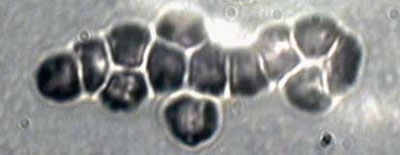
In a paper accepted for publication in Physical Review E, the researchers describe how the effect is probably caused by the response of red blood cells. These iron-rich cells are the most common type of blood cell and they play the leading role in transporting oxygen around the body. In the presence of a strong magnetic field, the red blood cells form chains that align themselves with the field lines where convoys of red blood cells line up behind a leading cell. This process could enable the cells to pass through the blood in a more streamlined fashion, thus reducing the blood's viscosity.

Towards clinical trials

Tao says that patients can safely be exposed to magnetic fields of up to 3 T. He intends to develop the work further by testing blood flow under a magnetic field in capillary tubes that are similar in size to blood vessels. He also plans to apply for a research grant from the US National Institutes of Health to allow clinical trials to be carried out.

Kalvis Jansons, a mathematician at University College London, believes that the researchers may be onto something "very interesting". "If the effect really does exist, it would appear to me that it would not be difficult to use it in a clinical setting," he says. But he also believes that a lot of work would need to be done to show that the process is safe. "Could it lead to blood clots, for example?" he asks.

Giacinto Scoles, a materials scientist at Princeton University who develops medical applications, believes there is a "tremendous thirst" in the medical community for this kind of physics-based innovation. "I believe the work has raised a lot of interesting questions and that a new field of investigation has been opened up," he says.

But the medical community will still need to be convinced about the need for the new technology and about its safety. Tammy Ustet, a medical doctor who carries out rheumatology research at the University of Chicago, believes that the main focus should remain tackling the causes of vascular conditions. "Treating symptoms is extremely important, but treating the root cause is the best way to relieve symptoms," she says.

The battle to find Maxwell's perfect image

To make a perfect lens – one that produces images at unlimited resolution – you need a very special material that exhibits "negative refraction". Or so researchers had thought.

Now scientists in the UK and Singapore have published experimental evidence that shows perfect lenses don't need negative refraction at all – and that a simpler solution lies in a 150 year-old design pioneered by James Maxwell. If true, the discovery could be a goldmine for the computer-chip industry, allowing electronic circuits to be made far more complex than those of today. However, the work is proving so controversial that the lead scientist has become embroiled in a fiery debate with other experts in the field.

The route to perfection

Until the turn of the century, perfect imaging was thought impossible. Light diffracts around features the same size as its wavelength, which should make it impossible for a lens to resolve details that are any smaller.

But in 2000 John Pendry of Imperial College London found a way to beat this "diffraction limit". He understood that, in addition to the light captured by normal lenses, an object always emits "near field" light that decays rapidly with distance. Near-field light conveys all an object's details, even those smaller than a wavelength, but no-one knew how to capture it.

Pendry's answer was negative refraction, a phenomenon that bends light in the opposite direction to a normal substance like glass. If someone could make such a negative-index material, he said, it would be able to reign in an object's near-field light, producing a perfect image.

It was a controversial prediction, but in 2004 researchers at the University of Toronto proved the sceptics wrong by creating a negative-index material and using it to focus radio waves beyond the diffraction limit. And that might have been where the story ended, except that negative-index lenses ultimately proved to be impractical for many applications. They absorb a lot of light, and only work within a wavelength's distance of the object.

Maxwell's fisheye

In 2009 Ulf Leonhardt of St Andrews University in the UK realized there may be another way forward. He had been examining a flat "fisheye" lens, first conceived by Maxwell in the mid 19th century, in which a unique refractive-index profile forces light rays to travel in circles, as though they were hugging the surface of an invisible sphere. Indeed, light rays emitted from an object anywhere on the flat surface would always meet at a point precisely opposite.

Leonhardt solved the standard equations of light propagation for the fisheye and came to a remarkable conclusion: all light, including the near field, is refocused at the image point as though it were travelling backwards in time to the source. In other words, said Leonhardt, the image would be the object's exact, perfect, replica.

The fisheye did have a slight problem. For one half of the lens, the change in refractive index implied light would have to travel faster than it does in a vacuum – a known impossibility. Leonhardt's solution again played on the symmetry: replace that half with a mirror, he said, so the semicircles of light on that side are simply reflected from the other.

But like Pendry's nine years before, the prediction met fast resistance. Within two months, Richard Blaikie of the University of Canterbury in New Zealand published a response claiming that any enhanced focusing would not be intrinsic to the fisheye, but an artefact left by having a "drain" where the image is. "An everyday example I can think about is a lightning rod, which concentrates electric fields around its sharp tip," says Blaikie. "Leonhardt and others somehow confuse this natural (and very well understood) field concentration with imaging."

A perfect illusion?

The drain, which is essentially a detector, was mentioned as a requirement in Leonhardt's paper. Yet he admits that he wasn't initially aware of its role – that it captures the image before the light continues on its circular track back to the source. "It turns out that perfect imaging is only possible when the image is detected; the perfect image appears, but only if one looks...Purists may call it an artefact, but if the 'artefact' creates a perfect image, it's a useful feature."

Others, including Pendry, were not convinced: at least five other papers have been published arguing against Leonhardt's prediction. However, in a paper published today in the New Journal of Physics, Leonhardt and colleagues from St Andrews and the National University of Singapore claim "unambiguous" proof that they have beaten the diffraction limit with the fisheye for microwaves.

In its experiment, Leonhardt's group forms the fisheye's varying refractive index profile with concentric rings of copper, surrounded by a mirror. Microwaves enter on one side from a pair of cables just one-fifth of a wavelength apart, and travel across the rings to a bank of 10 cables, functioning as drains (see "Leonhardt's fisheye").

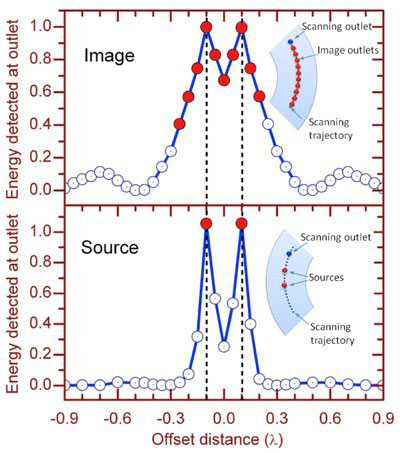
Crucially, the researchers show that the signal arriving at the bank is not smoothed out over all the cables, as would be the case in a normal, diffraction-limited lens. Instead, only those two drains precisely opposite the two cables register strong signals (see "Perfect evidence?"). For Leonhardt, this is proof of imaging beyond the diffraction limit, and the basis of a perfect lens. "The behaviour cannot be explained as an artefact of the drains," he adds, "because otherwise all 10 drains would register intensity spikes."

Clone wars

Yet despite this demonstration, all authors of the original arguments against Leonhardt's prediction told physicsworld.com that they are not convinced. Pendry believes the lens works only when the drains are a "clone" of the source, so that the near-field light is tricked into reappearing. "If the clone is removed, resolution degrades and is limited by wavelength as in a normal lens," he says. The need of a clone would make the lens useless for imaging features that are too small to see.

Leonhardt disagrees. His drain cables were half the length of the source cables, so were not clones, he says. Indeed, he believes that it would be possible to repeat the experiment for visible light, with photographic film recording the perfect image. And he has supporters: Matti Lassas, a mathematician at the University of Helsinki, Finland, thinks Leonhardt has answered his critics' arguments convincingly. The ideas are "true breakthroughs in transformation optics", Lassas says.

"It will take time and more experiments," says Leonhardt, "but I'm sure in the end even the most hard-nosed critics will be convinced that it works. Maybe they need to see a perfect photograph of fine structures that are otherwise impossible to see. Seeing is believing, but then it will be too late for the sceptics to be ahead of the game."

How to walk through walls

Imagine being able to walk through a solid wall. That sort of trick might sound far-fetched, but it’s a little closer to reality now that researchers in China have created what they call an “invisible gateway”.

Huanyang Chen at Soochow University, Jiangsu, says that the effect is a bit like “platform nine and three-quarters” – that is, the fictional area of King’s Cross railway station in the Harry Potter books that is only accessible through a secret, illusionary wall. Although the researchers’ current demonstration is based on an electrical circuit for radio waves, Chen claims that it could also work for visible light.

The idea for the invisible gateway stems from so-called transformation optics, which gave us the first invisibility cloak back in 2006. Yet the invisible gateway is almost the opposite of a cloak: rather than bend light round an object to make the object invisible, the device makes an object – a wall – appear that isn’t really there. It is, according to Chen’s group, the first demonstration of illusion optics.

Network of capacitors and inductors

Chen, whose colleagues are based at the Chinese Academy of Sciences, Beijing, and the Hong Kong University of Science, created the invisible gateway using a network of capacitors and inductors. The network forms a channel that separates two electric conductors – the walls – one of which contains a slab of material with a negative index of permittivity and refraction. The combination of these two materials allows collective waves of electron, called plasmons, to form on the surface. The plasmons prevent electromagnetic waves from passing through the channel. To an observer, the channel looks like a continuation of the walls – so long as they are looking at electromagnetic radiation between 45 and 60 MHz.

Tom Driscoll, a researcher who studies novel electromagnetic devices at the University of California, San Diego, calls the demonstration a “good step”, although he notes that the progression to devices that work with visible light and at human scales are “decades or more away”. “The total sample size is quite small compared with the wavelength used, so I would like to have seen a bigger example,” he says. “However, this does demonstrate that the principle works.”

Martin McCall, a theoretical physicist at Imperial College, London, also thinks that the invisible gateway is an interesting development. “It's a viable addition to the pile of interesting electromagnetic structures being produced,” he says.

Chen and colleagues’ invisibility gateway is one of many ideas to have been realised used transformation optics in recent years. Last year, groups at Cornell University and the University of California at Berkeley independently created 2D cloaks that operated at optical wavelengths. Earlier this year, a team at the Karlsruhe Institute of Technology in Germany went one step further to produce a 3D optical cloak.

In 2008, Chen’s group proposed what might be the next step on these lines – a device that can cloak objects at a distance.

The research is available in Phys. Rev. Lett. 105, 233906

Measuring the Magnetism of Light

Light is a wave of both electric and magnetic fields, but when these waves strike matter, the weaker effect of the magnetic component has been nearly impossible to detect directly. Now two groups have independently demonstrated that a tiny, metallic probe will interact strongly with the magnetic field of light waves trapped in a sort of semiconductor "box." As described in a pair of papers in the 17 September Physical Review Letters, a similar set-up could be used either to measure the high frequency magnetic properties of individual nano-scale objects, or to map the magnetic field inside so-called metamaterials that can control light in new ways.

When light interacts with matter, the dominant action is often a "shaking" up and down of electrons in response to the electric field. This interaction is typically 10,000 times larger than the "swirling" action from a light wave's magnetic field. The case is different in metamaterials, which contain small components like metal rings that are often tailored to have an enhanced response to magnetic fields. Thanks to this sensitivity, light traveling through a metamaterial can bend in unusual ways, making feasible such devices as super-lenses and invisibility cloaks.

Previously, researchers could measure the magnetic interaction between light and some form of matter only by subtracting the dominant electric interaction from the total effect of the light. Now two experimental groups have managed to directly isolate the magnetic field effect. They worked with a type of 2-dimensional device called a photonic crystal microcavity. The crystal is fabricated by perforating a thin layer of semiconductor with a pattern of tiny holes, like a micron-sized punch card. The cavity is made by leaving a small region "un-punched" and letting the surrounding lattice of holes act like mirrored walls that keep infrared light bouncing around in the cavity as standing waves.

In the last few years, researchers have been characterizing the trapped light in photonic cavities by bringing the tip of a needle-shaped optical fiber within nanometers of the surface. This probe perturbs the electric field and shifts the trapped light to longer wavelengths. The new experiments used a fiber tip coated with a thin layer of aluminum that covers all but the very bottom of the tip. This "tube" of metal acts like a ring a few hundred nanometers across.

Both research teams were at first surprised to find that these metal rings caused a blue-shift in the trapped light. But later they realized that according to classical electrodynamics, the light's oscillating magnetic field induces a current in the tip's metallic ring, which creates a secondary magnetic field that points in the opposite direction to the original. This field cancels out some of the magnetic field in the cavity and thereby reduces the volume for the trapped light. Less volume means shorter, bluer wavelengths. "It's like playing guitar," says Tobias Kampfrath of the FOM Institute for Atomic and Molecular Physics (AMOLF) in Amsterdam. "If you make the guitar strings shorter, the resonant wavelengths will shorten as well."

A team including Kampfrath, AMOLF's Kobus Kuipers, and others, was able to measure a blue-shift of about 0.03 percent with their cavity and probe. They combined this with an estimate for the cavity's maximum magnetic field to obtain the magnetic properties of their nano-sized ring. The results matched theoretical expectations, so the authors suggest this method could be used to measure the magnetic response of other small objects, such as carbon nanotubes or even single atoms. They also recently performed a variant on this experiment, in which they used a tip with an open ring to probe the magnetic field of propagating (untrapped) light.

The other group's experiment was similar, except that they gleaned different information from the magnetic interaction. Instead of measuring the ring's properties, Silvia Vignolini, now at the University of Cambridge, Diederik Wiersma of the European Laboratory for Non-linear Spectroscopy (LENS) in Florence, Italy, and their collaborators, scanned their metal-coated tip over the photonic crystal surface to construct an image showing the spatial patterns of the magnetic field.

"The imaging itself is nice," says Claus Ropers, of the University of Göttingen in Germany, "but the real breakthrough of these works lies in the quantitative extraction and potential control over local magnetic interactions and coupling strengths." Harald Giessen of the University of Stuttgart compares the experiments to the late 19th century work of Heinrich Hertz, who used a ring-shaped antenna to map the magnetic fields of radio waves. Giessen believes these new probing techniques will prove useful in the fabrication of novel optical devices.

لینک منبع

نیروهای طبیعت

تا کنون تنها چهار نوع از میدانهای نیرو کشف شده اند: گرانش، الکترومغناطیسی، نیروی هسته ای قوی و ضعیف. که هر یک ذرات خاص خود را دارند: به ترتیب گراویتونها، فوتونها، گلئونها و بوزونهای Z و W. هر نوع نیرو مطابق با نوعی پرتو است. هر چند دوتا از آن پرتوها، پرتو گرانشی و الکترومغناطیسی در فاصله ای بسیار بزرگتر از ابعاد هسته اتمی انتشار می یابند. در هر مرحله، ذره، پرتو یا نیروهای زمینه ای مختلف از وجود فیزیکی مربوطه را بازگو می کنند.

گرانش ساده ترین نیروست و برای جفت شدن فقط به حضور انرژی نیاز دارد. بنابراین گرانش صورتهای انرژی را به صورتهای دیگر تبدیل می کند (این شامل هر دو میدان نیرو و ماده می گردد). هر ذره از هر نوعی که باشد، به این دلیل که برای وجود باید انرژی منتقل کند ، یک نیروی گرانشی احساس می کند. این نیرو برای تمامی شکلها ماده ، به صورت گرانی است. نیروی گرانشی، تمایل به حرکت دادن اجسام به سوی یکدیگر دارد ـ تا کنون هیچ نوع گرانش منفی مشاهده نشده است. اگر چه در برخی حالتها از نظر فیزیکی امکان پذیر است و چنین به نظر میرسد که به صورت بحرانی در آغاز انفجار بزرگ با اهمیت بوده است. در نهایت باید گفت که این نیرو دارای بعد طولانی است. مهم نیست که اجسام چقدر از هم فاصله دارند، گرانش آنها را با هم جفت میکند. به همین دلیل گرانش مهمترین نیرو در میان اجسام بسیار بزرگ است. که حتی در میان خورشید و سیاراتش و همچنین در داخل کهکشانها، این نیرو وجود دارد؛ و همچنین، گرانش انبساط جهان را نیز تحت کنترل خویش دارد. گرانش نخستین نیرو با یک رابطه دقیق ریاضی بود ؛ قانون جهانی گرانش نیوتن نشان داد که همان نیرو (گرانی) سقوط سیب به سطح زمین، سقوط دائمی ماه و سقوط سیارات در مدارشان را تحت کنترل دارد. پرتو گرانش ، یعنی امواج گرانشی به صورت مستقیم کشف نشده اند، هر چند که انرژی از دست رفته آن به صورت غیر مستقیم اندازه گیری می شود.

الکترومغناطیسی نیرویی است پیچیده تر از گرانش؛ به منظور جفت شدن با این نیرو ، به بار الکتریکی نیاز است. بر خلاف انرژی که تمام ذرات دارای آن هستند، بار الکتریکی خصوصیتی است که برخی از ذرات دارند و بقیه فاقد آن می باشند. از آنجا که برخی از انواع ماده از نظر الکتریکی خنثی هستند، هیچ نیروی الکتریکی را احساس نمی کنند. همچنین بار الکتریکی با دو علامت مثبت و منفی ظاهر می شود که اگر هر دو از نظر عددی به یک اندازه باشند ، یکدیگر را خنثی می کنند. نیروی الکتریکی میان ذرات می تواند از نوع گرانی باشد (برای بارهای مخالف) یا از نوع دافعه باشد (برای بارهای موافق). نیروهای مغناطیسی که همانند نیروهای الکتریکی در نهاد و وجود اجسام قرار دارند، اگر دارای حرکت بارها باشند، زیاد می شوند. همانند جریان الکتریکی منظم در داخل یک سیم پیچ یا اتمهایی که در سوزن یک قطب نما، در یک راستا قرار گرفته اند. نیروهای الکترومغناطیسی همانند گرانشی، در فواصل زیاد عمل می کنند. میدانهای الکترومغناطیسی بر روی بادهای خورشیدی و پرتوهای کیهانی [و آب و هوای زمین] تاثیر می گذارند. آنها در بین کهکشانها گسترش می یابند ، شکل گیری ستارگان را کنترل می کنند و اصل و خاستگاه اصلی انرژی از سیاهچاله ها را کاتالیزه می نمایند. تمامی نوری که شامل پرتوها از رادیو موج در میان نور مرئی تا اشعه ایکس است ، از جنبش میدانهای الکترومغناطیسی تشکیل شده است. واقعیت شگفت آوری که در قرن نوزدهم صریحا ً توضیح داده شد ، همین مورد بود. تمام اختلافات آشکار میان انواع گوناگون پرتوها تنها از چگونگی سریع یا کند جنبیدن الکترونها ، فرکانس و یا طول موج نور نشات می گیرند. باید توجه کرد که نور در ذات خود از نظر الکتریکی باردار نیست و فقط با بار الکتریکی جفت می شود. نور از همان میدانهای الکترومغناطیسی شکل یافته است که عقربه قطب نما را می گردانند و موهای سر شما را به صورت ایستاده نگه میدارند. همین حضور و حرکت اجسامی که بار الکتریکی دارند، این میدانها را ایجاد می کند. الکترومغناطیس به همراه قوانین مکانیک کوانتومی، ساختار ابرهای الکترونی که بیشتر توده های اتمی را در مواد معمولی بوجود آورده اند، مشخص می کند. این نیرو همچنین رفتار شیمیایی تمام اتمها و مولکولها و چیزهایی را که ما از آنها درست شده ایم تحت کنترل خود دارد.

نیروی قوی که همچنین نیروی «رنگ دینامیکی» نیز نامیده میشود، از نظر ریاضی پیچیده ترین نیروهاست. اگر چه این نیرو، اعتبار مهمی برای ساختن ماده دارد، در زندگی روزمره به طور مستقیم و واضح درک نمی شود. نیروی قوی بر خلاف بار الکتریکی منفرد، با یک «بار قوی» مرکب و پیچیده که «رنگ» نامیده میشود، جفت می گردد و در سه نوع مختلف می باشد: R (قرمز) G (سبز) و B (آبی). این بارها می توانند در یک ذره منفرد با یکدیگر ترکیب شوند و نیرو به این ترکیب بستگی دارد. نیروهای قوی می توانند از نوع جاذبه یا دافعه باشند. آنها حتی می توانند یک جانبه باشند. در بعضی جهات اغلب توام و در برخی جهات دیگر جدا از هم هستند. نظر به اینکه تنها یک فوتون وجود دارد (و آن یک نوع پرتو الکترومغناطیسی است) ، رنگهای مختلف تنها در بسامد با هم اختلاف دارند. هشت نوع متمایز از گلئونها نیروی قوی را تشکیل می دهند، هشت نوع مختلف از «نور قوی» بر خلاف فوتونها. گلئونها خودشان بارهای رنگی را که با آنها جفت شده اند ، حمل می کنند. به دلیل اینکه فوتونها از نظر الکتریکی خنثی هستند، دو پرتو نور به راحتی از میان یکدیگر عبور می کنند. نور هرگز از خود روشنایی ساطع نمی کند و تنها ماده می تواند این کار را انجام دهد. ولی گلئونها از نشر دیگر گلئونها به دست می آیند و خود همیشه گلئونهای دیگری را منتشر می سازند. این «خود واکنشی»، نیروهای گلئونی موثری را در یک محدوده کوچک به وجود می آورند. آنها هیچ گاه از هم دور نمی شوند و به فواصل دور نمی روند. نیروهای قوی همیشه به خنثی کردن یکدیگر اقدام می کنند. این نیرو تنها در فواصل کوچک و انرژی ذره ای بالا عمل می کنند. این نیرو اندازه ها و اشکال هسته اتمها و اجتماعات کوچک نوترونها و پروتونها (نوکلئونها) در مرکز اتمها را کنترل می کند. هسته اتم بیشتر جرم اتم را شامل می شود؛ در واقع بیشتر جرم، از انرژی گلو ئونیک درست شده است. این مطلب غیر منتظره به نظر می رسد که ما گلوئونها ـ را که ماده نیستند و نیرو می باشند ـ به عنوان تشکیل دهنده بیشتر جرم اجسام تلقی کنیم. ذهن ما چقدر آرامش می باید که مرزهای ناشناخته طبیعت را بپذیرد!! نیروی قوی مشخص می کند که هسته کدامین اتمها در طبیعت به طور پایدار وجود دارند و کدام عناصر شیمیایی می توانند وجود داشته باشند.

نیروی ضعیف، با بار پیچیده و به خصوصی جفت می شود که « هم اسپین» ضعیف نام دارد. این نام پس از مشاهده رفتار یک اسپین وابسته به ریاضی برگزیده شد. بر خلاف گراویتونها ، فوتونها و گلئونها و بوزونهای W و Z که نیروی ضعیف را منتقل می کنند، جرم دارند که به این نیرو یک برد بسیار کوتاهی می دهد. در واقع آنقدر کوتاه که واکنشهای ضعیف کاملا ً به ندرت اتفاق می افتند و پرتو تولید شده از ذرات Wو Z حتی نمی توانند به اندازه کافی حرکت کنند تا از یک هسته اتمی بگذرند. اگر چه نیروی ضعیف، ظریف و کند است، بسیار حائز اهمیت می باشد ؛ چرا که ذرات را در میان اشکال مختلف و تقریبا ً پایدار تغییر شکل می دهد (به عنوان مثال از نوترون به پروتون). این گونه نابودی ، ترکیب هسته را تغییر می دهد و یک عنصر را بع دیگری متحول می گرداند؛ پرتوزایی تریتیوم که به عقربه های ساعت نیرو و توان می دهد ، در حال نابودی از یک شکل هیدروژن سنگین به یک ایزوتوپ سبکتر هلیوم می باشد.

شباهتهایی که در میان صفات این نیروها به چشم میخورد، شاید یک عمومیت ژرفتری از آن چیزی را که تحت الشعاع خود دارند، منعکس کنند. در سطحی فراتر از دانش، تمامی نیروها ممکن است در نهایت به عنوان صورتهای مختلف یک نیروی واحد و منفرد شناخته شوند. در واقع مثل همان ارتباطی که پیش از میان نیروی الکترومغناطیسی و نیروی ضعیف ظاهر گردید و هر دو بعنوان نیروی « الکتروضعیف» با هم متحد شدند. تقارن بنیادین میان این نیروها هم اکنون بعلت پدیده ای که «شکست تقارن اسپوتانئوس» نامیده می شود، قابل مشاهده است که مجموعه میدانها را وادار به قرار گرفتن در سطح کمترین انرژی هدایت می کند که این سطح تقارن میان نیروها را رعایت نمی کند. در چنین وضعیتی ، برخی از میدانهای الکتروضعیف شبیه به فوتونها و میدانهای دیگر همانند بوزونهای سنگین Wو Z هستند. فرآیند فرعی مورد علاقه در طی این شکست تقارن این است که به ذرات جرم سکون می بخشد که در غیر اینصورت، بی جرم خواهند بود؛ همانند الکترون. هم اینک نظریه های زیادی برای وحدت و یگانگی با شکوه تر نیروها وجود دارند. نظریه های عمده وحدت، متوجه اتحاد میان نیروهای قوی و الکتروضعیف بوسیله همان طرح رایج برای یگانگی الکتروضعیف هستند. به نظر می رسد که وحدت با نیروی گرانش خیلی مشکلتر باشد و شاید مستلزم اتحاد نیروها با ماده باشد. در واقع این برای نیرویی مناسب است که با تمامی صورتهای انرژی جفت گردد.