هیگز بوزون چیست و چرا مهم است؟

با اینکه جهان علم انتظار تأیید کشف احتمالی ذره هیگز بوزون را می‌کشد، هنوز پرسش‌های زیادی راجع به اینکه اصلاً این ذره چیست، چرا سخت‌کوشانه در پی کشف‌اش افتاده‌ایم و چرا تا به این حد احتیاط می‌کنیم، از گوشه و کنار به گوش می‌خورد. این مقاله، پاسخی به همین پرسش‌هاست.

نخست پاسخ کوتاه
 
اگر هیگز بوزون کشف شود، احتمالاً یکی از گسترده‌ترین فتوحات خرد انسانی در حافظه اخیر تاریخی‌مان رقم خورده است، چراکه توجیهی برای ارائه یکی از بزرگ‌ترین نظریات دنیای علم و همچنین احداث پیچیده‌ترین ماشین تولیدشده به‌دست بشر است. پس خبر خیلی خوبی است. اما اگر هیگز بوزون همه آن چیزی باشد که در "ابرتصادم‌گر هادرونی" (LHC) پیدا شود، آن‌وقت هنوز چیزهای زیادی برای یافتن باقی است. رهنمود عملی و تعیین‌کننده‌ای که فیزیکدانان برای فهم پرسش‌های اساسی‌مان راجع به هستی- اعم از اینکه آیا چهار نیروی بنیادین طبیعت را می‌توان به‌طریقی برای توجیه علت مهبانگ (یا همان Big Bang) با هم متحد کرد- هنوز در هاله‌ای از ابهام است. پاسخ بدین پرسش‌ها را شاید اصلاً بایستی در آن‌سوی امکانات فناورانه و مالی نسل انسان‌های کنونی یافت.
 
حالا پاسخ مشروح
 
اگر معلوم شود که ایده‌های‌مان راجع به ذره هیگز بوزون، درست و بی‌نقص بوده، آن‌وقت هرآنچه در جهان‌ می‌بینیم، همانند یک ویترین پر زرق و برق و مستقر بر بافتی از حقیقت است که ما نبایستی به طور مستقیم در آن وجود داشته باشیم. ذراتی که ما را ساخته- تا پس از پیوستن به‌ یکدیگر، ذراتی همچون پروتون‌ها، نوترون‌ها، هسته‌های اتمی و در نهایت اتم‌ها را به وجود آورند- همگی صاحب جرم هستند. در فقدان ذره هیگز، این ذرات هم مثل فوتون‌ها (که ذرات سازنده نور باشند) فاقد جرم می‌شوند.
 
ما بر اساس تجربیات شخصی‌مان، از وزن اشیاء در نسبت با محیطی که در آن واقع شده‌اند، اطلاع داریم. مثلاً اشیائی که روی زمین سنگین‌اند، در آب سبک‌تر می‌شوند و به‌همین نحو، اگر قاشقی را درون عسل بگردانید، انگاری سنگین‌تر از زمانی شده که آن را در هوا می‌چرخانده‌اید. طبق مدل استاندارد ذرات بنیادی، یک "میدان هیگز"ی وجود دارد که در سرتاسر فضا ریشه دوانده است. این میدان، در سطوح مختلفی با ذرات واکنش نشان می‌دهد. آن ذره‌هایی که بیشتر واکنش می‌دهند، مقاومت بیشتری هم نسبت به حرکت از خود نشان می‌دهند و سنگین‌تر به‌نظر می‌رسند. آن‌هایی هم که مثل فوتون‌ها اصلاً واکنشی به این میدان نشان نمی‌دهند، اصلاً فاقد جرم می‌مانند. پس بدین‌ترتیب جرم هر چیزی با وجود این میدان معنا می‌یابد و جرم، انعکاسی از اوضاع پیرامونی ماست، چراکه ما در جهانی به سر می‌بریم که میدان هیگز، خود از آن نشئت گرفته است.
دیگر اما چه نیازی به "ذره" هیگز بوزون است؟ نظریه نسبیت خاص به ما گفته که هیچ اطلاعاتی نمی‌تواند سریع‌تر از نور جابه‌جا شود. اگر این فرض را در چارچوب مکانیک کوانتومی تفسیر کنیم، آن‌وفت همه نیروهایی که ما گمان می‌کنیم از یک میدان سرچشمه گرفته‌اند (همچون گرانش و الکترومغناطیس)، در واقع از طریق مبادله ذرات زیراتمی انتقال پیدا کرده‌اند. انتقال این ذرات هم کمی مثل بازی دستش دِه است: اگر من توپی را بیاندازم و شما بگیریدش، در واقع من با پرتاب توپ اندکی به پشت خم شده بودم و شما هم با مهار آن اندکی به پشت خم می‌شوید. پس مثل این می‌ماند که هر دوی‌مان خود را دفع کرده‌ایم. با این‌حساب اگر میدان هیگز وجود داشته باشد، حتماً ذره‌ای مربوط به چنین میدانی هم وجود دارد و این، همان ذره هیگز بوزون است. البته این چیزی شبیه به یک خیال‌پردازی است و چندان با تصور فرشته‌‌‌هایی که روی سر یک سوزن نشسته‌اند، فرقی نمی‌کند، اما چه چیزی فیزیکدانان را به ارائه چنین فرضیه‌ای واداشته است؟
یکی از بزرگ‌ترین دستاوردهای فیزیکی پنجاه سال گذشته، یگانه‌سازی دو نیروی طبیعت بود: الکترومغناطیس و نیروی ضعیف هسته‌ای. در نظریه "الکتروضعیف"، نیروی الکترومغناطیس از طریق مبادله دوربرد فوتون‌های فاقد جرم انتقال پیدا می‌کند، و نیروی کوتاه‌برد ضعیف هسته‌ای هم محصول مبادله ذرات به نسبت سنگینی موسوم به W و Z بوزون‌هاست. این ذرات در دهه ۶۰ میلادی پیش‌بینی و در دهه ۸۰ هم در مرکز تحقیقات هسته‌ای اروپا (CERN)، که هم‌اکنون میزبان LHC است، پیدا شدند. برای اینکه این یگانگی نظری، از حیث ریاضیاتی هم مورد قبول واقع شود، تمامی این سه ذره بایستی فاقد جرم باشند و لذا نیروهایی هم را که سبب آن می‌شوند، ویژگی‌های تقریباً یکسانی ببخشند. تنها در صورتی‌که W و Zبوزون‌ها در واکنش با یک میدان پس‌زمینه- که همان میدان هیگز باشد- صاحب جرم شوند، از حیث نظری می‌توان دلیل اختلاف‌های ظاهری این دو نیرو را، دست‌کم در مقیاس‌هایی که ما هم‌اکنون توان اندازه‌گیری‌شان را داریم، در عین شباهت ریاضیاتی‌شان توجیه کرد.
 
خیاط، در لبالب کوزه
 
بر اساس نظریات فعلی، جرم ذره هیگز بایستی در حدود یکصد برابر جرم پروتون باشد، هرچند که مقدار دقیق آن مشخص نیست. طی بالغ بر ۲۵ سالی که از کشف W و Z بوزون‌ها می‌گذرد، فیزیکدانان تجربی در تلاش برای راه‌اندازی شتاب‌دهنده‌هایی برآمده بودند که انرژی کافی برای تولید یک ذره هیگز را (در صورت وجود)، داشته باشد. شتاب‌دهنده "تواترون" در آزمایشگاه فرمی‌لب آمریکا، توان تولید ذره‌هایی با جرم حداکثر ۱۲۰ برابر پروتون را داشت (که می‌شود در حدود ۱۲۰ گیگاالکترون‌ولت)، اما موفق به شکار هیگز بوزون نشد. شتاب‌دهنده LHC، با هدف کنکاش در محدوه‌های جرمی ِ فراتر از این ساخته شد. اگر جرم ذره هیگز، طبق شایعات کنونی، در حدود ۱۲۵ گیگالکترون‌ولت باشد، آن‌وقت این ذره به خرمهره درک فعلی‌مان، هم از نظریه وحدت‌یافته الکتروضعیف و هم از خاستگاه ما و تقریباً تمام جرمی خواهد شد که در این جهان قادر به محاسبه‌اش هستیم.
 
همه‌چیز، هیگز بوزون نیست
 
البته تمام ماجرا هم اینگونه گل و بلبل نیست. مدل استاندارد، هیچگونه توضیحی راجع به ماهیت جرم ذره هیگز و W و Z بوزون‌ها نمی‌دهد. در واقع برخی بر این عقیده‌اند که برای توضیح اینکه چرا عوامل کوانتومکانیکی، مانع از این می‌شوند که جرم ذرات مزبور از این مقدار بیشتر باشد، به نظریات سراسر جدیدی نیاز است. یکی از هیجان‌انگیزترین روش‌هایی که با کمکش می‌توان دست به محک چنین محدودیت‌هایی زد، نظریه "ابرتقارن" است. اگر ابرتقارن راست باشد، جمعیت ذرات بنیادی دوبرابر خواهد شد، و ما نه فقط به یک ذره هیگز که به دوتایش نیازمندیم. این درست همان چیزی است که خیلی از فیزیکدانان انتظار کشف آن را می‌کشند. شایعاتی که از CERN درز کرده، نشان از وجود ذره‌ای با جرم حدوداً ۱۴۰ گیگاالکترون‌ولت هم می‌دهد.
 
از آنجایی‌که ابرتقارن، جزو لاینفک مدل‌های به مراتب بحث‌برانگیزتر نظریه ریسمان به شمار می‌رود که خود نظریه‌ای برای یگانگی گرانش و مکانیک کوانتومی‌ست، هنوز دلایلی هست که برخی نظریه‌پردازان امیدشان را به کشف دو ذره هیگز، و یا حتی ذرات پیش‌بینی‌نشده بیشتر از دست ندهند. اگر فقط یک ذره هیگز درLHC پیدا شود، آن‌وقت اوضاع به‌هم می‌ریزد و این احتمالاً بدترین امکانی است که ما نظریه‌پردازان توان تصورش را داریم. ما به‌همان نحوی به اطلاع‌تان رسانده‌اند، منشأ جرم جهان را به‌زودی پیدا خواهیم کرد، اما رهنمود تجربی جدیدی در اختیارمان نیست تا قدم بعدی را به پیش برداریم.
 

آزمایش‌های اطلس و سی.ام.اس. وضعیت جست‌وجوی هیگز را شرح دادند

در سمیناری که روز سیزدهم دسامبر ٢٠١١ در سرن برگزار شد آزمایش های اطلس و سی.ام.اس. وضعیت فعلی‌ی جست‌وجویشان برای بوزون هیگز را ارائه کردند. در حالی که نتایج آنها بر اساس داده‌ها‌ئی به مراتب بیشتر از آن‌چه است که در هم‌آیش‌ها‌ی تابستان در دست‌رس بود مقدار این داده‌ها هنوز آن قدر نیست که بتوان با قطعیت در باره‌ی وجود یا عدم وجود ذره‌ی هیگز اظهار‌نظر کرد. نتیجه‌ی اصلی‌ این است که اگر بوزون هیگز وجود داشته باشد محتمل‌ترین مقدار برای جرمش بر اساس داده‌های آزمایش اطلس باید بین ١١٦ و ١٣٠ و بر اساس داده‌های سی.ام.اس. بین ١١٥ و ١٢٧ گیگاالکترون‌ولت باشد. هر دو آزمایش نشانه‌ها‌ی امیدوار‌کننده‌ئی از وجود بوزون هیگز در این نواحی دیده‌اند اما این نشانه‌ها هنوز آن قدر قوی نیست که بتوان ادعا کرد بوزون هیگز مشاهده شده است. ذره‌ی هیگز اگر وجود داشته باشد عمر بسیار کوتاه خواهد داشت و از راه‌های بسیار وامی‌پاشد و کشف آن فقط بر اساس مشاهده‌ی ذرات حاصل از واپاشی‌ی آن میسر است. هر دو آزمایش اطلس و سی.ام.اس. در ناحیه‌های کم‌جرمی که ذکر شد شمار افزون‌بر‌انتظاری رخ‌داد مشاهده کرده‌اند

اگر نتایج هر کدام از آزمایش‌ها به‌تنهایی در نظر گرفته شوند هیچ‌کدام از نظر آماری اهمیتی بیشتر از آمدن ِ دو شش ِ پیاپی در دو بار انداختن ِ تاس ندارند اما نکته‌ی جالب چند اندازه‌گیری‌ی مستقل است که در هر دو آزمایش ناحیه‌ی ١٢٤ تا ١٢٦ گیگاالکترون‌ولت را برجسته می‌کنند. هنوز خیلی زود است که بگوییم اطلس یا سی.ام.اس. بوزون هیگز را کشف کرده‌اند اما نتایجی که تا کنون به‌دست آمده توجه جامعه‌ی فیزیک ذرات را بسیار جلب کرده است. فابیولا جانوتی سخن‌گوی آزمایش اطلس می گوید که هنوز به بررسی‌ی داده‌های بیشتر نیاز است و با توجه به عمل‌کرد بسیار عالی‌ی امسالِ ال.اچ.سی. می‌توانیم امیدوار باشیم که در سال ٢٠١٢ تکلیف‌مان معلوم شود.

سخن‌گوی سی.ام.اس. گوییدو تونلی می گوید "نمی‌توانیم وجود هیگز را در ناحیه‌ی ١١٥ تا ١٢٧ گیگاالکترون‌ولت رد کنیم زیرا به‌شکلی کاملاً سازگار در ٥ کانال مستقل رخ‌دادهای افزون بر انتظار مشاهده شده است. این رخ‌دادها بیش از همه با جرمی حدود ١٢٤ گیگاالکترون‌ولت یا کم‌تر در مدل استاندارد سازگار است اما اهمیت آماری‌ی آنها آن‌قدر نیست که بتوانیم با قطعیت ادعا‌ئی کنیم. آن چه تا کنون دیده‌ایم هم با افت‌و‌خیز آماری سازگار است و هم با وجود بوزون هیگز. تحلیل‌های ظریف تر و داده‌های بیشتر در ٢٠١٢ آماده خواهد بود زیرا این دستگاه ِ فوق‌العاده عالی حتماً به ما جواب خواهد داد." هر دو آزمایش طی‌ی ماه‌های آینده تحلیل داده‌های خود را دقیق‌تر خواهند کرد و نتایج‌شان را در هم‌آیش‌های فیزیک در ماه مارس ارائه خواهند کرد اما نظری قطعی‌تر برای وجود یا عدم‌وجود ذره‌ی هیگز نیاز به داده‌های بیشتری خواهد داشت که احتمالاً تا سال ٢٠١٢ در دست‌رس نخواهد بود. مدل استاندارد ماده‌ی سازنده‌ی ما و هر آن‌چه را که در عالم به‌چشم می‌آید به‌خوبی توضیح می‌دهد اما ٩٦درصد عالم از جنس دیگری‌ست و تا کنون مشاهده نشده است (ماده‌ی تاریک و انرژی‌ی تاریک). یکی از هدف‌های برنامه‌ی پژوهشی‌ی ال.اچ.اسی. رفتن فراسوی مدل استاندارد است و بوزون هیگز می تواند کلید راه‌گشاینده‌ی این هدف باشد.

کشف بوزون هیگز، تأیید نظریه‌ئی خواهد بود که نخست در دهه‌ی ١٩٦٠ به میان آورده شد اما بوزون هیگز بر اساس نظریه‌های مختلفی که فراسوی مدل استاندارد می‌روند می‌تواند شکل‌های مختلف بگیرد. در مدل استاندارد نیز بوزون هیگز می‌تواند راه را برای رفتن فراسوی مدل استاندارد نشان دهد، اما چنین چیزی فقط با بررسی‌ی ظرافت‌های کانال‌های پرشمار واپاشی‌ی ذره‌ی هیگز میسر خواهد شد. چه نتایج اطلس و سی.ام.اس. در ماه‌های آینده وجود هیگز را تأیید کنند و چه عدم وجود هیگز را، درهائی به روی فیزیک جدید گشوده خواهد شد.

لینک منبع مقاله

Higgs hunters close in on their quarry

The first solid experimental evidence for the existence of the Higgs boson has been unveiled today by physicists working on the Large Hadron Collider (LHC) at CERN in Geneva. Members of the ATLAS experiment revealed evidence that the Higgs particle has a mass of about 126 GeV/c2. Physicists working on the rival CMS experiment released similar – albeit weaker – evidence for a Higgs with a mass of about 124 GeV/c2.  However, ATLAS spokesperson Fabiola Gianotti cautions that the measurements are not good enough yet to claim the discovery of the particle.

Physicists are keen to discover the Higgs boson to complete the Standard Model of particle physics. The particle and its associated field are needed to explain how electroweak symmetry broke just after the Big Bang – which gave certain elementary particles the property of mass. The Standard Model does not, however, actually predict the mass of the Higgs, and successive experimental programmes at CERN's Large Electron–Positron Collider, Fermilab's Tevatron and now the LHC have sought to measure its mass.

If the current glimpse of the Higgs proves to be an illusion, and it – or a similar symmetry-breaking entity – is never found, all would not be lost, as physicists would be forced to concede that the Standard Model is incomplete and to look for "new physics" beyond it.

Evidence versus discovery

The ATLAS measurement was made at a confidence level of about 3.6σ, which means that the measurement could be the result of a random fluke just 0.1% of the time. While these might sound like fantastic odds, particle physicists normally wait until they have a confidence of 5σ or greater before they call it a "discovery". Anything above 3σ is described as "evidence".

There are several reasons why particle physicists require such high confidence levels. One is the "look elsewhere" effect that arises because the data are sorted into mass/energy bins to create a histogram – which could concentrate fluctuations. After the look elsewhere effect is considered in the ATLAS result, the confidence level drops to 2.3σ, according to Gianotti.

Another potential problem is that there could be unknown systematic errors lurking in the experiment that could be responsible for the apparent result, and therefore requiring a very high confidence could help avoiding such errors.

Despite the preliminary results announced at CERN today, unravelling the mystery of the Higgs will take some time. Assuming that the signal at 126 GeV/c2 survives further analysis, the next step for physicists will be to tease out the precise nature of the Higgs they have discovered. According to Matt Strassler of Rutgers University in the US, a mass of about 126 GeV/c2 could indicate many different things. These include a Standard Model Higgs, a Higgs that is best described by theories beyond the Standard Model such as supersymmetry (SUSY), a "little Higgs" or various other theories.

Different reactions

To gain a better understanding of the Higgs, Strassler says that several different reactions that produce the Higgs at the LHC must be studied, as well as several different decay channels of the particle. In particular, physicists must find out how closely the Higgs is described by the Standard Model, which involves studying interactions involving W and Z particles, top and bottom quarks, and tau leptons.

In total, he believes that seven or eight different measurements are required before physicists will have a handle on the Higgs. "Next year we could be in a position to say that we have a particle that's reasonably consistent with the Standard Model," says Strassler. This would allow physicists to eliminate theories – such as technicolor – that do not include the Higgs particle.

"By 2014/2015 we could have enough additional data to eliminate large classes of theories that attempt to explain the Higgs," adds Strassler, although he warns that it could take as long as 10 years to gain a full understanding of the particle.

However, not all physicists believe that the road to understanding the Higgs will be a long one. Gordon Kane of the University of Michigan and colleagues have recently published a preprint on the arXiv server that calculates the mass of the Higgs using string theory – calculations that put the Higgs mass in the 122–129 GeV/c2 range. Kane told physicsworld.com that physics beyond the Standard Model has "jumped out as string theory". "The game is over and we have won – we have landed on the shores of a new world," he adds.  For more information about the search for the Higgs, watch our video with Guido Tonelli, spokesperson for the CMS experiment, and ATLAS researcher Pippa Wells.

Are pulsars giant 'neutromagnets'?

Pulsars are created when a star collapses to form a neutron star in which the magnetic moments of the neutrons are frozen in a particular direction – much like the atomic moments in a permanent magnetic. That is the claim of two physicists in Sweden, who believe that their theory can account for many of the unexplained properties of these astronomical oddities.

First discovered in 1967, pulsars are astronomical objects that emit radiation pulses with astonishing regularity. Astronomers believe pulsars are rapidly rotating neutron stars that have very large magnetic fields. Just like the Earth, the magnetic dipole moment of the star is believed to be offset from its rotational axis. Jets of radiation are emitted from the star along its magnetic poles. Because the star is rotating about a different axis, the jet sweeps round like a lighthouse beam that appears as a regular pulse if it happens to strike Earth.

Beyond this basic description, however, little is known about the physics of pulsars and how they formed. One important question is the origin of the magnetic field, which can range from about 104 to 1011 T. That is huge compared with the Sun's magnetic field, which is about 100 µT. Furthermore, the regular nature of the pulses suggests that a pulsar's magnetic field must be extremely stable. In contrast, the Sun's magnetic field is notoriously unstable because it is generated by the rotation of the star's plasma, which is prone to instabilities.

Nuclear force favours alignment

"There is no good explanation for how the magnetic field is generated," explains Johan Hansson of Lulea University of Technology, who put forward this latest theory with colleague Anna Ponga. Hansson and Ponga suggest that the magnetic moments of all the neutrons in the star point in the same direction in a state of matter called a "neutromagnet". This is similar to the alignment of atomic magnetic moments in a ferromagnetic material. The researchers point out that the nuclear force that binds protons and neutrons together in nuclei favours the alignment of spins – an effect that they say could be enhanced in neutron stars, where neutrons are packed even more tightly together.

Hansson and Ponga assumed that the energy gained by two neutrons by aligning their spins in the same direction is about 10% of the total nuclear binding energy of the pair. This gives a Curie temperature – below which all the neutrons in the star align to become a giant magnet – of about 1010 K.

Because neutron stars all seem to have about the same mass, the maximum magnetic field that could result is about 1012 T. This would occur when all the neutrons are aligned in the same direction. However, just like everyday magnets, it is possible that different regions of the star have domains of neutrons – with each domain pointing in a different direction. This would reduce the overall magnetic field and could explain why some neutron stars have much smaller magnetic fields. According to Hansson, this maximum value of the magnetic field provides astronomers with a simple way of falsifying the theory.

Moment is frozen in

Hansson told physicsworld.com that their model also explains the fixed misalignment between the magnetic moment and the rotational axis of a pulsar. "The orientation of the magnetic field is set by the direction of the star's magnetic field at the moment it collapses to form the neutron star," he explains. "The direction is then 'frozen in' by the nuclear force".

However, not all astronomers are convinced. "I don't claim that the current 'understanding' is complete or free of contradiction – the problem is very hard – but I believe that the concept presented in this paper is not nearly as good as the standard models," says Michael Kramer of the University of Manchester in the UK.

درک بهتر فیزیک رنگین‌کمان‌ها

متخصصان علوم رایانه‌ای دانشگاه کالیفرنیا- سن‌دیه‌گو که قصد شبیه‌سازی تمامی انواع طبیعی رنگین‌کمان را کرده بودند، به پاسخ‌هایی راجع به فرآیند تشکیل این پدیده برخورد کردند. آن‌ها نمونه‌های متنوعی از رنگین‌کمان را به‌کمک روشی پیشرفته‌ در بررسی نحوه برهمکنش پرتوهای نور و قطره‌های آب با ابعاد و اشکال متفاوت، شبیه‌سازی کردند؛ کمان‌های اولیه، کمان‌های ثانویه، رنگین‌کمان‌هایی که به‌هنگام غروب ایجاد می‌شوند و نیز آن‌هایی که در روزهای مه‌آلود و در میان ابرها ظاهر می‌شوند. این رهیافت تازه، حتی به شبیه‌سازی‌های واقع‌گرایانه‌ای از رنگین‌کمان‌های کمیاب و دوقلویی انجامید که گویی از میان نصف شده‌اند.
 
ایمان صادقی، دانشجوی دانشگاه کالیفرنیا سن‌دیه‌گوست که پژوهش‌ مزبور را تحت پروژه دکتری خود در دانشکده مهندسی ژاکوبز و زیر نظر پروفسور هنریک ون ینسن (Henrik Wann Jensen) و با همکاری دانشمندانی از کشورهای اسپانیا، انگلستان و سوئیس به ثمر رسانده که قرار است که ماحصل آن را طی اجلاس ACM با محوریت گرافیک رایانه‌ای، در همین ماه دسامبر ارائه کنند.
 
ینسن می‌گوید: "این کار، چیزی فراتر از گرافیک رایانه‌ای‌ست. تقریباً می‌شود هم‌اکنون گفت که ما درکی به نسبت کامل از نحوه تشکیل رنگین‌کمان‌ها پیدا کرده‌ایم." او کسی نیست که با پیشرفت‌های حوزه گرافیک رایانه‌ای بیگانه باشد، بلکه به‌واسطه انجام پژوهش‌هایی که به بازسازی طبیعی بافت پوستی شخصیت‌های انیمیشن انجامیده بود، جایزه اسکار سال ۲۰۰۴ را از آن خود ساخت.
 
ینسن در برخی از شاهکارهای فنی هالیوود از جمله فیلم "آواتار" جیمز کامرون نیز حضور داشته است. او، صادقی و سایر همکاران‌شان قرار بوده است که به‌منظور درک بهتر نحوه بر هم‌کنش قطرات کروی آب با پرتوهای نوری که به تولید کمان‌های رنگارنگی که به‌هنگام توقف بارندگی در هوای مرطوب و گرمسیری می‌انجامد، دست به شبیه‌سازی‌های انواع مختلفی از رنگین‌کمان‌ها بزنند. امیدشان هم به بهبود روش‌های به‌کاررفته در انیمیشن‌ها و بازی‌های ویدئویی بود.
 
صادقی که هم‌اکنون به‌عنوان مهندس رایانه در بخش گرافیکی شرکت گوگل در سانتا مونیکا مشغول به فعالیت است، می‌گوید: "معمولاً فرصت بررسی چنین پدیده‌هایی را حین کار روی تز دکترای‌تان پیدا نمی‌کنید. رنگین‌کمان‌ها خیلی بیشتر از آن چیزی که به چشم می‌آید قابل توصیف هستند.»
 
این دانشمندان، با شروع فرآیند شبیه‌سازی‌شان متوجه شدند که صرفاً برهم‌کنش ساده نور با قطرات کروی آب، توصیفی قابل قبول از برخی انواع رنگین‌کمان‌ها نظیر رنگین‌کمان‌های دوقلو به دست نمی‌دهد. آن‌ها در جریان پژوهش‌های‌شان متوجه شدند که قطره‌های آب حین سقوط در هوا، تحت تأثیر فشار هوای تحتانی‌شان، از زیر اندکی یخ می‌شوند و شکلی شبیه به همبرگر به خود می‌گیرند.
ینسن و تیم‌اش، این قطره‌های تغییر شکل‌یافته آب را "برگروید" (Burgeroid) می‌نامند. او می‌گوید: "این اصطلاح، آنقدرها هم فنی نیست، ولی مایلیم آن را اینگونه بنامیم." شبیه‌سازی‌هایی که از آن پس بر این برگرویدها، به‌جای قطره‌های طبیعی آب انجام گرفت، پژوهشگران را قادر به تقلید از فرآیند تشکیل گستره‌ای وسیع از انواع رنگین‌کمان‌های طبیعت کرد. صادقی می‌افزاید: "ما اولین گروهی هستیم که روش دقیق شبیه‌سازی رنگین‌کمان‌های دوقلو را ارائه می‌کنیم."
 
ساز و کار اصلی تشکیل رنگین‌کمان، قرن‌ها بود که برملا شده بود: یک پرتو از نور، در فضای درونی یک قطره آب، هم انعکاس و انکسار می‌یابد و تا نزدیکی زاویه خاصی موسوم به "زاویه رنگین‌کمان"، به‌شدت تمرکز می‌یابد. این زاویه برای هر رنگی از نور سفید تفاوت می‌کند و لذا نور خورشید به چندین جزء طیفی‌اش تفکیک می‌شود و رنگ‌هایی را که ما در آسمان می‌بینیم، به هوا می‌پراکند. صادقی می‌گوید: "اختلاف ظاهر رنگین‌کمان‌ها، به‌واسطه ابعاد و شکل قطره‌های باران است."
 
به‌گفته ینسن، عجیب است که هنوز هیچکس به فرآیند فیزیکی دقیق تشکیل رنگین‌کمان‌ها پی نبرده بود. در گذشته، دانشمندان برجسته‌ای نظیر ایزاک نیوتن و ریاضیدان فرانسوی، رنه دکارت، محاسباتی انجام داده و آزمایشاتی را به‌منظور توصیف نحوه تشکیل رنگین‌کمان پیشنهاد کرده بودند، اما امروزه بودجه‌های پژوهشی راجع به رنگین‌کمان‌ها و همچنین کار در این حوزه به‌ندرت به چشم می‌خورد. تلاش‌های ینسن با هدف فهم بهتر فرآیند فیزیکی تشکیل رنگین‌کمان‌ها، پای وی را به کنفرانس "رنگ و نور در طبیعت"، در کالج سن‌ماری شهر سن‌ماری ایالت مریلند آمریکا کشاند. در آنجا وی ایراد سخن کرد و ملاقاتی با فیلیپ لی‌ون (Philip Laven)، متخصص رنگین‌کمان‌ها صورت داد که بعداً از کمک نویسندگان پژوهش وی نیز شد.
 
در اکثر شبیه‌سازی‌هایی که تاکنون راجع به رنگین‌کمان‌ها صورت پذیرفته بود، فرض بر این گرفته می‌شد که قطرات آب، کروی‌اند که به‌گفته لی‌ون، این در خصوص قطرات درشت‌تر صدق نمی‌کند. آن‌ها در این پژوهش، با رویکردی سراسر متفاوت به واکاوی قضیه پرداخته‌اند و مدلی واقع‌گرایانه‌تر از فرآیند دخیل در این پدیده‌ها را ارائه کرده‌اند. وی می‌افزاید: "شبیه‌سازی‌هایی که در این مقاله شرح داده شده‌، نشان از دورنمایی بس بهتر در فهم رنگین‌کمان‌های واقعی می‌دهند. امیدوارم که گام بعدی، استفاده از این روش‌ها برای بررسی سیستمایک رنگین‌کما‌ن‌هایی باشد که محصول قطره‌های غیرکروی آب هستند."
 
ینسن، صادقی، لی‌ون و همکاران‌شان بنا دارند تا یافته‌های خود را در کنفرانس SIGGRAPH که سال میلادی آتی در شهر لس‌آنجلس برگزار می‌شود هم ارائه کنند. ینسن همچنین تصمیم به شرکت در کنفرانس بعدی "رنگ و نور در طبیعت" را دارد که این‌بار در آلاسکا برپا خواهد شد. آیا هدف بعدش‌اش، شبیه‌سازی شفق‌های قطبی است؟ خودش که می‌گوید شاید اینطور باشد.

String theory calculations describe 'birth of the universe'

Researchers in Japan have developed what may be the first string-theory model with a natural mechanism for explaining why our universe would seem to exist in three spatial dimensions if it actually has six more. According to their model, only three of the nine dimensions started to grow at the beginning of the universe, accounting both for the universe's continuing expansion and for its apparently three-dimensional nature.

String theory is a potential "theory of everything", uniting all matter and forces in a single theoretical framework, which describes the fundamental level of the universe in terms of vibrating strings rather than particles. Although the framework can naturally incorporate gravity even on the subatomic level, it implies that the universe has some strange properties, such as nine or ten spatial dimensions. String theorists have approached this problem by finding ways to "compactify" six or seven of these dimensions, or shrink them down so that we wouldn't notice them. Unfortunately, Jun Nishimura of the High Energy Accelerator Research Organization (KEK) in Tsukuba says "There are many ways to get four-dimensional space–time, and the different ways lead to different physics." The solution is not unique enough to produce useful predictions.

These compactification schemes are studied through perturbation theory, in which all the possible ways that strings could interact are added up to describe the interaction. However, this only works if the interaction is relatively weak, with a distinct hierarchy in the likelihood of each possible interaction. If the interactions between the strings are stronger, with multiple outcomes equally likely, perturbation theory no longer works.

Matrix allows stronger interactions

Weakly interacting strings cannot describe the early universe with its high energies, densities and temperatures, so researchers have sought a way to study strings that strongly affect one another. To this end, some string theorists have tried to reformulate the theory using matrices. "The string picture emerges from matrices in the limit of infinite matrix size," says Nishimura. Five forms of string theory can be described with perturbation theory, but only one has a complete matrix form – Type IIB. Some even speculate that the matrix Type IIB actually describes M-theory, thought to be the fundamental version of string theory that unites all five known types.

The model developed by Sang-Woo Kim of Osaka University, Nishimura, and Asato Tsuchiya of Shizuoka University describes the behaviour of strongly interacting strings in nine spatial dimensions plus time, or 10 dimensions. Unlike perturbation theory, matrix models can be numerically simulated on computers, getting around some of the notorious difficulty of string-theory calculations. Although the matrices would have to be infinitely large for a perfect model, they were restricted to sizes from 8 × 8 to 32 × 32 in the simulation. The calculations using the largest matrices took more than two months on a supercomputer, says Kim.

Physical properties of the universe appear in averages taken over hundreds or thousands of matrices. The trends that emerged from increasing the matrix size allowed the team to extrapolate how the model universe would behave if the matrices were infinite. "In our work, we focus on the size of the space as a function of time," says Nishimura.

'Birth of the universe'

The limited sizes of the matrices mean that the team cannot see much beyond the beginning of the universe in their model. From what they can tell, it starts out as a symmetric, nine-dimensional space, with each dimension measuring about 10–33 cm. This is a fundamental unit of length known as the Planck length. After some passage of time, the string interactions cause the symmetry of the universe to spontaneously break, causing three of the nine dimensions to expand. The other six are left stunted at the Planck length. "The time when the symmetry is broken is the birth of the universe," says Nishimura.

"The paper is remarkable because it suggests that there really is a mechanism for dynamically obtaining four dimensions out of a 10-dimensional matrix model," says Harold Steinacker of the University of Vienna in Austria.

Hikaru Kawai of Kyoto University, Japan, who worked with Tsuchiya and others to propose the IIB matrix model in 1997, is also very interested in the "clear signal of four dimensional space–time". "It would be a big step towards understanding the origin of our universe," he says. Although he finds that the evolution of the model universe in time is too simple and different from the general theory of relativity, he says the new direction opened by the work is "worth investigating intensively".

Will the Standard Model emerge?

The team has yet to prove that the Standard Model of particle physics will show up in its model, at much lower energies than this initial study of the very early universe. If it leaps that hurdle, the team can use it to explore cosmology. Compared with perturbative models, Steinacker says, "this model should be much more predictive".

Nishimura hopes that by improving both the model and the simulation software, the team may soon be able to investigate the inflation of the early universe or the density distribution of matter, results which could be evaluated against the density distribution of the real universe.

Scientists create light from vacuum

In the Chalmers scientists’ experiments, virtual photons bounce off a “mirror” that vibrates at a speed that is almost as high as the speed of light. The round mirror in the picture is a symbol, and under that is the quantum electronic component (referred to as a SQUID), which acts as a mirror.

Scientists at Chalmers University of Technology have succeeded in creating light from vacuum – observing an effect first predicted over 40 years ago. The results will be published tomorrow (Wednesday) in the journal Nature. In an innovative experiment, the scientists have managed to capture some of the photons that are constantly appearing and disappearing in the vacuum.

The experiment is based on one of the most counterintuitive, yet, one of the most important principles in quantum mechanics: that vacuum is by no means empty nothingness. In fact, the vacuum is full of various particles that are continuously fluctuating in and out of existence. They appear, exist for a brief moment and then disappear again. Since their existence is so fleeting, they are usually referred to as virtual particles.

Chalmers scientist, Christopher Wilson and his co-workers have succeeded in getting photons to leave their virtual state and become real photons, i.e. measurable light. The physicist Moore predicted way back in 1970 that this should happen if the virtual photons are allowed to bounce off a mirror that is moving at a speed that is almost as high as the speed of light. The phenomenon, known as the dynamical Casimir effect, has now been observed for the first time in a brilliant experiment conducted by the Chalmers scientists.

“Since it’s not possible to get a mirror to move fast enough, we’ve developed another method for achieving the same effect,” explains Per Delsing, Professor of Experimental Physics at Chalmers. “Instead of varying the physical distance to a mirror, we've varied the electrical distance to an electrical short circuit that acts as a mirror for microwaves.

The “mirror” consists of a quantum electronic component referred to as a SQUID (Superconducting quantum interference device), which is extremely sensitive to magnetic fields. By changing the direction of the magnetic field several billions of times a second the scientists were able to make the “mirror” vibrate at a speed of up to 25 percent of the speed of light.

“The result was that photons appeared in pairs from the vacuum, which we were able to measure in the form of microwave radiation,” says Per Delsing. “We were also able to establish that the radiation had precisely the same properties that quantum theory says it should have when photons appear in pairs in this way.”

What happens during the experiment is that the “mirror” transfers some of its kinetic energy to virtual photons, which helps them to materialise. According to quantum mechanics, there are many different types of virtual particles in vacuum, as mentioned earlier. Göran Johansson, Associate Professor of Theoretical Physics, explains that the reason why photons appear in the experiment is that they lack mass.

“Relatively little energy is therefore required in order to excite them out of their virtual state. In principle, one could also create other particles from vacuum, such as electrons or protons, but that would require a lot more energy.”

The scientists find the photons that appear in pairs in the experiment interesting to study in closer detail. They can perhaps be of use in the research field of quantum information, which includes the development of quantum computers.

However, the main value of the experiment is that it increases our understanding of basic physical concepts, such as vacuum fluctuations – the constant appearance and disappearance of virtual particles in vacuum. It is believed that vacuum fluctuations may have a connection with “dark energy” which drives the accelerated expansion of the universe. The discovery of this acceleration was recognised this year with the awarding of the Nobel Prize in Physics.

کشف دمای نهایی انجماد آب

به نظر شما آب در چه دمایی یخ می‌زند؟ دانشمندان که می‌گویند الزاماً صفر درجه نیست. در دماهای پایین‌تر از این هم آب می‌تواند حالت مایع خود را حفظ کند که در این‌صورت اصطلاحاً حالت "فروتافته" (Supercooled) به‌خود می‌گیرد.
 
 
به‌گفته دانشمندان، این نوع از آب، نه تنها در صفر درجه یخ نمی‌بندد که می‌تواند تا دمای منفی ۴۸ درجه سلسیوس هم به همان حالت مایع بماند. بر اساس این پژوهش، اگر بخواهید آب را به یخ بدل کنید، به نوعی "بذر یخ" نیازمندید. یعنی بلور ریزی که به‌عنوان هسته و مرجع تجمع دیگر بلورها به شمار می‌آید، اما تولید یخ از آب کاملاً خالصی که در آن هیچگونه آلودگی بیرونی یا ذره‌ای که نقش هسته رسوبی یخ‌ را ایفا کند دیده نمی‌شود، به‌واسطه رفتارهای ترمودینامیکی نامعمول مولکول H2O، کار ساده‌ای نیست.
 
والریا مولینلو (Valeria Molinelo)، شیمیدانی از دانشگاه یوتا و سرنویسنده مقاله مرتبطی است که امروز در نشریه علمی nature انتشار یافته. وی معتقد است تغییر ساختاری آب از حالت مایع به نوعی "یخ واسط"، توصیفی قابل قبول از "چیزی که نقطه انجماد آب را تعیین می‌کند"، به دست می‌دهد. او می‌گوید: "این یخ واسط، چیزی مابین ساختار کامل یک یخ و ساختار سیال یک مایع است. ما مشغول حل معمای دیرینه اتفاقاتی هستیم که در آب فروتافته در جریان است."
 
آب مایع، شبکه‌ای به‌هم‌پیوسته از مولکول‌های آب است که خود از دو اتم هیدروژن و یک اتم اکسیژن ایجاد شده‌اند و با پیوند سستی موسوم به "پیوند هیدروژنی" که چیزی شبیه به کشش ناچیز ناشی از الکتریسیته ساکن است، در این شبکه به هم ارتباط پیدا کرده‌اند. به‌گفته مولینلو، یخ آب، بسته به دما و فشاری که در آن واقع شده است، شانزده شکل بلوری متفاوت دارد که هرکدام‌شان شامل آرایش متمایزی از پیوندهای هیدروژنی می‌شوند. او می‌افزاید: "چیزی که آب را جالب توجه کرده این است که نوع رفتار آب مایع از دیگر انواع مایعات متفاوت است. مثلاً یخ روی آب شناور می‌ماند، حال‌آن که اکثر جامدات، در محیط مملو از حالت مایع‌شان ته‌نشین می‌شوند، چراکه چگال‌ترند». اما چگالی آب از دمایش تبعیت می‌کند و حداکثر آن در دمای ۳.۸ درجه سلسیوس رخ می‌دهد. به همین‌واسطه هم ماهی‌ها در برکه‌ پوشیده از یخ همچنان زنده می‌مانند، چراکه به دیگر کلام، آب برکه گرم‌تر و البته پرچگال‌تر است، اما به‌گفته مولینلو، "جذاب‌ترین ویژگی آب این است که می‌توان تا دماهای زیر صفر درجه هم سردش کرد، حال‌آنکه حالت مایعش از بین نمی‌رود."
 
تا به‌حال، آب فروتافته را تا دمای منفی ۴۱ درجه نگه‌داشته‌اند، اما دانشمندان از مدت‌ها پیش معتقدند که حداقل دمای ممکن این حالت، از این هم کمتر است. البته آن‌ها نمی‌توانند این عدد را مشخص کنند، چراکه در این دما آب با چنان سرعتی یخ می‌زند که تعیین ویژگی‌های آب باقی‌مانده در اطرافش محال است. مولینلو و همکارش امیلی مور (Emily Moore) از دانشگاه یوتا، با کمک شبیه‌سازی‌های رایانه‌ای، دست به بازسازی رفتار آب فروتافته در مقیاس‌های میکروسکوپی زدند. نرم‌افزارشان، رفتارهای ۳۲۷۶۸ مولکول آب را به‌هنگام سرد شدن تقلید می‌کرد و ظرفیت گرمایی، چگالی و سطح تراکم‌پذیری‌شان را نیز همزمان محاسبه می‌نمود. پس از چندین‌هزار ساعت محاسبه مشخص شد دمایی که در آن آب، بی‌برو برگرد از حالت مایع خود به یخ بدل می‌شود، منفی ۴۸ درجه سلسیوس است.
 
وقتی آب به چنین دمایی نزدیک می‌شود، چگالی‌اش کمتر و لذا ساده‌تر می‌شود آن را فشرده کرد و به‌علاوه ساختارش دچار تغییر می‌شود. در نتیجه هر مولکول آب، پیوند سستی را با چهار مولکول کناری برقرار می‌کند و یک چهاروجهی یا هرم را تشکیل می‌دهد. یخ واسط نیز چیزی مابین ساختار شیمیایی مایع و ساختار کامل یک یخ است.
 
این پژوهش، چیزی بیشتر از یک کنجکاوی علمی است. هواشناسانی که با مقوله زمین‌گرمایی دست به گریبان‌اند، بایستی از دمای دقیقی که در آن آب یخ می‌زند و حالت بلوری به خود می‌گیرد، اطلاع داشته باشند. آب، تا دماهای منفی ۴۰ درجه هم در ابرها دیده می‌شود. مولینلو می‌گوید: "برای تخمین مقادیر مایع یا جامد موجود در ابرها، به این دما نیازمندید. این دما، نقش مهمی را در پیش‌بینی‌های مربوط به اقلیم جهانی به خود اختصاص می‌دهد."
 

Mysterious Christmas star explosion

Christmas Day 2010 the Swift satellite observed a very strange gamma-ray burst in the distant universe. Gamma-ray bursts are extremely powerful bursts of radiation predominantly associated with massive stars that die in a violent supernova explosion, and researchers thought that they had a handle on the different types of gamma-ray bursts. The new gamma-ray burst was very different and now researchers, including members from the Niels Bohr Institute, have observed a new variant, which apparently ‘only’ produce thermal radiation. The results are published in the prestigious scientific journal, Nature. 

Gamma-ray bursts are the most powerful explosions in the universe. They result from a stellar explosion where a portion of the stellar material collapses into a black hole, while the remainder is shot out into the universe. In the process, the dying star rotates very quickly and a disc of incidental material forms around the newly formed black hole. Perpendicular to the rotating disc of matter there is a compression of magnetic fields and when new matter is pulled towards the black hole, some of it is shot out into space as two powerful jets. The gamma-ray bursts are believed to come from these jets. These two jets are discharged in opposite directions at a rate approaching the speed of light.

Strange death of a star

The gamma-ray outburst typically lasts only a few minutes. The gamma-ray burst that was observed on the 25th of December 2010 lasted more than half an hour. This is longer than most gamma-ray bursts previously observed and at the same time behaved very strangely. It was also impossible to measure the precise distance. This gave rise to several different explanations, for example, that it could be the case of a comet that had fallen into a neutron star in our own galaxy.

“In our analysis we discovered that it had to be an entirely new kind of stellar death”, explains Christina Thöne, who received her PhD in 2008 from the Dark Centre at the Niels Bohr Institute at the University of Copenhagen and who was a guest researcher at the Niels Bohr International Academy this year. She led the research of the unknown type of gamma-ray burst with Antonio de Ugarte Postigo, who until September this year worked as a postdoc at the Dark Cosmology Centre They are both now affiliated with IAA in Granada, Spain.

Gamma-ray bursts are detected by satellites, which transmit information about the position of the gamma-ray bursts to Earth where the afterglow is observed using a series of telescopes. The afterglow occurs when the jets hit the thin, interstellar material and gives rise to a glow of light, which is observed from X-ray to radio wavelengths.

The first special feature of the afterglow was its very long duration gamma radiation, which lasted for more than half and hour. A series of observations quickly made it clear to the researchers that the afterglow was produced by two terminal sources, which in the language of physics, emit ‘blackbody’ radiation. While one of the sources had a stable temperature, the other grew and then cooled down. So the researchers worked out a model that could explain this phenomenon.

Collisions of binary stars

“We think that we are dealing with a binary star system. Our model shows that it is a neutron star that is about to collide with its companion, which is an ordinary star late in its life and is burning helium in its core and is surrounded by a hydrogen rich atmosphere. When the neutron star slams into the atmosphere of the helium star a large portion of the atmosphere is cast out into space. Finally, the neutron star fuses with what remains of the helium star and forms a kind of gamma-ray burst. The interaction of the discharged jet from the explosion with the atmosphere of the former helium star causes this jet to slow down so that the radiation is no longer relativistic, that is to say, that the jet is no longer moving close to the speed of light. This is also called ‘thermalizing’ of the jet, i.e. that there was a uniform heat in the jet. What was observed was precisely this hot material – a mixture of jet and the discharged atmosphere. Eventually this leads to these unusual gamma-ray bursts as well as a weak supernova, just as astronomers measured, explains Christina Thöne.

She points out that gamma-ray bursts can apparently originate from more processes and stellar explosions than previously thought. A gamma-ray burst like the ‘Christmas burst’ has not been observed before, perhaps because the thermal radiation can only be detected in relatively nearby gamma-ray bursts. And nearly 15 years after it was discovered that gamma-ray bursts come from cosmic explosions, new surprises still await us.

کهکشان‌ها هم بازیافت می‌شوند

راز طول عمر، در بازیافت نهفته است. دست کم برای کهکشان‌ها که اینگونه است. این را دانشمندانی می‌گویند که اخیراً از طریق سه‌گانه‌ای از تلسکوپ‌های برجسته دنیا، دست به بررسی فضای نامکشوف پیرامون کهکشان‌های جوان و ستاره‌ساز و نیز عموزاده‌های نه‌چندان جوانشان زده‌اند.

کهکشان‌ها از‌‌ همان ابتدای تاریخ هستی آموخته‌اند که زندگی سبزی داشته باشند و پیوسته حجم سرسام‌آور گاز هیدروژن و نیز عناصر سنگینشان را برای تولید چندین نسل متوالی از ستارگان، در بازه‌ای بالغ بر چندین میلیارد سال به خدمت بگیرند. این فرآیند بازیافتی، کهکشان‌ها را از تحلیل رفتن مخازن سوختیشان (که‌‌ همان گاز هیدروژن اتمی باشد) ایمن نگه می‌دارد و لذا مدت‌زمان ستاره‌سازیشان را به بیش از ۱۰ میلیارد سال متوالی ارتقا می‌بخشد. این درحالی است که کهکشان‌هایی که توفانی از ستاره‌سازی را در درونشان به‌راه می‌اندازند (و به کهکشان‌های «ابرستاره‌ساز» معروفند)،‌‌ همان سوخت اضافیشان را هم به فضا می‌ریزند و اساساً خط تولید ستاره‌های تازه را زود‌تر متوقف می‌کنند. این فرضیه چندی پیش توسط مجموعه‌ای متشکل از رصدخانه ۱۰ متری کک-۱، ماژلان و تلسکوپ فضایی هابل به تأیید تجربی رسید.
 
تلسکوپ هابل، با «طیف‌نگار خاستگاه‌های کیهانی»‌اش (که به‌طور مختصر ابزار COS نامیده می‌شود)، از طریق نور فرابنفش کهکشان‌های دوردستی که از میان گاز پراکنده در گرداگرد کهشان‌های نزدیک‌تر و مورد مطالعه می‌تابند، اطلاعاتی را راجع به این هاله‌های گازی به‌دست آورد. روی زمین از طرفی، ابزارهای LRIS تلسکوپ غول‌آسای کک-۱ (مخفف «طیف‌نگار فروسرخ با رزولوشن پایین») و نیز ابزار MagE تلسکوپ ماژلان، دست به تعیین فاصله تا کهکشان‌های مزبور، محاسبه جرم ستارگان سازنده‌شان و حتی تعیین آهنگ ستاره‌سازی برخی از آن‌ها زدند. نتیجه این نقشه‌برداری، کشف رابطه مهمی مابین کهکشان‌ها و گازهای گرداگردشان شد که طی سه مقاله در شماره ۱۸ نوامبر نشریه علمی Science انتشار یافته است. «دسترسی به هردوی مجموعه‌داده‌ها (هم از زمین و هم از فضا)، به ما امکان استنباط رابطه فوق‌العاده مهم مابین ستاره‌های درون کهکشان‌های مزبور، با توده‌های گازی بسط یافته در گرداگرد‌‌ همان کهکشان‌ها را داد»، این را جسیکا ورک (Jessica Werk) از رصدخانه لیک دانشگاه کالیفرنیا- سانتاکروز می‌گوید. او نویسنده همکار هر سه مقاله‌ای بوده که در Science انتشار یافته‌اند و همچنین نویسنده ارشد مقاله پشتیبان دیگری که ماه ژانویه آتی در نشریه علمی Astrophysical Journal انتشار داده خواهد شد. وی می‌افزاید: «با این کشف، از این پس می‌توان گفت که جذب نور فرابنفشی که با طیف‌نگار COS هابل تشخیص داده شده، در‌‌ همان فاصله‌ای از ما رخ داده که با تلسکوپ کک و در نور مرئی آن را محاسبه کرده‌ایم.»
 
این روابط نامنتظره مابین کهکشان‌ها و گاز پیرامونیشان، حین مقایسه داده‌های مرتبط با ستاره‌های درون کهکشان و گازهای پیرامونی‌اش کشف شد. ورک می‌گوید: «چیزی که در ‌‌نهایت یافتیم، حیرتمان را برانگیخت. کهکشان‌هایی که فرآیند ستاره‌سازیشان فوق‌العاده فعال است، همیشه با هاله‌های غول‌آسا و سنگینی از گاز اکسیژنه احاطه شده‌اند و اگر نه به‌قدر تمامی گاز موجود در درون کهکشان، اما دست‌کم به‌‌ همان اندازه گاز را در درون خودشان جا داده‌اند.» عجیب اینجاست که این نوع از ذخایر گازی، ظاهراً در اطراف کهکشان‌هایی که آهنگ ستاره‌سازیشان آهسته‌تر است، اصلاً دیده نمی‌شود. ورک در ادامه می‌گوید: «یک فرد عادی، شاید با شنیدن نام کهکشان، به یاد سازه منظم و زیبا و مارپیچی که مملو از گاز و ستاره است، بیفتد. اما هم‌اکنون ما جزئی قابل توجه از کهکشان‌ها را مشاهده می‌کنیم که تا پیش‌تر تشخیص داده نشده بود: هاله‌ای سنگین و اشباع از اکسیژن که تا فواصل فوق‌العاده دوردستی از بخش مرئی و مارپیچ کهکشان امتداد پیدا کرده و دیدگاه‌مان را راجع به سیر تکاملی کهکشان‌ها دگرگون کرده است.»
 
در میان کشفیات کلیدی این بررسی، می‌توان به رنگ و شکل کهکشانی اشاره کرد که تا حد زیادی تابع جریان گاز بسط یافته به هاله پیرامونی‌اش بوده است. هیچ‌یک از شبیه‌سازی‌های نوین فرآیند تشکیل کهکشان‌ها، قادر به توضیح ویژگی‌های دیده شده در آن‌ها، بدون در نظرگرفتن فرآیندهای پیچیده و به‌هم‌پیوسته‌ای نیستند که در جریان‌شان، کهکشان، مقادیر عظیمی گاز را به‌دست آورده و بعد از تولید ستارگان آن را به پس می‌راند. هر سه این بررسی‌ها (که در سه مقاله پیاده شده‌اند)، جوانب مختلفی از پدیده بازیافت این گاز را به نمایش گذاشته‌اند.
 
جیسون توملینسون (Jason Tumlinson) از «مؤسسه علمی تلسکوپ فضایی» (STScI- متولی علمی تلسکوپ فضایی هابل) در شهر بالتیمور مریلند که از کمک‌نویسندگان یکی از این سه پژوهش نیز بوده می‌گوید: «نتایجمان نه‌تن‌ها نشان از صحت حدسیاتی می‌دهد که بر اساسشان کهکشان‌ها قادر به بازیافت گاز درونیشان هستند، بلکه چالش نوینی را هم پیش روی مدل‌های نظری مربوط به درک فرآیندهای حاکم بر جریان این گاز‌ها قرار داده و چنین سئوالاتی را به پس‌زمینه تصویر کلیمان سیر تکاملی کهکشان‌ها سنجاق کرده است.»


Coherent Schrödinger's cat still confounds

The famous paradox of Schrödinger's cat starts from principles of quantum physics and ends with the bizarre conclusion that a cat can be simultaneously in two physical states – one in which the cat is alive and the other in which it is dead. In real life, however, large objects such as cats clearly don't exist in a superposition of two or more states and this paradox is usually resolved in terms of quantum decoherence. But now physicists in Canada and Switzerland argue that even if decoherence could be prevented, the difficulty of making perfect measurements would stop us from confirming the cat's superposition.

Erwin Schrödinger, one of the fathers of quantum theory, formulated his paradox in 1935 to highlight the apparent absurdity of the quantum principle of superposition – that an unobserved quantum object is simultaneously in multiple states. He envisaged a black box containing a radioactive nucleus, a Geiger counter, a vial of poison gas and a cat. The Geiger counter is primed to release the poison gas, killing the cat, if it detects any radiation from a nuclear decay. The grisly game is played out according to the rules of quantum mechanics because nuclear decay is a quantum process.

If the apparatus is left for a period of time and then observed, you may find either that the nucleus has decayed or that it has not decayed, and therefore that the poison has or has not been released, and that the cat has or has not been killed. However, quantum mechanics tells us that, before the observation has been made, the system is in a superposition of both states – the nucleus has both decayed and not decayed, the poison has both been released and not been released, and the cat is both alive and dead.

Mixing micro and macro

Schrödinger's cat is an example of "micro-macro entanglement", whereby quantum mechanics allows (in principle) a microscopic object such as an atomic nucleus and a macroscopic object such as a cat to have a much closer relationship than permitted by classical physics. However, it is clear to any observer that microscopic objects obey quantum physics, while macroscopic things obey the classical physics rules that we experience in our everyday lives. But if the two are entangled it is impossible that each can be governed by different physical rules.

The most common way to avoid this problem is to appeal to quantum decoherence, whereby multiple interactions between an object and its surroundings destroy the coherence of superposition and entanglement. The result is that the object appears to obey classical physics, even though it is actually following the rules of quantum mechanics. It is impossible for a large system such as a cat to remain completely isolated from its surroundings, and therefore we do not perceive it as a quantum object.

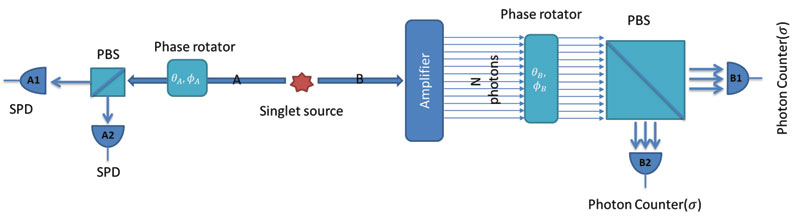
While not disputing this explanation, Christoph Simon and a colleague at the University of Calgary, and another at the University of Geneva, have asked what would happen if decoherence did not affect the cat. In a thought experiment backed up by computer simulations, the physicists consider pairs of photons (A and B) generated from the same source with equal and opposite polarizations, travelling in opposite directions. For each pair, photon A is sent directly to a detector, but photon B is duplicated many times by an amplifier to make a macroscopic light beam that stands in for the cat. The polarizations of the photons in this light beam are then measured.

Two types of amplifier

They consider two different types of amplifier. The first measures the state of photon B, which has the effect of destroying the entanglement with A, before producing more photons with whatever polarization it measures photon B to have. This is rather like the purely classical process of observing the Geiger counter to see whether it has detected any radiation, and then using the information to decide whether or not to kill the cat. The second amplifier copies photon B without measuring its state, thus preserving the entanglement with A.

The researchers ask how the measured polarizations of the photons in the light beam will differ depending on which amplifier is used. They find that, if perfect resolution can be achieved, the results look quite different. However, with currently available experimental techniques, the differences cannot be seen. "If you have a big system and you want to see quantum features like entanglement in it, you have to make sure that your precision is extremely good," explains Simon. "You have to be able to distinguish a million photons from a million plus one photons, and there is no current technology that would allow you to do that."

Quantum-information theorist Renato Renner of ETH Zurich is impressed: "Even if there was no decoherence, this paper would explain why we do not see quantum effects and why the world appears classical to us, which is a very fundamental question of course." But, he cautions, "The paper raises a very fundamental question and gives us an answer in an interesting special case, but whether it is general remains to be seen."

New tests support superluminal-neutrino claim

Physicists working on the OPERA experiment in Italy have released preliminary results of a new experiment that appears to confirm their previous finding that neutrinos can travel faster than the speed of light. In September the OPERA collaboration announced that neutrinos travelling 730 km underground from the CERN particle-physics lab in Switzerland to the Gran Sasso lab in Italy appeared to be travelling faster than the speed of light – something that goes against Einstein's special theory of relativity.

Although some theories allow superluminal speeds for neutrinos, many in the physics community were sceptical of the finding. Shortly after the result was announced, a paper was published in the journal Physical Review Letters that argued that any superluminal neutrinos detected at Gran Sasso should have a distinct energy spectrum as a result of the Cerenkov-like emission of charged particles on the journey – something that was not evident. There also seemed to be some disagreement within the OPERA community about whether the results should be subject to further internal scrutiny before being submitted for publication in a peer-reviewed journal.

Many physicists suspect a systematic error to be the cause of the excess neutrino speed. One issue that was highlighted early on is the effect of the length of the neutrino pulses on the result. In the original experiment the pulses lasted 10.5 µs and were separated by 50 ms, and some critics had suggested that such wide pulses could introduce a systematic error in the time-of-flight measurement.

One neutrino at a time

In this latest experiment the neutrino pulses were shortened to 3 ns long and separated by up to 524 ns. As a result, the experiment is essentially looking at single neutrinos rather than bunches. "With the new type of beam produced by CERN's accelerators, we've been able to measure with accuracy the time of flight of neutrinos one by one," says Dario Autiero of the Institute of Nuclear Physics of Lyon in France.

This latest experiment involved 20 neutrinos, rather than the 16,000 studied in the previous analysis. However, Autiero claims that the new measurement delivers accuracy that is comparable to the previous work. "In addition, [the] analysis is simpler and less dependent on the measurement of the time structure of the proton pulses and its relation to the neutrinos' production mechanism," he says. However, Autiero adds that both results require further scrutiny.

Jenny Thomas of MINOS – a similar neutrino experiment at Fermilab in the US – agrees. "OPERA's observation of a similar time delay with a different beam structure only indicates no problem with the batch structure of the beam," she says. "It doesn't help to understand whether there is a systematic delay that has been over looked."