Muon-capture measurement backs QCD prediction

The rate at which protons capture muons has been accurately measured for the first time by the MuCap collaboration at the Paul Scherrer Institute (PSI) in Switzerland. This process, which can be thought of as beta decay in reverse, results in the formation of a neutron and a neutrino. The team has also determined a dimensionless factor that influences the rate of muon capture, which was found to be in excellent agreement with theoretical predictions that are based on very complex calculations.

Muons are cousins of the electron that are around 200 times heavier. Beta decays demonstrate the weak nuclear force in which a neutron gets converted into a proton by emitting an electron and a neutrino. Now, replace the electron with the heavier muon and run the process backwards: a proton captures a muon and transforms into a neutron while emitting a neutrino. This process – known as ordinary muon capture (OMC) – is crucial to understanding the weak interaction involving protons.

The proton and the weak force

The proton's interaction with the weak force is explained by the chiral perturbation theory (ChPT) – an approximation of quantum chromodynamics (QCD) applicable at low particle energies. At such energies, the weak interaction inside a proton is affected by the presence of the strong force. The strength of this weak interaction is determined by certain coupling constants, which must be experimentally established.

"Essentially, these constants represent the basic properties of the proton, and describe the fact that it is not point-like but has a complex internal structure," says Peter Kammel from the University of Washington, Seattle, one of the physicists involved in this research. Three of these dimensionless parameters have been previously measured, but attempts at measuring the fourth, known as "pseudoscalar coupling", provided conflicting results, until now. "Of course," continues Kammel, "the pseudoscalar coupling constant could be calculated quite precisely by using chiral perturbation theory, which predicts a value of 8.26 ± 0.23." In order to measure its value, the physicists had to first determine with a high accuracy the rates at which muon capture takes place.

Capture versus decay

The muons used in the study were produced by smashing protons into carbon targets at an energy of 590 MeV. These collisions produce both positive and negative pi-mesons (or pions), which promptly decay into positive and negative muons, respectively. Muons with an energy of 5.5 MeV are then fired into a MuCap time projection chamber (TPC), which contains ultrapure hydrogen gas at 10 bar.

The negative muons supplant the electrons that orbit the hydrogen nuclei to form a proton–muon bound state, while the positive muons remain free. A small fraction of the bound muons – around 0.16% – will get captured by the proton and disappear, as they form a neutron and a neutrino. All of the remaining muons, both positive and negative, will decay after about two millionths of a second into electrons and neutrinos. The decay times were calculated precisely by measuring the time between the muons entering the TPC and the electrons from the decay exiting the chamber. These decay times were then compared to the well-known free muon decay rate and the difference between the two determines the elusive muon-proton capture rate.

A total of around 12 billion decay events involving negative muons were detected, corresponding to 30 TB of raw data that were analysed. The analysis was performed blind to prevent any unintentional bias from distorting the results and, following the unblinding, the measured muon-capture rate was found to be 714.9 ± 5.4 (stat) ± 5.1 (syst) s–1.

Confirming predictions

Using this figure, the team could calculate the value of the pseudoscalar coupling constant, which worked out to be 8.06 ± 0.48 ± 0.28, consistent with the predictions of ChPT. Although experimental methods to determine the pseudoscalar coupling constant started in the 1960s, it was not until the MuCap experiment that the objective was achieved.

"The nucleon weak-interaction coupling constants played a significant role in understanding the weak and strong interactions," continues Kammel. "The modern description of the process we have investigated is based on ideas proposed by Yoichiro Nambu, for which he won the Nobel Prize for Physics in 2008." The approximate methods of calculation presented by ChPT agree very well with the experimental result, confirming yet another prediction of the Standard Model of particle physics.

Mesons measure collision temperatures

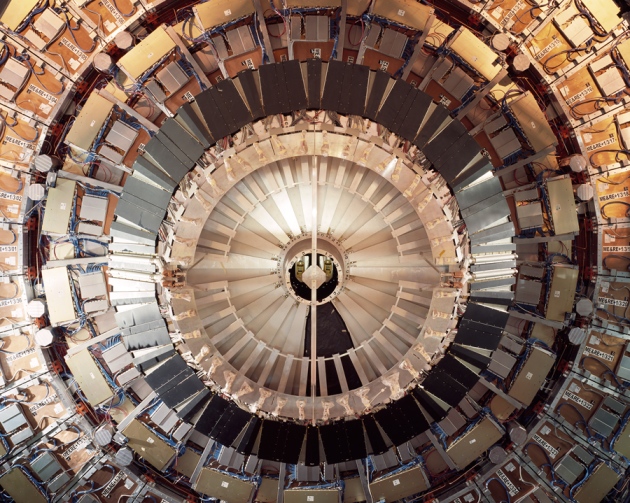
A new method to accurately work out the temperature of a quark–gluon plasma has been developed by researchers at the Compact Muon Solenoid (CMS) collaboration at the Large Hadron Collider (LHC) at CERN. The technique involves looking at the behaviour of certain mesons in lead–lead collisions. While a similar result was reported last year, this latest effort is claimed to be much stronger and more statistically significant.

Cosmologists and particle physicists have long been keen to understand in what state matter existed in the primordial universe. Theories suggest that in the first few microseconds after the Big Bang, the basic building blocks of matter – quarks and gluons – were not bound within composite particles such as protons and neutrons, as they are today. Instead, they existed in a "quark–gluon plasma" – a sort of hot, dense soup-like medium in which the quarks and gluons (the carriers of the strong nuclear force) exist as free entities.

As the strong force does not diminish as the distance between quarks is increased, a very large amount of energy is necessary for the bound quarks to remain free. As a result, the QGP can only exist for very short times and at very high temperatures. When heavy particles such as lead nuclei collide in the Large Hadron Collider, a QGP could form in a number of ways. But it is not easy to tell if this extreme state of matter has formed, and it is even more difficult to measure it as it is expected to be at trillions of degrees.

Excited particles

One of the ways in which the CMS collaboration looks to see if a QGP has formed is to look at the effect its formation would have on other particles. One of the signs the researchers look out for is the sequential melting of excited states of the upsilon mesons (ϒ) – a bound state of a quark and its anti-quark – that emerges from heavy-ion collisions. It exists in three states, each of which have identical properties, but different binding energies. These are referred to as 1S, 2S and 3S. The more excited a state is, the less tightly bound are its quarks, meaning that 1S is the ground state, while 2S and 3S are loosely bound excited states that would melt more easily in the presence of a QGP.

"Here at the CMS, we can distinguish the signatures of the three states very clearly and distinctly, because of the excellent mass resolution of the CMS detector," explains Nuno Leonardo, from Purdue University, who is a member of the CMS collaboration and was one of the leaders of this experiment. The melting of these states is actually observed as a "suppression of states" – that is, fewer mesons are produced in lead–lead (Pb–Pb) collisions, compared with the number produced in proton–proton (p–p) collisions, which are known not to produce a QGP at all, making the p–p a reference system. For the three states, the fraction of ϒ(2S) and ϒ(3S) particles produced relative to ϒ(1S) in the Pb–Pb collisions should be less than the fraction for collisions between protons, where the suppression would not exist. "This is what we exploit to measure the temperature of the QGP," says Leonardo.

Foggy effects

Ian Shipsey, another team member and the chairperson elect of the CMS Collaboration Board, refers to the suppression as a "screening effect". He explains that the QGP screens the quark and its antiquark from their binding forces, making them fall apart even quicker than usual. "It is a bit like two people standing close to each other in a room...they form our ϒ particle. Even if there is a fog in the room, they can see each other as they are standing close," he explains. "But for the 2S and 3S states, they are further apart and so there is more fog between them and they cannot see each other. In this case, the fog is the QGP and the two people are the quark and its anti-quark, that now act as free particles and so do not form a ϒ particle anymore," he told physicsworld.com. Shipsey extends his fog analogy by saying that the p–p system has no fog at all, while for the Pb–Pb system the fog was expected, and now they have the evidence for it.

To determine the actual temperature of the plasma, the researchers use models that link binding energy with the temperature and the fact that the suppression of the states becomes more pronounced at higher plasma temperatures. "We know that the 3S is the least tightly bound and so if the temperature is at a certain value, the 3S will be the first to break," says Leonardo. Similarly, at consecutively higher temperatures, the 2S and then the 1S states would be expected to break.

Suppressed states

"With the current CMS data, we found that the 3S state is completely gone, the 2S is significantly suppressed but the 1S is very subtly suppressed," explains Shipsey. He says that the slight suppression of the 1S state may not be due to the QGP at all, but because "the amount of 1S observed depends in part on how much 2S and 3S are present as both of these states can disintegrate forming a 1S. If the 2S and 3S are suppressed the 1S is automatically suppressed". This means that the QGP formed is at an intermediate temperature, and not at the highest temperature theoretically expected. With the new data from 2012, the statistical significance of the researcher's findings has increased from 2.4σ to 5σ – the golden standard for a particle-physics discovery. To ensure the effects that they have observed are really a QGP being formed, the researchers plan to look at proton–lead (p–Pb) collision taking place at the LHC early next spring, which would serve as a middle ground. These collisions would also allow the team to ensure that the fog is produced by a QGP and not a phenomenon known as "cold nuclear effects" that could produce their own fog or screening effect. So the p–Pb system would provide a final qualification.

Truant particles turn the screw on supersymmetry

Absence of evidence is not necessarily evidence of absence. That’s what theoretical physicist John Ellis of King’s College London says of the latest result in the search for supersymmetry, an idea that has captivated particle physicists for 30 years. Although researchers are still digesting the discovery of the Higgs boson, announced in July at CERN, Europe’s particle-physics laboratory near Geneva in Switzerland, more exotic creations are needed to fill out their picture of the subatomic world. The Higgs provides the last missing particle of the standard model of particle physics, but this theory still has some major deficiencies — it is silent on gravity and on what makes up dark matter, among other things. Supersymmetry (SUSY), which predicts that every standard-model particle has a heavier partner, is a step towards a more unified theory of the particles and forces.

Last week at a conference in Kyoto, Japan, physicists working on the LHCb experiment — one of four large detectors located around CERN’s Large Hadron Collider (LHC) — announced the hotly anticipated results of an indirect search for new superparticles, known by the cognoscenti as ‘sparticles’. The team clocked an extremely rare process in which a BS meson — composed of a strange quark and a bottom antiquark — decays into a muon–antimuon pair. Only one in roughly every 300 million BS mesons is predicted to do this, because the decay relies on a highly unlikely chain of events involving the fleeting appearance of virtual particles. But with the help of sparticles, the rate could increase by perhaps a factor of 100.

However, the LHCb team found that the BS behaves just as the standard model says it should, although further data are needed to confirm the measurement. Some members of the 800-strong collaboration proclaimed the result as “very damaging” for SUSY. But SUSY is a slippery animal — it introduces more than 100 new parameters into the standard model, all adjustable — and SUSY proponents don’t seem particularly worried. “To paraphrase Mark Twain, news of SUSY’s death has been greatly exaggerated,” says theoretical physicist and SUSY pioneer Savas Dimopoulos of Stanford University in California.

Nevertheless, the LHC has undoubtedly lengthened the odds of SUSY being correct, at least in its simplest, ‘natural’ incarnations. “Models of natural supersymmetry are looking increasingly hard to believe,” says Brian Feldstein of the Kavli Institute for the Physics and Mathematics of the Universe at the University of Tokyo. The LHCb result comes on top of tough direct constraints from the LHC’s larger ATLAS and CMS detectors. These have seen no sign of sparticles such as squarks and gluinos — nor of any particles outside the standard model. Updates from ATLAS and CMS, presented in Kyoto, continue to show that the lightest superparticles, if they exist, must have truly elephantine masses of more than 1 teraelectronvolt (TeV).

Studies of the Higgs boson itself are yielding mixed signals for SUSY-seekers. So far, rough measurements of CERN’s new boson — updated last week — suggest that it behaves just as the standard model predicts, with no hint that additional particles are influencing its behaviour. Yet the mass of the Higgs, 126 gigaelectronvolts (GeV), is pretty much what SUSY predicted, says Sven Heinemeyer at the Institute of Physics of Cantabria in Spain. “If it had been 140 GeV or more, the minimal supersymmetric standard model would have been dead without any possibility of resurrection,” he says. SUSY also predicts the existence of four further Higgs particles, at different masses, which have yet to be discovered. The next chance for some cheering news about SUSY will come in March, when physicists will present results encompassing much more of the data gathered by the LHC, which will continue to smash protons until 17 December. SUSY will probably then remain in limbo until early 2015, when the LHC will re-open for experiments after a long shutdown for maintenance, and will begin colliding protons at energies of 13 TeV. So far, the collider has operated at energies of up to only 8 TeV. The increase in energy will put discoveries of more massive particles within the LHC’s reach.

Yet sparticles with masses of several TeV or higher might be too heavy to be produced in the LHC or any other conceivable experiment — a troubling possibility. One of the main attractions of SUSY is that it solves a problem in the standard model, which predicts that the Higgs field — the constant sea of energy from which the Higgs boson arises — should be ramped up to ridiculously high values by the ever-present fluctuations of standard-model particles. SUSY’s sparticles are supposed to prevent that by cancelling out the fluctuations, thereby stabilizing the Higgs. But there is disagreement about whether superheavy sparticles can offer enough stabilization.

In another blow to SUSY’s explanatory power, such sparticles could also become too heavy to be convincing candidates for dark matter, the unseen stuff that astronomers believe has a key role in shaping cosmic structure. Fans of SUSY are likely to lose faith only if the LHC finds nothing after a year or two of high-energy running. That would force them to look for an even more audacious idea to break free from the standard model. Even so, SUSY will probably live on in mathematical physics, says theorist Ben Allanach of the University of Cambridge, UK. “It is such a powerful new mathematical symmetry that it would be a shame if nature didn’t make use of it,” he says.

لینک مقاله

Particle Physics with Ferroelectrics

انحراف توزیع بار الکترون‌ها از تقارن کاملاً کروی (به این معنا که الکترون گشتاور دوقطبی الکتریکی دارد)، می‌تواند نشانه‌ای از یک فیزیک جدیدی فرای مدل استاندارد ذرات فیریکی باشد. تاکنون بیشتر آزمایش‌های دقیقی که مورد مطالعه قرار گرفته است مربوط به الکترون‌های اتم‌هاو مولکول‌ها در یک پرتو است. اما به عنوانی جایگزینی برای این آزمایش‌ها منبع چگالتری از الکترون‌ها‌ی متصل به اتم‌ها در جامدات مورد مطالعه قرار می‌گیرد. در این مطالعات نشانه‌های بیشتری برای یک فیزیک جدید به چشم می‌خورد. طبق گزارشی در Physical Review Letter٬ پژوهش‌های حالت جامد برای گشتاور دوقطبی الکتریکی الکترون (EDM) هنوز ۵۰۰ بار دقیق‌تر از یافته‌های مربوط به فیزیک اتمی می‌باشد. اما پیشرفت آن‌ها در سال تنها سه برابر بوده است.

EDM الکترون‌ها٬ باید هم‌راستا با اسپین الکترون باشد. بنابراین به طور معمول در پژوهش‌های EDM در حالت جامد٬ در یک نمونه‌ی قرار گرفته شده در میدانِ الکتریکی تلاش می‌شود تا سیگنال‌های مغناطیسیِ القایی اندازه گیری شود. Stephen Eckel و همکارانش در دانشگاه یل در Connecticut این آزمایش را بر روی Eu0.5Ba0.5TiO3٬ سرامیکی با چگالش بالایی از اسپین‌های نامنظمِ جفت نشده و با پاسخ فروالکتریکی قابل تنظیم٬ انجام دادند. این به این معنا است که میدان الکتریکی خارجی حتی میدان الکتریکی درونی بزرگتری را برای اسپین‌ها بوجود می‌آورد. نویسندگان مقاله شکاف مغناطیسی دقیقی را بین دو دیسک Eu0.5Ba0.5TiO3با قطر ۱۲ میلیمتر و ضخامت ۱.۷ میلیمتر قرار دادند و مجموعه‌ای از پالس‌های میدان الکتریکی کوتاه را برای تنظیم سیگنال از EDM و حذف میدان‌های مزاحم اعمال کردند.

Eckel و همکارانش به این نتیجه رسیدند که اگر EDM غیر صفر باشد مقدارش می‌تواند بزرگتر از 6.06x10⁻²⁵ecm باشد. این مقدار در مقایسه با حدی که از اندازه‌گیری پرتو اتمی به‌دست می‌آید (1.05x10⁻²⁷ecm)٬ ممکن است همانند یک شکست در کارزاری برای یافته‌های حالت جامد باشد. اما کشف مواد جدید و اندازه‌گیری‌های با اختلال پایین‌تر همچنان عاملی برای تشویق به ادامه این نوع آزمایش‌ها است.

لینک منبع مقاله

Neutrinos point to rare stellar fusion

Neutrinos captured under a mountain in central Italy have provided the first direct evidence for a nuclear reaction involved in the conversion of hydrogen to helium inside the Sun. The observation was made by the Borexino collaboration, which next hopes to ensnare as-yet-unseen neutrinos from fusion reactions taking place in stars heavier than our own.

Most of the Sun's heat is generated in fusion reactions that form what is known as the "proton–proton cycle". This involves the fusion of two hydrogen nuclei (protons) to form heavy hydrogen, the fusion with a third hydrogen nucleus to form helium-3 and then, via various pathways, the creation of extremely stable helium-4.

Physicists can learn about this cycle by intercepting the chargeless, nearly massless particles known as neutrinos that are produced in many of the constituent reactions. In fact, by measuring the fluxes of these particles, they can learn not just about the structure and dynamics of the Sun, but also about the properties of neutrinos themselves. To date, however, most neutrino detectors have been sensitive to the highest energy solar neutrinos – those having energies of between about 5–18 MeV. However, the vast majority of solar neutrinos have energies below 5 MeV, and Borexino was built specifically to study these particles.

Detection is demanding

Detecting any kind of neutrino is difficult because the particles interact extremely weakly with all other kinds of matter. But capturing the low-energy neutrinos from the Sun is particularly demanding as natural radioactive processes here on Earth generate particles with energies up to about 3 MeV, which can therefore obscure the low-energy neutrino interactions. Like other neutrino experiments, Borexino is located deep underground to protect it from interference from cosmic rays, being housed in the laboratory of Italy's National Institute of Nuclear Physics at Gran Sasso. And, like other experiments, it contains a large mass of detecting material, in this case about 280 tonnes of a liquid scintillator, which generates flashes of light when neutrinos scatter off electrons inside it. What sets the experiment apart, however, is the extreme purity of the materials used to create it, such as the scintillator itself and the stainless-steel sphere that holds the scintillator – with levels of radioactivity inside each one reduced by up to 10 or 11 orders of magnitude.

In data collected between 2007–2010, the Borexino collaboration, made up of physicists from Italy, the US, Germany, France and Russia, had already identified solar neutrinos from the conversion of beryllium-7 into lithium-7. Having a very well-defined energy of 0.86 MeV, these neutrinos were detected at a rate of about 50 a day for every 100 tonnes of scintillator. In the latest analysis, which uses data obtained since January 2008, the researchers observe even rarer events – the detection of solar neutrinos with a precise energy of 1.44 MeV that are generated by the fusion of two protons and an electron in "pep" reactions. Using a new data-analysis technique to mask interference from nuclei of carbon-11, which are produced by the few cosmic-ray particles that make it down to the experiment, the researchers found that, on average, pep neutrinos collide with 100 tonnes of detector material 3.1 times a day.

First direct evidence

According to Borexino spokesman Gianpaolo Bellini, this is the first direct evidence of pep reactions taking place in the Sun, and he says that the observed flux matches well with the predictions of astrophysicists' "standard solar model". But he points out that further data will be needed to fully exploit Borexino’s potential as a probe of neutrino "oscillations". Results from many different experiments over several decades have revealed that neutrinos oscillate from one kind (electron, muon or tau) to another as they travel through space, but physicists would like to know exactly how the strength of these oscillations varies with neutrino energy. Other experiments have shown that theoretical predictions agree well with the data at higher energies, while Borexino's beryllium-7 result shows that there is also a good fit at the lowest energies. But, says Bellini, more pep neutrinos will have to be detected in order to gather sufficient data at intermediate energies.

In fact, the Borexino researchers are currently overhauling their detector to reduce levels of radioactivity still further and then hope to start three more years of data-taking in March or April. These new data might also confirm the existence of neutrinos from a completely different set of fusion reactions that are believed to fuel massive stars and also provide a small fraction of the helium inside the Sun – the "carbon–nitrogen–oxygen cycle" (CNO), which fuses hydrogen into helium via the formation of the three heavier elements. These neutrinos should interact with Borexino's detector nuclei at a similar rate to the pep neutrinos but they have a less-distinctive energy spectrum that makes it harder to tell them apart from the background, although the latest analysis did place a new stringent upper limit on their flux.

Bellini says that detecting CNO neutrinos might also solve the "metallicity puzzle" regarding the composition of the Sun's atmosphere. Scientists have created a 3D model of the atmosphere that agrees well with spectroscopy data, and which predicts about 30–40% less carbon, nitrogen, oxygen, neon and argon on the Sun's surface than does an alternative, less sophisticated, 1D model. But it is this latter model that is more consistent with data from helioseismology – the study of the Sun's interior via the pressure waves that propagate through it. According to Bellini, the observation of CNO neutrinos should settle the matter, since their predicted flux is quite sensitive to the abundance of the various elements in the solar atmosphere.

Copper collisions create much strangeness

Colliding pairs of copper ions produce significantly more strange quarks per nucleon than pairs of much larger gold atoms. That is the surprising discovery of physicists working on the Relativistic Heavy Ion Collider (RHIC) at the Brookhaven National Laboratory in the US. The finding gives further backing to the core–corona model of such high-energy collisions and could shed further light on the quark–gluon plasma – a state of matter though to have been present in the very early universe.

Quarks are normally bound-up by gluons in particles such as protons and it takes a high-energy collision to create a glimpse of free quarks. If large nuclei such as gold or lead are smashed together at high enough energies, the result is expected to be a soup of free quarks and gluons called a quark–gluon plasma. In addition to boosting our understanding of the strong force that binds quarks together, a quark–gluon plasma is thought to provide a microscopic picture of the very early universe.

When heavy nuclei are collided at RHIC, they generate a fireball that dissipates much of its energy by creating new particles. Some of these particles contain strange quarks – the lightest of the exotic quarks – and a relatively large number of strange quarks produced in a collision can imply the presence of a quark–gluon plasma. This is because an unconfined quark in a plasma behaves as if it is lighter than a quark confined in a nucleon, and this effective reduction in mass means that generating strange quarks does not take as much energy. For this reason, those hunting quark–gluon plasmas pay close attention to the number of strange quarks that crop up in particle collisions – the number should be larger than expected if the plasma is produced.

Something strange about copper

When trying to create a quark–gluon plasma, it is normally thought that the larger the nucleus, the better. As such, RHIC normally collides gold ions and the Large Hadron Collider (LHC) smashes lead. But now, physicists in the STAR collaboration at RHIC have found that copper–copper collisions produce between 20% to 30% more strange quarks per nucleon than their gold–gold counterparts. The latest study involves about 40 million copper–copper collisions and 20 million gold–gold collisions, all of which were carried out at an energy of 100 GeV per nucleon.

The copper ions contained a total of 63 nucleons – 29 protons and 34 neutrons. If their collisions produced more strange quarks than 63 proton–proton collisions at the same energy, then this is called a "strangeness enhancement", which could be evidence that the collision created a quark–gluon plasma.

There is, however, an alternative explanation for why colliding copper produces more quarks than protons. It could be that the production of strange hadrons (particles containing strange quarks) are suppressed in proton–proton collisions because of the requirement that strangeness must be conserved. Conservation rules require that for every strange quark, its antimatter version (the antistrange quark) must be produced. In collisions involving smaller nuclei, where fewer particles are generated, the burden of making extra antistrange quarks means that particles containing two or more strange quarks are harder to create. This limitation brings down the number of strange quarks generated on average in proton–proton collisions.

Almond-shaped collision

The team compared gold and copper collisions with the same number of "participating" nucleons. Because gold has 197 nucleons, many more than copper, the gold nuclei had to sideswipe one another rather than crash head on in order to get a collision involving 126 nucleons or less – the number involved when two copper nuclei collide. This results in an almond-shaped collection of protons and neutrons, rather than the more circular head-on copper collisions.

"The canonical picture says that the strangeness enhancement should just depend on the number of participants," says Anthony Timmins, a STAR collaborator at the University of Houston. But if that were true, the copper collisions would not have come out significantly stranger than the gold collisions.

As an alternative, the collaboration suggests that the core–corona model describes the data best. In this picture, the colliding nucleons form a core of quark–gluon plasma surrounded by ordinary nucleon–nucleon collisions. A relatively compact copper collision collects its energy in a smaller space, meaning that more nucleons join the quark–gluon plasma and produce strange quarks. Meanwhile, more nucleons in the almond-shaped gold sideswipe are lost to collisions in the corona, thus generating fewer strange quarks.

Other particles get a boost

Aneta Iordanova, a former STAR collaborator who is now at the University of California, Riverside, is particularly interested in the fact that other particles – without strange quarks – also get a boost in the head-on copper collisions compared with the gold collisions. "If the particles produced in the core region dominate the particle production as a whole, then an increase in the yield of all particles, strange or not, is expected," she says.

Federico Antinori, physics co-ordinator for the ALICE experiment on CERN's Large Hadron Collider in Geneva, Switzerland, calls this a "bonus point" for the core–corona model. "It's not the final proof, but it's interesting to note that this model does rather well at explaining the data," he says. ALICE collaborators presented their first look at particles containing multiple strange quarks coming out of lead–lead collisions last year, and although quantitative comparisons with the core–corona model have yet to be made, he notes that the behaviour is qualitatively similar.

هیگز بوزون چیست و چرا مهم است؟

با اینکه جهان علم انتظار تأیید کشف احتمالی ذره هیگز بوزون را می‌کشد، هنوز پرسش‌های زیادی راجع به اینکه اصلاً این ذره چیست، چرا سخت‌کوشانه در پی کشف‌اش افتاده‌ایم و چرا تا به این حد احتیاط می‌کنیم، از گوشه و کنار به گوش می‌خورد. این مقاله، پاسخی به همین پرسش‌هاست.

نخست پاسخ کوتاه
 
اگر هیگز بوزون کشف شود، احتمالاً یکی از گسترده‌ترین فتوحات خرد انسانی در حافظه اخیر تاریخی‌مان رقم خورده است، چراکه توجیهی برای ارائه یکی از بزرگ‌ترین نظریات دنیای علم و همچنین احداث پیچیده‌ترین ماشین تولیدشده به‌دست بشر است. پس خبر خیلی خوبی است. اما اگر هیگز بوزون همه آن چیزی باشد که در "ابرتصادم‌گر هادرونی" (LHC) پیدا شود، آن‌وقت هنوز چیزهای زیادی برای یافتن باقی است. رهنمود عملی و تعیین‌کننده‌ای که فیزیکدانان برای فهم پرسش‌های اساسی‌مان راجع به هستی- اعم از اینکه آیا چهار نیروی بنیادین طبیعت را می‌توان به‌طریقی برای توجیه علت مهبانگ (یا همان Big Bang) با هم متحد کرد- هنوز در هاله‌ای از ابهام است. پاسخ بدین پرسش‌ها را شاید اصلاً بایستی در آن‌سوی امکانات فناورانه و مالی نسل انسان‌های کنونی یافت.
 
حالا پاسخ مشروح
 
اگر معلوم شود که ایده‌های‌مان راجع به ذره هیگز بوزون، درست و بی‌نقص بوده، آن‌وقت هرآنچه در جهان‌ می‌بینیم، همانند یک ویترین پر زرق و برق و مستقر بر بافتی از حقیقت است که ما نبایستی به طور مستقیم در آن وجود داشته باشیم. ذراتی که ما را ساخته- تا پس از پیوستن به‌ یکدیگر، ذراتی همچون پروتون‌ها، نوترون‌ها، هسته‌های اتمی و در نهایت اتم‌ها را به وجود آورند- همگی صاحب جرم هستند. در فقدان ذره هیگز، این ذرات هم مثل فوتون‌ها (که ذرات سازنده نور باشند) فاقد جرم می‌شوند.
 
ما بر اساس تجربیات شخصی‌مان، از وزن اشیاء در نسبت با محیطی که در آن واقع شده‌اند، اطلاع داریم. مثلاً اشیائی که روی زمین سنگین‌اند، در آب سبک‌تر می‌شوند و به‌همین نحو، اگر قاشقی را درون عسل بگردانید، انگاری سنگین‌تر از زمانی شده که آن را در هوا می‌چرخانده‌اید. طبق مدل استاندارد ذرات بنیادی، یک "میدان هیگز"ی وجود دارد که در سرتاسر فضا ریشه دوانده است. این میدان، در سطوح مختلفی با ذرات واکنش نشان می‌دهد. آن ذره‌هایی که بیشتر واکنش می‌دهند، مقاومت بیشتری هم نسبت به حرکت از خود نشان می‌دهند و سنگین‌تر به‌نظر می‌رسند. آن‌هایی هم که مثل فوتون‌ها اصلاً واکنشی به این میدان نشان نمی‌دهند، اصلاً فاقد جرم می‌مانند. پس بدین‌ترتیب جرم هر چیزی با وجود این میدان معنا می‌یابد و جرم، انعکاسی از اوضاع پیرامونی ماست، چراکه ما در جهانی به سر می‌بریم که میدان هیگز، خود از آن نشئت گرفته است.
دیگر اما چه نیازی به "ذره" هیگز بوزون است؟ نظریه نسبیت خاص به ما گفته که هیچ اطلاعاتی نمی‌تواند سریع‌تر از نور جابه‌جا شود. اگر این فرض را در چارچوب مکانیک کوانتومی تفسیر کنیم، آن‌وفت همه نیروهایی که ما گمان می‌کنیم از یک میدان سرچشمه گرفته‌اند (همچون گرانش و الکترومغناطیس)، در واقع از طریق مبادله ذرات زیراتمی انتقال پیدا کرده‌اند. انتقال این ذرات هم کمی مثل بازی دستش دِه است: اگر من توپی را بیاندازم و شما بگیریدش، در واقع من با پرتاب توپ اندکی به پشت خم شده بودم و شما هم با مهار آن اندکی به پشت خم می‌شوید. پس مثل این می‌ماند که هر دوی‌مان خود را دفع کرده‌ایم. با این‌حساب اگر میدان هیگز وجود داشته باشد، حتماً ذره‌ای مربوط به چنین میدانی هم وجود دارد و این، همان ذره هیگز بوزون است. البته این چیزی شبیه به یک خیال‌پردازی است و چندان با تصور فرشته‌‌‌هایی که روی سر یک سوزن نشسته‌اند، فرقی نمی‌کند، اما چه چیزی فیزیکدانان را به ارائه چنین فرضیه‌ای واداشته است؟
یکی از بزرگ‌ترین دستاوردهای فیزیکی پنجاه سال گذشته، یگانه‌سازی دو نیروی طبیعت بود: الکترومغناطیس و نیروی ضعیف هسته‌ای. در نظریه "الکتروضعیف"، نیروی الکترومغناطیس از طریق مبادله دوربرد فوتون‌های فاقد جرم انتقال پیدا می‌کند، و نیروی کوتاه‌برد ضعیف هسته‌ای هم محصول مبادله ذرات به نسبت سنگینی موسوم به W و Z بوزون‌هاست. این ذرات در دهه ۶۰ میلادی پیش‌بینی و در دهه ۸۰ هم در مرکز تحقیقات هسته‌ای اروپا (CERN)، که هم‌اکنون میزبان LHC است، پیدا شدند. برای اینکه این یگانگی نظری، از حیث ریاضیاتی هم مورد قبول واقع شود، تمامی این سه ذره بایستی فاقد جرم باشند و لذا نیروهایی هم را که سبب آن می‌شوند، ویژگی‌های تقریباً یکسانی ببخشند. تنها در صورتی‌که W و Zبوزون‌ها در واکنش با یک میدان پس‌زمینه- که همان میدان هیگز باشد- صاحب جرم شوند، از حیث نظری می‌توان دلیل اختلاف‌های ظاهری این دو نیرو را، دست‌کم در مقیاس‌هایی که ما هم‌اکنون توان اندازه‌گیری‌شان را داریم، در عین شباهت ریاضیاتی‌شان توجیه کرد.
 
خیاط، در لبالب کوزه
 
بر اساس نظریات فعلی، جرم ذره هیگز بایستی در حدود یکصد برابر جرم پروتون باشد، هرچند که مقدار دقیق آن مشخص نیست. طی بالغ بر ۲۵ سالی که از کشف W و Z بوزون‌ها می‌گذرد، فیزیکدانان تجربی در تلاش برای راه‌اندازی شتاب‌دهنده‌هایی برآمده بودند که انرژی کافی برای تولید یک ذره هیگز را (در صورت وجود)، داشته باشد. شتاب‌دهنده "تواترون" در آزمایشگاه فرمی‌لب آمریکا، توان تولید ذره‌هایی با جرم حداکثر ۱۲۰ برابر پروتون را داشت (که می‌شود در حدود ۱۲۰ گیگاالکترون‌ولت)، اما موفق به شکار هیگز بوزون نشد. شتاب‌دهنده LHC، با هدف کنکاش در محدوه‌های جرمی ِ فراتر از این ساخته شد. اگر جرم ذره هیگز، طبق شایعات کنونی، در حدود ۱۲۵ گیگالکترون‌ولت باشد، آن‌وقت این ذره به خرمهره درک فعلی‌مان، هم از نظریه وحدت‌یافته الکتروضعیف و هم از خاستگاه ما و تقریباً تمام جرمی خواهد شد که در این جهان قادر به محاسبه‌اش هستیم.
 
همه‌چیز، هیگز بوزون نیست
 
البته تمام ماجرا هم اینگونه گل و بلبل نیست. مدل استاندارد، هیچگونه توضیحی راجع به ماهیت جرم ذره هیگز و W و Z بوزون‌ها نمی‌دهد. در واقع برخی بر این عقیده‌اند که برای توضیح اینکه چرا عوامل کوانتومکانیکی، مانع از این می‌شوند که جرم ذرات مزبور از این مقدار بیشتر باشد، به نظریات سراسر جدیدی نیاز است. یکی از هیجان‌انگیزترین روش‌هایی که با کمکش می‌توان دست به محک چنین محدودیت‌هایی زد، نظریه "ابرتقارن" است. اگر ابرتقارن راست باشد، جمعیت ذرات بنیادی دوبرابر خواهد شد، و ما نه فقط به یک ذره هیگز که به دوتایش نیازمندیم. این درست همان چیزی است که خیلی از فیزیکدانان انتظار کشف آن را می‌کشند. شایعاتی که از CERN درز کرده، نشان از وجود ذره‌ای با جرم حدوداً ۱۴۰ گیگاالکترون‌ولت هم می‌دهد.
 
از آنجایی‌که ابرتقارن، جزو لاینفک مدل‌های به مراتب بحث‌برانگیزتر نظریه ریسمان به شمار می‌رود که خود نظریه‌ای برای یگانگی گرانش و مکانیک کوانتومی‌ست، هنوز دلایلی هست که برخی نظریه‌پردازان امیدشان را به کشف دو ذره هیگز، و یا حتی ذرات پیش‌بینی‌نشده بیشتر از دست ندهند. اگر فقط یک ذره هیگز درLHC پیدا شود، آن‌وقت اوضاع به‌هم می‌ریزد و این احتمالاً بدترین امکانی است که ما نظریه‌پردازان توان تصورش را داریم. ما به‌همان نحوی به اطلاع‌تان رسانده‌اند، منشأ جرم جهان را به‌زودی پیدا خواهیم کرد، اما رهنمود تجربی جدیدی در اختیارمان نیست تا قدم بعدی را به پیش برداریم.
 

آزمایش‌های اطلس و سی.ام.اس. وضعیت جست‌وجوی هیگز را شرح دادند

در سمیناری که روز سیزدهم دسامبر ٢٠١١ در سرن برگزار شد آزمایش های اطلس و سی.ام.اس. وضعیت فعلی‌ی جست‌وجویشان برای بوزون هیگز را ارائه کردند. در حالی که نتایج آنها بر اساس داده‌ها‌ئی به مراتب بیشتر از آن‌چه است که در هم‌آیش‌ها‌ی تابستان در دست‌رس بود مقدار این داده‌ها هنوز آن قدر نیست که بتوان با قطعیت در باره‌ی وجود یا عدم وجود ذره‌ی هیگز اظهار‌نظر کرد. نتیجه‌ی اصلی‌ این است که اگر بوزون هیگز وجود داشته باشد محتمل‌ترین مقدار برای جرمش بر اساس داده‌های آزمایش اطلس باید بین ١١٦ و ١٣٠ و بر اساس داده‌های سی.ام.اس. بین ١١٥ و ١٢٧ گیگاالکترون‌ولت باشد. هر دو آزمایش نشانه‌ها‌ی امیدوار‌کننده‌ئی از وجود بوزون هیگز در این نواحی دیده‌اند اما این نشانه‌ها هنوز آن قدر قوی نیست که بتوان ادعا کرد بوزون هیگز مشاهده شده است. ذره‌ی هیگز اگر وجود داشته باشد عمر بسیار کوتاه خواهد داشت و از راه‌های بسیار وامی‌پاشد و کشف آن فقط بر اساس مشاهده‌ی ذرات حاصل از واپاشی‌ی آن میسر است. هر دو آزمایش اطلس و سی.ام.اس. در ناحیه‌های کم‌جرمی که ذکر شد شمار افزون‌بر‌انتظاری رخ‌داد مشاهده کرده‌اند

اگر نتایج هر کدام از آزمایش‌ها به‌تنهایی در نظر گرفته شوند هیچ‌کدام از نظر آماری اهمیتی بیشتر از آمدن ِ دو شش ِ پیاپی در دو بار انداختن ِ تاس ندارند اما نکته‌ی جالب چند اندازه‌گیری‌ی مستقل است که در هر دو آزمایش ناحیه‌ی ١٢٤ تا ١٢٦ گیگاالکترون‌ولت را برجسته می‌کنند. هنوز خیلی زود است که بگوییم اطلس یا سی.ام.اس. بوزون هیگز را کشف کرده‌اند اما نتایجی که تا کنون به‌دست آمده توجه جامعه‌ی فیزیک ذرات را بسیار جلب کرده است. فابیولا جانوتی سخن‌گوی آزمایش اطلس می گوید که هنوز به بررسی‌ی داده‌های بیشتر نیاز است و با توجه به عمل‌کرد بسیار عالی‌ی امسالِ ال.اچ.سی. می‌توانیم امیدوار باشیم که در سال ٢٠١٢ تکلیف‌مان معلوم شود.

سخن‌گوی سی.ام.اس. گوییدو تونلی می گوید "نمی‌توانیم وجود هیگز را در ناحیه‌ی ١١٥ تا ١٢٧ گیگاالکترون‌ولت رد کنیم زیرا به‌شکلی کاملاً سازگار در ٥ کانال مستقل رخ‌دادهای افزون بر انتظار مشاهده شده است. این رخ‌دادها بیش از همه با جرمی حدود ١٢٤ گیگاالکترون‌ولت یا کم‌تر در مدل استاندارد سازگار است اما اهمیت آماری‌ی آنها آن‌قدر نیست که بتوانیم با قطعیت ادعا‌ئی کنیم. آن چه تا کنون دیده‌ایم هم با افت‌و‌خیز آماری سازگار است و هم با وجود بوزون هیگز. تحلیل‌های ظریف تر و داده‌های بیشتر در ٢٠١٢ آماده خواهد بود زیرا این دستگاه ِ فوق‌العاده عالی حتماً به ما جواب خواهد داد." هر دو آزمایش طی‌ی ماه‌های آینده تحلیل داده‌های خود را دقیق‌تر خواهند کرد و نتایج‌شان را در هم‌آیش‌های فیزیک در ماه مارس ارائه خواهند کرد اما نظری قطعی‌تر برای وجود یا عدم‌وجود ذره‌ی هیگز نیاز به داده‌های بیشتری خواهد داشت که احتمالاً تا سال ٢٠١٢ در دست‌رس نخواهد بود. مدل استاندارد ماده‌ی سازنده‌ی ما و هر آن‌چه را که در عالم به‌چشم می‌آید به‌خوبی توضیح می‌دهد اما ٩٦درصد عالم از جنس دیگری‌ست و تا کنون مشاهده نشده است (ماده‌ی تاریک و انرژی‌ی تاریک). یکی از هدف‌های برنامه‌ی پژوهشی‌ی ال.اچ.اسی. رفتن فراسوی مدل استاندارد است و بوزون هیگز می تواند کلید راه‌گشاینده‌ی این هدف باشد.

کشف بوزون هیگز، تأیید نظریه‌ئی خواهد بود که نخست در دهه‌ی ١٩٦٠ به میان آورده شد اما بوزون هیگز بر اساس نظریه‌های مختلفی که فراسوی مدل استاندارد می‌روند می‌تواند شکل‌های مختلف بگیرد. در مدل استاندارد نیز بوزون هیگز می‌تواند راه را برای رفتن فراسوی مدل استاندارد نشان دهد، اما چنین چیزی فقط با بررسی‌ی ظرافت‌های کانال‌های پرشمار واپاشی‌ی ذره‌ی هیگز میسر خواهد شد. چه نتایج اطلس و سی.ام.اس. در ماه‌های آینده وجود هیگز را تأیید کنند و چه عدم وجود هیگز را، درهائی به روی فیزیک جدید گشوده خواهد شد.

لینک منبع مقاله

Higgs hunters close in on their quarry

The first solid experimental evidence for the existence of the Higgs boson has been unveiled today by physicists working on the Large Hadron Collider (LHC) at CERN in Geneva. Members of the ATLAS experiment revealed evidence that the Higgs particle has a mass of about 126 GeV/c2. Physicists working on the rival CMS experiment released similar – albeit weaker – evidence for a Higgs with a mass of about 124 GeV/c2.  However, ATLAS spokesperson Fabiola Gianotti cautions that the measurements are not good enough yet to claim the discovery of the particle.

Physicists are keen to discover the Higgs boson to complete the Standard Model of particle physics. The particle and its associated field are needed to explain how electroweak symmetry broke just after the Big Bang – which gave certain elementary particles the property of mass. The Standard Model does not, however, actually predict the mass of the Higgs, and successive experimental programmes at CERN's Large Electron–Positron Collider, Fermilab's Tevatron and now the LHC have sought to measure its mass.

If the current glimpse of the Higgs proves to be an illusion, and it – or a similar symmetry-breaking entity – is never found, all would not be lost, as physicists would be forced to concede that the Standard Model is incomplete and to look for "new physics" beyond it.

Evidence versus discovery

The ATLAS measurement was made at a confidence level of about 3.6σ, which means that the measurement could be the result of a random fluke just 0.1% of the time. While these might sound like fantastic odds, particle physicists normally wait until they have a confidence of 5σ or greater before they call it a "discovery". Anything above 3σ is described as "evidence".

There are several reasons why particle physicists require such high confidence levels. One is the "look elsewhere" effect that arises because the data are sorted into mass/energy bins to create a histogram – which could concentrate fluctuations. After the look elsewhere effect is considered in the ATLAS result, the confidence level drops to 2.3σ, according to Gianotti.

Another potential problem is that there could be unknown systematic errors lurking in the experiment that could be responsible for the apparent result, and therefore requiring a very high confidence could help avoiding such errors.

Despite the preliminary results announced at CERN today, unravelling the mystery of the Higgs will take some time. Assuming that the signal at 126 GeV/c2 survives further analysis, the next step for physicists will be to tease out the precise nature of the Higgs they have discovered. According to Matt Strassler of Rutgers University in the US, a mass of about 126 GeV/c2 could indicate many different things. These include a Standard Model Higgs, a Higgs that is best described by theories beyond the Standard Model such as supersymmetry (SUSY), a "little Higgs" or various other theories.

Different reactions

To gain a better understanding of the Higgs, Strassler says that several different reactions that produce the Higgs at the LHC must be studied, as well as several different decay channels of the particle. In particular, physicists must find out how closely the Higgs is described by the Standard Model, which involves studying interactions involving W and Z particles, top and bottom quarks, and tau leptons.

In total, he believes that seven or eight different measurements are required before physicists will have a handle on the Higgs. "Next year we could be in a position to say that we have a particle that's reasonably consistent with the Standard Model," says Strassler. This would allow physicists to eliminate theories – such as technicolor – that do not include the Higgs particle.

"By 2014/2015 we could have enough additional data to eliminate large classes of theories that attempt to explain the Higgs," adds Strassler, although he warns that it could take as long as 10 years to gain a full understanding of the particle.

However, not all physicists believe that the road to understanding the Higgs will be a long one. Gordon Kane of the University of Michigan and colleagues have recently published a preprint on the arXiv server that calculates the mass of the Higgs using string theory – calculations that put the Higgs mass in the 122–129 GeV/c2 range. Kane told physicsworld.com that physics beyond the Standard Model has "jumped out as string theory". "The game is over and we have won – we have landed on the shores of a new world," he adds.  For more information about the search for the Higgs, watch our video with Guido Tonelli, spokesperson for the CMS experiment, and ATLAS researcher Pippa Wells.

New tests support superluminal-neutrino claim

Physicists working on the OPERA experiment in Italy have released preliminary results of a new experiment that appears to confirm their previous finding that neutrinos can travel faster than the speed of light. In September the OPERA collaboration announced that neutrinos travelling 730 km underground from the CERN particle-physics lab in Switzerland to the Gran Sasso lab in Italy appeared to be travelling faster than the speed of light – something that goes against Einstein's special theory of relativity.

Although some theories allow superluminal speeds for neutrinos, many in the physics community were sceptical of the finding. Shortly after the result was announced, a paper was published in the journal Physical Review Letters that argued that any superluminal neutrinos detected at Gran Sasso should have a distinct energy spectrum as a result of the Cerenkov-like emission of charged particles on the journey – something that was not evident. There also seemed to be some disagreement within the OPERA community about whether the results should be subject to further internal scrutiny before being submitted for publication in a peer-reviewed journal.

Many physicists suspect a systematic error to be the cause of the excess neutrino speed. One issue that was highlighted early on is the effect of the length of the neutrino pulses on the result. In the original experiment the pulses lasted 10.5 µs and were separated by 50 ms, and some critics had suggested that such wide pulses could introduce a systematic error in the time-of-flight measurement.

One neutrino at a time

In this latest experiment the neutrino pulses were shortened to 3 ns long and separated by up to 524 ns. As a result, the experiment is essentially looking at single neutrinos rather than bunches. "With the new type of beam produced by CERN's accelerators, we've been able to measure with accuracy the time of flight of neutrinos one by one," says Dario Autiero of the Institute of Nuclear Physics of Lyon in France.

This latest experiment involved 20 neutrinos, rather than the 16,000 studied in the previous analysis. However, Autiero claims that the new measurement delivers accuracy that is comparable to the previous work. "In addition, [the] analysis is simpler and less dependent on the measurement of the time structure of the proton pulses and its relation to the neutrinos' production mechanism," he says. However, Autiero adds that both results require further scrutiny.

Jenny Thomas of MINOS – a similar neutrino experiment at Fermilab in the US – agrees. "OPERA's observation of a similar time delay with a different beam structure only indicates no problem with the batch structure of the beam," she says. "It doesn't help to understand whether there is a systematic delay that has been over looked."

LHC May Have Found Crack in Modern Physics

n late 2008, a few onlookers believed that the Large Hadron Collider (LHC) would bring the end of the world. Three years later, our planet remains intact, but the European particle smasher may have made its first crack in modern physics. If this crack turns out to be real, it might help explain an enduring mystery of the universe: why there’s lots of normal matter, but hardly any of the opposite—antimatter. “If it holds up, it’s exciting,” says particle physicist Robert Roser of the Fermi National Accelerator Laboratory in Batavia, Illinois.

To understand why physicists are excited, look around: We’re surrounded by stuff. That might seem obvious, but scientists have long wondered why there’s anything at all. Accepted theories suggest that the big bang should have produced equal amounts of matter and antimatter, which would have soon annihilated each other. Clearly, the balance tipped in favor of normal matter, allowing the creation of everything we see today—but how, no one’s sure.

Most probably, theorists say, the properties of matter and antimatter aren’t quite symmetrical. Technically, this disparity is known as charge-parity (CP) violation, and it should crop up when particles naturally decay: either normal particles would decay more often than their antiparticles do or vice versa. According to the accepted theory of elementary particles, the standard model, there should be a low level of CP violation but not enough to explain the prevalence of normal matter. So experiments have been trying to find cases in which CP violation is higher.

That’s where LHCb, one of six detectors at the LHC, may have been successful. It has been tracing the paths of particles known as D0 mesons, which, along with their antiparticles, can decay into pairs of either pions or kaons. By tallying these pions and kaons, the LHCb physicists have calculated the relative decay rates between the D0 particles and antiparticles. The result, revealed at a meeting in Paris this week, is startling: the rates differ by 0.8%.

On the face of it, this level of CP violation is at least eight times as high as the standard model allows, so it could help explain why there is still “stuff” in the universe. But there’s a caveat: It’s not precise enough. For true discoveries, physicists demand a statistical certainty of at least five sigma, which means there should be less than one chance in 3 million of the result’s being a random blip in the data. Currently, the LHCb team has a certainty of three sigma, so there’s about one chance in 100 the result is a fluke.

Matthew Charles, a physicist at the University of Oxford in the United Kingdom and spokesperson for the 700-strong LHCb collaboration, is naturally cautious. “The next step will be to analyze the remaining data taken in 2011,” he says. “The sample we’ve used so far is only about 60 percent of what we’ve recorded, so the remainder will improve our precision quite a bit and will give us a strong clue as to whether the result will hold up.” For that analysis, the public will have to wait until next year.

Particle physicist Paul Harrison of the University of Warwick in the United Kingdom, who works on other LHCb studies, isn’t getting his hopes up. “I’m not betting my pension on this result standing the test of further data,” he says. He thinks the uncertainty is simply too big. “Since we are measuring hundreds of different things at the LHC, then every so often one of them will give a three-sigma effect like this at random.”

There are reasons to be positive, though. Last year, the CDF collaboration based at Fermilab reported a similar difference between the D0 decay rates of 0.46 percent. At the time, the result was thought likely to be a blip because CDF’s statistical uncertainty was fairly big, but taken together with the LHCb result, it might be seen to carry more weight. And CDF, like LHCb, still has more data to trawl through. “We are now obviously very motivated to extend our analysis to our full data sample and see if we can get an independent confirmation of the LHCb result,” says Giovanni Punzi of the University of Pisa in Italy, a spokesperson for the CDF collaboration.

لینک منبع مقاله

LHC trials proton–lead collisions

Physicists at CERN's Large Hadron Collider (LHC) are analysing the results of their first attempt at colliding protons and lead ions. Further attempts at proton–lead collisions are expected over the next few weeks. If these trials are successful, a full-blown experimental programme could run in 2012.

Since the Geneva lab began experiments with the LHC in 2009, it has mostly been used to send two beams of protons in opposite directions around the 27 km accelerator, with the hope of spotting, among other things, the Higgs boson in the resulting collisions. Two beams of lead ions have also been smashed into each other in order to recreate the hot dense matter, known as a quark–gluon plasma, that was present in the early universe. But to fully understand the results of such collisions, physicists need to know the properties of the lead ions before they collide. That is, their "cold state" before vast amounts of heat are released by the collisions. One way to do this, according to Urs Wiedemann at CERN, is to collide protons with lead ions.

Parton distribution

The problem at the moment is that our knowledge of the "parton distribution functions" for high-energy lead ions is not good enough to fully understand the results of lead–lead collisions at the LHC. Partons are the quarks and gluons that make up hadrons such as protons and neutrons – and hence the lead nuclei. At low energies hadrons can be thought of as containing just three valence quarks that interact via gluons. However, at the energies found in the LHC, hadrons comprise a large number of additional partons that can significantly affect how collisions occur. This "sea" of partons is described by a distribution function, which cannot be calculated to the desired degree of accuracy – so physicists must rely on experimental measurements.

The advantage of lead–proton collisions is that when a proton smashes into a lead nucleus, it does not heat the nucleus up much. The collision can therefore be analysed to reveal important details about the parton distribution functions of the lead ions in their cold state.

First test 'successful'

The first test occurred on Monday and lasted 16 hours. CERN accelerator physicist John Jowett described it as "extremely successful". Jowett and colleagues first injected a few lead bunches in the presence of 304 proton bunches. A few bunches of each were then accelerated to the LHC's current full energy of 3.5 TeV for protons and 287 TeV for lead – or 1.38 TeV per lead nucleon.

At this top energy both beams are extremely relativistic. This means that with a small adjustment of the orbits, the protons and lead ions take the same time to complete one circuit of the accelerator. Initially, the lead and proton bunches met some 9 km away from the ATLAS experiment, but the team was able to move this meeting point back to the centre of ATLAS. This procedure lines up the bunches so they collide properly in all four experiments.

Jowett stresses that the beams were separated transversely so there have been no collisions yet. He added, "We still need to do some analysis of our data to determine whether the lead beam sizes were being blown up more than they usually are by other effects – that's important for projecting future performance." Further sessions on proton–lead collisions are planned at the LHC over the next four weeks, although most of the beam time in November will be devoted to lead–lead collisions.

Scientists still seek explanation for faster-than-light neutrino result

Scientists on the OPERA experiment announced last month that they had measured neutrinos traveling faster than the speed of light. Either this was the start of a revolution or the result of a systematic error. Being scientists, they assumed the latter and asked for help finding the glitch.

Despite what some headlines have suggested, the question of whether the result is correct is still up in the air. Experimentalists have not been able to establish how the experiment is flawed, and yet theorists have not been able to determine how its conclusion could be true. “There’s no model that explains it,” said CERN theorist Gian Giudice.

Scientists have posted dozens upon dozens of reactions to the OPERA result on the arXiv, an open-source archive of scientific papers, since scientists announced it on Sept. 23. But each proposed explanation contradicts other established measurements in particle physics. “Things have moved quite fast in these past few weeks,” Giudice said. “In my opinion, we’ve almost reached the point of saturation. The situation looks pretty grim.”

Finding the glitch

Experimentalists could ease theorists’ minds if they could find a problem with the original measurement. Plenty of people have tried, said Antonio Ereditato, spokesperson for the OPERA experiment. “After our seminar when we requested collaboration, we got some 700 emails,” he said.

People asked whether OPERA physicists had taken into account the rotation of the Earth, general relativity, continental drift and other factors that might affect their measurement. In response, the OPERA collaboration has explicitly calculated some of the effects they had originally argued would be negligible. Those trying to explain the OPERA result have quite a job to do in clearing up the difference between the measured speed of the neutrinos and the speed of light.

Neutrinos that the OPERA collaboration studied appeared to beat light by 60 nanoseconds traveling the 730 kilometers between CERN in Switzerland and Gran Sasso National Laboratory in Italy. “But light only takes 2.4 milliseconds to make this trip,” he said. “Imagine a faraway galaxy emitting light and neutrinos. Depending on the distance, you could have neutrinos arriving 10 or more years earlier than light.”

The new calculations did not cast doubt on the result, Ereditato said. “One actually increased our effect by 2 nanoseconds.”

OPERA will add these details to their scientific paper this month, addressing scientists’ queries but leaving open the question: If neutrinos cannot travel faster than light, what is causing this mistaken measurement? “If it were something obvious, it would’ve certainly come out during these weeks,” Giudice said. “I think the majority of physicists agree the job was done very carefully.”

A challenge from theory

One challenge to the validity of the OPERA result that has received media attention recently stems from a theoretical paper by physicists Andrew Cohen and Sheldon Glashow, a Nobel laureate. Cohen and Glashow wrote that, if a neutrino were to surpass the speed of light, it would emit pairs of electrons and positrons, thus losing energy during flight. We see a similar effect when particles are able to outpace light while traveling through water.

The OPERA experiment, in addition to a neighboring experiment, ICARUS, found several examples of neutrinos that managed to arrive at Gran Sasso with high levels of energy in tact, meaning that they had not lost electron-positron pairs as predicted during their journey. Scientists also did not detect stray electron-positron pairs coming from the traveling neutrinos. It seems the radiation Cohen and Glashow predicted did not occur.

If Cohen and Glashow are right, the neutrinos traveling from CERN to Gran Sasso did not beat the cosmic speed limit. However, their prediction has not been proven experimentally, and in science, experimental results trump theoretical predictions. The scientific community’s best option seems to be waiting for a second opinion from the MINOS neutrino experiment at Fermilab. MINOS physicists will take a similar measurement next year after making an upgrade to their detector in December. They may be able to collect enough data before a long shutdown next summer. But if not, the scientists at OPERA and the rest of the world might need to wait more than a year for an answer.

For now, the mystery remains, and the hunt for answers continues.

ذراتی سریع‌تر از نور

سه هفته پیش، تیمی از دانشمندان ایتالیایی اعلام کردند که موفق به کشف ذراتی شده‌اند که با نقض ریشه‌ای‌ترین قوانین فیزیک جدید، سرعتی فراتر از سرعت نور را به نمایش گذاشته‌اند. از آن پس، آزمایش این دانشمندان مورد هجمه منتقدان فراوانی قرار گرفت. فیزیکدانان مدعی بودند که معایبی را در روشی که این گروه به‌منظور ثبت سرعت نوترینوها به کار بسته پیدا کرده‌اند و می‌گفتند با احتساب این معایب، سرعت نوترینوهای فراری به حد قابل توجهی افت خواهد کرد.
 
 
پژوهشگرانی که آزمایش OPERA را به ثمر رسانده بودند، اما هنوز بر عقیده خود که موفق به کشف نوترینوهایی در فاصله سوئیس تا ایتالیا با سرعتی 1.000025 برابر سرعت نور شده‌اند، ایستاده‌اند و جامعه علمی را هم به بررسی دقیق یافته‌های‌شان فراخوانده‌اند. این تمام اتفاقی است که تاکنون افتاده است. یعنی نمونه‌ای کاملاً معمولی از آزمایش‌های علمی در شرف وقوع است که گاهی متمایل به وفاق جمعی می‌شود و گاهی هم مایه مباحثات فراوان. بحث و جدل فعلی، مشتمل بر رایزنی‌هایی مابین دانشمندان OPERA و رونالد فن البورگ از دانشگاه گرونینگن هلند هم می‌شود.
 
البورگ، مدعی شده است که دانشمندان ایتالیایی، این نکته را مد نظر قرار نداده‌اند که ماهواره‌هایی از سامانه GPS را که به‌‌عنوان زمان‌سنج استفاده می‌کردند، حرکت هم می‌کنند. اگر آنها سرعت ماهواره‌ها را با درنظرگرفتن معادلات نسبیت خاص اینشتین محاسبه می‌کردند، سرعت نوترینوها را با عددی فراتر از سرعت نور به دست نمی‌آوردند.
 
دانشمندان OPERA، ساعت مستقر بر ماهواره‌های GPS را به‌منظور زمان‌بندی خروج نوترینوها از آزمایشگاه CERN در شهر ژنو سوئیس و رسیدن‌شان به آزمایشگاه ملی گران‌ساسو در نزدیکی شهر رم ایتالیا که در حدود 721.5 کیلومتر از هم فاصله دارند استفاده کردند. همانگونه هم که همه می‌دانند، آنها متوجه شدند این نوترینوها در حدود 60 نانوثانیه پیش از زمان مورد نیاز برای رسیدن یک پرتو نوری به مقصد رسیده‌اند. اما فن البورگ مدعی است که زمان‌سنجی این تیم اشتباه بوده است؛ چراکه ساعت GPS، در مدار غرب به شرق‌اش از فراز CERN و گران‌ساسو می‌گذشته که تقریباً به موازات خط واصل غربی- شرقی این دو منطقه هم به‌شمار می‌رفته که با این حساب، بر اساس اصول نسبیت خاص، مکان ساعت در مقایسه با دو آزمایشگاه زمینی در حال تغییر بوده است. وقتی سیگنال‌های رادیویی ماهواره‌های GPS در هر دو منطقه به‌منظور زمان‌سنجی اوقات خروج و دخول نوترینوها مورد ارزیابی قرار می‌گرفتند، دانشمندان OPERA می‌بایستی زمانی که این سیگنال در راه بوده را از نتایج تحقیقات‌شان کم می‌کردند. فن البورگ مدعی است که آن‌ها محاسبات درستی از فاصله‌ها صورت نداده‌اند، چراکه تاثیرات نسبیتی کاهش فاصله ناشی از حرکت ساعت ماهواره‌های GPS را در نظر نگرفته‌اند.
 
اگر آن‌ها تصحیحات مد نظر را به زمان خروج نوترینوها از CERN اعمال می‌کردند، آنگاه زمان خروج این ذرات از مبداء حرکت‌شان را 32 نانوثانیه زودتر حساب می‌کردند و به همین ترتیب اگر این تاثیرات را بر زمان‌سنجی ورود نوترینوها به گران‌ساسو هم اعمال می‌کردند، آنگاه ورود ذرات به مقصد، 32 نانوثانیه دیرتر حساب می‌شد. اگر این تغییرات را جمع بزنیم، مدت حرکت نوترینوها در واقع 64 نانوثانیه طولانی‌تر از آن چیزی است که دانشمندان این آزمایش گمان می‌کنند و به این ترتیب این ذرات حتی چهار نانوثانیه هم از نور عقب افتاده‌ بودند.
 
تیم OPERA پاسخ فن البورگ را داده است. پاسکال میگلیوزی، سخنگوی این تیم می‌گوید: "نویسنده مقاله (فن البورگ) در واقع نسبیت خاص را مد نظر قرار نداده، بلکه تلاش کرده تا سرعت ماهواره را با سرعت سیگنال‌های رادیویی مقایسه کند که در این‌صورت این مسئله جایی در نسبیت خاص نخواهد داشت."
 
فن البورگ اما مدعی است که میگلیوزی منظور او را دقیقاً متوجه نشده است: "من سرعت‌ها را دستکاری نکرده‌ام، اما دو فاصله را در یک چارچوب مرجع لحاظ کرده‌ام." چهارچوب مرجع را می‌توان چشم‌انداز یک جسم متحرک تعریف کرد که در این مورد همان ماهواره‌های GPS هستند. میگلیوزی هم در قالب دفاعیه‌ای گفته است: "نویسنده نمی‌داند که تصحیحات نسبیتی، در ماهواره‌های GPS عملاً لحاظ شده‌اند." فن البورگ هم در واکنش به این حرف اعلام کرده که مشغول بازبینی داده‌هاست و به‌زودی نتایج آن را منتشر خواهد کرد. با این وجود عمیق‌ترین چالش پیش روی دانشمندان OPERA، توسط شلدون گلاشو (برنده سابق جایزه نوبل فیزیک) و همکارش اندرو کوهن از دانشگاه بوستون ایجاد شده است. نشریه علمی Physical Review Letters، چندین هفته پیش اعلام کرد که مقاله گلاشو و همکارش را برای انتشار پذیرفته و بدین‌ترتیب نخستین نشریه‌ای شده که به انتقادات نظری مربوط به آزمایش OPERA پرداخته است.
 
کوهن و گلاشو در این مقاله نشان داده‌اند اگر نوترینوها بتوانند از سرعت نور فراتر بروند، آنگاه اصولاً بایستی یک جفت الکترون- پوزیترون را طی فرآیندی موسوم به گسیل تابش چرنکوف از خود آزاد کنند که چیزی شبیه شکستن دیوار صوتی است. هر جفت الکترون- پوزیترون، بخش اعظمی از انرژی هر نوترینو را تخلیه می‌کنند و بدین‌ترتیب انرژی‌شان نبایستی اصولاً فراتر از 12 گیگاالکترون‌ولت برود، اما در آزمایش OPERA، دانشمندان چندین نوترینو با انرژی بیش از 40 گیگاالکترون‌ولت را تشخیص داده بودند.
 
حمله دیگری که به نتایج این آزمایش شده از این واقعیت نشئت گرفته که نوترینوها، همیشه با نیروی ضعیف هسته‌ای، هم‌پیوند با ذرات زیراتمی دیگری شامل الکترون‌ها، موئون‌ها و ذرات تاو هستند. به‌همین خاطر هیچ نوترینویی نمی‌تواند از سرعت نور فراتر برود، مگر اینکه الکترون‌ها هم بروند؛ هرچند که الکترون‌ها نیازی به حرکت با چنین سرعتی ندارند، اما به‌هرحال گیان گیودایس، از فیزیکدانان CERN و همکارانش حساب کرده‌اند اگر یک الکترون به میزان یک واحد در یکصدمیلیون، از سرعت نور بیشتر حرکت کند (یعنی مقداری که در چهارچوب دقت آزمایش OPERA محسوب می‌شود)، آنگاه چه اتفاقی خواهد افتاد؟ چنین الکترون‌هایی، مخروطی از تابش چرنکوف از خود گسیل خواهند کرد که آزمایش‌ها، این فلاش نوری را تشخیص نداده‌اند.
 
CERN درنظر دارد اشعه نوترینویی جدیدی را به‌همین منظور در بوته آزمایش بگذارد، اما در نتایج اولیه، حسگر دیگری در آزمایشگاه گران‌ساسو هیچ نشانی از صحت فرضیه شکستن دیوار نوری را به تأیید نرسانده است. آزمایش دیگری موسوم به ICARUS (مخفف تصویربرداری از سیگنال‌های کیهانی و کمیاب زیرزمینی)، از سال گذشته مشغول دریافت نوترینوهای شلیک‌شده در CERN بوده است. از میان بیش از 100 اشعه نوترینویی دریافتی از CERN، مسئولان ICARUS هیچ نشانی از وجود ذرات سریع‌تر از نور پیدا نکرده‌اند و ضمناً هیچ نشانی از گسیل تابش چرنکوف را هم که کوهن و گلاشو پیش‌بینی‌ کرده بودند، نیافته‌اند. با این حال هنوز پرونده OPERA مختومه نیست. ایگنات آنتونیادیس، از فیزیکدانان CERN می‌گوید: «فعلاً هیچ پاسخی نداریم، اما این بدین‌معنی نیست که هیچ پاسخی وجود ندارد.»
 

Tevatron shuts down

Physicists and dignitaries are gathering at Fermilab on the outskirts of Chicago to mark the final day of collisions at the Tevatron particle collider. The shutdown procedure will begin today at 2 p.m. local time, marking the end of the facility's 26-year lifetime. The shutdown comes despite calls to extend operations for a further three years, meaning that the search for the elusive Higgs boson is now likely to become a one-horse race involving the Large Hadron Collider (LHC) at CERN.

Commissioned in 1985, the facility's achievements include the discovery of the top quark in 1995. This helped the Japanese physicists Makoto Kobayashi and Toshihide Maskawa win the 2008 Nobel Prize in Physics for their prediction of the particle's existence.

Discoveries kept coming

Other notable discoveries made at the Tevatron are the tau neutrino in 2000; the Bc meson in 1998 and the first sighting of a single top quark in 2009. The collider, which has a circumference of more than six kilometres, also played important roles in the study of CP violation, measuring the mass of the W boson – and more recently, placing constraints on the mass of the Higgs boson.

The Tevatron collides protons with antiprotons at energies as high as 1.96 TeV, which made it the world's most energetic collider until it was usurped by the LHC in 2009. However, that did not stop physicists working on Tevatron's two main experiments – CDF and DØ – from churning out interesting results. Earlier this year, for example, particle physicists were buzzing about a mysterious "bump" that was seen in CDF data and could be evidence for a completely new particle.

Tevatron was also a centre of development of new accelerator and detector technology. The collider was the world's first major accelerator to use superconducting magnets – which allow particles to be accelerated to much higher energies than conventional magnets. During its life time, Tevatron physicists managed to boost the luminosity (collision rate) of the collider to more than 300 times that of the original design.

Accelerator innovations

Fermilab's director of accelerator physics, Vladimir Shiltsev, puts this and other accelerator-related successes down to a number of key technological developments, including improvements to the Tevatron's superconducting and permanent magnets; new ways of focusing and collimating the beams; and the development of new methods of high-intensity beam manipulations, which allow physicists to split one bunch of particles into a number of smaller bunches. On the detector side, Tevatron physicists have pioneered the use of silicon vertex detectors in a hadron collider; played an important role in the development of the ring-imaging Cerenkov counter; as well as making improvements in systems that are used to track particles through the detector.

The Tevatron and its experiments produced about 1400 PhD theses and about one scientific paper per week during its 26 years. CDF and DØ are among the largest scientific collaborations ever, with a paper from either group listing more than 500 authors.

'Physics by committee'

Although the groups' successes show that big science can work, not everyone is convinced that "physics by committee" is a good thing. "I'd guess that thing about the Tevatron that captivates me is that no Nobel prizes will likely be awarded for research done at the facility," says Michael Riordan, a historian of physics at the University of California, Santa Cruz (Kobayashi and Maskawa are theorists who were not involved in the experiments at Tevatron). "The top-quark discovery probably qualifies, but to what three physicists do you award it?" asks Riordan. "Doing physics by committee was a sharp break from what had occurred previously in the United States and had helped it dominate [particle] physics for three decades."

Riordan is not the only person worried about the future of particle physics in the US. There are currently no plans for a US-based replacement for the Tevatron and all eyes are now on the LHC. While many American physicists are involved in experiments at CERN, the country is not a full member of the lab. As a result, US-based particle physics could be facing a few years in the wilderness. One hope is that the International Linear Collider (ILC) – which is expected to replace the LHC – could be located at Fermilab. However, the ILC promises to be extremely expensive and funding pressures in the US and other countries could mean that the project never gets off the ground.

Meanwhile, at Fermilab, the facility is gearing up for a post-Tevatron world. The ground will soon be broken for the new Illinois Accelerator Research Center, which will see scientists and engineers from Fermilab, Argonne National Lab and Illinois universities working with industrial partners to create new technologies for accelerators.

Do neutrinos move faster than the speed of light?

Can particles travel faster than the speed of light? Most physicists would say an emphatic "no", invoking Einstein's special theory of relativity, which forbids superluminal travel. But now physicists working on the OPERA experiment in Italy may have found tantalizing evidence that neutrinos can exceed the speed of light.

The OPERA team fires muon neutrinos from the Super Proton Synchrotron at CERN in Geneva a distance of 730 km under the Alps to a detector in Gran Sasso, Italy. The team studied more than 15,000 neutrino events and found that they indicate that the neutrinos travel at a velocity 20 parts per million above the speed of light.

Simple measurement

The principle of the measurement is simple – the physicists know the distance travelled and the time it takes, which gives the velocity. These parameters were measured using GPS, atomic clocks and other instruments, which gave the distance between source and detector to within 20 cm and the time to within 10 ns.

This is not the first time that a neutrino experiment has glimpsed superluminal speeds. In 2007 the MINOS experiment in the US looked at 473 neutrinos that travelled from Fermilab near Chicago to a detector in northern Minnesota. MINOS physicists reported speeds similar to that seen by OPERA, but their experimental uncertainties were much larger. According to the OPERA researchers, their measurement of the neutrino velocity is 10 times better than previous neutrino accelerator experiments.

'Totally unexpected'

"This outcome is totally unexpected," stresses Antonio Ereditato of the University of Bern and spokesperson for the OPERA experiment. "Months of research and verifications have not been sufficient to identify an instrumental effect that could explain the result of our measurements." While the researchers taking part in the experiment will continue their work, they look forward to comparing their results with those of other experiments so as to fully assess the nature of this observation.

Although a measurement error could be the cause of the surprising result, some physicists believe that superluminal speeds could be possible. Its discovery could help physicists to develop new theories – such as string theory – beyond the Standard Model of particle physics. However, the OPERA measurements will have to be reproduced elsewhere before they are accepted by the physics community.
Jenny Thomas of University College London, who works on MINOS, said "The impact of this measurement, were it to be correct, would be huge. In fact it would overturn everything we thought we understood about relativity and the speed of light."

Alexei Smirnov, a high-energy physicist at the Abdus Salam International Centre for Theoretical Physics, Italy says he finds the OPERA result “extremely surprising” as while some small deviation could have been expected, the observed deviation is very large - much larger than what is expected from even very exotic theories. “If this result is proved to be true, the consequences for modern science would undoubtedly be enormous,” he says. He agrees with conclusion of the OPERA collaboration that currently unknown systematic effects should be looked for and they should continue observations. Smirnov was one of three researchers who discovered the “matter-mass” effect that modifies neutrino oscillations in matter.

Talking about neutrinos

On Friday afternoon, OPERA researcher Dario Autiero from the Institut de Physique Nucleaire de Lyon discussed the details of their experiment at a seminar at CERN. Autiero addressed possible reasons for their result that took into consideration everything from inherent errors during calibration of clocks, to tidal forces and the position of the Moon with respect to CERN and Gran Sasso at the time of the readings.

They considered the possibility of problems internal to the detector itself, the chances of which OPERA say were reduced thanks to the independent external calibration methods they used. They also discussed if it would be possible to re-create the results at different energies. “We don’t claim energy dependence or rule it out with our level of precision and accuracy” said Autiero. The final note of the seminar seemed to suggest that the real reason is indeed a mystery for the time being and further analysis will definitely be required.

دومین کنفرانس فیزیک ذرات و میدانها

داده‌های امیدوارکننده به کشف ذره «هیگز»

جئوف برومفیل-داده‌های جدید دریافتی از دو حسگر اصلی شتاب‌دهنده غول‌آسای LHC، حاکی از وقوع رخداد‌هایی غیرمنتظره‌ هستند و همانگونه که انتظار آن هم می‌رود، این رخداد مربوط به همان ذره‌ای می‌شود که سال‌ها جهان فیزیک را به دنبال خود دوانده است: هیگز بوزون.

هر دو حسگر «اطلس» و CMS، نشانه‌هایی از احتمال وجود ذره‌ای جدید، در بازه جرمی 130 تا 150 گیگاالکترون‌ولت یافته‌اند (از آنجا که جرم و انرژی قابل تبدیل به همدیگرند و این رخداد در جهان ذرات زیراتمی کاملاً محسوس است؛ از واحدهای انرژی برای بیان جرم ذرات استفاده می‌شود). هرچند که این داده‌ها خام‌تر از آن هستند که بتوان به پشتوانه‌شان، نتایجی قطعی ارائه داد؛ اما فیزیکدانان معتقدند که این ممکن است اولین خودنمایی رسمی ذره «هیگز بوزون» باشد؛ ذره‌ای که آن را به‌عنوان بنیان جرم ماده تلقی می‌کنند. این نتایج، دیروز طی کنفرانس فیزیک انرژی‌های بالای «یوروفیزیکس»، در گرنوبل فرانسه ارائه شد.

با این حال فیزیکدانانی که با سازوکار آزمایشات‌شان به‌خوبی آشنایی دارند، هشدارهایی هم می‌دهند: به‌گفته «متیو استراسلر» (Matthew Strassler)، که یک فیزیکدان نظری از دانشگاه راتگرز نیوجرسی است، هنوز تا «کشف» هیگز بوزون راه درازی باقی است و «من ترجیح می‌دهم این [شواهد] را امیدوارکننده بنامم».

در جست‌وجوی هیگز

ذره هیگز، از زمان پیش‌بینی‌اش در سال 1964، به‌عنوان مهم‌ترین ذره تحت تعقیب فیزیکدان شناخته می‌شود. هیگز، جزئی از فرآیندی به‌شمار می‌رود که به دیگر ذرات زیراتمی، کمیت معروفی به نام «جرم» عطا می‌کند. مدل استاندارد ذرات زیراتمی هم که تاکنون با دقت اعجاب‌آوری به تأیید رسیده، نیازمند ذره هیگز (و یا چیزی شبیه به آن) است تا به وحدت نیروی ضعیف هسته‌ای (که واپاشی هسته‌ای را موجب می‌شود) و نیروی الکترومغناطیسی (که هدایت‌گر نیروهای الکتریسیته و مغناطیس و همچنین نور به‌شمار می‌رود)، موجودیت ببخشد.

فیزیکدانان حوزه ذرات پرانرژی، برای تعقیب این ذره اقدام به ساخت ماشین LHC کرده‌اند؛ یک تونل حلقوی 27 کیلومتری که در قرارگاه اصلی «سازمان تحقیقات هسته‌ای اروپا» (CERN)، در نزدیکی شهر ژنو سوئیس واقع شده است. LHC، پروتون‌ها را تا سرعتی نزدیک به سرعت نور شتاب می‌بخشد و بعدش آن‌ها را به‌ هم می‌زند. این برخوردهای مهیب، می‌توانند در مدت‌زمان به شدت کوتاهی، به تولید ذرات سنگین‌تر از پروتون بیانجامند. این ذرات سنگین هم در کسری از ثانیه به ذرات ریزتر وامی‌پاشند و حسگرهای غول‌پیکر مستقر در گرداگرد تونل، آثار غیرمستقیم حضورشان را شکار می‌کنند.

حال، دو حسگر اصلی LHC، یعنی اطلس و CMS، از ذرات واپاشیده بیشتری در بازه 130 تا 150 گیگاالکترون‌ولت حکایت می‌کنند و این داده‌ها درست در بازه‌ای واقع شده که دانشمندان انتظار وجود هیگز بوزون را در آن می‌کشند. آمارهای فعلی، هنوز آنقدر دقیق نیست که بتوان به پشتوانه‌‌اش، نتایج قطعی گرفت. ممکن است این سیگنال مرموز، دیگر هرگز تکرار نشود. «گویدو تونلی» (Guido Tonelli)؛ سخنگوی حسگر CMS، می‌گوید: «واقعاً باید محتاط و روش‌مند عمل کنیم». به‌گفته تونلی، در ماه‌های آتی، توجه CMS معطوف به اثبات درستی یا نادرستی این آمارهای نامتعارف خواهد شد.

«فابیولا جیانوتی» (Fabiola Gianotti)؛ سخنگوی حسگر اطلس نیز این گفته‌ها را تایید می‌کند و می‌گوید: «فکر کنم باید فوق‌العاده مراقب باشیم». به‌گفته او، این داده‌ها و سایر آمارهای نامتعارفی که در حوزه انرژی‌های بالا گزارش می‌شود، اصلاً ممکن است با جمع‌آوری داده‌های بعدی، کاملاً تصادفی از آب درآمده و دیگر هرگز تکرار نشود.

این داده‌ها، بیشترین رشد جمعیتی ذرات واپاشیده شده را به ذراتی موسوم به «W بوزون»ها نسبت می‌دهند. این ذرات، به تعادل نیروی ضعیف هسته‌ای کمک می‌کنند و طبق نظریات فعلی، ذره هیگز (در صورت وجود) به دو W بوزون تجزیه خواهد شد. هردو این حسگرها، داده‌های کاملاً نامتعارفی که حاکی از افزایش آمار جفت همین ذرات است را نشان داده‌اند؛ اما وفور داده‌ها به حدی نبوده که یک سیگنال بارز از خود به جا بگذارد. ضمناً نحوه واپاشی W بوزون‌ها هم به‌گونه‌ای است که نمی‌توان از طریقش به جرم دقیق هیگز بوزون پی برد.

به‌گفته استراسلر، اگر حتی این داده‌ها را یک سیگنال مشخص هم بدانیم، احتمال ارائه نتیجه‌گیری‌های نادرست هنوز وجود دارد. پیش‌بینی شمار دقیق شرایطی که طی آن یک ذره به W بوزون‌ها تجزیه می‌شود، امر دشواری است؛ و مدل استاندارد، اساساً برای توضیح چنین آماری نیازمند بازبینی است.

این تصورات، تا چند ماه آینده به سرعت دگرگون خواهد شد، اما فعلاً به قول «ویوک شارما» (VivekSharma)، پژوهشگری از دانشگاه کالیفرنیا-‌سن‌دیه‌گو و سرپرست پژوهش‌های مرتبط با ذره هیگز در حسگر CMS، در LHC قرار است آتش‌بازی بزرگی به راه بیفتد. نتایج اطلس و CMS، ماه آینده طی نشست «لپتون فوتون» در شهر بمبئی هندوستان با هم تلفیق خواهد شد. داده‌هایی هم که طی پاییز و زمستان سال جاری به دست خواهد آمد، یا صحت این سیگنال را تأیید می‌کنند و یا یک‌ بار برای همیشه اعلام می‌کنند که نبایستی در بازه‌های جرمی اندک به دنبال ذره هیگز بوزون گشت.

تونلی می‌گوید: «هیجان‌زده‌ هستم! ما بالغ بر 20 سال در این حوزه فعالیت کرده‌ایم و حال، تنها طی چندین ماه به پاسخ‌مان خواهیم رسید.»

Hunt for the Higgs enters endgame

Tantalizing hints that the Higgs boson is rearing its head at CERN's Large Hadron Collider (LHC) have become slightly less thrilling than was previously thought, reported physicists on the opening day of the Lepton Photon 2011 conference taking place in Mumbai, India, this week. Possible sightings of the famous particle had caused a stir at last month's European Physical Society meeting in Grenoble, when data presented from both the ATLAS and CMS experiments showed a small excess of events consistent with the production and decay of Higgs bosons with a relatively low mass of about 144 GeV.

Now, having almost doubled their datasets since the Grenoble meeting, the researchers continue to see a small excess in the low-mass region, but it is one with a lower statistical significance (about 2–2.5σ compared with 2.8σ). If the excess really is the genuine signature of a new particle, rather than a statistical fluctuation of similar-looking background events, physicists would have expected its significance to grow – not to shrink – as more proton–proton collisions were analysed. "The fact that we're introducing data collected up until two weeks ago is scary and wonderful," Vivek Sharma, who presented the results of the CMS experiment, told physicsworld.com. "We don't know if the excess is a statistical fluctuation as it seems to persist, but the picture will become much clearer when we add data collected during the next two months."

CMS spokesperson Guido Tonelli cautions that a real Higgs signal could become weaker, despite extra data being included. "Some people got a bit too excited about the Grenoble excess so this latest snapshot of the data may therefore appear a let-down, but it's simply too early to say," he told physicsworld.com on Friday. "This is a historical time for particle physics and we have to be absolutely sure before we draw any conclusions."

Keep calm and carry on

As well as using more data, the new Higgs results are based on improved analysis routines, says deputy ATLAS physics coordinator Richard Hawkings. "With more time, we've done a better job of handling the background, which gives us increased sensitivity," Hawkings told physicsworld.com. "There's still plenty of room for the Higgs to hide at lower masses – we just need more data." Discovering the Higgs boson would complete the Standard Model of particle physics, providing an explanation for how electroweak symmetry broke a fraction of a second after the Big Bang to leave certain elementary particles with the property of mass. Not discovering the Higgs, or something else that performs this symmetry-breaking role, would leave a major hole in physicists' understanding of nature's fundamental constituents.

"Some people are starting to think 'What if the Higgs isn't there?'," CERN's head of communications James Gillies admitted to physicsworld.com. "Our job is to stay calm and to get the message out that a non-discovery of the Higgs, if that plays out, is a big scientific discovery in itself."

Narrowing the range

Apart from a couple of narrow windows at mid-range masses, the LHC has now pretty much excluded Higgs bosons with masses between 145–466 GeV and finds no significant excess of events across the region 110–600 GeV. Direct searches at CERN's previous Large Electron Positron (LEP) collider, which shut down in 2000, excluded a Higgs lighter than 114 GeV, while fits to precision measurements of electroweak Standard Model parameters disfavour a Higgs heavier than 180 GeV. Meanwhile, the latest results from Higgs searches at the Tevatron collider at Fermilab near Chicago, which is due to close down at the end of September, that were also shown at the Mumbai meeting exclude the regions 100–109 GeV and 156–177 GeV.

"The mass regions in which to search for the Higgs boson are narrowing," says Aleandro Nisati, who presented the ATLAS results. "I'm an Higgs enthusiast and I'm getting very excited by this!" With the LHC delivering data faster than the researchers can analyse them, physicists have decided against presenting an official combination of the ATLAS and CMS Higgs results until the end of this year's data-taking. The LHC is due to cease proton–proton collisions in early November, switching to heavy-ion collisions for a month before closing down until early 2012.

"As head of the CMS Higgs group I can't hold 'religious' views on whether or not the Higgs exists," says Sharma. "But I'm not particularly fond of the Higgs hypothesis, which seems ad hoc; so if we don't find the Higgs, I'd be quite happy." CERN theorist John Ellis says there is still everything to play for. "The region that is currently surviving the LHC's onslaught is precisely the favoured region for the Higgs based on previous electroweak fits," he explains from a sofa in the CERN theory department's common room. "With just two inverse femtobarns of data [more than 20 trillion collisions] recorded by each of CMS and ATLAS, a Standard Model Higgs boson has been excluded at the 95% confidence level between 130 and 600 GeV, demonstrating the need for new physics in the electroweak symmetry-breaking sector."

Quarks break free at two trillion degrees

Physicists in the US, India and China have calculated that quarks and gluons can break free from their confinement inside protons and neutrons at a temperature of around two trillion degrees Kelvin – the temperature of the universe a fraction of a second after the Big Bang. The researchers arrived at this figure by combining the results of supercomputer calculations and heavy-ion collision experiments. They say that it puts our knowledge of quark matter on a firmer footing.

According to the Big Bang model, the very early universe was filled with "quark–gluon plasma", in which quarks and gluons (the carriers of the strong nuclear force) existed as individual entities. The strong force between quarks increases rapidly with distance, which means that the quarks need large amounts of energy to remain free – and therefore the plasma can only exist at extremely high temperatures. When the cosmos was only about a millionth of a second old, it had cooled to the point where quarks and gluons combined to form composite particles such as protons and neutrons. Exactly what this temperature is, however, has not been easy to work out.

The theory of quantum chromodynamics (QCD) explains the interactions of quarks and gluons extremely well at very small distances, which are relevant in the collisions taking place inside the Large Hadron Collider (LHC) at CERN in Geneva. But at the larger distances characteristic of the quark–gluon plasma, QCD fails because it becomes impossible to account for all of the constituent interactions, which include many virtual pairs of quarks and antiquarks. So physicists use an approximation of the theory known as lattice QCD, in which the complexity of quark–gluon interactions is limited by breaking down space–time into manageable chunks.

Anchoring lattice QCD

Now Nu Xu of the Central China Normal University and the Lawrence Berkeley National Laboratory in California and colleagues have anchored the value of one of the key parameters of lattice QCD. They used results from the STAR detector at Brookhaven Laboratory's Relativistic Heavy Ion Collider (RHIC), which collides gold ions together at high energies to work out the temperature at which the quark–gluon plasma "condenses" to form individual hadrons.

Team member Bedangadas Mohanty of the Variable Energy Cyclotron Centre in Kolkata, India, explains that knowing this temperature helps to map out the phase diagram of QCD. This diagram charts the transition from normal, hadronic, matter to quark matter (or possibly to another exotic state known as "colour superconductivity") as two variables are altered. These are the temperature and "baryonic chemical potential", the latter being the energy needed to remove or add a proton or neutron to the strongly interacting matter. He points out that thermodynamics can be used to work out how the temperature of water's phase transitions varies with pressure but that absolute values for these temperatures require the measurement of at least one fixed point within the phase diagram, say the boiling point at atmospheric pressure. "Likewise," he says, "in QCD we want to find out what is the temperature of the phase transition at zero chemical potential."

Calculating susceptibilities

Xu and co-workers didn't measure this temperature directly but derived it from theory and experiment. On the theoretical side, Sourendu Gupta and others at the Tata Institute of Fundamental Research in India calculated the first, second, third and fourth derivatives of the baryonic chemical potential with respect to pressure, and then worked out how these "susceptibilities" should vary with temperature. Meanwhile, the experimental half of the collaboration counted how many more protons than antiprotons were produced in millions of collisions of gold ions at RHIC and plotted the variation in this measured quantity. At the quark–gluon plasma transition temperature, certain combinations of the theoretical susceptibilities should numerically equal particular quantities relating to the shape of the measured distributions. So, by varying the susceptibilities with temperature until they equalled the quantities derived from experiment, the researchers arrived at a value for the transition temperature.

The value obtained by Xu's team was 175 +1/–7 MeV, equivalent to 2 × 1012 Kelvin, which is exactly the value predicted by other indirect methods in lattice QCD. "This is the first time that there has been a direct comparison between high-temperature quark-matter theory and high-energy experiments," says Mohanty. "People have predicted what the theoretical susceptibilities should be, but you need to compare these predictions with experiment to be sure that the theory is correct."

Finding a critical point

The next step, adds Mohanty, is to measure a predicted critical point within the QCD phase diagram. At a critical point, a boundary between two phases comes to an end and the properties of the two phases become identical. There is a critical point for liquid water and steam, for example, and nuclear physicists believe that likewise there is one for normal and quark matter. Finding this critical point will involve carrying out heavy-ion collisions over a range of collision energies, something, says Mohanty, which RHIC is ideally suited to do. The LHC's ALICE detector, on the other hand, should be able to nail down the quark–gluon plasma's viscosity, with previous measurements having suggested that the plasma has a lower viscosity than any other liquid in the universe.

David Evans, a physicist at Birmingham University and head of the UK group at ALICE, is impressed by the latest work. "I think these techniques will allow theorists to tune up and improve lattice QCD by direct comparisons with experiment," he says, "and hence provide even better calculations and predictions in the future."

However, Johann Rafelski of the University of Arizona believes that the research suffers from "major deficiencies", in particular a lack of analysis of systematic errors. For example, he says, Xu and colleagues have not accounted for the fact that the detector counts only a limited fraction of all collision products. "The total systematic error is very probably much, much larger than the statistical error [as presented]," he says, adding that his "colleagues from the lattice-QCD community believe that this analysis has `errors at every step'".

Heaviest ever antimatter discovered

Physicists at the Relativistic Heavy Ion Collider (RHIC) in New York say they have created nuclei of antihelium-4 for the first time – the heaviest antimatter particles ever seen on Earth.

Antimatter nuclei are built from antiprotons and antineutrons but of all the various two- and three-quark combinations that can arise in particle collisions, it is rare that multiple antiprotons and antineutrons appear near enough to one another that they bind into anti-nuclei. Although the first antiprotons and antineutrons were discovered in the 1950s, the construction of heavier nuclei has been extremely taxing as each additional anti-nucleon makes the anti-nucleus 1000 times less likely to appear in a particle collision. Up until now, the largest anti-nuclei observed were capped at three anti-nucleons.

But RHIC is an experiment that can generate the right conditions for the formation of antimatter by smashing gold ions together in an effort to simulate conditions shortly after the Big Bang. Two antihelium nuclei seemed to have turned up in this hot soup of particles in 2007, their signatures appearing in collisions recorded by RHIC's STAR detector at an energy of 62 giga-electron-volts (GeV) per nucleon pair. However, as Peter Braun-Munzinger of the GSI Helmholtz Centre for Heavy Ion Research in Germany, who was not involved in this latest research, points out: "If you have something very rare, you would like to measure it twice."

Last year, the STAR collaboration installed an advanced time-of-flight detector that can help to spot unconventional particles among all the debris. The STAR detector, sitting inside a solenoid magnet, enables researchers to determine the masses and charges of new particles by their speeds and deflections in the presence of the magnetic field. From a catalogue of about a billion of collisions at energies of 200 GeV and 62 GeV, a total of 18 revealed themselves as antihelium-4, with masses of 3.73 GeV. The researchers have published their findings on the arXiv preprint server but were unavailable to comment on the work.

250,000 times hotter than the Sun

The rate at which the antihelium-4 was produced at RHIC supports the view that there are two ways to think about how anti-nuclei form. On the system level, the mass of the nucleus is understood in terms of energy and its probability of showing up depends on the system's temperature – in RHIC, that's over 250,000 times the temperature of the Sun's core. But, on the level of individual particles, the formation of antihelium-4 relies on the odds that the right nucleons are created in the collision, near enough to one another so that they clump together as a nucleus.

According to the STAR collaboration, the amount of energy needed to add extra nucleons makes it unlikely that larger stable anti-nuclei will be found in the foreseeable future. No known 5-nucleon particle is stable, so experiments will need to jump to something like antilithium-6 – nearly a million times less likely to turn up than antihelium-4.

The low rate at which antihelium-4 is produced at RHIC makes it unlikely that the Alpha Magnetic Spectrometer (AMS), scheduled for launch to the International Space Station next month, will detect them – at least from ordinary nuclear reactions.. The AMS will measure cosmic rays in space, before they can get torn apart in Earth's atmosphere. From these interstellar and intergalactic particles, the AMS collaboration hopes to solve mysteries such as why antimatter appears to be largely missing in the universe. "If we find antihelium-4 in the cosmic rays, it is definitely coming from a fusion process inside an anti-star," says AMS deputy spokesperson Roberto Battiston. Currently, anti-stars aren't believed to exist.

Meanwhile, researchers at the ALICE experiment on CERN's Large Hadron Collider have revealed that they also detected antihelium-4 in collisions of lead ions last November. Braun-Munzinger, a member of the ALICE team, says that these results should appear on arXiv in a week or so. He says that he has not relinquished hope of finding heavier antimatter but whatever happens he is looking forward to finding new exotic anti-nuclei, in which the anti-up and anti-down quarks of the antiprotons and antineutrons are replaced by rarer antiquarks.

Will the LHC find supersymmetry?

The first results on supersymmetry from the Large Hadron Collider (LHC) have been analysed by physicists and some are suggesting that the theory may be in trouble. Data from proton collisions in both the Compact Muon Solenoid (CMS) and ATLAS experiments have shown no evidence for supersymmetric particles – or sparticles – that are predicted by this extension to the Standard Model of particle physics.

Supersymmetry (or SUSY) is an attractive concept because it offers a solution to the "hierarchy problem" of particle physics, provides a way of unifying the strong and electroweak forces, and even contains a dark-matter particle. An important result of the theory is that every known particle has at least one superpartner particle – or "sparticle". The familiar neutrino, for example, is partnered with the yet-to-be discovered sneutrino. These sparticles are expected to have masses of about one teraelectronvolt (TeV), which means that they should be created in the LHC.

In January the CMS collaboration reported its search for the superpartners of quarks and gluons, called squarks and gluinos, in the detector. If these heavy sparticles are produced in the proton–proton collisions, they are expected to decay to quarks and gluons as well as a relatively light, stable neutralino.

SUSY's answer to dark matter

The quarks and gluons spend the energy that was bound up in the sparticle's mass by creating a cascade of other particles, forming jets in the detector. But neutralinos are supersymmetry's answer to the universe's invisible mass, called dark matter. They escape the detector unseen, their presence deduced only through "missing energy" in the detector.

CMS physicists went hunting for SUSY in their collision data by looking for two or more of these jets that coincide with missing energy. Unfortunately, the number of collisions that met these conditions was no greater than expected with Standard Model physics alone. As a result, the collaboration could only report new limits on a variation of SUSY called constrained minimal supersymmetric standard model (CMSSM) with minimal supergravity (mSUGRA).

ATLAS collaborators chose a different possible decay for the hypothetical sparticle; they searched for an electron or its heavier cousin, the muon, appearing at the same time as a jet and missing energy. ATLAS researchers saw fewer events that matched their search and so could set higher limits, ruling out gluino masses below 700 GeV, assuming a CMSSM and mSUGRA model in which the squark and gluino masses are equal.

Good or bad omens?

Many believe that these limits are not bad omens for SUSY. The most general versions of the theory have more than a hundred variables, so these subtheories simplify the idea to a point where it can make predictions about particle interactions. "It's just a way to compare with the previous experiments," says CMS physicist Roberto Rossin of the University of California, Santa Barbara. "No-one really believes that this is the model that nature chose."

ATLAS collaborator Amir Farbin, of the University of Texas, Arlington, calls these first results an "appetiser" for the SUSY searches to be discussed at the March Moriond conferences in La Thuile, Italy. "At this point, we're not really ruling out any theories," he says.

Still, CMS scientists Tommaso Dorigo of the National Institute of Nuclear Physics in Padova, Italy, and Alessandro Strumia of the National Institute of Chemical Physics and Biophysics in Tallinn, Estonia, say that there is some cause for concern. Supersymmetry must "break", making the sparticles much heavier than their partners. It stands to reason that this should happen at the same energy as electroweak symmetry breaking – the point where the weak force carriers become massive while the photon stays massless.

This is thought to occur in the vicinity of 250 GeV. "But the LHC results now tell us that supersymmetric particles must be somehow above the weak scale," says Strumia.

Dorigo notes that although SUSY can allow for high sparticle masses, its main benefit of solving the hierarchy problem is more "natural" for masses near the electroweak scale. The hierarchy problem involves virtual particles driving up the mass of the Higgs boson. While supersymmetric particles can cancel this effect, the models become very complex if the sparticles are too massive.

John Ellis of CERN and King's College London disagrees that the LHC results cause any new problems for supersymmetry. Because the LHC collides strongly interacting quarks and gluons inside the protons, it can most easily produce their strongly interacting counterparts, the squarks and gluinos. However, in many models the supersymmetric partners of the electrons, muons and photons are lighter, and their masses could still be near the electroweak scale, he says.

Benchmark searches

CMS collaborator Konstantin Matchev of the University of Florida, Gainesville, explains that new physics was expected between 1 and 3 TeV – a range that the LHC experiments have hardly begun to explore. In particular, he notes that of the 14 "benchmark" searches for supersymmetry laid out by CMS collaborators, these early data have only tested the first two.

"In three years, if we have covered all these benchmark points, then we can say the prospect doesn't look good anymore. For now it's just the beginning," says Matchev.

But not everyone is optimistic about discovering SUSY. "We will get in a crisis, I think, in a few years," Dorigo predicts, sceptical of the theory because it introduces so many new particles of which data presently show "no hints". However, even though he would lose a $1000 bet, he says that he would still be among the first celebrating if the LHC does turn up sparticles.

Tevatron still churning out exciting physics

Fermilab's ageing Tevatron may be due to cease operations at the end of September but for the time being it continues to produce new physics results. Researchers have found that pairs of top quarks and anti-top quarks are produced at the Tevatron with a greater spatial asymmetry than is expected from theory. The result suggests the existence of particles outside of the Standard Model, but this will need to be backed up with more data before physicists overhaul their current theories.

The Tevatron, located at the Fermilab near Chicago, collides protons with antiprotons. Among the many different kinds of particle produced in these collisions are pairs of top quarks and anti-top quarks, generated via the strong force. Detailed calculations reveal that charge should introduce a slight asymmetry when these particles are produced. The reason for this is that the positive charge of a quark contained within an incoming proton tends to repel a top quark very slightly while attracting an anti-top quark, and vice-versa for an incoming antiproton, thereby introducing a small asymmetry into the distribution of outgoing top quarks and anti-top quarks.

Analyses published in 2008 by the CDF and D0 collaborations at Fermilab did indeed provide evidence for this asymmetry. In fact, by carefully measuring the momenta of the particles into which the top and anti-top quark pairs decay, the researchers found that this asymmetry was larger than predicted by the Standard Model. But the discrepancy between theory and experiment was not that significant – the measured value of the asymmetry lying within two standard deviations, σ, of the predicted value.

Now, however, having accumulated a lot more data in the last two years, CDF has found the discrepancy to be more substantial. In particular, the collaboration studied how the asymmetry varies according to the total energy of the top/anti-top pair. At energies of less than 450 GeV (gigaelectronvolts), they found the asymmetry to actually be slightly negative, at –12±15%, but still therefore in line with the Standard Model prediction of 4%. Above 450 GeV, in contrast, they measured an asymmetry of 48±11%, compared with 8% predicted by theory. This anomaly, say the researchers, has a statistical significance of 3.4σ, or less than a 1 in 100,000 chance that it is simply a statistical fluctuation.

Wouldn't bet their house on it

Despite the apparently very slim chance of the result being a fluke, CDF co-spokesperson Robert Roser says that no-one in the collaboration is "prepared to bet their house on it". He points out that "sometimes three sigma results turn into five or six sigma whereas others turn into zero sigma", adding that theorists are publishing new papers every day regarding the possible new particles that might be able to explain this result, but refusing to be drawn into theoretical speculation himself.

Indeed, Tommaso Dorigo, a member of the CMS collaboration at CERN in Geneva, which is also concerned with the analysis of symmetry in particle decays, cautions that the anomaly might not be so large if the uncertainty in the predicted asymmetry has in fact been underestimated. One potential cause of such an underestimation could be the modelling of how quarks and gluons are distributed within the colliding protons and antiprotons. So-called parton distribution functions, he points out, are measured in other experiments and then extrapolated to the energies at which the Tevatron operates and it is possible, he says, that this extrapolation produces a larger uncertainty than estimated. "The predicted asymmetry is just like a soup," he adds, likening the soup's recipe to the Standard Model. "There are many ingredients in the soup, and if the soup tastes bad, this may mean that one ingredient was not fresh; it does not necessarily mean that the recipe is wrong."

Establishing whether or not the latest result is watertight will require collecting more data at the Tevatron, says Roser. As he points out, the Tevatron is ideally suited to studying this asymmetry because the proton/anti-proton collisions automatically lead to pairs of top quarks and anti-top quarks. Producing anti-top quarks at the LHC, in contrast, requires collecting huge amounts of data because the accelerator's collision energy must be just right to produce an anti-top quark out of the vacuum. Roser adds that he is "disappointed but not surprised" that the Tevatron has not been granted a hoped-for extension beyond September, but expects the US collider to "still dominate the physics landscape for the next year to 18 months".

سرن شیدای دوباره‌ی پلاسمای کوارک گلوئون

برخورددهنده‌ی بزرگ هادرونی (ال‌اچ‌سی) پس از هشت ماه کار پی‌درپی، روز ۶ دسامبر با آخرین باریکه‌ کار خود را در سال ۲۰۱۰ به پایان رساند. از ۷ نوامبر یون‌های سرب با انرژی‌های حدود ۰/۵ پتاالکترون‌ولت در ال‌اچ‌سی به‌هم برخورد داده ‌شدند. این انرژی ۸۰ برابر انرژی‌ئی‌ست که در برخوردهای پروتون پروتون تولید می‌شود و منجر به شکل‌گرفتن حبابی چنان داغ و چگال از ذرات زیراتمی می‌شود که هسته‌ها به اجزای سازنده‌ی خود یعنی کوارک و گلوئون تجزیه می‌شوند. این حالت ماده که پلاسمای کوارک گلوئون (QGP) نام دارد، تنها کمی پس از مه‌بانگ در عالم اولیه وجود داشته است و جست‌وجو برای آن نخست در سال ۲۰۰۰ در سرخط خبرها قرار گرفت. در آن هنگام در برخورد یون‌های سنگین با "هدف‌های ثابت" در سرن شواهدی از حالت تازه‌ی ماده به‌دست آمد که ظاهراً نوعی پیش‌دستی بر آزمایشگاه ملی‌ی بروک‌هِیوِن در نیویورک بود که شتابگری مختص QGP به نام برخورددهنده‌ی یون‌های سنگین نسبیتی (RHIC) ساخته و تازه شروع به کار کرده بود. اما در سال ۲۰۰۵ RHIC اعلام کرد حباب‌گونه‌های کوارک گلوئون برخلاف آن‌چه انتظارمی‌رفت به گاز شبیه نیستند و رفتاری شبیه به مایعی با گران‌روی(ویسکوزیته)‌ی صفر دارند. در اوایل امسال فیزیکدان‌های RHIC تأیید کردند که کوارک و گلوئون و نه ذرات هادرونی اجزای اصلی‌ی شارش این مایع هستند.

انرژی‌ی برخوردهای ال‌اچ‌سی ۱۴برابر انرژی‌ی برخوردها در RHIC است و بزرگ‌ترین آزمایشگاه ذرات بنیادی در اروپا بار دیگر شیدای پلاسمای کوارک و گلوئون شده است. پس از چند روز، آزمایش آلیس که مختص بررسی‌ی برخوردهای یون‌های سنگین است شواهد حالتی چگال و داغ را یافته که علی‌رغم دمای بسیار زیاد مانند مایع حرکت می‌کند (arXiv: 1011.3914v1) و افزایش بارزی را در شمار ذرات حاصل از برخورد آشکار کرده است (arXiv: 1011.3916v2). سرن می‌گوید که اگر این دو نتیجه با هم در نظر گرفته شود برخی نظریه‌ها در باره‌ی رفتار عالم اولیه را می‌توان رد کرد.

تحول عالم در طفولیت
توماس شیفر، نظریه‌پرداز دانشگاه ایالتی‌ی کارولینای شمالی، می‌گوید که ارتباط‌دادن نتایج ال‌اچ‌سی به تکامل عالم در دوران طفولیت آن سرراست نیست: "تصویر اصلی اثبات شده است (یعنی این‌که پلاسمای کوارک و گلوئون وجود دارد)، در این باره که شاره‌ی کامل است نیز چیزهای جالب یاد گرفته‌ایم، اما هیچ‌کدام از اینها مستقیماً بر دینامیک عالم اولیه مثلاً بر هسته‌زایش در مه‌بانگ تأثیر ندارد."

استیو ویگدُور از بروک‌هِیوِن می‌گوید که از نتایج آلیس مسلماً رفتاری شبیه به مایعات با گران‌روی‌ی کم برمی‌آید اما هنوز زود است که ادعا شود تصویر مایع تقریباً کامل "تأیید" شده است: "پرسشی که اینک باید پاسخش را یافت این است که اندازه‌ی این گران‌روی‌ی برشی چه‌قدر ا‌ست – چه‌قدر به حد کوانتومی‌ی زیرین که در فرضیه‌ها مطرح شده است نزدیک هستیم؟ برای یافتن این پاسخ وقت زیادی صرف تحلیل داده‌های RHIC شده است و ال‌اچ‌سی هنوز به این مرحله هم نرسیده است"

دو آشکارگر اطلس و سی‌ام‌اس در سرن که همه‌ی ذرات را آشکار می‌کنند چشم‌اندازهای تازه‌ئی در باره‌ی حالت کوارک گلوئون به‌دست داده‌اند. در سمیناری که هفته‌ی پیش در سرن برگزار شد نمایندگان گروه‌های پژوهشی‌ی این دو آشکارگر از مشاهدات مستقیم "فروکوبش جت‌ها" گزارش دادند باریکه‌ی هم‌راستای هادرون‌هائی که تقریباً آناً از واپاشی‌ی کوارک‌ها و گلوئون‌ها حاصل می‌شوند در گذر از پلاسمای کوارک و گلوئون فروکوفته می‌شوند. ویگدور می‌گوید می‌توان گمان کرد فروکوبی‌ی جت‌ها در باره‌ی برهم‌کنش کوارک‌ها و گلوئون‌های پرانرژی آگاهی‌های جدید بدهد و به‌ هم‌بستگی‌های کوارک گلوئون که به شاره‌ئی با گران‌روی‌ی کم منجر می‌شود وضوح بیشتری ببخشد. اطلس نتایج خود را دوشنبه‌ی گذشته منتشر کرد (arXiv: 1011.6182) و انتظار می‌رود که سی‌ام‌اس نیز هنگامی که تحلیل داده‌های برخورد یون‌های سنگین کامل شود نتایجش را منتشر کند. در سمینار هفته‌ی پیش سرن، سخن‌گوی آلیس، یورگن شوکرافت گفت جست‌وجو برای پلاسمای کوارک گلوئون اساساً خاتمه یافته، کشفش اعلام خواهد شد،‌ و اندازه‌گیری‌ی خواصش تازه آغاز شده است.


پلاسمای کوارک-گلوئون در برخورد پروتون‌ها؟
داستان پلاسمای کوارک گلوئون در ال‌اچ‌سی پیچش تازه‌ئی یافته است. در ماه ژوئیه که کار اصلی‌ی ال‌اچ‌سی برخورددادن پروتون‌ها بود، کارگردانان آشکارگر سی‌ام‌اس در برخی پس‌ماندهای برخوردهای حاوی‌ی ذرات پرشمار، هم‌بستگی یافته‌اند یعنی زوج‌های ذرات در چنان زاویه‌هائی از محل برخورد دور شده‌اند که نشان می‌دهد پروتون‌ها در نقطه ی برخورد بر یک‌‌دیگر تأثیر گذاشته‌اند. در ماه سپتامبر اعضای گروه 3000نفری‌ی آزمایش سی‌ام‌اس اعلام کردند "اثری بالقوه جدید و جالب" مشاهده کرده‌اند که یادآور ویژگی ها ئی مشابه در آزمایش ها ی RHIC است (arXiv: 1009.4122v1)؛ در آن آزمایش ها این مشاهدات به معنی‌ی حضور ماده‌ی داغ و چگال تعبیرشده است.

مایکل تاننباؤم فیزیکدان RHIC می گوید "برخلاف کشف فروکوبش جت ها در ال‌اچ‌سی که شاهدی قوی بر تولید پلاسمای کوارک گلوئون است، یادآوربودن را نمی‌توان به معنای علمی به اندازه در آورد و ادعای کشف اثرهای تازه در هم بستگی‌ها ی دوذره ای در نتایج سی ام اس عجولانه و بی‌دقت است.  تاننباؤم در اظهارنظری در باره ی نتایج آزمایش سی‌ام‌اس (arXiv: 1010.0964v1) فهرستی از چند آزمون داده است که باید پیش از ادعای مشاهده‌ی پلاسمای کوارک گلوئون باید انجام بگیرد. این آزمون‌ها به جنبه‌ها‌ئی از ویژگی‌های برخورد یون‌های طلا در RHIC مربوط می‌شوند.

پی‌یر وان مَکلِن از دانشگاه آنت‌وِرپ و عضو آزمایش سی‌ام‌اس می‌گوید که گروه‌ها‌ی همکار در این آزمایش تنها آن‌چه را اندازه گرفته‌اند گزارش کرده‌اند و هشدار می‌دهد که با قلمرو تازه‌ی انرژی سروکار داریم: "به نظر می رسد شماری مدل وجود دارند که از پس توضیح کیفی‌ی هم‌بستگی‌ها برمی‌آیند اما چالش واقعی بازساختن دقیق اعدادی‌ست که در نتایج سی‌ام‌اس به دست آمده."

ظرافت موضوع
تعبیر برخوردهای ال‌اچ‌سی نیاز به ظرافت و باریک‌‌بینی دارد. کوارک‌ها بخش کوچکی از پروتون را می‌سازند و تقریباً همه‌ی جرم پروتون برخاسته از افت‌وخیزهای دریای گلوئون‌هاست که عمرشان در انرژی‌های برخورد در ال‌اچ‌سی آن قدر اتساع زمانی می‌یابد که می توان برخوردهای پروتون‌ها را به صورت برخورد پیکربندی‌های کاتوره‌ای‌ی "نقاط داغ" گلوئونی دید. تجربه‌گرها باید از انبوه جت‌ها و پس‌ماندهائی که در تلاطم برخورد حاصل می‌شود جزئیات فیزیک کوارک‌ها و گلوئون‌ها را که کرومودینامیک کوانتومی توصیف می‌کند بیرون بکشند و به هم ارتباط دهند. معاون هماهنگ‌کننده‌ی آزمایش سی‌ام‌اس گونتر دیسرتوری می‌گوید: " لبه‌ئی را که در نتایج سی‌ام‌اس دیده می‌شود هیچ‌یک از مدل‌های مونت‌کارلوی فعلی در QCD پیش‌بینی نکرده بودند، و برای کسانی که با برخورد یون‌های سنگین سروکار نداشته‌اند نتیجه‌ئی که به دست آمد کاملا غیرمنتظره بود."

به‌دنبال انتشار نتایج سی‌ام‌اس مقالات زیادی برای توضیح این هم‌بستگی‌ها منتشر شده است: چه این هم‌بستگی‌های دوذره‌ای برخاسته از چگاله‌ی شیشه‌گون رنگ باشد (arXiv: 1009.5295v2)، یا پلاسمای کوارک گلوئون، یا حالت چرخان (arXiv: 1009.5229v3) یا انفجاری (arXiv: 1009.4635v1) ازبندرسته‌ی کوارک و گلوئون، یا شاید درهم‌تافتگی‌ی کوانتومی‌ی گلوئودینامیکی، فیزیکدان‌ها برای آن‌که در نهایت بتوانند در جست‌وجوی ذرات جدید سیگنال را از پس‌زمینه‌ جدا کنند باید لبه‌ئی را که در نتایج مشاهده کرده‌اند توضیح دهند. باریکه‌ی ال‌اچ‌سی ممکن است تا فوریه دوباره راه نیافتد اما هنوز تعبیر داده‌های سال اول کار ال‌اچ‌سی به سرانجام نرسیده است.

ترجمه از؛ سپهــر

لینک مقاله اصلی

لینک مقاله در وبلاگ

ثوابتی که دگرگون شدند

ثوابت بنیادین طبیعت همچون ثابت پلانک، ثابت بولتزمن و یا نسبت بار به جرم یک الکترون، بی‌سبب «ثابت» خوانده نمی‌شوند. بلکه گمان می‌رود (یا احتمالاً؛ می‌رفت) که فیزیک و قوانین گوناگون‌اش در گستره‌ی بیکران کیهان و سیر زمان، رفتاری مشابه از خود بروز دهد؛ اما محاسبات جدید صورت‌پذیرفته بر طیف رادیویی یک ابر گازی دوردست، اشاره بر بی‌ثباتی برخی کمیات بنیادین طبیعت، و در نتیجه رشد احتمال نیازمان به بازنگاهی ریشه‌ای در مدل استاندارد ذرات بنیادین دارند؛ مدلی که پذیرفته‌ترین قوانین حاکم بر جهان ریز ذرات زیراتمی را در هم‌اکنون ائتلافی واحد، گرد هم آورده است.

مدارک این ادعا، با مشاهدات پیوسته‌ی ابری متراکم از گاز، واقع در ۲.۹ میلیارد سال نوری آن‌‌طرف‌تر به‌دست آمده؛ ابری که چون پرده‌ای میان ما و یک چشمه‌ی فعال تابش رادیویی، یعنی ابرسیاهچاله‌ی PKS ۱۴۱۳+۱۳۵ عمل می‌کند.

مولکول‌های رادیکال هیدروکسیل (OH) که در اینجا (زمین) ایجادشان با آماج هجوم ترکیبات مولکولی پیرامون و تبدیلی ناگزیر به یک ترکیب باثبات همراه است؛ در جایی چون ابر گازی نام‌برده، از جوشش مدام امواج پرانرژی پیرامون عملاً پایدار مانده‌اند و با جذب و بازنشر قسمت‌های خاصی از طیف رادیویی پرقدرت گسیلی از ابرسیاهچاله‌‌ای که در همان نزدیکی است، آزمایشگاهی بی‌مانند را برای فیزیکدانان زمین به‌منظور ارزیابی دانسته‌‌های دیرین‌شان شکل داده‌اند. این جذب و دفع توأمان، «عارضه‌های مزدوج»ی را در نمودار شدت انرژی طیف رادیویی ابر گازی ایجاد می‌کند که شامل یک افت شدید؛ حاصل از جذب انرژی، و خیزی به همان شدت؛ حاصل از گسیل‌ مجدد پرتو رادیویی می‌شود.

شکل افت و خیزهای نمودار شدت انرژی، مشابه است و این خود نمایان‌گر نشأت‌گرفتن‌شان از منبع گازی مشابهی است. اما دکتر «نیسیم کانه‌کار» از مرکز ملی اخترفیزیک رادیویی پیون در هند و همکاران‌اش، به‌تازگی یافته‌اند که اختلاف فرکانس مابین این دو عارضه‌، کمتر از آن چیزی است که از خواص هیدروکسیل رادیکال انتظار می‌رود.

این اختلاف اساساً به سه ثابت بنیادین دنیای فیزیک وابسته است: ۱- نسبت جرم پروتون به الکترون؛ ۲- نسبتی که معرف میزان واکنش‌پذیری یک پروتون با حضور در یک میدان مغناطیسی است؛ و نهایتاً ۳- «ثابت آلفا» که قدرت نیروی الکترومغناطیس را تعیین می‌کند.

از این‌رو به‌گفته‌ی کانه‌کار، ناهمخوانی فرکانس‌های دیده‌شده در هر افت و خیز متوالی با آنچه تاکنون می‌دانسته‌ایم؛ شاهدی تجربی بر این حقیقت است که یک یا چند مورد از این ثوایت در آن نقطه از فضا (و نتیجتاً در آن نقطه از زمان) بایستی که متفاوت از امروز و اینجا‌ بوده باشند.

دگرگونی این ثوابت اگر حقیقت داشته باشد، بسیار اندک است. مثلاً اگر تغییر ثابت آلفا موجبات چنین مشاهدات متناقضی را فراهم آورده باشد؛ طبق محاسبات صورت‌گرفته، در ۳ میلیارد سال پیش این عدد تنها ۰.۰۰۰۳۱ درصد کمتر از میزان کنونی‌‌اش بوده است. اما حتی چنین تأثیر ناچیزی هم نیازمند فرضیه‌ای جدید و فراگیرتر در توصیف رفتار ذرات بنیادی‌ست. این را دکتر «مایکل مورفی» از دانشگاه صنعتی سوئین‌برن استرالیا می‌گوید.

محاسبات مورفی و همکاران‌اش از نور مرئی کوازارهای دوردست که توسط گازهای بین راه جذب می‌شود نیز نشان داده که آلفا بایستی در گذشته از امروز کمتر بوده باشد؛ هرچند این پژوهش از یکی بودن مبدأ تمامی امواج دریافتی اطمینانی نداشته؛ حال‌آنکه به گفته‌ی مورفی «همین، فرض تعیین‌کننده‌ای [در محاسبات] است.»

دکتر «جفری نیومن» از دانشگاه پیتس‌بورگ پنسیلوانیا نیز می‌گوید: «هم‌اکنون محاسبات رادیویی، امیدبخش‌ترین راه ممکن در تشخیص قاطعانه‌ی تحولات جزئی یک ثابت فیزیکی است. با این‌‌حال، من این [کشفیات اخیر] را اشاره‌ای بیش به موضوع نمی‌دانم. این، نخستین مورد کاربری از روشی کاملاً جدید است.»

تناقض ناچیزی که توسط تیم کانه‌کار بدان پی برده شد، ممکن است که حاصل ناخالصی‌های نوری آمده از ابرهای گازی دیگر باشد. از این‌رو ماه گذشته این تیم، استفاده از رادیوتلسکوپ غول‌پیکر «آرسیبو» در جنگل‌های پورتوریکو را با هدف نامحتمل شمردن چنین فرضی آغاز کرد. آرسیبو، بزرگترین رادیوتلسکوپ تک‌بشقابی جهان، با بشقابی به قطر ۳۰۵ متر است. ‌با تمام این اوصاف، اما دقت محاسبات‌مان از میزان واقعی ثوابت فیزیکی را چه معیاری تعیین می‌کند که اینچنین، «فیزیک» را مسئول این تناقض می‌دانیم و نه خود را؟

ثوابت فیزیکی را می‌توان به ‌دقتی باورناپذیر با ساعت‌های اتمی محاسبه کرد. این ساعت‌ها، مطابق معمول با فرکانس نوری مورد نیاز الکترون‌ها برای گذار مابین سطوح مختلف انرژی حین گردش به‌دور هسته‌، کار می‌کنند.

محاسبه‌ی این فرکانس‌ها همچنین به تعیین فوق‌دقیق ثوابت فیزیکی کمک کرده و نشان می‌دهد هر تغییر ناچیزی در ثابت آلفا – که تعیین‌کننده‌ی قدرت برهم‌کنش‌های الکترومغناطیسی است – بیش‌تر از یک واحد در هر ۱۰ به توان ۱۷ سال رخ نمی‌دهد و این در حالی است که هنوز حتی ۱۰ به توان ۱۱ سال هم از عمر جهان‌مان نگذشته است! در نتیجه مقصر تناقضات ‌دیده‌شده در پهنه‌ی دوردست کیهان را نمی‌توان خطای انسانی دانست؛ بلکه به‌راستی در این میان، تغییرات بنیادینی رخ داده است.

«وید رلرجرت» از دانشگاه کالیفرنیا-لوس‌انجلس و همکاران‌اش معتقدند ساعتی‌ که از گذار انرژی الکترون‌های چرخنده به گرد هسته‌ی اتم توریوم-۲۲۹ بهره بَرد، استعداد بهبود یکصدبرابری توان کنونی‌ ساعت‌های اتمی را داراست! هسته‌ی توریوم—۲۲۹، برخلاف دیگر هسته‌های اتمی، مجهز به گذار انرژی ویژه‌ای است که می‌توان از آن منحصراً در کالیبراسیون ساعت‌های اتمی بهره برد. این گذار، حساسیت خاصی به هرگونه تغییر در ثوابت بنیادین از خود بروز می‌دهد و از این‌رو هرگونه تغییری در فرکانس‌اش، نه‌‌فقط آشکارکننده‌ی تغییرات ثوابتی چون آلفاست، که محدودیت‌های تند و تیزی را هم در بازه‌ی این دگرگونی‌ها اعمال می‌کند.

اعضای گروه، هم‌اکنون در حال کار بر ایجاد کریستال‌هایی از توریوم-۲۲۹ هستند که به یاری‌شان می‌توان محاسباتی هم‌زمان را با ۱۰ میلیارد هسته‌ی توریوم-۲۲۹ انجام داد. به‌عبارتی می‌توان گفت اینچنین، هر انحرافی در فرکانس نام‌برده در طول زمان قابل ردگیری است.

ترجمه از احسان سنایی

Quark–gluon mania returns to CERN

After a successful run of eight months – including recent collisions that could shed light on the primordial universe – the last beam of 2010 was extracted yesterday evening from CERN's Large Hadron Collider (LHC). Since 7 November the LHC has been colliding lead ions at energies of around 0.5 PeV, 80 times higher than generated by earlier proton collisions. This creates a subatomic blob so hot and dense that nuclear matter dissolves into its constituent quarks and gluons – a state of matter that dominated the universe shortly after the Big Bang.

The search for such a quark–gluon plasma (QGP) first hit the headlines in 2000 when "fixed target" heavy-ion experiments at CERN found evidence for a new state of matter – apparently scooping Brookhaven National Laboratory in the US, where a dedicated QGP machine called the Relativistic Heavy Ion Collider (RHIC) was just starting up. But then in 2005 RHIC announced that its quark–gluon gloop behaved not like a gas, as expected, but like a liquid with zero viscosity. Earlier this year RHIC physicists confirmed that the primary participants in the flow are indeed quarks and gluons, not hadrons.

With the LHC now having created conditions 14 times as energetic as those at RHIC, quark–gluon mania returns to Europe. After a few days of running, the LHC's dedicated heavy-ion experiment ALICE found evidence for a hot, dense state that still flows like a fluid despite the higher temperatures (arXiv: 1011.3914v1), and revealed a marked increase in the number of particles created in the collisions (arXiv: 1011.3916v2). Taken together, says CERN, these results rule out some theories about how the primordial universe behaved.

Evolution of the infant universe

Theorist Thomas Schaefer of North Carolina State University says that linking the LHC collisions with the evolution of the infant universe is not straightforward, however. "We verified the basic picture (the quark–gluon plasma really exists), we learned very interesting things about it such as its perfect fluidity, but neither of these things directly affects the dynamics of the early universe such as big bang nucleosynthesis," he told physicsworld.com.

Brookhaven's Steve Vigdor says the ALICE results certainly suggest liquid behaviour with low viscosity, but he thinks it premature to claim that this "confirms" the near-perfect liquid picture. "The question at this point is what the magnitude of the sheer viscosity of the matter is – how close is it to the conjectured lower quantum limit?" he said. "It's taken much analysis of RHIC data to start to pin down this question quantitatively; LHC is not there yet."

The two general purpose detectors at the LHC – ATLAS and CMS – have also brought new perspective on the quark–gluon state. At a seminar held at CERN last Thursday, representatives from ATLAS and CMS reported direct observations of "jet quenching" – when a collimated stream of hadrons created almost instantaneously from the decays of quarks and gluons is swamped as it traverses a dense quark–gluon state. "Jet quenching presumably teaches us about how energetic quarks and gluons interact in the QGP, and should help elucidate the quark–gluon correlations that lead to low-viscosity liquid flow," says Vigdor.

ATLAS published its result last Monday (arXiv: 1011.6182) and CMS is expected to follow suit once the full heavy-ion dataset has been analysed. At CERN's heavy-ion seminar last week, ALICE spokesman Jurgen Schukraft stated that the search for the QGP is essentially over, its discovery is well under way, and measuring its properties is just beginning.

QGP in proton collisions?

The LHC has added a further twist in the tale of the QGP. In July, when the machine was perfecting its main job of firing protons at each other, researchers on the CMS detector found that some of the debris from certain collisions containing a large number of particles was correlated – pairs of particles were flying out at angles which suggested they influenced each other at the point of the proton–proton collision. Members of the 3000-strong CMS collaboration claimed in September (arXiv: 1009.4122v1) that they had observed a "potentially new and interesting effect" reminiscent of similar features seen by experiments at RHIC that were interpreted as being due to the presence of hot and dense matter.

"Reminiscent is not a quantifiable scientific measure," says RHIC physicist Michael Tannenbaum. "In contrast to the great physics that is the discovery of jet quenching at the LHC, which is very strong evidence that a QGP is also produced, claims for the discovery of a new effect in the CMS two-particle correlations are uninformed and inadequately researched." In a comment about the CMS result (arXiv: 1010.0964v1), Tannenbaum lists several checks that must be made before evidence for a QGP in proton collisions can be claimed, for example concerning features of the QGP observed in gold–gold collisions at RHIC.

Tannenbaum's co-author, Richard Weiner of the University of Marburg in Germany, says the CMS observation is in line with both RHIC's findings and previous observations in particle physics made at CERN in the late 1970s, which were interpreted by some as possible evidence for QGP. "Most people are now convinced that a transition from the nuclear matter state to QGP has been seen in relativistic heavy-ion reactions," he said. "At RHIC this effect has been interpreted in hydrodynamical terms, and the same interpretation applies to proton–proton reactions." Weiner says that even for many heavy-ion people this is a surprise, yet on the other hand he says many particle physicists have difficulties in accepting the interpretation due in part to the ever-increasing specialization in high-energy physics.

CMS member Pierre Van Mechelen of the University of Antwerp says that the CMS collaboration just reported what it measured, and cautions that this is a new energy domain. "Many models seem to be able to explain the correlations qualitatively, but the real challenge is to reproduce the result seen by CMS in exact numbers," he said.

Subtle business

Interpreting LHC collisions is a subtle business, though. Protons are only a tiny part quark, while almost all of their mass comes from a sea of fluctuating gluons whose lifetimes at LHC energies are dilated to the point where proton collisions can be viewed as a clash of randomly configured gluonic "hot spots". Experimentalists have to piece together the underlying physics of quark and gluon interactions, as described by quantum chromodynamics (QCD), from a bucket full of jets and junk produced almost immediately in the mêlée. "The CMS ridge is not predicted by any of the current, widely used QCD Monte Carlo models for proton–proton scattering," says CMS deputy physics co-ordinator Guenther Dissertori. "For the non-heavy-ion people (the large majority), it was a complete surprise."

Brookhaven's Raju Venugopalan, who thinks a framework of high-energy QCD called a colour glass condensate can explain key features of both the CMS result and the ridge events seen in gold–gold collisions at RHIC, says that understanding the detailed structure of the CMS ridge provides a unique snapshot into the microscopic structure of visible matter. "Clearly, this novel phenomenon has triggered a rash of papers and will continue to do so, but few people have so far considered the systematics of the effect."

Whether the CMS two-particle correlations are due to a colour glass condensate, a quark–gluon plasma, a rotating or an exploding deconfined quark–gluon state, or perhaps gluodynamic quantum entanglement, physicists ultimately have to be able to account for it if they are to disentangle signal from background when searching for new particles. The LHC beam may be down until February, when protons will be reinstated, but the task of interpreting its first year of data is far from over.

پروتون، ریزتر است؟

پژوهش‌گران اخیراً با اعلام کوچک‌تر بودن ابعاد بنیادین‌ترین ساختار سازنده‌ی جهان مرئی‌مان یعنی پروتون از آنچه تا پیش‌تر تصورش می‌رفت؛ حقیقتاً بمبی را میان فرضیات حاکم بر جهان ریز ذرات زیراتمی منفجر کردند. به بیانی، محاسبات مجدّدی که اخیراً در نشریه‌ی علمی نیچر انتشار یافته‌، تا ۴ درصد از شعاع متصوّره‌ی پیشین پروتون را تراشیده شده و این یعنی سرآغاز یک پرسش.

تفاوت چندان زیاد نیست، آن‌هم با درنظر گرفتن ابعاد شدیداً ریز این ذره؛ اما چنانچه صحت چنین ادعایی در آزمایشات آتی به اثبات رسد، این یافته می‌تواند که اساسی‌ترین قوانین «الکترودینامیک کوانتومی» را به چالش کشد؛ نظریه‌ای که گویای نحوه‌ی برهم‌کنش متقابل نور و ماده است. تیمی متشکل از ۳۲ دانشمند بین‌المللی، به سرپرستی دکتر «رندولف پل» از انیستیتو پلانک آلمان، پژوهش‌شان را صرفاً به‌منظور تأیید مفروضات پیشین که طی سال‌ها حالتی محترم به خود گرفته‌ بودند، و به‌منظور تکذیب‌شان – که شاید امری محال می‌نمود – کلید زدند.

تا چندین دهه فیزیکدانان حوزه‌ی ذرات بنیادین، از اتم هیدروژن به‌عنوان مبنایی برای محاسبه‌ی ابعاد پروتون – که جزئی جدایی‌ناپذیر از هسته‌های اتمی‌ست – بهره می‌گرفته‌اند. مزیت هیدروژن در این بین، سادگی بی‌اندازه‌‌اش است: فقط یک الکترون، به گرد یک پرتون.

چنانچه این پژوهش اثبات عملی یابد، هرآنچه از محاسبات پیشین بدست‌ آمده، با تفاوتی ریز اما تعیین‌کننده نادرست خواهد بود. دکتر «پل ایندلیکاتو»؛ سرپرست آزمایشگاه «کاستلر بروسل» دانشگاه «پیر، و ماری کوری» پاریس و نیز از کمک‌نویسندگان این پژوهش می‌گوید: «تصورش را هم نمی‌کردیم که اختلافی میان محاسبات ما و نمونه‌های معروف صورت‌پذیرفته از [ابعاد] پروتون [در گذشته] وجود داشته باشد.»

نخستین ایده‌های این نوع از محاسبات جدیدی که دقت‌اش دست‌کم ۱۰ برابر از هر تلاشی که تاکنون در این زمینه صورت گرفته، بیشتر است؛ حدوداً ۴۰ سال پیش در اندیشه‌ی فیزیکدانان آن روزگار جولان می‌داد؛ حال‌آنکه پیشرفت‌های اخیر حوزه‌ی فناوری بدان جامه‌ی عمل پوشاند. اساس آن هم جایگزینی یک «موئون» منفی با الکترون اتم هیدروژن است؛ ذره‌ای با بار دقیقاً برابر با الکترون، اما ۲۰۰ بار سنگین‌تر و البته ناپایدار. این جرم بیشتر، هیدروژن موئونی را کوچک‌تر کرده و برهمکنش هسته (یا همان پروتون) با موئون گردنده در مدار را شدیداً افزایش می‌دهدکه نتیجتاً ساختار پروتون را می‌توان دقیق‌تر از هیدروژن عادی محاسبه کرد.

دکتر «جف فلاورز»، پژوهش‌گری در آزمایشگاه ملی فیزیک بریتانیا در تدینگتون، در نزدیکی لندن؛ طی تفسیری بر این یافته که در همان نشریه‌ی نیچر انتشار یافته، گفته که این کار، قابلیت تغییر قلمرو فرضیات فیزیک ذرات را داراست و این یعنی که چیزی بیشتر از شتاب‌دهنده‌ی چندین‌میلیارد‌دلاری LHC، برای محک زدن مدل استاندارد ذرات بنیادین که خود رونویسی از رفتار انبوه ذرات زیراتمی‌ می‌باشد، نیاز است.

حال، یا محاسبات پیشین که صدها محاسبه خود بر آن‌ها استوارند اشتباه است و یا اینکه فرضیه‌ی الکترودینامیک کوانتومی، خود دچار مشکلاتی‌ست. به هر ترتیب همچنان فیزیکدانان در شرح این تناقضات، تفاسیری ارائه داده‌اند. ایندلیکاتو در این‌باره می‌گوید: «هم‌اکنون، تئوریسین‌ها قصد بازآغاز حل معادلات‌شان را کرده‌اند و آزمایشات بیشتری نیز در رد و یا تأیید این فرض انجام خواهد شد. تا دو سال آینده آزمایشی دیگر را با همین ابزار به‌ثمر خواهیم رساند؛ اما این‌بار با هیدروژن موئونی.»

لینک منبع

ترجمه: احسان سنایی

New particle links dark matter with missing antimatter

Physicists in the US and Canada have proposed a new particle that could solve two important mysteries of modern physics: what is dark matter and why is there much more matter than antimatter in the universe?

The yet-to-be-discovered "X" particle is expected to decay mostly to normal matter, whereas its antiparticle is expected decay mostly to "hidden" antimatter. The team claims that its existence in the early universe could explain why there is more matter than antimatter in the universe – and that dark matter is in fact hidden antimatter.

Dark matter is a mysterious substance that appears to make up about 80% of the material universe. Although its existence can be inferred from its gravitational pull on normal matter, physicists have yet to detect it directly and therefore don't know what it is made of. Antimatter, on the other hand, is easy to create and study in the lab. However, the Standard Model of particle physics cannot explain why antimatter is so rare in a universe that is dominated by matter – a mystery called baryon asymmetry.

Hypothetical and hidden

Now, Hooman Davoudiasl of Brookhaven National Laboratory and colleagues at TRIUMF and the University of British Columbia have proposed a new particle dubbed X that could solve both of these mysteries. X has a mass of about 1000 GeV – making it about a thousand times heavier than a proton. This particle can decay to a neutron or to two hypothetical hidden particles called Y and Φ. Both hidden particles would have masses of about 2–3 GeV. Its antiparticle, anti-X, decays to an antineutron or to the pair anti-Y and anti-Φ.

Physicists have tried to try to explain the baryon asymmetry by invoking a violation of the charge–parity (CP) symmetry – the result being that decaying particles are more likely to generate matter than antimatter. CP violation has been observed in laboratories, but the preference for matter is far too small to account for the proportion of matter in the universe.

X also commits CP violation in a way that author Kris Sigurdson of the University of British Columbia calls a "yin yang" decay pattern. While X decays to neutrons more often than anti-X decays to antineutrons, it is balanced by anti-X, which decays to anti-Y and anti-Φ more often than Y and Φ. When almost all particles with an available antiparticle annihilated one another in the early universe, these discrepancies left a chunk of visible matter and a heavier chunk of dark antimatter to form the cosmos.

Look for proton decays

The team has also thought of how the anti-Y and anti-Φ particles could be detected. Unlike weakly interacting massive particles (WIMPs) – which dominate many theories of dark matter – anti-Y and anti-Φ do not annihilate each other. However, the antiparticles would cause protons to decay, which is forbidden by the Standard Model. If an anti-Y particle collides with a proton, for instance, a virtual interaction with particle X can break the proton apart, transforming it into a positively charged kaon, and turning the anti-Y particle into a Φ particle.

A detector looking for proton decays, such as SuperKamiokande in Japan's Kamioka mine, could catch the kaon. Kaons produced this way would have much higher energies than those generated by proton decays allowed by other theories that go beyond the Standard Model. Although protons are expected to be fairly resilient to this decay process, Sigurdson says, "This scenario could be on the boundary of detectability."

"It looks like a very interesting model," says Dan Hooper of Fermilab. Although at least three more models linking the production of dark matter to the baryon asymmetry are in development, he says that the proton-decay signature sets this scenario apart.

Driven by experiments

Matthew Buckley of Fermilab says that there is a sudden interest in linking dark matter with the baryon asymmetry because of recent experiments that have tried (unsuccessfully) to detect dark matter. Although WIMP models prefer dark-matter particles with masses around 100 GeV, the experiments suggest that dark-matter particles have masses nearer 7 or 8 GeV.

Having such a large mass "definitely isn't what a WIMP is 'supposed to look like'," says Buckley. However, dark matter that also explains the baryon asymmetry seems to be more in line with recent experimental results – which is why Buckley believes it deserves further exploration.

لینک مقاله منتشـر شده

LHC sees its first ZZ event

The Large Hadron Collider (LHC) at CERN in Geneva has produced its first pair of Z bosons, based on data released by the compact muon solenoid (CMS) collaboration. Seeing this first pair is an important step in the giant collider's hunt for the Higgs boson because the generation and analysis of many more such events could provide one of the key signatures of the elusive Higgs.

Believed to provide all particles with mass, the Higgs boson is the last missing piece of the Standard Model of particle physics. The LHC, designed to collide protons into one another at energies of up to 14 TeV, is expected to find the elusive boson – assuming that the Higgs does indeed exist.
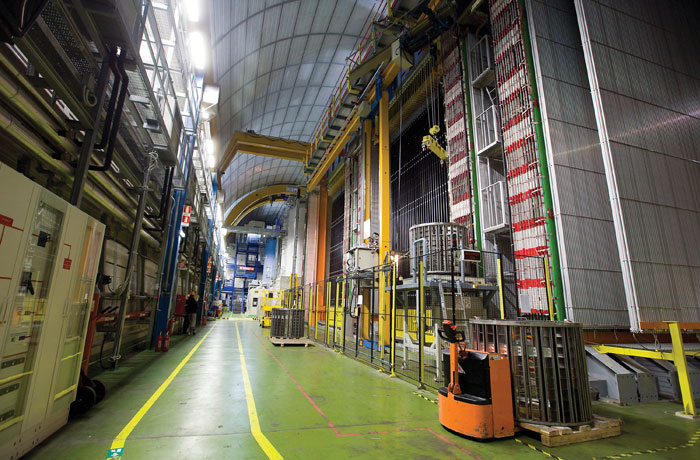
Evidence for the Higgs will not come as a single observation. Instead, physicists must accumulate data related to the energy distribution of the particles that the Higgs decays into. One of the cleanest such decay signatures is the transformation of the Higgs into two Z bosons – particles that are one of the carriers of the weak nuclear force. The Z bosons then decay into pairs of heavy charged particles known as muons, which leave an unmistakable footprint in a detector such as CMS.

Layers of particle sensors

Now, the first such event at the LHC has been seen by CMS – one of the collider’s two enormous general-purpose detectors. CMS consists of concentric layers of particle sensors placed inside and around the bore of a 4 T superconducting magnet. Any Z bosons produced by the proton–proton collisions at the centre of the bore are too short-lived to be detected by the surrounding instrumentation. However, the muons last for long enough to travel out from the collision point and traverse all of the detector's inner sensors. They then travel through a number of gas-filled layers revealing their trajectory via the ionization of this gas. Moving charged particles are bent by a magnetic field such that the curvature of the muons’ paths reveals their momentum.

The CMS data, obtained in the early hours of 24 September, clearly reveal the tracks of four muons (see figure). And the masses of these muons, grouped into two pairs, result in values for the mass of the Z of just over 92 GeV, which is very close to the known Z mass. CMS collaboration member Tommaso Dorigo of the University of Padova in Italy is delighted with the result, describing it on his blog as “as beautiful as they get, or even more so”.

No Higgs required

But Dorigo says that this result on its own provides no evidence that the Higgs boson exists. He points out that pairs of Z bosons can be produced directly by the proton collisions and do not require the intermediate creation of the Higgs. Indeed, he says that this is likely to be the reaction that took place in this case. Showing that the Higgs exists will involve observing many such ZZ pairs and then plotting the distribution of the mass of the pairs. If the pairs are produced in only the direct reaction, then this distribution should be fairly flat; but if instead the Higgs is involved, then the distribution should instead show a peak at a particular value – the mass of the Higgs.

Predicting how many data are likely to be needed to prove that this peak exists, and therefore how long the machine will have to run for before the Higgs is found, is difficult because the fraction of ZZ events that would result from the decay of the Higgs depends on its mass, which is not known from theory. Above about 180 GeV – the combined mass of two Zs – the Higgs can readily decay into a Z-pair, but at lower masses it would be far more likely to decay into other particles that are not so easy to detect.

"For a given Higgs mass we know how many Z pairs, and therefore how many muon quadruplets, we should produce," says Dorigo. "But since we don't know the mass, the fraction of muon events that is due to a Higgs could be lower than a tenth or as high as a few tenths."

Don't speculate, accumulate

Dorigo is reluctant to speculate on when he and his colleagues might finally bag the Higgs. But in very round terms, he says that about 100 pairs of Zs are likely to be needed, which, he believes, means about 100 times the amount of collision data collected so far. This would be about five times the amount of data that would be accumulated before the collider is due to be switched off for an upgrade to full energy at the end of 2011, meaning that conclusive evidence of a Higgs decay to ZZ pairs before then is unlikely (although other decay signatures might enable a discovery with fewer data).

However, ATLAS team member Andy Parker of Cambridge University in the UK points out that the Fermilab's Tevatron accelerator in the US could have its lifespan extended to 2014, which might prompt CERN to delay the upgrade for a year. He says that any decision on whether to extend the current run will depend on how well the accelerator performs next year, but he believes that "this year has gone exceptionally well" and that CERN "could still decide to run in 2012". Either way, he says, the latest CMS result shows that the LHC's experiments "now have enough data to begin the Higgs search in earnest".

LHC now fully fledged heavy metal collider

In the early hours of Sunday morning, the first collisions between lead ions were recorded at the Large Hadron Collider (LHC) at CERN. The complete transition from protons to lead took just four days, after the final proton beams of 2010 were extracted from the LHC last Thursday.

"The speed of the transition to lead ions is a sign of the maturity of the LHC," says Rolf-Dieter Heuer, CERN's director-general. "The machine is running like clockwork after just a few months of routine operation."

The development marks the beginning of the main physics programme for the ALICE experiment, which has been designed specifically for heavy-ion collisions and is seeking to recreate the conditions that existed just 10–11 s after the Big Bang. At this time, the energy in the universe was so concentrated that protons and neutrons could not hold together – instead, space began to be filled with a dense soup of subatomic particles known as quark–gluon plasma.

Strong but mysterious

One of ALICE's main scientific goals is to characterize the quark–qluon plasma in an attempt to find out more about the nature of the strong force, one of the four fundamental forces in nature. Despite being responsible for generating 98% of the mass of atoms, the strong force is still the most poorly understood of the forces.

To do this, the detector was specifically designed to track large numbers of particles. It can detect up to 15,000 particles per event, which may be produced from the collisions between lead nuclei occurring in the centre of the detector.

These images show the first collisions, recorded yesterday by ALICE's innermost detector, the Inner Tracking System. The shaded structures represent a perspective view of the detector elements; and the lines are the reconstructed particle trajectories with the colour scale indicating the energy of the particles. As expected such collisions produce an unprecedented number of particles, reaching 2500–3000 charged particles per collision.

Mini Big Bangs

"We are thrilled with the achievement!" says David Evans, leader of the UK team at the ALICE experiment. "The collisions generated mini Big Bangs and the highest temperatures and densities ever achieved in an experiment."

Lead ions within the LHC are colliding with a centre-of-mass energy of 2.76 TeV per colliding nucleon pair, which generates temperatures in the region of 10 trillion degrees. The temperatures and densities are an order of magnitude larger than the previous record held by the Relativistic Heavy Ion Collider (RHIC) at the Brookhaven National Laboratory in the US.

CERN engineers will now spend up to a week tuning the beamlines in preparation for the scientific programme. Evans and his fellow researchers will then record data until 6 December when CERN will shut down for maintenance work over Christmas. Operation of the collider will start again with protons in February and physics runs will continue through 2011.

مشاهده تصاویر ارائه شده در ادامه مطالب

ادامه نوشته

مکانیک کوانتوم در قرنی که گذشت... قسمت ششم

فراتر از مدل استاندارد:

در حال حاضر، فیزیکدانها برهم کنشهای ذرات زیر اتمی را با انرژیهای بیشتر از یک تریلیون الکترون ولت امتحان کرده و هیچ گونه انحراف تجری از مدل استاندارد مشاهده نشده است. با این حال، گرچه این نظریه، به دور از هر گونه شبه ای موفقیت آمیز بوده است ولی این مدل به دلایل زیر رضایت بخش به نظر نمی رسد:

* برهم کنشهای قوی با سی و شش کوارک توصیف می شوند و دارای شش مزه، سه رنگ و جفت ماده / پاد ماده هستند. «چسب» ای که آنها را به هم پیوند می دهد تا پروتونها و نوترونها را تشکیل دهند، گلوئونها هستند که به وسیله میدان یانگ میلز توصیف می شوند که در مجموعه هشت میدان گلوئون وجود دارند.

* برهم کنش ضعیف نیز با لپتون ها که شامل سه نسل از الکترون، مئون و تاو به همراه نوترینوی وابسته به آنها توصیف می شوند که به نوبه خود با تبادل ذرات W و Z برهم کنش می کنند؛ که میدانهای شدید یانگ میلز هستند.

* نوزده ضریب اختیاری که شامل جرم لپتونها، جرم ذرات W و Z و همچنین شدت نسبی برهم کنشهای قوی و ضعیف را شامل می شود. لازم به ذکر است که مدل استاندارد، مقدار این نوزده عدد را مشخص نمی کند، بلکه آنها را به طور دستی و بدون توجیه در مدل جا داده شده و با اندازه گیری دقیق خواص این ذرات تعیین شده اند.

* برهم کنشهای الکترومغناطیسی که در بستر میدان ماکسولی با تبادل فوتونها توصیف می شوند.

* سرانجام ذره هیگز که شکستن تقارن میدان یانگ میلز را باعث می شود.

* و در نهایت؛ با توجه به اینکه هدف غایی فیزیک، اتحاد بین تمامی نیروهای شناخته شده و رسیدن به یک نظریه واحد است و از آنجا که مدل استاندارد، نیروی گرانشی را توصیف نمی کند، این مدل صرفا با تمام موفقیتهای اعجاب انگیزش یک گام میانی شناخته می شود.

ساده ترین نظریه ای که بتواند تمامی این ذرات را تجدید سازمان دهد، تقارن SU5 است؛ که هوارد گئورکی و شلدون گلاشو، آن را در 1974، محاسبه کردند. در این نظریه یگانگی بزرگ، تقارن SU5 الکترون، نوترینو و کوارکها را به هم پیوند می دهد. آزمایش این نظریه به دلیل اینکه انرژیهایی که در آنها، برهم کنشهای قوی با نیروی الکتروضعیف یگانه می شوند، فراتر از میزان انرژی شتابدهنده های امروزی است، بسیار مشکل است. این نظریه پیش بینی می کند که کوارک می تواند با گسیل یک ذره دیگر به الکترون تبدیل شود. البته این بدین معنی است که پروتون در نهایت به الکترون واپاشی می کند و بدین ترتیب، طول عمر محدودی دارد. این پیش بینی شایان توجه نظریه یگانگی بزرگ که پروتون سرانجام باید به الکترون واپاشی کند، نسل جدیدی از فیزیکدانان تجربی را در سراسر جهان بر آن داشت که به دنبال آزمایش این پیش بینی برآیند. با وجود اینکه نظریه یگانگی بزرگ، نمایانگر پیشرفتی مهم در اتحاد نیروی الکتروضعیف با نیروی قوی است، اما هنوز با مسائل تجربی جدی رو به روست و علاوه بر آن، این نظریه هنوز از نظر تئوری نیز کامل نیست. به عنوان مثال؛ این نظریه نمی تواند توضیح دهد که چرا سه خانواده ذرات که کپی یکدیگر هستند، وجود دارد و همچنین تعداد زیادی از ثابتهای اختیاری (مانند جرم کوارکها، جرم لپتونها و تعداد ذرات هیگز) در نظریه وجود دارد. مهمتر از تمامی این مشکلات، همانند مدل استاندارد، این نظریه، نیروی گرانشی را در بر نمی گیرد و نمی تواند به عنوان یک نظریه نهایی مطرح شود.

پ.ن: از مجموعه مقالات مدیریت وبلاگ

مکانیک کوانتوم در قرنی که گذشت؛ قسمت پنجم

مدل استاندارد:

در ژوئیه 1994، فیزیکدانان آزمایشگاه ملی فرمی یک کشف تازه و سرنوشت ساز انجام دادند؛ آنها توانستند که «کوارک سر» را آشکارسازی نمایند. خبر این کشف بزرگ در صفحه اول روزنامه نیویورک تایمز، به عنوان تیتر اصلی قرار گرفت! چیزی که به کوارک سر این قدر اهمیت داده بود این بود که این آخرین کوارک برای تکمیل «مدل استاندارد» یعنی نظریه کنونی در زمینه برهم کنشهای ذرات و موفق ترین تئوری تاریخ علم بود. فیزیکدانان در سال 1977، اندکی پس از کشف «کوارک ته» در آزمایشگاه ملی فرمی، در جستجوی این ذره بودند، که تلاش آنها در طول پانزده سال بی نتیجه بود. اکثر همایشهای بین المللی فیزیک ذرات، شامل گزارشهایی از شکست های پی در پی آزمایشهای کوارک سر بود.

برای به دام انداختن کوارک سر، شتابدهنده ذرات آزمایشگاه فرمی که تواترون نام دارد دو باریکه از ذرات زیراتمی بسیار پر انرژی تولید کرد که در داخل لوله بزرگ دایره ای شکلی، در دو جهت مخالف حرکت می کردند. باریکه اول از پروتونهای معمولی تشکیل شده بود و باریکه دیگر که در جهت عکس باریکه اول و در زیر آن حرکت می کرد، از پادپروتون تشکیل شده بود. سپس تواترون، این دو باریکه ذرات را به هم برخورد می داد به طوری که پروتونها، پاد پروتونها را با انرژی حدود دو تریلیون الکترون ولت خرد کنند. انرژی عظیم آزاد شده ناشی از این برخورد ناگهانی، سیلی از خرده های زیراتمی را رها می ساخت. با استفاده از تعداد زیادی دوربین عکاسی خودکار و پیچیده و کامپیوتر، فیزیکدانها این خرده ها را از میان یک تریلیون عکس، تحلیل کردند. سپس؛ چندین گروه از فیزیکدانها به بررسی داده ها پرداختند، عکسها را با دقت بازبینی کردند و در نهایت، دوازده برخورد انتخاب شد که «اثر انگشت» برخورد یک کوارک سر در آنها یافت می شد. فیزیکدانان سپس برآورد کردند که کوارک سر، باید جرمی برابر با 174 میلیارد الکترون ولت داشته باشد؛ بدین ترتیب این سنگین ترین ذره بنیادی بود که تا آن زمان کشف شده بود. در واقع، این ذره بسیار سنگین، تقریبا هم جرم با طلا است.

برای درک اهمیت کشف کوارک سر لازم است بدانیم که کوارکها در چندین جفت یا در چند نسل یافت می شوند. پایین ترین نسل، کوارک «بالا» و «پایین» نام دارد. زمانی که سه تا از این کوارکها سبک با هم ترکیب شوند، پروتون و نوترون را تشکیل می دهند. (پروتون از دو کوارک بالا و یک کوارک پایین و نوترون از دو کوارک پایین و یک کوارک بالا تشکیل شده است.) هر یک از کوارک های بالا و پایین به نوبه خود در سه «رنگ» مختلف وجود دارند. بنابراین کوارک های نسل اول، شش کوارک را در بر می گیرند. نسل سنگین تر بعدی کوارک ها، کوارک «شگفت» و کوارک «دلربا» نام دارند. موقعی که این کوارکها به هم می پیوندند، بسیاری از فرآیندهای سنگین موجود در خرده های ناشی از برخورد اتمها، به وجود می آیند. این کوارکها نیز در سه رنگ ظاهر می شوند. کشف کوارک ته در 1977 به این معنی بود که نسل سومی از کوارکها و همچنین کوارک سر نا آشکاری که سومین جفت را تکمیل می کند، باید وجود داشته باشد. بنابراین الگوی معیار یا مدل استاندارد، بر سه نسل کوارک پایه گذاری شد که هر نسل به استثنای جرم خود، همانند نسل قبلی بود. امروزه می دانیم که، کوارکها در شش طعم (بالا، پایین؛ شگفت، دلربا؛ سر و ته) و همچنین سه رنگ یافت می شوند. بنابراین تعداد کوارکها هجده است و چون هر ماده، پاد ماده ای دارد، تعداد کوارکها و پاد کوارکها سی و شش می شود.

پ.ن: از مجموعه مقالات مدیریت وبلاگ

مکانیک کوانتوم در قرنی که گذشت؛ قسمت چهارم

برهم کنشهای قوی:

دیدیم که تقارن پیمانه ای، واگراییهای نظریه الکترودینامیک کوانتومی و نظریه الکتروضعیف را حذف کرد. اما آیا تقارن پیمانه ای می توانست راهگشای حذف بینهایتهای برهم کنش قوی نیز باشد؟ سرآغاز نظریه برهم کنشهای قوی به سال 1935 بر می گردد. در این سال، فیزیکدان ژاپنی هیدکی یوکاوا پیشنهاد کرد که پروتونها و نوترونها با کمک نیروی جدیدی به هم فشرده نگه داشته می شوند که با تبادل ذراتی به نام «مزونهای پی» به وجود می آید؛ وی همچنین توانست جرم این ذرات فرضی را پیش بینی کند. یواکاوا اولین شخصی بود که تبادل ذرات سنگین را برای توضیح نیروهای کوتاه برد، لازم دانست. در سال 1947، فیزیکدان انگلیسی سسیل پاول، این مزون را در جریان آزمایشی با پرتوهای کیهانی کشف کرد. جرم این ذره، با آنچه یوکاوا در دوازده سال قبل پیش بینی کرده بود، بسیار نزدیک بود. به پاس کار پیشگام یوکاوا در آشکار کردن اسرار نیروی قوی، جایزه نوبل در 1949 به وی اعطا شد و پاول جایزه نوبل سال بعد را دریافت کرد. با وجود اینکه نظریه مزون با موفقیت بسیار رو به رو شد و قابلیت باز بهنجارش را داشت، اما فیزیکدانان در دهه های 1950 و 1960 با استفاده از شتابدهنده ها، صدها ذره با برهم کنشهای قوی از انواع گوناگونی که اکنون «هادرون» نامیده می شوند را کشف کردند. با وجود صدها هادرون، هیچ کس نمی توانست بفهمد که با کاوش بیشتر هر روز دانشمندان در قلمرو زیراتمی، چرا طبیعت به طور ناگهانی، بیشتر پیچیده می شود.! تا 1958، تعداد ذرات با برهم کنشهای قوی به قدری زیاد شده بود که فیزیکدانان دانشگاه کالیفرنیا برای اینکه ردپای آنها را گم نکنند، نشریه ای را حاوی مشخصات آنها منتشر کردند؛ اولین نشریه نوزده صفحه داشت که مشخصات شانزده ذره در آن چاپ شده بود. در سال 1995، نشریه به دویست صفحه رسید که صدها ذره را تشریح می کرد. نظریه یوکاوا، با وجود باز بهنجارش پذیری، بسیار ابتدایی تر از آن بود که بتواند این باغ وحش ذرات را که از آزمایشگاه ها بیرون می آمدند، توضیح دهد؛ ظاهرا قابلیت بازبهنجارش کافی نبود!

اولین نظر قاطع در دهه 1950، توسط یک گروه از فیزیکدانان ژاپنی که سخنگوی آن شوئیشی ساکاتا از دانشگاه ناگویا بود، ارائه شد. گروه ساکاتا، با اشاره به آثار فلسفی هگل و انگلس، نظر داد که باید لایه ای در زیر هادرونها باشد که حتی از تعداد کمتری از ذرات زیر اتمی تشکیل شده است. ساکاتا ادعا که هادرونها باید از سه تا از این ذرات و مزون از دو ذره تشکیل شده باشد. گروه او همچنین پیشنهاد کرد که این ذرات پایه، باید از نوعی تقارن جدید به نام (۳)SU تبعیت کنند. این تقارن، روش ریاضی را که این سه ذره باید به هم آمیخته شوند، تشریح می کند. تقارن ریاضی )SU به ساکاتا و گروه او اجازه داد تا پیش بینیهای ریاضی دقیقی درباره لایه موجود در زیر هادرونها به عمل آورند. مکتب ساکاتا، با تکیه بر اصول فلسفی و ریاضی، استدلال کرد که ماده باید از یک دسته بینهایت از این لایه ها، تشکیل شده باشد؛ این نظریه گاهی نظریه دنیاهایی در میان دنیاها نامیده می شود. طبق نظریه ماتریالیسم دیالکتیک، هر لایه از واقعیت فیزیکی، از برهم کنش قطبها آفریده می شود؛ به عنوان مثال، برهم کنش ستاره ها، کهکشانها را به وجود می آورد. برهم کنش بین سیاره ها و خورشید، منظومه شمسی را خلق می کند. برهم کنش بین الکترون و هسته، اتم را به وجود می آورد و بالاخره، برهم کنش بین پروتونها و نوترونها، هسته را می آفریند.

کشف غیر منتظره بعدی، بر پایه این عقیده که لایه ای در زیر هادرونها وجود دارد، در اوایل دهه شصت به دست آمد. موری گلمان از انستیتوی تکنولوژی کالیفرنیا و فیزیکدان اسرائیلی یووال نیمن نشان دادند که این صدها هادرون، در ردیف های هشت تایی جای می گیرند. گلمان، این نظریه ریاضی را «راه هشت گانه» نامید؛ نامی که از طریق وصول عقل محض در مکتب بودایی ها اقتباس شده بود. بعدها گلمان و جرج تسوایگ، نظریه کامل را پیشنهاد کردند. آنها کشف کردند که موضوع راه هشت گانه، از وجود ذرات زیر هسته ای ریشه می گیرد. (گلمان، آنها را با الهام از یک داستان جیمز جویس به نام مراسم عزاداری فینگن «کوارک» نامید!) این ذرات از تقارن )SU پیروی می کنند که مکتب ساکاتا، سالها قبل پیشگام آن بود. گلمان دریافت که با درنظر گرفت ترکیبات ساده ای از سه کوارک، می تواند به طرز معجزه آسایی صدها ذره ای را که در آزمایشگاه ها کشف شده بودند، توضیح دهد و مهمتر از آن، وجود ذرات کشف نشده ای را پیش بینی کند. به این ترتیب، او یک اشتباه کوچک ولی مهم را در نظریه ساکاتا تصحیح کرد. در واقع، با ترکیب مناسب این سه کوارک، گلمان توانست عملا تمام ذراتی را که در آزمایشگاه ها به ظهور رسیده بودند، توضیح دهد. به پاس سهمی که گلمان در فیزیک برهم کنشهای قوی داشت، جایزه نوبل سال 1969 به او اهدا شد.

در همین سالها و در اوایل دهه هفتاد، هیجان برخاسته از نظریه الکتروضعیف به سوی الگوی کوارک سرازیر شد. اما با وجود موفقیتی که نصیب الگوی کوارک شد، هنوز موضوع دیگری باقیمانده بود؛ نظریه بازبهنجارش پذیر و رضایت بخشی که بتواند نیروی نگه دارنده این کوارک را توضیح دهد، وجود نداشت! با وجود نتایج به دست آمده، عملا یک اتفاق نظر جهانی وجود داشت که نظریه یانگ میلز می تواند با موفقیت، کوارکها را در یک چارچوب بازبهنجارش پذیر، پیوند دهد. در پاره ای از شرایط، یک ذره یانگ میلز که «گلوئون» نام دارد، می تواند همانند یک ماده چسبناک، کوارکها را بهم متصل کند. این نیرو، «رنگ» نام دارد و نظریه منتج از آن «کرومودینامیک کوانتومی» نام گرفته است. حال مسئله بعدی که پیش روی فیزیکدانان قرار گرفته بود؛ این بود که آیا می توان یک نظریه واحد برای برهم کنش های قوی، ضعیف و الکترومغناطیسی به وجود آورد؟

پ.ن: از مجموعه مقالات مدیریت وبلاگ

Heavy atoms set to collide at the LHC

THE world's most powerful particle smasher is moving on to heavy ions in its bid to explore the universe's first microseconds.

The Large Hadron Collider at CERN, near Geneva, has already met its 2010 target for the number of proton collisions. It is set to start colliding lead ions in November.

"It's one of the largest steps that any collider has made over its predecessor, possibly the largest in history," says John Jowett, lead physicist for heavy ion collisions at the LHC. As the ions smash into each other they will create a fireball of the quarks and gluons that make up protons and neutrons. The collision energies should far outstrip those achieved by the current record holder, the Relativistic Heavy Ion Collider (RHIC) at Brookhaven National Laboratory in New York.

Contrary to early expectations, the RHIC collisions showed that particles in the soup of quarks and gluons behave as if they are in a liquid. It will be interesting to see whether this behaviour holds at the LHC's higher temperatures, says Peter Steinberg of Brookhaven.

دوستان عزیز؛ ترجمه این پست را میتوانند در وبلاگ زیر بخوانند.

حسام الدین

مدرکی جدید برای توضیح معمای هستی

نظریات فیزیک بیان می‌دارند که مقدار ماده و پادماده در جهان باید برابر باشد، این درحالی است که می‌دانیم در دنیای ما خبری از پادماده نیست. فیزیک‌دانان فرمی‌لب حدس می‌زنند پاسخ این معما را یافته‌اند.

سالیان سال است که دانشمندان به دنبال کشف معمای هستی هستند. اخیرا (مقاله مربوط به ماه می میلادی می باشد.) فیزیک‌دانان آزمایشگاه ملی شتابدهنده فرمی در ایالات متحده توانسته‌اند مدارکی جدید کشف کنند که شاید بتواند در حل یکی از بزرگ‌ترین معماهای گیتی کمک کند، این‌که چرا جهان به جای پادماده از ماده تشکیل شده است؟ اگر این مدرک تایید شود، می‌تواند توضیحی منطقی برای این سئوال دیرینه ارایه کند.

بد نیست بدانید که در یک دنیای کاملا متقارن ریاضی، ما اصلا نباید وجود داشته باشیم. طبق قوانین نسبیت انیشتن و مکانیک کوانتومی، وقتی انفجار بزرگ در حدود 14 میلیارد سال پیش رخ داد، مقادیر مساوی از ماده و پادماده تولید شده که بلافاصله می‌بایست همدیگر را خنثی می‌کرده‌اند؛ اما امروز ما وجود داریم و می‌دانیم که ستارگان و کهکشان‌های بسیار زیاد دیگری هم وجود دارند که همگی از ماده تشکیل شده‌اند. به همین دلیل فیزیک‌دان‌ها و خیلی‌های دیگر به‌شدت دوست دارند بدانند که چرا ما وجود داریم و چه بلایی سر آن‌همه پادماده آمده است؟

به گزارش نیویورک تایمز، فیزیک‌دانان آزمایشگاه فرمی که تا سال گذشته قوی‌ترین شتاب‌دهنده ذرات در دنیا را در اختیار داشتند، با هدف دست‌یابی به پاسخی برای این سئوال، گروهی را به نام دی‌زیرو (DZero) تشکیل دادند و با بررسی اطلاعات حاصل از برخورد پروتون‌ها و پادپروتون‌ها دریافتند که در گوی‌های آتشین برجامانده از برخورد، به جای تولید تعداد مساوی زوج ذره میون و پادمیون، میون‌ها اندکی بیشتر از پادمیون‌ها تولید می‌شوند که موجب می‌شود دنیای مینیاتوری درون شتاب‌دهنده از حالت خنثی به این سمت برود که یک درصد ماده بیشتر به جای پادماده داشته باشد.

به گفته گنادی بوریسوف، عضو این تیم تحقیقاتی از دانشگاه لانکستر انگلیس، چنین نتیجه‌ای می‌تواند اطلاعات مهمی برای این موضوع باشد که چرا در دنیای ما ماده بر پادماده غالب است. ما حدس می‌زنیم که اتفاق مشابهی در نخستین آتوثانیه‌های پس از مهبانگ (اگر یک ثانیه را به هزار میلیارد قسمت تقسیم کنیم، هر یک از آن‌ها معادل یک آتوثانیه خواهد بود) روی داده باشد.

اولین کسی که راجع به غلبه ماده بر پادماده در ابتدای جهان استدلال کرد، یک فیزیکدان روس به نام اندری ساخاروف بود. او گفت که تفاوت بسیار کمی در خصوصیات ذرات و پادذرات وجود دارد که وقتی بارها و چرخش ذرات معکوس می‌شود، باعث رفتار اندک متفاوت آن‌ها خواهد شد. سال‌ها بعد فیزیک‌دانان دیگری هم توانستند مثالهایی برای این موضوع در واکنش‌های بین ذرات درون اتمی پیدا کنند، اما این مثال‌ها هنوز هم برای توضیح وجود ما کافی نبود.

دکتر گوستاو بروجمانز، یکی دیگر از اعضای تیم دی‌زیرو، راجع به اثر جدید گفته است که این اثر به رفتار بسیار عجیب ذراتی تحت عنوان "مزون‌های ب خنثی" بستگی دارد. به گفته وی این ذرات هزاران میلیارد بار در ثانیه بین حالت عادی خود و حالت پادماده در نوسان هستند. اما به نظر می‌رسد مزون‌هایی که در برخورد پروتون-پادپروتون تولید می‌شوند، کمی سریع‌تر از دیگر حالت‌ها از حالت پادماده به ماده منتقل می‌شوند و همین امر به برتری یک درصدی ماده بر پادماده منجر می‌شود.

دکتر بروجمانز در ادامه افزود که حتی اگر این یافته بتواند توضیحی کافی برای وجود ما باشد، هنوز هم یک سئوال بی‌پاسخ دیگر باقی است: «دلیل این رفتار اسرارآمیز مزون‌های بی چیست؟ شاید بهترین توضیح این باشد که برخی از ذرات جدید و یا برخی از انواع جدید از تعاملات بین ذرات در مدل استاندارد پیش‌بینی نشده‌اند».

مکانیک کوانتوم در قرنی که گذشت؛ قسمت سوم

برهم کنشهای ضعیف:

برهم کنشهای ضعیف، به رفتار الکترونها و همتای نوترینوی آنها مربوط می شوند. ذراتی که برهم کنش ضعیف دارند، به طور کلی «لپتون» نامیده می شوند. از همه ذراتی که در جهان وجود دارند، شاید نوترینو ها بیشتر از همه کنجکاوی انسان را برانگیخته باشند؛ زیرا از همه ذرات دیگر، گریزانترند. این ذره، بار الکتریکی و احتمالا جرم ندارد و آشکارسازی آن فوق العاده مشکل است. در سال 1930، ولفگانگ پائولی، به دلایل کاملا نظری، وجود این ذره را پیش بینی کرد تا بتواند از دست رفتن عجیب انرژی را در واپاشی رادیواکتیو توضیح دهد. پائولی نظر داد که این انرژی از دست رفته، به ذره جدیدی که در آزمایشها دیده نمی شود، انتقال یافته است. در سال 1933، فیزیکدان ایتالیایی انریکو فرمی، اولین نظریه جامع این ذره را منتشر کرد. وجود نوترینو سرانجام در سال 1953 در آزمایشی دشوار که مستلزم بررسی تابش عظیم ناشی از یک راکتور هسته ای بود، تایید شد. پس از کشف نوترینو، مخترعان طی سالها سعی کردند که راهی برای استفاده عملی از نوترینو پیدا کنند؛ جالبترین طرحها؛ تلسکوپ نوترینو و بمب نوترینو بود.

علاوه بر نوترینو، معمای برهم کنشهای ضعیف با کشف ذرات برهم کنش کننده دیگر مانند «مئون» عمیقتر شد. در سال 1937، زمانی که این ذره در عکس های پرتوهای کیهانی کشف شد، مانند یک الکترون ولی دویست بار سنگینتر از آن نمایان شد که برای هر منظور و هر مقصودی می توانستیم آنرا همچون الکترون سنگینی به کار ببریم. این تحولات زمانی وخیم تر شد که در سال 1962، فیزیکدانان با استفاده از اتم شکن بروکهاون در لانگ آیلاند آمریکا نشان دادند که مئون نیز همتای مشخصی برای خود به نام نوترینوی مئونی دارد. آزمایشهای سال های 1977 و 1978 در دانشگاه استانفورد آمریکا و دانشگاه هامبورگ آلمان، وجود یک نوع الکترون دیگر را تایید کرد که وزن آن سه هزار و پانصد برابر جرم الکترون بود. این ذره «تاو» نامیده شد. اکنون سه نوع الکترون وجود داشت که هر یک نوترینوی خود را داشت و همه به استثنای جرمشان، از خانواده الکترون بودند. حال دیگر ایمان فیزیکدانان به ساده بودن طبیعت با موجودیت سه زوج خانواده لپتونها، متزلزل شده بود.

فیزیکدانان که با مسئله برهم کنشهای ضعیف مواجه شده بودند، روشی مشابه با نظریه الکترودینامیک کوانتومی برگزیدند. بر اساس مبانی الکترودینامیک کوانتومی، نیروی بین الکترونها با تبادل فوتونها توضیح داده می شود؛ بر پایه همان دلایل، فیزیکدانان حدس زدند نیروی بین الکترونها و نوترینوها با تبادل یک دسته از ذرات جدید که ذرات W نامگذاری شدند، به وجود می آید. با این وجود، مشکل این بود که این نظریه قابل بازبهنجارش نبود و بینهایتهای موجود در این نظریه، از ذرات واسطه W نشات می گرفت که برخلاف فوتونها در الکترودینامیک کوانتومی، تقارن پیمانه ای نداشتند.

در سال های 1967 و 1968؛ استیون واینبرگ، عبدالسلام و شلدون گلاشو، تشابه شگفت انگیزی بین فوتون و ذره W مشاهده کردند که به خلق نظریه جدیدی منجر شد که توانست اتحاد بین نیروهای ضعیف و الکترومغناطیسی را بر اساس یک تقارن جدید ریاضی برقرار کند؛ در این نظریه ذره W از عالیترین شکل تقارنهای پیمانه ای که در آن زمان موجود بود [SU(2)×U(1)] و از تئوری میدان یانگ میلز نشات گرفته بود؛ استفاده می کرد. این نظریه همچنین با الکترون و نوترینو، به صورت تقارنهای یک خانواده رفتار کرد، اما توضیحی برای اینکه چرا سه خانواده الکترون وجود دارند، ارائه نمی داد.

نهایتا پس از سه دهه، یک دانشجوی بیست و چهار ساله دوره کارشناسی ارشد به نام گراد، ت. هوفت توانست اثبات کند که نظریه یانگ میلز بازبهنجارش پذیر است. اما حتی هنوز نیز فیزیکدانان کاملا درک نکرده اند که تقارنهای موجود در نظریه یانگ میلز، چگونه بینهایتهای نظریه ذره W را حذف کرده اند. این رخداد، همانگونه که قبلا نیز توضیح داده شد، تاثیر متقابل تقارن و بازبهنجارش است.

پ.ن: از مجموعه مقالات مدیریت وبلاگ

Does dark matter trigger strange stars؟

The energy needed to convert a neutron star into a so-called strange star may come from annihilating dark-matter particles. That is the conclusion of a new study by physicists in Spain, the UK and the US, who propose that this conversion mechanism may be a good way to put a lower limit on the mass of weakly interacting massive particles (WIMPs), a leading candidate for dark matter.

Once their nuclear fuel has burnt up, stars below a certain mass collapse to form neutron stars. These incredibly dense objects consist almost entirely of neutrons, the gravitational collapse having forced protons and electrons to merge. It has been proposed, however, that, given some kind of source of additional energy, neutron stars can convert to strange stars, objects consisting of strange matter – a soup of unbound up, down and strange quarks.

The idea is that adding this energy to a certain limited volume of the neutron star will unlock the up and down quarks confined inside the neutrons. Some of these quarks will then naturally convert into strange quarks, producing a region of strange matter known as a strangelet. If, as has been hypothesized, strange matter is in fact more stable than normal, nuclear, matter it will exist a lower energy. The excess energy given off by the conversion of normal matter into strange matter then unlocks more up and down quarks, leading to the creation of more strangelets.

Illustration of a neutron star and a strange quark star showing the relative sizes and the constituent quarks. (Courtesy: CXC/M Weiss)

The result is a runaway process capable of converting an entire neutron star into strange matter within a second or less. "The neutron star is metastable, like someone on a mountain ledge," explains Joseph Silk of the University of Oxford who was involved in the work. "Just as a little kick can push that person off the ledge and send them to the bottom of the mountain, so a little energy is enough to transform a neutron star into a strange star."

Does strange matter exist?

While there is no clear evidence that strange matter actually exists, the observation of extremely brief but ultra-bright bursts of gamma rays from the cosmos suggests the existence of strange stars. Researchers have proposed that the enormous power needed to produce a gamma-ray burst could come from the formation of a black hole, but the large numbers of particles of normal matter surrounding a black hole could absorb much of that energy. The conversion of a neutron star into a strange star, however, could provide the required energy but without the surrounding matter.

However, that still leaves the question of where the neutron star gets its initial spark of energy. Some have suggested it simply comes from the energy of collapse or from very high-energy cosmic rays colliding with the star. Silk, however, points out that the former mechanism requires neutron stars to have a minimum mass and maintains that the latter mechanism is problematic because, he says, it would be unlikely to dump energy in the middle of the star, which is where it is needed to initiate the chain reaction.

Instead, Silk, Angeles Perez-Garcia of the University of Salamanca and Jirina Stone of the University of Tennessee, have calculated that annihilating WIMPs, which can accumulate in the centre of stars, could provide this energy. If confirmed, the mechanism would provide a new, independent lower limit for the mass of a WIMP. This is approximately 4 GeV (gigaelectronvolts), half of the minimum energy that the trio calculate is needed to initiate the neutron star conversion in this way (with each WIMP providing half of the mass-energy in each collision).

New way to find WIMPs

With direct, ground-based dark matter searchers able to go down to about 50 GeV, Silk says that this new approach could provide a useful complement to existing experiments. He points out that theory does not favour a WIMP mass of between 4 and 50 GeV but that a figure of about 10 GeV has been suggested by the recent, contested, results from ground-based detectors.

The team claims that two lines of observation could support their thesis and thereby help place a new limit on the mass of WIMPs. One would involve measuring the mass and radius of a strange star, obtained by studying the radiation of pulsars, and comparing these values with the predictions made by their model and those of alternative models. Evidence could also be obtained by creating and then measuring strangelets at the Relativistic Heavy Ion Collider in the US or in the Large Hadron Collider at the CERN laboratory near Geneva.

Paolo Gondolo of the University of Utah in the US believes that the new mechanism is plausible but has his doubts as to whether it could be used in the search for dark matter. "Even if a strange star is detected it might be hard to tell if it was formed by dark matter annihilation," he says.

Cautious support for the dark-matter mechanism also comes from Dejan Stojkovic of the State University of New York in Buffalo, who says that this process "might be realized in nature". But he maintains that the stability of the strange star in this scenario must be investigated. "If WIMP annihilation is too quick or too slow, the star may never reach thermodynamic equilibrium," he says.

لینک خلاصه مقاله

New High-Speed Integrated Circuit for World's Biggest Physics Experiment Is Fastest of Its Kind

This new "link-on-chip" -- or LOC serializer circuit -- was designed by physicists at Southern Methodist University in Dallas as a component for use in a key experiment of the Large Hadron Collider particle accelerator in Europe.

The miniscule SMU LOC serializer was designed for ATLAS, which is the largest particle detector at the Large Hadron Collider.

The LHC, as it's called, is a massive, high-tech tunnel about 100 meters underground. Within the LHC's circular, 17-mile-long tunnel, protons traveling at high energy are smashed together and broken apart so physicists worldwide can analyze the resulting particle shower detailed in a flood of electronic data.

ادامه نوشته

نوترینو و انرژی تاریک

طبق فرضيه تازه اي مهم ترين معماهاي فيزيک در دهه گذشته ، يعني جرم نوترينوها و آهنگ فزاينده انبساط جهان به ذرات بنيادي به نام اکسلرون مربوط مي شود. شايد بتوان دو دستاورد بزرگ فيزيک در دهه گذشته را مربوط به کيهان شناختي دانست ، يکي اينکه نوترينو ها (ذرات زير اتمي بسيار کوچک) جرم ناچيزي دارند که البته هنوز اندازه گيري نشده است و ديگري اينکه سرعت انبساط عالم در حال حاضر در حال افزايش است. سه فيزيکدان در دانشگاه واشنگتن معتقدند که اين دو کشف هر دو بگونه اي به ناشناخته ترين پديده ي کنوني در عالم ، يعني انرژي تاريک مرتبط است ـ ما هنوز به درستي آنرا نمي شناسيم ، تنها مي دانيم عاملي است که بر ضد گرانش ، سبب سرعت بخشيدن به انبساط عالم مي شود ـ آنها معتقدند همه چيز زير سر ذره زير اتمي ديگري است که تاکنون مورد توجه قرار نگرفته است و آنرا «اکسلرون» به معناي شتابگر ناميده اند.

انرژي تاريک در عالم اوليه چندان قابل توجه نبوده است اما در حال حاضر 70 درصد عالم را اشغال کرده است. شناخت انرژي تاريک به ما کمک مي کند تا بدانيم چرا در زمان دوري در آينده ؛ عالم آن چنان وسعت پيدا مي کند که ديگر هيچ کهکشاني در آسمان شب ديده نمي شود و آيا اين انبساط تا ابد و بينهايت ادامه خواهد داشت؟

در نظريه جديد مطرح شدن نوترينوها تحت تاثير نيروي جديدي که از برهم کنش آنها با اکسلرون ها ناشي مي شود قرار مي گيرد اين نيرو سبب مي شود که نوتيرنو ها از هم فاصله بگيرند. درست مثل اينکه يک تکه کش را از دو طرف بکشيم ، هر چقدر بيشتر کشيده شود ، انرژي بيشتري را در خود ذخيره مي کند. در هر ثانيه تريليونها نوترينو در کوره هستهاي ستارگان از جمله خورشيد ما ساخته ميشود. آنها در همه جاي عالم جريان پيدا مي کنند و ميليارد ها نوترينو از هر نوع ماده اي ، حتي بدن شما بدون هيچ برهمکنشي عبور مي کنند. نوترينو ها بار الکتريکي ندارند و جرم آنها هم آنقدر ناچيز است که هنوز اندازه گيري نشده است. «آن نيلسون» يکي از ارائه دهندگان نظريه جديد معتقد است برهمکنش ميان اکسلرونها و ذرات ديگر از اين هم ضعيفتر است ، براي همين اين ذرات تاکنون آشکار نشده اند. البته نيرويي که اين ذرات بر نوترينو ها وارد مي کنند ، آنها را تحت تاثير قرار مي دهد و به اين ترتيب بايد بتوان وجود چنين نيرويي را در آشکارسازهاي نوترينوي فعلي که در نقاط مختلف کره زمين وجود دارد نشان داد.

مدلهاي مختلفي براي انرژي تاريک ارائه شده ، اما آزمودن آنها محدود به اندازه گيريهاي دقيق در تغيير سرعت انبساط عالم است. اين امر تنها با رصد اجرام بسيار دور دست امکان پذير است ، اما اندازه گيريهاي دقيق در چنين فاصله هايي بسيار مشکل است. به گفته نيلسون اين تنها روشي است که ما مي توانيم با بکارگيري آشکارسازهاي فعلي در کره زمين به نيرويي که سبب افزايش انرژي تاريک در عالم مي شود پي ببريم.

محققان معتقدند جرم نوترينو در عبور از محيطهاي مختلف ، تغيير مي کند ؛ همانطور که عبور نور از هوا ، آب يا يک منشور متفاوت است. در نتيجه آشکارسازهاي مختلف بسته به اينکه در چه مکاني نصب شده اند ، نتايج متفاوتي به دست خواهند آورد. اما اگر بپذيريم که نوترينو ها نيز بخشي از انرژي تاريک هستند ، وجود نيروي جديدي مي تواند اين افت و خيزها را توضيح دهد. به عقيده نيلسون اين برهمکنش ميان نوترينو ها و اکسلرونها مي تواند تا ابد انرژي لازم براي انبساط عالم را تامين کند.

تا پيش از اين اخترشناسان به دنبال اطلاعاتي بودند که سرانجام تعيين کنند آيا عالم ما تا ابد منبسط خواهد شد ، يا زماني دوباره در يک «رمبش بزرگ» منقبض شده و روي خودش بسته ميشود. اما حالا بايد به دنبال اين باشيم که آيا سرعت انبساط عالم همچنان افزايش خواهد يافت يا در جايي ثابت خواهد ماند. بر اساس نظريه جديد ، هنگاميکه فاصله نوترينو ها بسيار زياد شود ، جرم آنها نيز آنقدر افزايش پيدا مي کند که ديگر انرژي تاريک بر آنها هيچ اثري نخواهد داشت ، در نتيجه شتاب انبساط عالم کم کم از بين مي رود ؛ و از اين پس عالم همچنان به انبساط خود ادامه خواهد داد ، اما با سرعتي که دائما ً در حال کاهش است.

نیروهای طبیعت

تا کنون تنها چهار نوع از میدانهای نیرو کشف شده اند: گرانش، الکترومغناطیسی، نیروی هسته ای قوی و ضعیف. که هر یک ذرات خاص خود را دارند: به ترتیب گراویتونها، فوتونها، گلئونها و بوزونهای Z و W. هر نوع نیرو مطابق با نوعی پرتو است. هر چند دوتا از آن پرتوها، پرتو گرانشی و الکترومغناطیسی در فاصله ای بسیار بزرگتر از ابعاد هسته اتمی انتشار می یابند. در هر مرحله، ذره، پرتو یا نیروهای زمینه ای مختلف از وجود فیزیکی مربوطه را بازگو می کنند.

گرانش ساده ترین نیروست و برای جفت شدن فقط به حضور انرژی نیاز دارد. بنابراین گرانش صورتهای انرژی را به صورتهای دیگر تبدیل می کند (این شامل هر دو میدان نیرو و ماده می گردد). هر ذره از هر نوعی که باشد، به این دلیل که برای وجود باید انرژی منتقل کند ، یک نیروی گرانشی احساس می کند. این نیرو برای تمامی شکلها ماده ، به صورت گرانی است. نیروی گرانشی، تمایل به حرکت دادن اجسام به سوی یکدیگر دارد ـ تا کنون هیچ نوع گرانش منفی مشاهده نشده است. اگر چه در برخی حالتها از نظر فیزیکی امکان پذیر است و چنین به نظر میرسد که به صورت بحرانی در آغاز انفجار بزرگ با اهمیت بوده است. در نهایت باید گفت که این نیرو دارای بعد طولانی است. مهم نیست که اجسام چقدر از هم فاصله دارند، گرانش آنها را با هم جفت میکند. به همین دلیل گرانش مهمترین نیرو در میان اجسام بسیار بزرگ است. که حتی در میان خورشید و سیاراتش و همچنین در داخل کهکشانها، این نیرو وجود دارد؛ و همچنین، گرانش انبساط جهان را نیز تحت کنترل خویش دارد. گرانش نخستین نیرو با یک رابطه دقیق ریاضی بود ؛ قانون جهانی گرانش نیوتن نشان داد که همان نیرو (گرانی) سقوط سیب به سطح زمین، سقوط دائمی ماه و سقوط سیارات در مدارشان را تحت کنترل دارد. پرتو گرانش ، یعنی امواج گرانشی به صورت مستقیم کشف نشده اند، هر چند که انرژی از دست رفته آن به صورت غیر مستقیم اندازه گیری می شود.

الکترومغناطیسی نیرویی است پیچیده تر از گرانش؛ به منظور جفت شدن با این نیرو ، به بار الکتریکی نیاز است. بر خلاف انرژی که تمام ذرات دارای آن هستند، بار الکتریکی خصوصیتی است که برخی از ذرات دارند و بقیه فاقد آن می باشند. از آنجا که برخی از انواع ماده از نظر الکتریکی خنثی هستند، هیچ نیروی الکتریکی را احساس نمی کنند. همچنین بار الکتریکی با دو علامت مثبت و منفی ظاهر می شود که اگر هر دو از نظر عددی به یک اندازه باشند ، یکدیگر را خنثی می کنند. نیروی الکتریکی میان ذرات می تواند از نوع گرانی باشد (برای بارهای مخالف) یا از نوع دافعه باشد (برای بارهای موافق). نیروهای مغناطیسی که همانند نیروهای الکتریکی در نهاد و وجود اجسام قرار دارند، اگر دارای حرکت بارها باشند، زیاد می شوند. همانند جریان الکتریکی منظم در داخل یک سیم پیچ یا اتمهایی که در سوزن یک قطب نما، در یک راستا قرار گرفته اند. نیروهای الکترومغناطیسی همانند گرانشی، در فواصل زیاد عمل می کنند. میدانهای الکترومغناطیسی بر روی بادهای خورشیدی و پرتوهای کیهانی [و آب و هوای زمین] تاثیر می گذارند. آنها در بین کهکشانها گسترش می یابند ، شکل گیری ستارگان را کنترل می کنند و اصل و خاستگاه اصلی انرژی از سیاهچاله ها را کاتالیزه می نمایند. تمامی نوری که شامل پرتوها از رادیو موج در میان نور مرئی تا اشعه ایکس است ، از جنبش میدانهای الکترومغناطیسی تشکیل شده است. واقعیت شگفت آوری که در قرن نوزدهم صریحا ً توضیح داده شد ، همین مورد بود. تمام اختلافات آشکار میان انواع گوناگون پرتوها تنها از چگونگی سریع یا کند جنبیدن الکترونها ، فرکانس و یا طول موج نور نشات می گیرند. باید توجه کرد که نور در ذات خود از نظر الکتریکی باردار نیست و فقط با بار الکتریکی جفت می شود. نور از همان میدانهای الکترومغناطیسی شکل یافته است که عقربه قطب نما را می گردانند و موهای سر شما را به صورت ایستاده نگه میدارند. همین حضور و حرکت اجسامی که بار الکتریکی دارند، این میدانها را ایجاد می کند. الکترومغناطیس به همراه قوانین مکانیک کوانتومی، ساختار ابرهای الکترونی که بیشتر توده های اتمی را در مواد معمولی بوجود آورده اند، مشخص می کند. این نیرو همچنین رفتار شیمیایی تمام اتمها و مولکولها و چیزهایی را که ما از آنها درست شده ایم تحت کنترل خود دارد.

نیروی قوی که همچنین نیروی «رنگ دینامیکی» نیز نامیده میشود، از نظر ریاضی پیچیده ترین نیروهاست. اگر چه این نیرو، اعتبار مهمی برای ساختن ماده دارد، در زندگی روزمره به طور مستقیم و واضح درک نمی شود. نیروی قوی بر خلاف بار الکتریکی منفرد، با یک «بار قوی» مرکب و پیچیده که «رنگ» نامیده میشود، جفت می گردد و در سه نوع مختلف می باشد: R (قرمز) G (سبز) و B (آبی). این بارها می توانند در یک ذره منفرد با یکدیگر ترکیب شوند و نیرو به این ترکیب بستگی دارد. نیروهای قوی می توانند از نوع جاذبه یا دافعه باشند. آنها حتی می توانند یک جانبه باشند. در بعضی جهات اغلب توام و در برخی جهات دیگر جدا از هم هستند. نظر به اینکه تنها یک فوتون وجود دارد (و آن یک نوع پرتو الکترومغناطیسی است) ، رنگهای مختلف تنها در بسامد با هم اختلاف دارند. هشت نوع متمایز از گلئونها نیروی قوی را تشکیل می دهند، هشت نوع مختلف از «نور قوی» بر خلاف فوتونها. گلئونها خودشان بارهای رنگی را که با آنها جفت شده اند ، حمل می کنند. به دلیل اینکه فوتونها از نظر الکتریکی خنثی هستند، دو پرتو نور به راحتی از میان یکدیگر عبور می کنند. نور هرگز از خود روشنایی ساطع نمی کند و تنها ماده می تواند این کار را انجام دهد. ولی گلئونها از نشر دیگر گلئونها به دست می آیند و خود همیشه گلئونهای دیگری را منتشر می سازند. این «خود واکنشی»، نیروهای گلئونی موثری را در یک محدوده کوچک به وجود می آورند. آنها هیچ گاه از هم دور نمی شوند و به فواصل دور نمی روند. نیروهای قوی همیشه به خنثی کردن یکدیگر اقدام می کنند. این نیرو تنها در فواصل کوچک و انرژی ذره ای بالا عمل می کنند. این نیرو اندازه ها و اشکال هسته اتمها و اجتماعات کوچک نوترونها و پروتونها (نوکلئونها) در مرکز اتمها را کنترل می کند. هسته اتم بیشتر جرم اتم را شامل می شود؛ در واقع بیشتر جرم، از انرژی گلو ئونیک درست شده است. این مطلب غیر منتظره به نظر می رسد که ما گلوئونها ـ را که ماده نیستند و نیرو می باشند ـ به عنوان تشکیل دهنده بیشتر جرم اجسام تلقی کنیم. ذهن ما چقدر آرامش می باید که مرزهای ناشناخته طبیعت را بپذیرد!! نیروی قوی مشخص می کند که هسته کدامین اتمها در طبیعت به طور پایدار وجود دارند و کدام عناصر شیمیایی می توانند وجود داشته باشند.

نیروی ضعیف، با بار پیچیده و به خصوصی جفت می شود که « هم اسپین» ضعیف نام دارد. این نام پس از مشاهده رفتار یک اسپین وابسته به ریاضی برگزیده شد. بر خلاف گراویتونها ، فوتونها و گلئونها و بوزونهای W و Z که نیروی ضعیف را منتقل می کنند، جرم دارند که به این نیرو یک برد بسیار کوتاهی می دهد. در واقع آنقدر کوتاه که واکنشهای ضعیف کاملا ً به ندرت اتفاق می افتند و پرتو تولید شده از ذرات Wو Z حتی نمی توانند به اندازه کافی حرکت کنند تا از یک هسته اتمی بگذرند. اگر چه نیروی ضعیف، ظریف و کند است، بسیار حائز اهمیت می باشد ؛ چرا که ذرات را در میان اشکال مختلف و تقریبا ً پایدار تغییر شکل می دهد (به عنوان مثال از نوترون به پروتون). این گونه نابودی ، ترکیب هسته را تغییر می دهد و یک عنصر را بع دیگری متحول می گرداند؛ پرتوزایی تریتیوم که به عقربه های ساعت نیرو و توان می دهد ، در حال نابودی از یک شکل هیدروژن سنگین به یک ایزوتوپ سبکتر هلیوم می باشد.

شباهتهایی که در میان صفات این نیروها به چشم میخورد، شاید یک عمومیت ژرفتری از آن چیزی را که تحت الشعاع خود دارند، منعکس کنند. در سطحی فراتر از دانش، تمامی نیروها ممکن است در نهایت به عنوان صورتهای مختلف یک نیروی واحد و منفرد شناخته شوند. در واقع مثل همان ارتباطی که پیش از میان نیروی الکترومغناطیسی و نیروی ضعیف ظاهر گردید و هر دو بعنوان نیروی « الکتروضعیف» با هم متحد شدند. تقارن بنیادین میان این نیروها هم اکنون بعلت پدیده ای که «شکست تقارن اسپوتانئوس» نامیده می شود، قابل مشاهده است که مجموعه میدانها را وادار به قرار گرفتن در سطح کمترین انرژی هدایت می کند که این سطح تقارن میان نیروها را رعایت نمی کند. در چنین وضعیتی ، برخی از میدانهای الکتروضعیف شبیه به فوتونها و میدانهای دیگر همانند بوزونهای سنگین Wو Z هستند. فرآیند فرعی مورد علاقه در طی این شکست تقارن این است که به ذرات جرم سکون می بخشد که در غیر اینصورت، بی جرم خواهند بود؛ همانند الکترون. هم اینک نظریه های زیادی برای وحدت و یگانگی با شکوه تر نیروها وجود دارند. نظریه های عمده وحدت، متوجه اتحاد میان نیروهای قوی و الکتروضعیف بوسیله همان طرح رایج برای یگانگی الکتروضعیف هستند. به نظر می رسد که وحدت با نیروی گرانش خیلی مشکلتر باشد و شاید مستلزم اتحاد نیروها با ماده باشد. در واقع این برای نیرویی مناسب است که با تمامی صورتهای انرژی جفت گردد.

شتابدهنده های ذرات

شتاب دادن ذرات باردار

اگر ذره بارداری از ناحیه ای که در آن میدان الکتریکی برقرار است بگذرد ، به آن نیرویی وارد می شود. ذارتی که بار مثبت دارند ، مانند پروتونها ، در جهت میدان شتاب می گیرند ؛ و سرعت آنها در آن جهت افزایش می یابد. ذراتی که بار الکتریکی آنها منفی است ، مانند الکترونها ، در جهت مخالف با جهت میدان الکتریکی شتاب می گیرند ؛ و سرعت آنها در جهت مخالف افزایش پیدا می کند. این افزایش سرعت ذره سبب افزایش انرژی (جنبشی) ذره می شود که همان هدف اصلی شتابدهنده هاست ؛ یعنی شتابدهنده در واقع انرژی ذره را افزایش می دهد. این افزایش انرژی ، امکان مطالعه واکنشهای بسیار جالبی را برای ذرات فراهم می آورد. ذراتی که در فیزیک انرژیهای زیاد شتاب داده می شوند عبارتند از : پروتون ، پادپروتون ، الکترون و پزیترون. این ذرات ، تنها به دلیل اینکه پایدارند و بار الکتریکی دارند مورد استفاده قرار می گیرند.

شتابدهنده های خطی

شتابدهنده خطی ، ساده ترین نوع شتابدهنده هاست. ذرات از یک سر به درون شتابدهنده وارد می شوند ، در داخل شتابدهنده به وسیله میدان الکتریکی شتاب می گیرند ، و با انرژی بیشتری از سر دیگر آن خارج می شوند. هر چه طول شتابدهنده خطی بیشتر باشد ، انرژی ذره خروجی بیشتر است. آزمایشهای مهمی در آزمایشگاه اسلک (مرکز شتابدهنده خطی استانفورد) در ایالت کالیفرنیا انجام شده است. طول شتابدهنده خطی اسلک اندکی بیش از 3 کیلومتر است و می تواند الکترون و پوزیترون را تا 50 Gev شتاب دهد. سرعت الکترونهایی که از شتابدهنده خطی خارج می شود ، خیلی نزدیک به سرعت نور است. پروتون و پادپروتون را نیز می توان در شتابدهنده خطی شتاب داد ، ولی چون این ذرات جرم خیلی بیشتری دارند (تقریبا ً 2000 برابر جرم الکترون) ، فرآیند شتابدهی هم پیچیده تر و هم پرهزینه تر است.

برخورددهنده های خطی

در سال 1989 در مرکز شتابدهنده خطی استانفورد ، شتابدهنده جدیدی به نام برخورددهنده خطی استانفورد راه اندازی شد. از شتابدهنده های خطی موجود به منظور شتاب دادن یک باریکه پوزیترونی و یک باریکه الکترونی ، در کنار هم ، استفاده می شود. سپس جهت خم کردن ذرات در امتداد دالانهای تازه تاسیسی که امکان برخورد باریکه ها را فراهم می آورند ، از میدانهای مغناطیسی استفاده می شود. در آوریل 1989 ، اولین برخورد میان باریکه الکترونی و پوزیترونی با انرژی 100 Gev به تحقق پیوست. این برخوردها مورد مطالعه قرار گرفتند و فیزیکدانان توانستند جرم ذره Z (یکی از حاملهای نیروی ضعیف) را با دقت بیشتری اندازه گیری کنند. این نوع شتابدهنده یک برخورددهنده تک گذر است ؛ یعنی ، باریکه های ذرات فقط یکبار شانس برخورد دارند ، آنگاه باید با باریکه های جدید همه چیز را از نو شروع کرد.

سنکروترونها

سنکروترون ابزرای است که ذرات را ، با استفاده از یدان الکتریکی در مسیری دایره ای مکررا ً  شتاب می دهد. برای خم کردن مسیر ذرات و حفظ آنها در مسیرهای دایره ای از میدانهای مغناطیسی استفاده می شود. از نظر علمی ، دسترسی به انرژیهای زیادتر برای سنکروترونهای پروتونی بیشتر از سنکروترونهای الکترونی است. هرگاه الکترونها یا پوزیترونها را در یک سنکروترون شتاب بدهیم ، افت انرژی این ذرات در گردش در مسیرها آنچنان زیاد است که قسمت عمده ای از انرژی شتابدهنده در این عمل تلف می شود و صرف شتاب دادن به ذره نمی شود. برای شتاب دادن الکترون و پوزیترون به انرژیهای بیشتر از 10 یا 20 Gev  احتیاج نیست ؛ شتابدهنده های خطی اقتصادی ترین نوع شتابدهنده ها هستند. هر ذره بارداری که در مسیر دایره ای شتاب پیدا کند ، انرژی تابش می کند. مقدار اتلاف انرژی ، بستگی دارد به این که انحنای مسیر دایره ای چه قدر است و نیز اینکه جرم ذره چه قدر است. ذرات سبکتر انرژی بیشتری را از دست می دهند و بنابراین این اتلاف انرژی در مورد الکترون (یا پوزیترون) مشکل جدی تری ایجاد می کند تا در مورد پروتون(یا پادپروتون). همچنین اگر محیط مسیر شتابدهنده خیلی بزرگ باشد ، مشکل کمتری ایجاد می کند. پادپروتونها را می توان به این صورت شتاب داد ، ولی در مورد ای ذرات مشکل اصلی در درجه اول در تولید و انبوه سازی آنهاست. سنکروترون پروتونی به نام شتابدهنده های با هدف ثابت نیز خوانده می شوند ، زیرا باریکه ذرات متحرک به محض اینکه از شتادهنده خارج شوند ، به هدف ساکن برخورد می کنند. عملکرد چنین شتابدهنده ای را می توان شامل سه مرحله دانست :

*  پروتونهای شتاب یافته در شتابدهنده ای خطی به داخل حلقه تزریق می شوند.

*  این ذرات در داخل حلقه آن قدر می جرخند تا به انرژی مورد نظر برسند.

*  این ذرات به صورت باریکه (یا باریکه هایی) از شتابدهنده خارج و به سوی هدف یا آشکارساز روانه می شوند.

یکی از جنبه های بسیار مفید دستگاههای با هدف ثابت توانایی آنها در تولید باریکه های ثانوی است. وقتی پروتونهای باریکه اولیه به هدف ثابت برخورد می کنند ، انواع مختلفی از ذرات تولید می شوند. اگر میدان مغناطیسی را در مسیر این ذرات قرار بدهیم ، ذرات مثبت به یک سو منحرف می شوند ، ذرات منفی به سویی دیگر و ذرات خنثی مسیری مستقیم را طی می کنند. به این ترتیب ، می توانیم باریکه های با بارهای متفاوت را از هم جدا کنیم. با استفاده از روشهای دیگری می توان ذرات را بیشتر جداسازی کرد و باریکه ای یکنواخت از ذرات به دست آورد. برای اینکه چند تایی از سنکروترونهای پروتونی را نام ببریم ، می توانیم از شتابدهنده های مستقر در آزمایشگاه های ملی بروکهاون ، آزمایشگاه فرمی و سرن (CERN) یاد کنیم.

برخورددهنده ها

نوع دیگر شتابدهنده دایره ای که در تحقیقات فیزیک انرژیهای زیاد مورد استفاده قرار می گیرد ، برخورددهنده است. در این نوع ماشین دو باریکه ذرات در جهتهای مخالف شتاب می گیرند. وقتی ذرات به انرژیهای مطلوب رسیدند ، امکان تلاقی مسیرها و برخورد باریکه ها فراهم می شود. در حال حاضر قدرتمندترین شتابدهنده های فرآیندهای انرژیهای زیاد از نوع برخورددهنده ها هستند. بزرگترین برخورددهنده الکترون ـ پوزیترون در جهان LEP  نام دارد. این دستگاه در تابستان 1989 در ژنو راه اندازی شد. آزمایشهای انجام شده در آنجا ، در تعیین سقف مستحکمی برای تعداد نوترینوها و تعیین دقیقتر جرم ذره تبادلی Z موفق بوده اند. احتمالا ً این آخرین برخورددهنده دایره ای الکترون ـ پوزیترون خواهد بود که ساخته شده است ، زیرا برای افزایش انرژی به میزان زیاد به ماشین بسیار بزرگتری نیاز خواهیم داشت ، و می دانیم که طول مسیر پیرامونLEP هم اکنون بالغ بر 27 کیلومتر است. برخورددهنده های الکترون ـ پوزیترون با انرژیهای زیادتر ممکن است با ماشینهایی مانند SLC ، که در آنها از دو شتابدهنده خطی با باریکه های ذره ای شاخ به شاخ استفاده می شود ، قابل حصول باشد. یکی از این انواع برخورددهنده شاخ به شاخ ممکن است تا اواخر دهه جاری ، در روسیه ساخته شود. قرار است که انرژیهای برخوردها در این شتابدهنده حداقل ده برابر LEP باشد. ابر برخورددهنده ابررسانا (SSC) که در تگزاس ساخته خواهد شد ، یک برخورددهنده پروتون ـ پروتون است که در طول مسیر پیرامون دایره ای آن بیش از 80 کیلومتر است. انتظار می رود که از آزمایشهایی که در SSC و LHC (برخورددهنده بزرگ هادرون در سرن ، ژنو) انجام حواهد شد ، مقدار زیادی اطلاعات جالب در مورد ساختار فیزیکی ذرات به دست آید. این آزمایشگاه ها قرار است که در حدود سالهای پایانی این قرن آغاز به کار کنند.

یکی از امتیازات بزرگ برخورددهنده ها عبارت است از مقدار زیاد انرژی قابل حصول در برخورد ها. اتومبیلی را در نظر بگیرید که با سرعت 50 کیلومتر در ساعت در حرکت است و با اتومبیل ساکنی برخورد می کند. خسارت ناشی از این برخورد را برآورد کنید. حال تصور کنید دو اتومبیل که هر دو با سرعت 50 کیلومتر در ساعت حرکت می کنند با هم به صورت شاخ به شاخ برخورد کنند ، خسارت ناشی از این برخورد مسلما ً بیشتر از حالت قبلی است. همین اصول را می توان در مورد شتابدهنده های با هدف ثابت و برخورددهنده ها به کار برد. در برخورددهنده انرژی خیلی بیشتری برای تولید ذرات جدید در اختیار خواهید داشت ؛ بعلاوه دو برابر کردن انرژی باریکه در برخورد دهنده ، انرژی قابل حصول برای تولید ذرات جدید را دو برابر خواهد کرد ، که در کورد ابزارهای با هدف ثابت چنین نیست.