Quantum memory works at room temperature

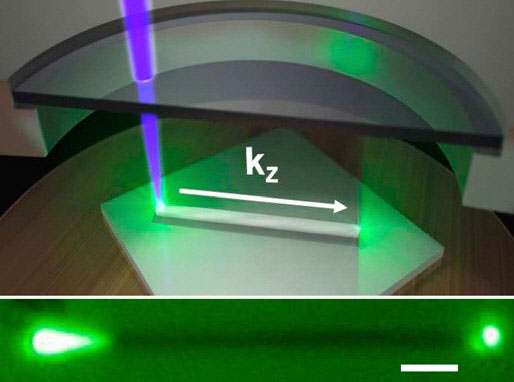
A quantum memory for photons that works at room temperature has been created by physicists in the UK. The breakthrough could help researchers to develop a quantum repeater device that allow quantum information to be transmitted over long distances.

Quantum bits (or qubits) of information can be transmitted using photons and put to use in a number of applications, including cryptography. These schemes rely on the fact that photons can travel relatively long distances without interacting with their environment. This means that photon qubits are able, for example, to remain in entangled states with other qubits – something that is crucial for many quantum-information schemes.

However, the quantum state of a photon will be gradually changed (or degraded) due to scattering as it travels hundreds of kilometres in a medium such as air or an optical fibre. As a result, researchers are keen on developing quantum repeaters, which take in the degraded signal, store it briefly, and then re-emit a fresh signal. This way, says Ian Walmsley of the University of Oxford, "you can build up entanglement over much longer distances".
Difficult to repair

A quantum memory, which stores and re-emits photons, is the critical component of a quantum repeater. Those made so far in laboratories must be maintained at extremely cold temperatures or under vacuum conditions. They also only tend to work over very narrow wavelength ranges of light and store the qubit for very short periods of time. Walmsley and his colleagues argue that it isn't feasible to use such finicky systems in intercontinental quantum communication – these links will need to cross oceans and other remote areas, where it's difficult to send a repair person to fix a broken cryogenic or vacuum system.

Moreover, they should also absorb a broad range of frequencies of light and store data for periods much longer than the length of a signal pulse. Walmsley calls this combination a "key enabling step for building big networks". The broad range of frequencies means the memory can handle larger volumes of data, while a long storage time makes it easier to accumulate multiple photons with desired quantum states.

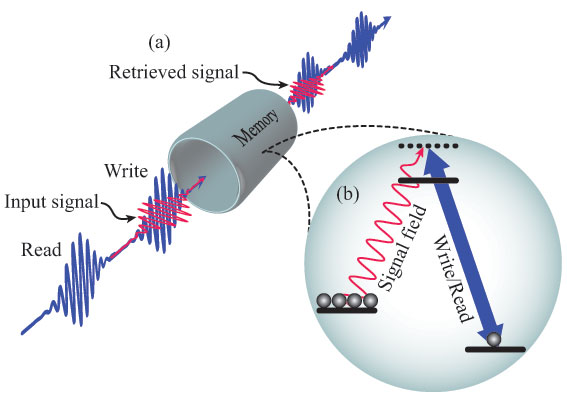
Working towards this goal, Walmsley and his team made a cloud of caesium atoms into a quantum memory that operates at an easy-to-achieve temperature of about 62 °C. Unlike previous quantum memories, the photons stored and re-emitted do not have to be tuned to a frequency that caesium electrons would like to absorb. Instead, a pulse from an infrared control laser converts the photon into a "spin wave", encoding it in the spins of the caesium electrons and nuclei.

Paint it black

Walmsley compares the cloud of caesium atoms to a pane of glass – transparent, so it allows the light through. The first laser paints the glass black in a sense, allowing it to absorb all the light that reaches it. However, instead of becoming dissipating as heat and as it would in the darkened glass, the light that passed into the caesium cloud is stored in the spin wave.

Up to 4 µs later, a second laser pulse converts the spin wave back into a photon and makes the caesium transparent to light again. The researchers say that the caesium's 30% efficiency in absorbing and re-emitting photons could increase with more energetic pulses from the control laser, while the storage time could be improved with better shielding from stray magnetic fields, which disturb the spins in the caesium atoms.

Even at 30% efficiency, Ben Buchler of the Australian National University in Canberra calls the device "a big deal" because it absorbs a wide band of photon frequencies. Due to Heisenberg's uncertainty principle, the ultra-short single-photon pulses from today's sources don't have well defined energies, so an immediately useful quantum memory must be able to absorb a wide range of frequencies – which Buchler says high-efficiency memories can't yet do.

Noise not a problem

Background noise, or extra photons generated in the caesium clouds that are unrelated to the signal photons, was a major concern for room-temperature memories. "People thought that if you started using room-temperature gases in storage mode, you'd just have a lot of noise," says Walmsley.

Temperatures near absolute zero suppress these extra photons other memories. But because the control and signal pulses in the Oxford team's set-up are far from caesium's favoured frequencies, the cloud was less susceptible to photon-producing excitations and the noise level remained small even at room temperature.

Hugues de Riedmatten of the Institute of Photonic Sciences in Barcelona, Spain, says that the researchers showed that the remaining noise is fundamental to the system, not caused by their set-up. If improvements cannot further reduce the noise, it will be challenging to maintain the integrity of the signal across a large, complex network, he explains.

Nevertheless, he says, "This approach is potentially very interesting because it may lead to a quantum memory for single photon qubits at room temperature, which would be a great achievement for quantum-information science."

خداحافظی آتلانتیس بر فراز پارکز

تلسکوپ رادیویی 64 متری پارکز بخاطر مشارکت در پرواز‌‌‌های انسانی به فضا شهرت خاصی دارد. این تلسکوپ عظیم رادیویی در زمان پروژه آپولو 11 یعنی اولین پرواز انسان به ماه، تصاویر تلویزیونی این رویداد تاریخی را از ماه دریافت و به ساکنین زمین مخابره نمود. در پیش زمینه این تصویر شامگاهی، این دیش قابل هدایت با عظمت خاصی خودنمایی می‌کند. بر فراز این دستگاه عظیم بشری، در آسمان پر ستاره شهر نیوساوت ولز آسترالیا، صورت‌های فلکی آشنای نیم‌کره جنوبی؛ بادبان، کشتیدم و شجاع به همراه نمایی تکرار نشدنی دیده می‌شوند. برفراز دیش، یعنی از راست به چپ در جهت محدوده کانون تلسکوپ، در آسمانی که هنوز از نور خورشید روشن است، شاتل فضایی آتلانتیس را می‌بینید که برای آخرین بار درخشان و چشمک زنان زیر نور آفتاب از ایستگاه فضایی بین المللی جدا شده است. خود ایستگاه فضایی بین المللی هم در گوشه راست پائین تصویر با ایجاد ردی درخشان در مداری پائین‌تر و با فاصله دو دقیقه به دنبال شاتل آتلانتیس در حرکت است. بامداد امروز 21 جولای (ساعت 5 و 56 دقیقه به وقت شرق آمریکا) شاتل آتلانتیس برای آخرین بار در مرکز فضایی کندی ناسا فرود آمد.

هابل، چهارمین قمر پلوتو را هم پیدا کرد

دبورا زابارنکو و درن اوسبورن-تلسکوپ فضایی کهنه‌کار هابل، موفق به کشف چهارمین قمری شد که به گرد سیاره کوتوله دوردست و سردسیر پلوتو می‌چرخد. هابل، مشغول جست,جوی حلقه‌های احتمالی گرداگرد پلوتو، واقع در مرز منظومه شمسی بود که به P4 برخورد؛ نام موقت قمر جدید این سیاره سابق.


به‌گفته سازمان فضایی ایالات متحده (ناسا)، P4 با قطر تقریبی 13 تا 34 کیلومتر، کوچکترین عضو از منظومه چهارتایی اقمار پلوتو است. قطر بزرگترین قمر پولو با نام «شارون»، 1043 کیلومتر hsj و دو قمر دیگرش به نام‌های «نیکس» و «هیدرا» هم به ترتیب حدود 32 و 113 کیلومتر قطر دارند. «مارک شوالتر» (Mark Showalter) از م,سسه SETI واقع در مونتین‌ویو کالیفرنیا که سرپرستی این رصد تلسکوپ هابل را عهده‌دار بوده است، می‌گوید: «واقعاً برایم حیرت‌آور است که دوربین‌های هابل، به ما امکان تماشای چنین جسم کوچکی را در فاصله بالغ بر 3 میلیارد مایلی (5 میلیارد کیلومتری) داده‌اند.»

پروفسور «پل فرانسیس» (Paul Francis)، از اخترشناسان رصدخانه کوه استروملو، وابسته به دانشگاه ملی استرالیا هم با این گفته موافق است و می‌گوید: «این قمر را فقط به بدین‌دلیل می‌شود دید که نور خورشید را منعکس می‌کند. این قمر، جسم بسیار کوچکی به‌شمار می‌رود و در فاصله بسیار دوردستی نسبت به خورشید هم واقع شده؛ به‌طوری که در آن نواحی، نور چندانی از طرف خورشید، برای بازتابیده شدن از سطح آن وجود ندارد.»

به‌گفته فرانسیس، کشف قمرهایی به‌گرد سیارات کوتوله واقع در ماورای مدار نپتون (که به اجسام فرانپتونی (TNO) هم مشهورند)، باعث شده تا ستاره‌شناسان از خودشان بپرسند که این اجرام اصلاً از کجا آمده‌اند؟ او می‌گوید: «ما در این‌که از کجا آمده‌اند، هیچ نظری نداریم. بعضی از آن‌ها مثل شارون، بزرگ هستند و بعضی‌شان هم مثل این یکی، کاملاً کوچک‌اند و این چیز عجیبی است. چراکه به‌نظر نمی‌رسد این اجرام آنقدرها نیروی جاذبه کافی برای نگهداشتن چنین قمرهایی به گرد خودشان را داشته باشند. این‌که در نبود نیروی جاذبه قابل توجه، این‌ها این شمار از قمر را به گرد خودشان نگه داشته‌اند، از معماهاست.»

یکی از علت‌ها شاید این باشد که قمرهای پلوتو، در پی برخورد این سیاره کوتوله با جسم سیاره‌مانند بزرگی در همان اوایل تاریخچه منظومه شمسی، تشکیل شده‌ باشند.

رصدی که توسط تلسکوپ فضایی هابل صورت گرفت، بخشی از برنامه ناسا به‌منظور پشتیبانی از مأموریت فضاپیمای «افق‌های نو» بود که قرار است در سال 2015، ملاقاتی را با پلوتو و اقمارش صورت دهد. P4، در حد فاصل مابین مدار قمرهای نیکس و هیدرا واقع است؛ دو قمری که در سال 2005، باز توسط تلسکوپ فضایی هابل پیدا شدند. شارون، در سال 1978 و در رصدخانه نیروی دریایی ایالات متحده کشف شد.

 
در سایه پلوتو

در ماه ژوئن سال جاری، پلوتو دقیقاً از مابین زمین و یک ستاره دوردست عبور کرد و سایه‌ ناچیزی از آن را روی زمین انداخت که ستاره‌شناسان در طول اقیانوس آرام، آن را پی گرفتند. طبق اعلام دانشمندان رصدخانه لاول در آریزونا، این پدیده که به «اختفا» مشهور است، در شب 23 ژوئن رخ داد. چهارتن از این دانشمندان، سوار بر هواپیمای بوئینگ 747 ارتقایافته‌ای شدند که به یک تلسکوپ غول‌پیکر مجهز است و موفق به تهیه تصاویری از پلوتو و جو رقیق آن شدند. به‌گفته متخصصین رصدخانه لاول، کسب اطلاعات بیشتر از جو رقیق پلوتو هنوز هم میسر است؛ چراکه این جو، نور ستاره‌ پشت‌اش را چنان سد می‌کند که به اخترشناسان امکان تعیین دما و چگالی‌‌اش را می‌دهد.

سایه پلوتو، فوق‌العاده طولانی بود: فاصله متوسط آن، حدود 9.495 میلیارد کیلومتر از خورشید می‌شد؛ حال‌آن‌که فاصله زمین تا خورشید، تنها 149.7 میلیون کیلومتر است.

Peer pressure keeps young planets growing

Two US astrophysicists claim they have answered an important question about how planets form: why don't young planets get pushed into their companion stars before they have a chance to grow? It turns out that a little company is enough to keep them there, say the researchers, who argue that multiple planets moving through a rocky disk can prevent one another from falling into the star.

"All young planets are subject to migration," says Scott Kenyon of the Smithsonian Astrophysical Observatory in Massachusetts, who did the work with Benjamin Bromley of the University of Utah. "Migration for gas or ice giants is more commonly discussed, but migration is also an issue for terrestrial planets with masses ranging from that of Pluto to the Earth."

Astronomers believe that planets form in a disk of gas and dust surrounding a young star. The first step towards planet formation is the planetesimal – a small rocky body with radius of roughly 1–10 km. As the dust condenses into planetesimals during the first few million years of a star's life, larger rocks begin to emerge that grow much more rapidly than the rest. These bodies, termed oligarchs, are on their way to young planethood, using their gravitational pull to attract and pack on more planetesimals.

Pushy planetesimals

In addition to providing a means for growth, planetesimals can also push an oligarch towards its doom in the central star. A lone oligarch orbiting through the disk of planetesimals clears a path much like a stick being dragged through sand. The planetesimals on either side of the trench press on the oligarch, says Kenyon, and as the outer ring has more mass, the planetesimals deliver a net inward push.

In the past, magnetic fields, turbulence and thermodynamics have been used to explain how rocky planets are prevented from falling into their stars. However, Bromley and Kenyon say that the wake patterns created by multiple oligarchs circling a star are enough to prevent structures from forming in the planetesimal disk that would push the young planets in.

Once the oligarchs account for about half of the material in the disk, a few tens of millions of years after the birth of the star, they begin making even more material gains by combining with one another. Rather than hollowing out a series of trenches, the oligarchs are now randomly scrawling in the planetesimal "sand", which also prevents the planetesimals from settling into patterns that would feed the oligarchs to the star.

Real, but not clear

"This is a real effect," says John Papaloizou of the University of Cambridge in the UK. "However, its extension to interactions with gas is not clear."

Making direct calculations of the movements of multiple planets through a more realistic disk of gas and planetesimals raises the complexity significantly, requiring more computing power than is practical today. Instead, Bromley and Kenyon extended their simulation to gas disks.

They looked for scenarios in which a gas cloud behaves like a disk of planetesimals, and they found two key requirements: the gas must have low viscosity; and the planets must be small. A denser, high-viscosity gas has a stronger tendency to smooth itself out after the oligarch runs through – like the wake of a canoe in water. This means that the disruptions to the patterns do not last as long. If the gas in the disk is dilute, the researchers argue that these conditions are met well enough that rocky planets should not fall into the star.

"Our results tell us that growing terrestrial protoplanets cannot migrate through a disk of planetesimals, allowing protoplanets to grow into the planets we see in our and other planetary systems," says Kenyon. If the generalization to gaseous disks is realistic, then Kenyon believes that "we are a step or two closer to understanding the origins of the Earth and other planets".

This research appears in the Astrophysical Journal 735 29.

Catching sight of the elusive wavefunction

In the orthodox interpretation of quantum mechanics, the wavefunction contains the maximal knowledge that is available about the state of a system. It determines the probabilities that various results will be obtained when measurements are made on the dynamic variables of the system such as its position or momentum.

However, measuring the wavefunction is no easy task. Thanks to Heisenberg's uncertainty principle, measuring a quantum system without effectively destroying it before the wavefunction is fully known has seemed impossible. Now, by taking a new approach to quantum measurement, Jeff Lundeen and his team from the National Research Council, Canada, have directly measured the wavefunction of identical single photons for the first time.

Making a measurement on just one copy of a system – such as just a single photon – gives us part of the wavefunction. However, the measurement must be repeated many times on an ensemble of identical photons to gain enough information to construct the entire wavefunction. This indirect form of measurement is known as "quantum tomography" and has been used for some time.

Recording ripples

Lundeen likens tomography to mapping the shape of a ripple on the surface of a pond (the wavefunction) by taking snapshots of the shadows of the ripples on the bottom. By combining information from many snapshots, the shape of the ripple can be inferred. In quantum tomography, however, each snapshot measurement is so "strong" that it destroys the ripple and the process must be repeated with identical ripples. Beyond the destructive nature, certain wavefunctions such as atomic or molecular orbitals cannot be determined using tomography.

Instead of focusing on the shadows, the team has worked out a way to directly probe both the real and imaginary parts of the wavefunction of an ensemble of photons. The method relies on the concept of "weak measurement", which has been used recently to measure some quantum systems – and does not destroy the wavefunction.

"Our understanding of the wavefunction is rather abstract and there is no official textbook definition," says Lundeen. "We decided to look into the method of weak measurements irrespective of how wary scientists seem to be of it," he continues, explaining that, although the theory of weak measurements was developed in the 1980s, it was dismissed by many researchers because it produced rather "odd results" that were much larger than expected. The reason for the unexpected results, explains Lundeen, is that a weak measurement gives a complex number – it has a real part and an imaginary part.

Gentle measurements

The theory of weak measurement says that it is possible to "gently" or "weakly" measure a quantum system and to gain some information about one property (say, position) without appreciably disturbing the complementary property (momentum) and therefore the future evolution of the system. Though the information obtained for each measurement is tiny, an average of multiple measurements gives an accurate estimation of the measurement of the property without distorting its final value.

For a generic quantum measurement, the system to be measured is coupled with another state that can be thought of as a "pointer". Information about a measured property is gained by observing a change in the position of the pointer. Generally, this is considered to be a strong measurement because there is little overlap between the original and final positions of the pointer. The detection of a photon in a CCD, for example, would swing the pointer from zero photons to one but result in the destruction of that photon.

In a weak measurement, it is just the opposite, with the final position of the pointer overlapping to a large extent with its initial position. In the measurement carried out by the team, the real part of the wavefunction is given by a small shift of the pointer related to the position of the photon. The imaginary part of the wavefunction is given by a shift of the pointer related to the momentum of the photon. So the position is weakly measured while the momentum is strongly measured.

Four basic steps

The experiment has four basic steps. The first is to generate a stream of single photons with identical wavefunctions. "It is virtually impossible to measure a wavefunction with just one copy of a quantum system (i.e. one photon), this we are almost sure of," explained Lundeen. The team either used an attenuated laser beam or a process known as spontaneous parametric down-conversion (SPDC) to produce its photon stream.

The next step is to set up the weak measurement of the transverse position of the photon by inducing a rotation in each photon's polarization by a very small amount – 10° – using a quartz crystal. Because the polarization change is small, the system is not greatly disturbed.

The photons are then collimated and only photons travelling in a specific direction are detected – a process called post-selection. This is the strong measurement. In the final step, the weak measurement is carried out by measuring the two types of polarization that have actually occurred in the photons post-collimation. This is two-fold because the real part of the measurement is the actual amount of linear rotation that has occurred and the imaginary part is given by the circular rotation or the "ellipticity" of the polarization that has occurred. Together, these values give the weak measurement of the wavefunction. The researchers repeated the measurement for photons with different wavefunctions to confirm the accuracy of the results.

Better than tomography?

Lundeen points out that the signal-to-noise ratio of his team's experiment was rather good. Indeed, he says that an important benefit of the weak measurement technique is that the results are amplified. Therefore it could prove to be especially useful for studying systems that are currently very hard to measure.

While he believes that there will still be a place for quantum tomography, Lundeen feels that certain systems will benefit from the technique used by his team. "While tomography is a global measurement that is more a reconstruction of the wave function, our measurement is local and direct." he explained. "The simple benefit of our research is that we now have an operational textbook definition of a wavefunction...something that is essential."

CoGeNT findings support dark-matter halo theory

New findings from the CoGeNT experiment in the US add strength to the claims of a group in Italy that has been saying for over a decade that it has detected dark matter.

More than 80% of the mass in the universe is believed to be accounted for by dark matter. But while the substance appears to have a strong gravitational influence on the motion of galaxies, it does not interact with light and has proven very difficult to detect directly – let alone study in any detail. The favoured candidate for a dark-matter particle is known as a "weakly interacting massive particle", or WIMP for short. Various experiments have been constructed to detect WIMPs by looking to see if they interact with highly sensitive detectors.

Researchers at one of these experiments, the DAMA/LIBRA detector at the Gran Sasso National Laboratories in central Italy, stand apart from the rest of the dark-matter community. That is because they have been claiming for years that they have successfully detected dark matter. Rather than looking for individual WIMPs, the DAMA/LIBRA experiment is designed to look for variations over the course of a year in the interactions between dark-matter particles and the sodium iodine crystals inside their detector. The researchers say they have observed an annual oscillation in detections for the past 13 years, which they believe is caused by Earth's motion through dark matter.

DAMA/LIBRA explains the oscillation by saying that, during the summer, the Earth is moving into the rest frame of a halo of dark matter that surrounds the Milky Way, which causes the number of interactions to peak. Then, in the winter, the Earth is moving away from this rest frame, causing the signal to drop off. The situation is analogous to a car driving through a rainstorm where more raindrops hit the front windshield than the back one.


A sceptical community

But while few in the dark-matter community deny the existence of modulation, many researchers have remained sceptical of the DAMA/LIBRA claims, and to date no other detector has managed to repeat the findings. Among the sceptics is Juan Collar, a member of the CoGeNT collaboration. CoGeNT is a relatively small dark-matter detector located in the Soudan Mine in northern Minnesota, which uses a germanium target to look for low-mass WIMPs. Indeed, Collar's collaboration set out to test the DAMA/LIBRA claims by looking for an oscillation in 15 months of data. "I thought we were going to blow the DAMA claims out of the water," Collar told physicsworld.com.

But to Collar's surprise, CoGeNT's findings appear to corroborate the DAMA/LIBRA data. They reveal a seasonal modulation consistent with the presence of WIMPs with masses of 7 GeV/c2. Detailing their findings in a paper submitted to arXiv, Collar and colleagues say that their results are reliable to a statistical significance of 2.8 sigma. In everyday terms, this means there is just a 0.6% chance that the result is a statistical fluke.

Collar says that his collaboration is still "as critical of DAMA as anyone else" over the claim that the seasonal modulation must be dark matter. But he admits that he cannot yet explain what could be causing the seasonal modulation. He says that his team was careful to exclude other possible sources that could have caused a modulation in the signal, such as seasonal variations in the flux of muons passing through the atmosphere, or radon emerging from rocks surrounding the detector.

Dan Hooper, a theorist based at Fermilab in the US, says that he is "very excited" about the CoGeNT results. "In all of the ways I have studied the data, they look like what you would expect to see from dark matter," he says. "I suspect that these results will cause some scientists to reconsider the long-claimed DAMA/LIBRA signal". Hooper warns, though, that the collaboration will need more data to rule out the possibility that the signal is purely due to chance.


Lucky escape from the fire

Indeed, Hooper was pleased to tell physicsworld.com that the CoGeNT team had commenced a fresh run a data collection last Monday (6 June). There had been concern that the detector had undergone damage following a fire in the Soudan Mine in March.

But other researchers have been more sceptical of the CoGeNT collaboration from its outset. Researchers at the XENON 100 experiment in Italy, for instance, claim that they have already ruled out the possibility of WIMPs existing within the mass range that CoGeNT is designed to consider. The XENON 100 is a liquid-xenon-based detector considered by many to be the most sophisticated experiment designed for direct dark-matter searches.

However, both Collar and Hooper believe that there are reasons to believe that a light-mass dark-matter particle could have escaped detection by XENON 100. In a separate paper submitted to arXiv, Collar questions the sensitivities of the XENON 100 detector and its predecessor, XENON 10. Collar proposes that the XENON teams have made far too many assumptions in excluding low-mass WIMPs. "XENON is tremendously biased," he told physicsworld.com.

The debate, however, is likely to go on. Henrique Araujo, a dark-matter researcher at Imperial College London remains open to the idea that CoGeNT has seen dark matter but he expects that other detectors should have seen the CoGeNT signal. "Bearing in mind that CoGeNT has a very small target mass of 440 g and that it actually claims to see quite a large total number of 'light WIMP' events, other detectors should find plenty of recoils creeping up at the energy threshold," he said.

Polariton coupling becomes stronger

Researchers at the University of Pennsylvania in the US claim that polaritons – quasiparticles that are part matter and part light – couple more strongly when confined in nanoscale semiconductors. The new result could benefit photonic circuits that exploit light rather than electricity.

A polariton is a particle-like entity (or quasiparticle) that can be used to describe how light interacts with semiconductors and other materials. It has two different components: an electron-hole pair (or "exciton") and a photon, which is emitted when the electron and hole recombine. When a photon is emitted, it is immediately reabsorbed to reform an exciton, so the cycle is repeated. This continuous exchange, or coupling, of energy between photons and excitons can be described in terms of polariton states.

Polaritons are expected to play an important role in future photonics devices that would use light instead of electricity to process information. Such devices would be much faster and use less energy than their electronic counterparts. The strong coupling of polaritons will be crucial for the success of this new photonics, but the coupling strength of polaritons in bulk semiconductors was always thought to be limited by the properties of the semiconductor material itself.

The right finishing techniques

Ritesh Agarwal and colleagues are now saying that this limit can be overcome if the right fabrication and finishing techniques are used to make the semiconductor structures in question. This is because the light-matter coupling strength increases dramatically as semiconductors become smaller than 500 nm or so, explains Agarwal.

"When you're working at bigger sizes, the surface is not as important," he said. "The surface to volume ratio – the number of atoms on the surface divided by the number of atoms in the whole material – is a very small number. But when you make a very small structure, say 100 nm, this number is dramatically increased. Then what is happening on the surface critically determines the device's properties."

Although researchers had previously attempted to make polariton cavities on such a small scale, the "top-down" chemical etching methods employed to fabricate the devices damaged the semiconductor surfaces, so creating defects. These defects trapped the excitons, making them unavailable for transporting current.

Self-assembling nanowires

Agarwal's team overcame this problem by self-assembling nanowires made from cadmium sulphide instead of etching nanoscale structures. Surface quality was still an issue, even with this fabrication technique, so they developed a way to "passivate" the surface of the nanowires by growing a silicon oxide around them. This greatly improved the optical properties of the wires because the oxide shell fills the electrical gaps in the nanowire surface and prevents the excitons from getting trapped on the surface, says Agarwal.

The scientists also developed techniques (based on detecting the energy of standing waves formed in the nanowire cavities) for measuring the light-matter coupling strength and showed that it was indeed enhanced as the semiconductor structures became smaller. Stronger light-matter coupling means faster photonic switches and much more efficient polariton lasers, light-emitting diodes and amplifiers – to name a few possible applications.

However, not all scientists are convinced of the team's results. Benoit Deveaud-Plédran of École Polytechnique Fédérale de Lausanne described the team's claims as "overstated" and said that they don't appear to be backed up by data presented in a paper outlining the experiment (PNAS 108 10050 ).

Others are more enthusiastic. "This paper looks like an interesting addition to the armoury of light-matter strong coupling effects in semiconductors," commented Jeremy Baumberg of the University of Cambridge's Cavendish Laboratory in the UK. "The results show a new way to reduce the volume of the microcavity, by using high refractive index nanowires, which tightly confine the light inside. The rate at which energy is flipped back and forth between light and excitons depends on inverse square root of the volume within which the light is trapped. Here the wall of the semiconductor is used to confine the light, and it is tighter than normal, giving rise to faster rates and thus a higher splitting between the polariton 'modes'."

Improvements needed

It is an interesting new route to making strong coupled systems at room temperature, he told physicsworld.com, but the design might not be more than just "fortuitous", Baumberg cautions. The light leaks out from the structure in many directions, and is not confined well enough to keep the resonances narrow. "Improvements will rely on much better control of the length, width, orientation and out-coupling of light from nanowires," he added.

Other teams around the world are also looking at new ways of achieving room temperature strong polariton coupling. Baumberg's group, for its part, has recently published a paper in Applied Physics Letters describing a set-up that comprises air suspended mirrors and simpler semiconductors based on the well known gallium arsenide. This system has light out-coupled in only vertical directions and it can be electrically controlled.

فرمول دوچرخه سواری

شايد کارهاي زيادي در اطراف شما وجود داشته باشند که انجام آنها اصطلاحا از دوچرخه سواري هم راحت تر باشد اما دانشمنداني که کارشان مطالعه بر روي توانايي هاي انسان است به تازگي کشف کرده اند دوچرخه سواري نه تنها کاري ساده نيست بلکه به شدت پيچيده و مشکل است. به گزارش تلگراف، محققان از سه کشور مختلف به مدت سه سال تلاش کردند تا بتوانند فرمول مکانيکي را براي شبيه سازي توانايي هاي کودکان در سن 10 سالگي به دست آورند.

اين معادله پيچيده که اينرسي، نيروهاي ژيروسکوپي و گريز از مرکز و گرانش را در خود جا داده است از 31 رقم و علامت و 9 سري پرانتز تشکيل شده است. فرمول به دست آمده مي گويد نيروهاي اينرسي + نيروهاي ژيروسکوپي + تاثير گرانش و نيروهاي گريز از مرکز= ميزان خميدگي بدن و ميزان گشتاوري که بر فرمان دوچرخه وارد مي شود. يا به زباني ساده تر اگر در هنگام دوچرخه سواري براي ادامه دادن به حرکت با سرعت کافي رکاب نزنيد به همراه دوچرخه سقوط خواهيد کرد.

اين معادله توسط دانشمنداني از هلند، آمريکا و انگلستان و طي مطالعات شرکت «هالفوردز» براي جمع آوري راهنمايي هاي آموزش دوچرخه سواري به کودکان، ويژه والدين به دست آمده است. «پائول مکلنگان» مدير مالي شرکت «هالفوردز» مي گويد: اين معادله نشان مي دهد جستن بر روي دوچرخه، حفظ تعادل آن و دور شدن سريع از خانه براي کودکان چندان کار ساده اي به شمار نمي رود. به گفته وي زماني که دوچرخه سواري را بياموزيد هرگز آن را فراموش نخواهيد کرد اما در پس اين مهارت به ظاهر ساده رويدادهاي علمي بسيار زيادي نهفته شده است.

به گفته «آرند شواب» از دانشگاه دلف در هلند که در ارائه اين معادله نيز نقش داشته است دانشمندان از زمان ابداع دوچرخه در دهه 1860 تا کنون در تلاش بوده اند با استفاده از قوانين حرکتي نيوتن حرکات منحصر به فرد و توانايي دوچرخه سواري را در حفظ تعادل توضيح دهند.

محاسبات رياضي و مهندسي دوچرخه سواري و ادامه يافتن اين تحقيقات بر روي آن مي تواند به تدريج منجر به ارائه طراحي هاي بهتر و ايمن تر از دوچرخه ها شود. به گفته «شواب» مي توان با استفاده از اين معادله حرکات دوچرخه را شبيه سازي کرده و ميزان ثبات و دوام آن را تحت شرايط خاص پيش بيني کرد.

Future is bright for CERN antimatter physicists

Last month Physicsworld.com reported (Also in this Weblog) that physicists from CERN's ALPHA experiment had trapped 309 atoms of antihydrogen for 1000 s – smashing their previous record of 38 atoms trapped for one-fifth of a second. Now we can reveal that the team's success has brought it extra funding that, in part, will allow two new antimatter experiments to be built, as well as a new source of antiprotons.

The study of antimatter such as antihydrogen is important in developing our understanding of the universe and in finding out why it contains so much more matter than antimatter. Speaking to physicsworld.com, ALPHA spokesperson Jeffrey Hangst explains that the team's next task is to study the structure of antihydrogen – an antiproton bound to an antielectron – using microwaves. "We will use the microwave frequency to flip the spin of the antimatter atoms. Then we may be able to detect the resonant interaction and look at their structure. This would be a modest first step towards actually understanding antimatter," says Hangst. Differences between the structures of hydrogen and antihydrogen are not predicted by the Standard Model of particles physics and could point towards new physics.

Hangst told physicsworld.com that the ALPHA team is in the process of building a new detector called ALPHA 2 that will be capable of spectral analysis. Unlike the current experiment, ALPHA 2 will include the lasers necessary to study the spectra of the anti-atoms. "We knowingly did not add lasers to the current ALPHA design as initially we wanted to just be able to create and hold the antimatter," explains Hangst. The team wants the new device to be up and running by 2012, so that the researchers can gather data before CERN's Large Hadron Collider shuts down for an upgrade in 2013 – which will also affect ALPHA 2.

A new source called ELENA

ALPHA's recent success has also encouraged CERN to go ahead with a new antiproton source called Extra Low Energy Antiprotons or ELENA. ELENA was proposed several years ago but stalled because of a lack of funding. But now, jubilant CERN boss Rolf-Dieter Heuer told physicsworld.com that he has given the go-ahead for the ELENA source. The current source decelerates antiprotons to 5 MeV before supplying them to ALPHA and other experiments at CERN. ELENA will deliver antiprotons at about 100 keV, which will provide ALPHA with a larger number of usable antiprotons and will also increase efficiency.

With the new ELENA source in place, Hangst hopes that a further update could be made to the ALPHA experiment, dubbed ALPHA 3. This next-generation experiment would allow the team to further cool trapped samples of antiprotons and allow the researchers to study gravitational effects on antimatter. "Laser cooling for hydrogen is difficult but it can be done," says Hangst, who believes that all these updates could occur during the next 10 years. "Just in time for me to retire!"

All in all, exciting times lie ahead for antimatter research in the coming years. "All the current news is good and encouraging. We know that our approach is the right one," says Hangst. Take a look at the video below – it is an interview conducted by Channel 4 News in the UK with CERN director-general Rolf-Dieter Heuer, where he talks about ALPHA's recent advances. Listen out for a mention of Physics World towards the end, when Heuer recalls that we made ALPHA's previous antimatter study our Breakthrough of the Year for 2010.

بازار داغ ماده‌ی تاریک

پس از سال‌ها شک و تردید در باره‌ی وجود ماده‌ی تاریک، شمار روزافزونی از آزمایش‌ها نشان می‌دهند ماده‌ی تاریک شاید پیش این هم پیدا شده باشد.
عالم را ماده‌ئی اسرارآمیز و نامرئی پر کرده است که پذیرای برهم‌‌کنش با نور نیست: نور را بازنمی‌تاباند و جذب هم نمی‌کند. اما ستاره‌شناس‌ها می‌دانند این ماده وجود دارد زیرا آثار گرانشی‌ی آن بر مواد مرئی را مشاهده می‌کنند. این ماده را ستاره‌شناس‌ها ماده‌ی تاریک می‌خوانند. اما مشکل این است که اگر ماده‌ی تاریک وجود داشته باشد باید به مقدار زیاد وجود داشته باشد. ستاره‌شناس‌ها تخمین می‌زنند 83 درصد جرم عالم باید ماده‌ی تاریک باشد و فقط 17 درصد بقیه ماده‌ی مرئی‌ست.

این ماده‌ی تاریک باید منظومه‌ی شمسی، زمین، و محیط اطراف ما را فرا گرفته باشد ولی فیزیکدان‌ها وقتی دنبال این ماده می‌گردند هیچ پیدا نمی‌کنند... دست‌کم بیشترشان چیزی پیدا نمی‌کنند! طی ی چند سال گذشته یک گروه فیزیکدان که 250 کیلوگرم سدیم‌یدید آلاییده به تالیم را ته ِ معدنی در ایتالیا گذاشته‌اند فریاد می‌زنند که ماده ی تاریک را مشاهده کرده اند. این طور گمان می‌رود که از برخورد ذره‌ی عجیب و غیرعادی‌ی ماده‌ی تاریک با یکی از هسته‌های بلور، فوتونی تولید خواهد شد که آشکارگرهای حساس ِ نور در نزدیکی‌ی بلور آشکار خواهند کرد.

آزمایش آنها DAMA/LIBRA نام دارد و نتایجش بحث‌انگیز بوده است. البته هر نوع ذره‌ی دیگر نیز می‌تواند در برخورد با بلور فوتون تولید کند. بنابراین تابش کیهانی، نوترون‌های حرارتی، پرتوزایی‌ی زمینه نیز در آزمایش دیده خواهد شد به‌عبارت دیگر همهمه زیاد است. اما برای جدا کردن سیگنال ماده‌ی تاریک از این پس‌زمینه راهی هست. خورشید در گذر از کهکشان از دریای ماده‌ی تاریک نیز می‌گذرد. زمین نیز به دور خورشید می‌گردد و این دریای ماده‌ی تاریک در برخی مواقع با سرعت بیشتر و در مواقع دیگر سال کند تر از این دریا عبور خواهد کرد. بنابراین سیگنال ماده‌ی تاریک باید مدولاسیون سالانه داشته باشد.

پژوهشگران آزمایش DAMA/LIBRA مدعی هستند دقیقاً چنین چیزی را دیده‌اند. سیگنال آنها در ماه مه به اوج می رسد و سپس افت می‌کند. این سیگنال ضعیف و موقتی نیست و این افراد می‌گویند شواهد آماری آن قدر واضحند که تقریبا هیچ امکان اشتباه وجود ندارد. اما بیشتر اخترفیزیکدان‌ها به نتایج DAMA/LIBRA توجهی نمی‌کنند و حتی آزمایش را مسخره می‌کنند. دلیلش این است که آشکارگرهای ماده‌ی تاریک در انتهای معادن گوشه‌وکنار دنیا فراوان وجود دارند که هیچ چیزی ندیده اند و نسبت به بسیاری از این آزمایش‌ها اطمینان بیشتری وجود دارد زیرا همهمه‌ی پس‌زمینه برخاسته از تابش کیهانی و غیره را حذف می کنند. این آزمایش‌ها باید فقط ماده‌ی تاریک را ببینند و نمی‌بینند... البته تا کنون ندیده بودند! چند هفته پیش گروهی که با آشکارگری به نام CoGeNT در ته معدنی در مینه‌سوتا کار می‌کند اعلام کرد شواهدی بسیار شبیه به شواهد آزمایش DAMA/LIBRA پیدا کرده‌اند. شاهد آنها از نظر آماری به قدرت آزمایش DAMA/LIBRA نیست اما مدولاسیون آن دقیقاً همان شکل را دارد یعنی در اواخر آوریل یا اوایل مه به اوج می‌رسد.

امروز دن هوپر از آزمایشگاه شتابگر ملی ی فرمی و کریس کِلسو از دانشگاه شیکاگو داده‌های CoGenT و DAMA/LIBRA را مرور کرده‌اند و می‌گویند با هم سازگارند. "اگر فاز حقیقی در اوایل مه به اوج می‌رسد این نماینده‌ی مدولاسیونی سازگار با گزارش‌های گروه‌های همکار در آزمایش DAMA/LIBRA است." با توجه به شک و تردیدی که بسیاری از پژوهشگران نسبت به گروه پژوهشی‌ی DAMA/LIBRA نشان داده‌اند این گفته بسیار مهم است.

اما شواهد به همین‌جا ختم نمی‌شود. هوپر و کلسو هم‌چنین می‌گویند که نوع ماده‌ی تاریکی که از این نتایج برمی‌آید با شواهد غیرمستقیم دیگر در باره‌ی ماده‌ی تاریک در آزمایش‌های دیگر نیز سازگار است. چیزهائی مانند طیف گامائی که تلسکوپ فضایی‌ی پرتوهای گامای فرمی مشاهده کرده، و غباری که WMAP دیده و گمان می‌رود از گسیل فوتون از الکترون‌های نزدیک به مرکز کهکشان برخاسته باشد. آنها می‌گویند آزمایشی دیگر به‌زودی نتایجی منتشر خواهد کرد که ادعاهای DAMA/LIBRA و CoGeNT را تأیید می‌کند: "گروه‌های همکار پروژه‌ی CRESST افزایشی در داده‌هاشان گزارش کرده‌اند که به‌تقریب با ذرات ماده‌ی تاریک از نوع CoGeNT سازگار است." بنابراین دنیای پژوهش‌های ماده‌ی تاریک در عرض تنها چند ماه سر و ته شده است و پس از سال‌ها گزارش ها ی منفی، ناگهان گزارش‌های مانند بهمن بر سرمان می‌ریزد.

این نکته موضوع را برای روان‌شناسان نیز جالب خواهد کرد چون می‌توانند دینامیک رفتارهای گروهی را بررسی کنند. فرآیندی که ایده‌های علمی را حقایق علمی می‌کند واضح نیست و عجیب به نظر می‌آید. اما حقیقت این است که تأثیر ضعف‌های انسان بر این فرآیند با تأثیرش بر دیگر زمینه‌ها متفاوت نیست و به یک اندازه از مد روز و تغییرات ناگهانی‌ی افکار عمومی اثر می‌پذیرد. جالب خواهد بود بدانیم مورخان علم از این داستان خاص چه برداشتی خواهند کرد.

لینک مقاله اصلی

لینک مقاله در وبلاگ

چرخه‌هاي بي‌پايان تولد و نابودي كيهاني (نظريه برخورد تناوبي جهان‌ها باهمديگر)

براساس متون كهن برجاي مانده از دوران هند باستان، كل جهان به طور متناوب چرخه‌هاي كيهاني تولد و نابودي را پشت سر مي‌گذارد. جهان متولد مي‌شود و كهكشان‌ها، ستاره‌ها و سيارات به آرامي شكل مي‌گيرند و داستان حيات آغاز مي‌شود. اين داستان ادامه دارد تا اينكه نهايتاً پس از به پايان رسيدن يك دوره كيهاني، عمر جهان  به پايان رسيده و كل كيهان نابود مي‌شود و بعد دوباره چرخه كيهاني جديدي آغاز مي‌شود و اين داستان همينطور از ازل تا ابد ادامه مي‌يابد. جالب اينجاست كه مسأله چرخه‌هاي متناوب تولد و نابودي كيهاني در بسياري ديگر از تمدن‌هاي باستاني نيز به چشم مي‌خورند. مثلاً در تقويم سنگي آزتك‌ها در آمريكاي جنوبي نيز چرخه‌هاي كيهاني به طور نمادين حك شده‌اند. اما آيا دانش كيهان‌شناسي نوين هم وجود اين چرخه‌هاي كيهاني را تأييد مي‌كند؟

بلي. اكنون چند دهه است كه مي‌دانيم جهان ما به واسطه رويدادي به نام مهبانگ (بيگ بنگ) به وجود آمده است. اما در اينجا يك سؤال مهم مطرح است. آيا ممكن است پيش از مِهبانگ و پيدايش جهان ما، جهان‌هاي ديگري هم موجود بوده باشند؟ آري. چند سال پيش يعني در سال 2002، دو فيزيكدان و كيهان‌شناس به نام‌هاي پائول اشتاينهارد از دانشگاه پرينستون آمريكا و نيل توراك از دانشگاه كمبريج انگلستان مشتركاً سناريويي را ارائه دادند كه بر مبناي آن، مهبانگ درواقع آغاز زمان نبوده بلكه صرفاً آغاز يك چرخه كيهاني جديد است.

مدل اشتاينهارد و توراك بر اساس نظريه ريسمان‌ها يعني مهم‌ترين رهيافت موجود براي وحدت بخشيدن مابين دو ستون اصلي فيزيك جديد يعني نظريات نسبيت عام و مكانيك كوانتومي شكل گرفته است. براساس اين مدل، جهان ما درواقع يك اَبَرصفحه 4 بُعدي است كه در ابعاد بالاتر كائنات شناور است. اما در همسايگي جهان ما در پهنه كائنات، جهان‌هاي ديگري هم شناورند كه ممكن است در هر يك از آنها قوانين فيزيك كاملاً متفاوتي حاكم باشد. اين جهان‌ها هر از چندگاه به همديگر برخورد كرده و از اين برخورد، انرژي فوق‌العاده عظيمي در هر يك از آنها آزاد خواهد شد. اين برخورد كيهاني درواقع همان مهبانگ (بيگ بنگ) است.

به واسطه همين برخورد، هر دو اَبَرصفحه - يعني هر دو جهان - شروع به انبساط خواهند كرد. اما از آنجائيكه ما همواره در يكي از اين دو اَبَرصفحه (يعني جهان خود) مقيد بوده‌ايم، در ظاهر تصور مي‌كنيم كه مِهبانگ همان آغاز جهان بوده است، غافل از اينكه پيش از آن هم جهان ديگري وجود داشته است. بر اساس اين مدل، دو جهان پس از برخورد، مجدداً از يكديگر جدا شده و شروع به دور شدن از همديگر خواهند كرد اما فاصله گرفتن آنها از يكديگر سرانجام به واسطه نيروي جاذبه موجود ميان آنها متوقف شده و دوباره به سوي همديگر كشيده خواهند شد و نهايتاً پس از چند صد ميليارد سال مجدداً با يكديگر برخورد خواهند كرد. با برخورد مجدد آنها دوباره مقدار عظيمي انرژي به هر يك از آنها تزريق خواهد شد، گويي كه مِهبانگ (بيگ بنگ) جديدي رخ داده است و اين چرخه بي‌پايان تولد و نابودي كيهاني همينطور تا ابد ادامه خواهد يافت.

به نقل از  New Scientist

جهان بر روي يك محور مي‌چرخد

يافته‌هاي اخير محققان دانشگاه ميشيگان نشان داده كه شكل مهبانگ (انفجار بزرگ) احتمالا بسيار پيچيده‌تر از تصورات پيشين بوده و اين كه جهان بر روي يك محور مي‌چرخد. فيزيكدانان و ستاره‌شناسان از مدتها پيش مي‌دانستند كه جهان از يك تقارن آينه‌اي مانند يك توپ بسكتبال برخوردار است. محققان براي آزمايش اين تقارن فرضي، مسير چرخش دهها هزار كهكشان مارپيچ را كه توسط تلسكوپ نقشه برداري ديجيتال آسمان اسلون ثبت شده بود، فهرست كردند.

محققان موفق به كشف شواهدي از تمايل كهكشانها به چرخش در يك جهت ارجح شده‌اند. آنها مازاد كهكشانهاي چپ‌دست يا متمايل به چرخش در خلاف ساعتگرد را در بخشي از آسمان به سمت قطب شمال كهكشان راه‌شيري شناسايي كردند. اين اثر تا آن سوي 600 ميليون سال نوري كشيده شده بود. اين نتايج بسيار اهميت دارد ؛ چرا كه با مفهوم پذيرفته شده قبلي در مورد همگرا بودن جهان در مقياسهاي بسيار بزرگ، بدون داشتن جهت خاص تناقض دارد. اين كار باعث به وجود آمدن بينش‌هاي جديد در مورد شكل مهبانگ شده ‌است.يك جهان تقارني و همگرا ممكن است با يك انفجار كروي‌شكل متقارن شبيه به يك توپ بسكتبال به وجود آمده باشد.

به گفته دانشمندان، اگر جهان در حال چرخش به وجود آمده باشد، ممكن است از يك محور ارجح برخوردار بوده و كهكشانها احتمالا آن مفهوم اوليه را حفظ كرده‌اند. آنها بر اين باور هستند كه با توجه به شواهد موجود احتمالا جهان هنوز در حال چرخش است.

The Dark Matter Data Bonanza

The universe is filled with mysterious invisible stuff that refuses to interact with light. It doesn't reflect, emit or absorb light. But astronomers know it is there because of its gravitational effect on the visible stuff. They call it dark matter. But there is a problem. If dark matter exists (and on this blog we've looked at a number of alternative ideas), there ought to be a lot of it out there. Astronomers estimate that 83 percent of the mass of the universe should take this form. The rest, a mere 17 percent, is visible.


So where is all this stuff? It should permeate the Solar System, the Earth and our environment. And yet when physicists look for it, they find zip. At least, most physicists find nothing. For the last few years, one group of scientists have been shouting from the rooftops that they can see dark matter. These guys have placed a giant lump of salt at the bottom of a mine in Italy. This lump is a 250 kg crystal of sodium iodide doped with thallium. The thinking is that a collision between an exotic particle and a nuclei in the crystal would generate a photon that can be picked up by sensitive light detectors nearby.

This experiment is called DAMA/LIBRA and its results are controversial. While particles of dark matter can certainly generate photons in the crystal, any other kind of particle can also generate light too. So the experiment also picks up cosmic radiation, thermal neutrons and background radioactivity. This makes the results extremely noisy. There is a way to separate the dark matter signal from all this background, however. As the Sun moves through the galaxy, it must also be moving through a sea of dark matter. And as the Earth moves around the Sun, it will plough more quickly into the sea of dark matter at some times of the year and at other times more slowly.

So the dark matter signal ought to have an annual modulation. This is exactly what the DAMA/LIBRA people say they can see. The dark matter signal peaks in May and then drops away. And this no weak tentative signal--the DAMA/LIBRA people say the statistical evidence is so clear that there is almost no possibility that they are mistaken.

But most astrophysicists have ignored and even ridiculed the DAMA/LIBRA result. The reason is that there are many other dark matter detectors at the bottom of other mines around the world that see nothing. Many of these are thought to be more reliable because they screen ought the background noise from cosmic radiation and so on.

They should only see the dark matter. But they don't. Or at least they didn't. A few weeks ago, a team with a detector called CoGeNT at the bottom of a mine in Minnesota announced that it had gathered very similar evidence to the DAMA/LIBRA experiment. Their evidence of dark matter is not as statistically strong but it is modulated in exactly the same way, peaking in late April or early May. Today, Dan Hooper at the Fermi National Accelerator Laboratory and Chris Kelso from the University of Chicago review the data from CoGenT and DAMA/LIBRA and say they are compatible with each other. "If the true phase peaks in early May, this would represent a modulation consistent with that reported by the DAMA/LIBRA collaboration," they say.

That's quite a statement given the scepticism that many researchers have showed towards the DAMA/LIBRA team. But the evidence doesn't stop there. Hooper and Kelso also say that the type of dark matter that these results imply is consistent with other indirect evidence of dark matter that other experiments have seen. Things like the spectrum of gamma rays observed by the Fermi Gamma Ray Space Telescope and the haze seen by the WMAP spacecraft, thought to be generated by electrons near the centre of the galaxy emitting photons.

And there is more to come. Hooper and Kelso say that another experiment is on the verge of publishing detailed results that back up the DAMA/LIBRA-CoGenT claims. "The CRESST collaboration has reported the observation of an excess of events roughly consistent with that anticipated from a CoGeNT-like dark matter particle." So the world of dark matter research has been turned on its head in just a few months.After years of negative reports, we suddenly have an avalanche of positive ones. That makes it an interesting topic not just for physicists but also for psychologists studying group dynamics too. The process by which scientific ideas become scientific facts has always been murky and strange.

But the truth is that it is as a susceptible to human foibles as any other field of endeavour and so just as likely to experience fads and fashions and sudden changes in opinion. It'll be interesting to see what historians of science make of this episode.

انریکو فرمی؛ فیزیکدانی که نخستین آزمایش شکافت هسته ای جهان را انجام داد

انريكو فرمي در 29 سپتامبر 1901 در شهر رم ايتاليا به دنيا آمد. او از كودكي به خواندن كتاب‌هاي علمي علاقه زيادي داشت. انريكو دو جلد كتاب قديمي آموزش فيزيك مقدماتي را از يك دست‌فروش تهيه كرد و با علاقه فراوان شروع به مطالعه آنها كرد. بعدها او به خواهر بزرگترش ماريا گفت كه آن زمان آنچنان مجذوب فرمول‌هاي كتاب شده بود كه تا پايان كتاب اصلاً متوجه نشده بود كه كتاب، به زبان لاتين نوشته شده است.

پيشرفت فرمي در فراگيري فيزيك و رياضيات، خارق‌العاده بود. انريكو پس از پايان دبيرستان در آزمون ورودي دانشگاه پيزا شركت كرد. در آن زمان متقاضيان ورود به دانشگاه پيزا مي‌بايست علاوه بر شركت در آزمون ورودي، يك مقاله علمي نيز به دانشگاه ارائه مي‌دادند. مقاله علمي فرمي از چنان سطح بالايي برخوردار بود كه حتي براي آزمون ورودي دكترا نيز مناسب بود. فرمي 19 ساله بود كه عملاً به اساتيد خود در دانشگاه درس مي‌داد. او درحاليكه هنوز يك دانشجوي دوره كارشناسي بود، كار بر روي اولين نظريه ماندگار خود در عرصه فيزيك را آغاز كرد. بدين ترتيب انريكو فرمي در 24 سالگي استاد فيزيك دانشگاه رم شد.

در آن زمان ايجاد راديواكتيويته مصنوعي با كمك پرتودهي عناصر با ذرات آلفا به‌تازگي توسط فردريك ژوليو و ايرن كوري (داماد و دختر ماري كوري) كشف شده بود. انريكو فرمي در مؤسسه فيزيك دانشگاه رم، به سرعت متوجه كاربرد بسيار مهم راديواكتيويته مصنوعي شد: توليد ايزوتوپ‌هاي جديد به كمك پرتودهي. بدين ترتيب فرمي بي‌درنگ مشغول كار شد اما بجاي استفاده از ذرات آلفا براي پرتودهي، از نوترون استفاده كرد زيرا به اين نتيجه رسيده بود كه نوترون به دليل خنثي بودن، ازسوي هسته پس‌رانده نخواهد شد و بنابراين كارآمدتر خواهد بود.

فرمي از 1934 به كمك دستياران خود به بمباران تك تك عناصر شناخته شده به ترتيب شماره‌شان در جدول تناوبي مشغول شد، به اين اميد كه از هريك از آنها ايزوتوپ‌هاي جديدي بدست آورد و موفق هم شد. او در ماه ژوئن همان سال اعلام كرد كه براي 47 عنصر از 68 عنصر مطالعه شده، ايزوتوپ‌هاي راديواكتيو ايجاد كرده است.

در پايان ژوئن نوبت به اورانيوم، يعني سنگين‌ترين عنصر شناخته شده آن زمان رسيد. مطالعه رفتار هسته اورانيوم با 92 پروتون براي فرمي بسيار جالب بود زيرا او تصور مي‌كرد كه احتمالاً هسته اورانيوم با جذب يك نوترون، ناپايدار شده و نتيجتاً يكي از نوترون‌هاي آن به واسطه واپاشي بتا، به پروتون تبديل شده و هسته‌اي با 93 پروتون ايجاد مي‌شود (يعني يك عنصر جديد كه پيش از آن در طبيعت موجود نبوده است.

اما پس از بمباران اورانيوم با نوترون، فرمي بجاي يك عنصر جديد با چند عنصر متفاوت مواجه شد و اين، نقطه عطفي در تاريخ فيزيك هسته‌اي بود چراكه فرمي بدون آنكه بداند، اولين واكنش شكافت هسته‌اي تاريخ را انجام داده بود (درواقع هسته اورانيوم آن‌قدر سنگين بود كه بر اثر برخورد نوترون، بجاي جذب آن، شكافته مي‌شد.

انريكو فرمي در 1938 به‌خاطر كشف ارزشمند خود يعني كشف ايزوتوپ‌هاي راديواكتيو عناصر، جايزه نوبل فيزيك را دريافت نمود. اما با توجه به روي كار آمدن دولت فاشيست موسيليني در ايتاليا، فرمي ديگر به كشور خود بازنگشت بلكه مستقيماً از استكهلم عازم آمريكا شد. فرمي در آمريكا آزمايشات خود را بر روي شكافت هسته‌اي ادامه داد و نهايتاً در دوم دسامبر 1942، اولين راكتور هسته‌اي جهان توسط گروه تحقيقاتي فرمي در دانشگاه شيكاگو به كار افتاد و اين، سرآغازي بود براي آشكاري انرژي عظيمي كه در قلب اتم نهفته است.

آیا کل جهان یک تصویر 3 بُعدی است؟

آیا ما هم اکنون در یک تصویر سه بُعدی کیهانی زندگی می کنیم؟ تصویری که انعکاسی از یک حقیقت فراکیهانی است؟

نظریه "جهان هولوگرافیک" پاسخ شگفت انگیزی به این معمای اسرارآمیز ارائه میدهد. براساس نظریه "جهان هولوگرافیک" در فیزیک، کل جهان درواقع تصویری از یک حقیقت برتر است، حقیقتی اسرارآمیز که در فراسوی کائنات است. 

برای درک بهتر این مطلب ابتدا باید با مفهوم هولوگرام آشنا شویم. هولوگرام درواقع یک تصویر سه بُعدی است که به کمک پرتوهای لیزر شکل می گیرد. در عکاسی معمولی وقتی از یک صحنه واقعی (که سه بُعدی است) عکس می گیریم، تصویر حاصله یک تصویر دو بُعدی خواهد بود اما به کمک روش هولوگرافی (تمام نگاری) و به کمک پرتوهای لیزر می توان برخلاف عکاسی معمولی، تصاویر سه بُعدی اجسام را نیز ثبت کرد، تصاویری که همانند شکل اصلی، واقعی به نظر می رسند. پدیده عجیبی است اما از این عجیب تر آنکه کل جهان هم ممکن است دقیقاً چنین حکایتی داشته باشد.

در واقع براساس برخی از جدیدترین نظریات مطرح در فیزیک، جهان ما هم درواقع یک هولوگرام عظیم کیهانی است و ما اکنون در یک تصویر کیهانی زندگی می کنیم. بر این اساس، آنچه ما به عنوان جهان درک می کنیم درواقع حقیقت هستی نبوده بلکه صرفاً تصویر یا تجسمی از آن است و حقیقت هستی در فراسوی این تصویر عظیم کیهانی است. به عبارتی، جهان، تصویر یا انعکاسی از یک حقیقت غایی کیهانی است که برای همیشه خارج از دسترس اندیشه های ما باقی خواهد ماند.

آیا ما رویای شعور خلاق کائنات هستیم؟ به راستی مفهوم زندگی چیست؟ نقش ما در این فیلم سه بُعدی جهان چیست؟ چگونه پیش از آنکه فرصت مان تمام شود نقش خود را در این فیلم به بهترین، خوب ترین و عاشقانه ترین شکل ممکن ایفا کنیم؟


آری، به راستی مفهوم زندگی چیست؟

What's going on with the Sun?

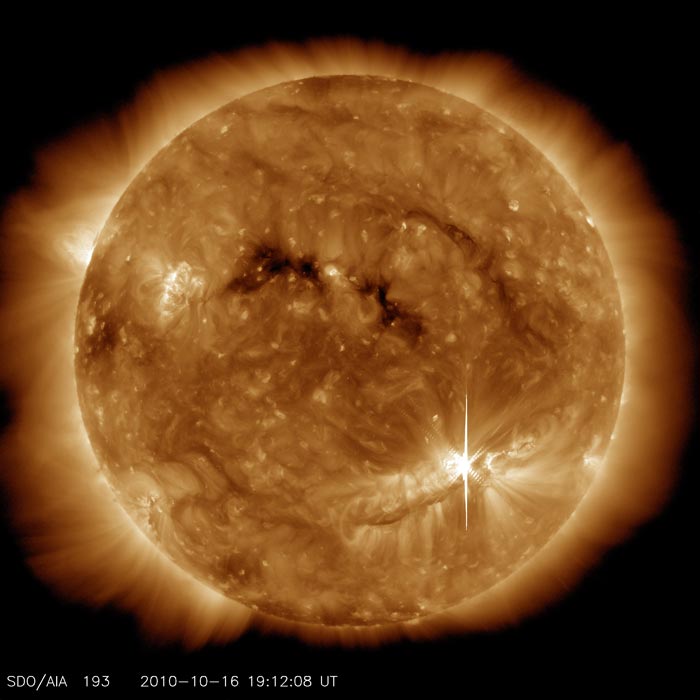
Earlier this month a lot of column inches were devoted to the news that the Sun continues to behave in a peculiar manner – and that solar activity could be about to enter a period of extended calm. The story emerged after three groups of researchers presented independent studies at the annual meeting of the Solar Physics Division of the American Astronomical Society, which appear to support this theory. But are the new findings really that clear-cut and what implications do they have for the climate here on Earth? Physicsworld.com addresses some of the issues.

Why the recent interest in the Sun's activities?

Solar physicists agree that the Sun has been acting strangely of late. It relates to apparent abnormalities in the solar cycle, an approximately 11-year period during which the Sun's magnetic activity oscillates from low strength to high strength, then back again. When the Sun's magnetic activity is low, during a solar minimum, its surface remains relatively quiet, which leads to fewer sunspots. Then, as magnetic activity begins to increase, the surface becomes more dynamic and the sunspot numbers begin to increase in the lead up to a solar maximum.

But following the last solar minimum in 2006, solar physicists were surprised to observe that sunspot numbers were unusually slow to pick up. This led some to suggest that the next solar maximum, due in 2013, could be late and weaker than usual. Some see this as a sign that solar magnetic activity is slowing down and the Sun may be about to head into a prolonged period of magnetic weakness. Some have speculated that a weakened Sun could offset some of the effects of man-made global warming, or even counteract it entirely.

What was presented at the recent AAS meeting in New Mexico?

In one paper, Frank Hill of the National Solar Observatory (NSO) and his colleagues argue that because a specific solar wind beneath the surface of the Sun has failed to appear during the present solar cycle it could signify that the next cycle will be delayed. Hill and his colleagues identified the wind flow – known as "torsional oscillation" – using data from the Global Oscillation Network Group (GONG). They believe that the migration of this flow from mid-latitudes to the equator is a precursor to new sunspot formation in each cycle. Because the wind is yet to appear during the present cycle, the researchers argue that the next cycle could be postponed to 2021 or 2022, or it may not happen at all.

In a second paper, Richard Altrock of the US Air Force Research Laboratory describes how a process known as the "rush to the poles" appears to be slowing down. This phenomenon describes how older magnetic activity is pushed to higher latitudes during new cycles as fresh magnetic activity emerges at about 70 degrees latitude. Altrock has observed, using data from NSO's 40-cm coronagraphic telescope, that this rush has been more like a crawl during the present cycle. For this reason, he believes that we'll see a very weak solar maximum in 2013 and if the rush to the poles fails to complete then it is not clear how the sun will respond.

In a final paper, Matt Penn and William Livingston of the National Solar Observatory, in Tucson, look more specifically at the nature of sunspots during the two most recent cycles. The magnetic field associated with sunspots is typically 2500–3500 Gauss, but Penn and Livingston believe that the field strength has been reducing of late. Using over 13 years of data collected at the McMath-Pierce Telescope at Kitt Peak in Arizona, the researchers found that the average field strength dropped by roughly 50 Gauss per year during the previous cycle and the trend has continued into the present one.

Has the Sun gone through quiet spells before?

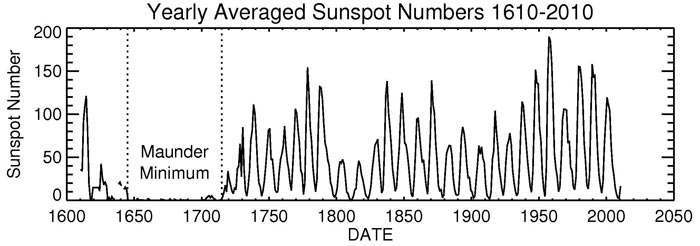
Scientists have known about the solar cycle since the mid 18th century and they have been able to reconstruct solar cycles back to the beginning of the 17th century based on historic observations of sunspot numbers. (Some researchers have even attempted to catalogue earlier solar cycles based on indirect observations of Sun spots). The first thing to say is that although solar activity has consistently oscillated over an approximately 11-year period, the timings and characteristics of each cycle are far from exact and new cycles have been late on arrival in the past.

Solar physicists do agree, however, that there was a 70-year stretch beginning in 1645 when the Sun remained in an extended period of calm referred to as the Maunder minimum. This period coincided with the "Little Ice Age" during which parts of the world including Europe and North America, experienced colder winters and increased glaciation. There was another shorter minimum from about 1790 to 1830, known as the Dalton Minimum.

So could we be heading for another Little Ice Age?

There are many uncertainties surrounding this question. Firstly, as explained in the previous answer, it is far from clear whether the Sun is headed for another period of calm. Recent research in the UK, predicts an 8% chance that we will return to Maunder minimum conditions over the next 40 years, based on past behaviour of the Sun over the last 9000 years.

Secondly, there are still debates over the details of the Little Ice Age and the role played by the Maunder minimum. In Europe, there were considerably more cold winters in this interval, but they were not unrelentingly cold as they were in an ice age. Also, the Earth's climate is evidently a highly complicated system, involving interconnected feedback systems, so it is difficult to disentangle causes and effects. For instance, several recent studies have suggested that solar-induced changes to the jet stream in the northern hemisphere may cause colder winters in Europe but this would be offset by milder winters in Greenland.

Finally, even if the Sun were to head into a quiet period, others argue that the reduction in solar irradiance on Earth would still be small compared with the heating caused by man-made global warming. Mike Lockwood, a researcher at the University of Reading, estimates that the change in climate radiative forcing since the Maunder minimum is about one tenth of the change caused by man-made trace greenhouse gases.

Flipping spins, one proton at a time

In a bid towards better understanding the inner workings of the proton, researchers in Germany have, for the first time, directly measured magnetic spin-transitions of a single trapped proton. Their work is an important step forward in understanding the magnetic properties of a proton. The technique could also be used to measure the spin of an antiproton, which could help us understand why the universe has more matter than antimatter.

The proton has an intrinsic angular momentum or spin, and behaves like a tiny bar magnet that can point up or down. The spin of a single proton has not been measured until now because the magnetic moment of the proton is much smaller and hence more difficult to detect, than that of the electron or the positron. Previous measurements have been made on clouds of protons which cannot be repeated on the much more scarce antiprotons. This new method looks at measuring the spin of just one proton produced and held in a special trap, which is capable of storing protons for months.


The researchers, based at Johannes Gutenberg University and the Helmholtz Institute in Mainz, Germany, together with colleagues from the Max Planck Institute for Nuclear Physics in Heidelberg and the GSI Helmholtz Center for Heavy Ion Research in Darmstadt, Germany, spent close to five years working on their experiment. One of the main developments was a specially designed miniature Penning trap – a vacuum trap that uses electric and magnetic fields to hold particles. "Such an experiment is challenging and has to be set up with extreme care." explains Stefan Ulmer, a team member from the Helmholtz Institute. "In the first two years we designed the cryogenic apparatus, the Penning traps and the highly sensitive superconducting detection systems. In the third year we got the apparatus running and succeeded in preparing a single proton. In the following two years we had to improve the apparatus and redesign some parts. Finally we succeed after four and a half years in observing a single proton spin flip." he said.

Wobbling protons

A proton in a Penning trap aligns its spin with the trap's magnetic field. The team introduced an additional magnetic filed, which creates a non-uniformity. The team then switched on an RF signal that causes the spin to precess or "wobble" like a spinning top. The non-uniform magnetic field causes the frequency of the wobble to depend on the direction of the spin. As a result, a spin flip can be detected by measuring a small change in that frequency, which can unobtrusively be detected. This can then be used to calculate the proton's magnetic moment.

Because the proton spin is still small, currently the researchers have measured it to a precision of 10–4. "The aim is the measurement of the magnetic moment of the single proton with a precision of 10–9, at least. We are right now working on the improvement of the apparatus to reach the 10–9 level." explains Ulmer.

Looking towards antimatter

In the near future, the researchers would like to apply their methods to measuring the magnetic moment of antiprotons – the antimatter counterpart of the proton. This would be carried out at research facilities where low energy antiprotons (5.3 MeV) are produced, such as the CERN Antiproton Decelerator (AD). "If the proton is measured, it will be possible to measure the antiproton. Currently there is only one facility worldwide which delivers antiprotons – CERN AD. Lots of groups want to have access, so it is a question of how it can be organized to get access. Such antiprotons are needed to perform high-precision low-energy experiments with antimatter. The antiprotons from CERN AD would be decelerated and stored in our Penning trap." says Ulmer. Another facility in Germany called a Facility for Low Energy Antiproton and Ion Research (FLAIR) has been set up to provide low-energy antiprotons, but it will be quite some time before FLAIR is operational.

Jeffrey Hangst, who works at the ALPHA experiment at CERN AD, says "This is a very difficult and elegant experiment; I am very pleased that they have achieved this important milestone. We should put matter and antimatter under the microscope when we have a chance to do a beautiful experiment like this one." Even with ALPHA's advance, it will be difficult to make magnetic measurements of the antiproton because that is not sufficient time. Currently, the magnetic moment of the antiproton is known only to three decimal places. The team hopes that its method will change this and help to conduct high-precision comparisons of the fundamental properties of particles and antiparticles, making it possible to accurately determine whether CPT symmetrical behaviour actually occurs, and maybe provide the basis for theories that extend beyond the Standard Model.

The research was published in Physical Review Letters.

غایتی ورای قوانین طبیعت... آری یا خیر؟

به‌ گفته‌ پَجِلز( فیزیک دان‌ آمریكایی‌): هیچ‌ شاهد علمی‌ بر وجود خالق‌ جهان ‌طبیعت‌ و اراده‌ یا غایتی‌ ورای‌ قوانین‌ شناخته‌ شده‌ طبیعت‌ نداریم‌.

به‌ قول‌بونر ( فیزیک دان‌ انگلیسی‌): كار علم‌ این‌ است‌ كه‌ برای‌ تمام‌حوادث‌ جهان‌ واقعی‌، تبیین هایی‌ عقلانی‌ فراهم‌ كند. اگر دانشمندی‌ در توضیح‌ چیزی‌، به‌ خدا متوسّل‌ شود، از حرفه‌ علمی‌ خود دور شده‌ است‌. اگر نتواند مسئله‌ای‌ را تبیین‌ كند، باید از داوری‌ درباره‌ آن‌ بپرهیزد و باید باور كند كه‌ نهایتاً برای‌ آن‌ تبیین‌ عقلانی‌ خواهد یافت‌

به‌ باور هاوكینگ‌ ( فیزیک دان‌ انگلیسی‌): می‌توان‌ جهان‌ را به‌ وسیله‌ الگویی‌ ریاضی‌ توصیف‌ كرد كه ‌تنها با قوانین‌ فیزیك‌ تعیین‌ می‌شود و وقتی‌ در شرایط‌ دیگری‌ از او می‌پرسند: در قرن‌ هفدهم‌، نیوتون‌ و كپلر احساس‌ می‌كردند كه‌ به‌ آثارمنظّم‌، منطقی‌ و زیبای‌ خداوند نظر می‌افكنند، ولی‌ حالا وقتی‌ كه‌ ما به‌این‌ معادلات‌ نگاه‌ می‌كنیم‌، چه‌ می‌فهمیم‌؟ جواب‌ می‌دهد: «ماهنوز اعتقاد داریم‌ كه‌ جهان‌ منطقی‌ و زیباست‌، تنها واژه‌ خداوند راحذف‌ كرده‌ایم‌

لینده‌ نیز در دهه‌ 1980، در سمپوزیومی‌ درباره‌ جهان‌ اوّلیه‌ چنین‌گفت‌: امكان‌ خلقت‌ از هیچ‌، جالب‌ است‌ و باید بیشتر مطالعه‌ شود. سؤال‌ِ حیرت‌انگیز این‌ است‌ كه‌ چه‌ چیزی‌ پیش‌ از پیدایش‌ جهان‌ وجود داشت‌؟ چنین‌ به‌ نظر می‌رسد كه‌ این‌ سؤال‌ مطلقاً متافیزیكی‌باشد. امّا تجربه‌ ما از متافیزیك‌ می‌گوید كه‌ گاهی‌ چنین‌ پرسش های ‌متافیزیكی‌ پاسخ‌ خود را از فیزیك‌ دریافت‌ می‌كنند.

سرنخ های ماده تاریک در برخورد خوشه های کهکشانی

منجمان یک "برخورد" آهسته کیهانی در ابعاد فوق العاده عظیم شامل چهار خوشه کهکشانی را ثبت کرده اند.

خوشه موسوم به "پاندورا" مجموعه ای از چهار خوشه کهکشانی است که طی ۳۵۰ میلیون سال به هم برخورد کرده اند. تحقیقات درباره این برخورد باید سرنخ هایی از ماهیت ماده تاریک به دست دهد. قرار است جزئیات این یافته در گزارشی که در نشریه ماهانه "یادداشت های ماهانه انجمن سلطنتی نجوم" منتشر خواهد شد تشریح شود.

خوشه های کیهانی بزرگترین ساختارهایی هستند که بشر تاکنون در جهان شناسایی کرده است، و شامل صدها کهکشان و تریلیون ها ستاره و مقدار زیادی گازهای داغ و ماده تاریک هستند. برخورد خوشه های کهکشانی تاکنون فقط در موارد خیلی معدود ثبت شده است. ریچارد مسی از رصدخانه سلطنتی ادینبورگ گفت برای کسب بیشترین اطلاعات ممکن درباره این برخوردها، باید آنها را در لحظه مناسب ثبت کرد.

او به بی بی سی گفت: "اگر آن را درست پیش از برخورد ثبت کنیم، مثل دو خوشه عادی به نظر می رسند." "همه گازها و کهکشان ها و مواد تاریک زیر قوه جاذبه خود جذب هم می شوند، بنابراین در طول زمانی بسیار طولانی، در هم مخلوط می شوند و یک خوشه بزرگ را تشکیل می دهند، به طوری که همه چیز در یک جا جمع می شود. باید آن را در لحظه مناسب ثبت کنید، درست پس از برخورد، زمانی که هنوز همه چیز جدا از هم است."

تاریک و تنها

خوشه پاندورا - که نام رسمی آن آبل ۲۷۴۴ است - توسط منجمان در چنین لحظه ای شناسایی شد: کهکشان ها و مقادیر عظیمی گازهای داغ در همه جهات پخش شده اند. آبل 2744 تا این اواخر فقط به عنوان یکی از هزاران خوشه کهکشانی در فهرست آبل شناسایی می شد.

اما دکتر مسی گفت که اشعه ایکس ساطع شده از گازهای فوق العاده داغ این خوشه که توسط تلسکوپ فضایی چاندرا ردیابی شد باعث شد این خوشه متمایز جلوه کند. تیم محققان متشکل از دکتر مسی و 17 محقق دیگر از اطراف جهان، سپس برای بررسی بیشتر این خوشه از تلسکوپ فضایی هابل کمک گرفتند. نگاه تیزبین هابل به این تیم امکان داد نقشه ماده تاریک در این خوشه را با کمک تکنیک "عدسی گرانشی" تهیه کنند.

ماده تاریک همچنان یک معماست حداقل از این جهت که کنش بسیار کمی با ماده معمولی دارد یا شاید هم هیچ کنشی نداشته باشد. به این ترتیب ماده تاریک خوشه "پاندورا" از محل برخورد گذشته و از سوی دیگر آن سر بر آورده است.

کهکشان ها و گازهای داغ تا حدودی عقب مانده اند و به گفته دکتر مسی این باعث می شود که مناطق بسیار وسیعی از ماده تاریک عریان بماند که امکان مطالعه بهتر آن را فراهم می کند.

به نقل از وب سایت بی.بی.سی

Quarks break free at two trillion degrees

Physicists in the US, India and China have calculated that quarks and gluons can break free from their confinement inside protons and neutrons at a temperature of around two trillion degrees Kelvin – the temperature of the universe a fraction of a second after the Big Bang. The researchers arrived at this figure by combining the results of supercomputer calculations and heavy-ion collision experiments. They say that it puts our knowledge of quark matter on a firmer footing.

According to the Big Bang model, the very early universe was filled with "quark–gluon plasma", in which quarks and gluons (the carriers of the strong nuclear force) existed as individual entities. The strong force between quarks increases rapidly with distance, which means that the quarks need large amounts of energy to remain free – and therefore the plasma can only exist at extremely high temperatures. When the cosmos was only about a millionth of a second old, it had cooled to the point where quarks and gluons combined to form composite particles such as protons and neutrons. Exactly what this temperature is, however, has not been easy to work out.

The theory of quantum chromodynamics (QCD) explains the interactions of quarks and gluons extremely well at very small distances, which are relevant in the collisions taking place inside the Large Hadron Collider (LHC) at CERN in Geneva. But at the larger distances characteristic of the quark–gluon plasma, QCD fails because it becomes impossible to account for all of the constituent interactions, which include many virtual pairs of quarks and antiquarks. So physicists use an approximation of the theory known as lattice QCD, in which the complexity of quark–gluon interactions is limited by breaking down space–time into manageable chunks.

Anchoring lattice QCD

Now Nu Xu of the Central China Normal University and the Lawrence Berkeley National Laboratory in California and colleagues have anchored the value of one of the key parameters of lattice QCD. They used results from the STAR detector at Brookhaven Laboratory's Relativistic Heavy Ion Collider (RHIC), which collides gold ions together at high energies to work out the temperature at which the quark–gluon plasma "condenses" to form individual hadrons.

Team member Bedangadas Mohanty of the Variable Energy Cyclotron Centre in Kolkata, India, explains that knowing this temperature helps to map out the phase diagram of QCD. This diagram charts the transition from normal, hadronic, matter to quark matter (or possibly to another exotic state known as "colour superconductivity") as two variables are altered. These are the temperature and "baryonic chemical potential", the latter being the energy needed to remove or add a proton or neutron to the strongly interacting matter. He points out that thermodynamics can be used to work out how the temperature of water's phase transitions varies with pressure but that absolute values for these temperatures require the measurement of at least one fixed point within the phase diagram, say the boiling point at atmospheric pressure. "Likewise," he says, "in QCD we want to find out what is the temperature of the phase transition at zero chemical potential."

Calculating susceptibilities

Xu and co-workers didn't measure this temperature directly but derived it from theory and experiment. On the theoretical side, Sourendu Gupta and others at the Tata Institute of Fundamental Research in India calculated the first, second, third and fourth derivatives of the baryonic chemical potential with respect to pressure, and then worked out how these "susceptibilities" should vary with temperature. Meanwhile, the experimental half of the collaboration counted how many more protons than antiprotons were produced in millions of collisions of gold ions at RHIC and plotted the variation in this measured quantity. At the quark–gluon plasma transition temperature, certain combinations of the theoretical susceptibilities should numerically equal particular quantities relating to the shape of the measured distributions. So, by varying the susceptibilities with temperature until they equalled the quantities derived from experiment, the researchers arrived at a value for the transition temperature.

The value obtained by Xu's team was 175 +1/–7 MeV, equivalent to 2 × 1012 Kelvin, which is exactly the value predicted by other indirect methods in lattice QCD. "This is the first time that there has been a direct comparison between high-temperature quark-matter theory and high-energy experiments," says Mohanty. "People have predicted what the theoretical susceptibilities should be, but you need to compare these predictions with experiment to be sure that the theory is correct."

Finding a critical point

The next step, adds Mohanty, is to measure a predicted critical point within the QCD phase diagram. At a critical point, a boundary between two phases comes to an end and the properties of the two phases become identical. There is a critical point for liquid water and steam, for example, and nuclear physicists believe that likewise there is one for normal and quark matter. Finding this critical point will involve carrying out heavy-ion collisions over a range of collision energies, something, says Mohanty, which RHIC is ideally suited to do. The LHC's ALICE detector, on the other hand, should be able to nail down the quark–gluon plasma's viscosity, with previous measurements having suggested that the plasma has a lower viscosity than any other liquid in the universe.

David Evans, a physicist at Birmingham University and head of the UK group at ALICE, is impressed by the latest work. "I think these techniques will allow theorists to tune up and improve lattice QCD by direct comparisons with experiment," he says, "and hence provide even better calculations and predictions in the future."

However, Johann Rafelski of the University of Arizona believes that the research suffers from "major deficiencies", in particular a lack of analysis of systematic errors. For example, he says, Xu and colleagues have not accounted for the fact that the detector counts only a limited fraction of all collision products. "The total systematic error is very probably much, much larger than the statistical error [as presented]," he says, adding that his "colleagues from the lattice-QCD community believe that this analysis has `errors at every step'".

اثبات وجود نظم در بی نظمي: تمامي ساختارهای جهان حاوی الگوهاي بسيار منظمی هستند

برطبق نوشته كتيبه‌اي كهن مربوط به 3500 سال پيش، زماني يك حكيم سومري در عهد باستان به ستارگان آسمان نگريست و در آنها نقش يك شير، يك گاو و يك عقاب را ديد و اينگونه بود كه صورت‌هاي فلكي به دنياي اخترشناسي وارد شدند. امروزه نيز اگر آسمان پُرستاره شب را در منطقه‌اي كويري يا كوهستاني و به دور از آلودگي‌هاي شهرهاي بزرگ به تماشا بنشينيد دقيقاً همان نقش‌هاي جالب و شگفت‌انگيز را درميان انبوه ستارگان مشاهده خواهيد كرد. اما سؤال اينجاست: آيا چنين نقش‌هايي واقعاً درميان ستارگان وجود دارند؟

اكنون مي‌دانيم كه سياره زمين و منظومه شمسي در نقطه‌اي نزديك به حاشيه كهكشان ما يعني راه شيري قرار دارند. تمامي ستارگان آسمان شب هم درواقع همان ميلياردها ستاره كهكشان راه شيري هستند كه بخش كوچكي از آنها با چشم غيرمسلح ديده مي‌شوند. بنابراين آيا واقعاً دليلي براي شكل‌گيري نقش‌هاي منظمي در ميان اين انبوه ستارگان پراكنده وجود دارد؟

رياضيات پاسخ بسيار جالبي را به اين پرسش ارائه ميدهد. در سال 1928، يك رياضيدان برجسته به نام فرانك پلامپتون رمزي ثابت كرد كه چنين نقش‌هايي عملاً در هر ساختاري كه اجزاء بسيار زيادي دارد - خواه مجموعه‌اي از ستارگان باشد يا آرايه‌اي از ريگ‌ها يا زنجيره‌اي از اعداد حاصل از انداختن تاس - همواره وجود دارند. به عبارتي هرچقدر هم كه يك ساختار در نگاه اول نامنظم به نظر برسد بازهم مي‌توان الگوهاي منظمي را در پشت بي‌نظمي ظاهري آن پيدا كرد. مثلاً با بررسي مجموعه‌اي با تعداد كافي از ستارگان، هميشه مي‌توان گروهي از آنها را يافت كه با تقريب بسيار خوبي يك نقش خاص را پديد مي‌آورند.

بدين ترتيب پلامپتون رمزي ثابت كرد كه هر ساختاري در جهان - هر قدر هم در ظاهر بي نظم به نظر برسد - الزاماً شامل يك زيرساختار منظم است. حدود 40 سال پس از اين اثبات شگفت‌انگيز، یک رياضيدان آمریکایی به نام تئودور موتسكين نشان داد كه نظريه رمزي تلويحاً حاكي از آن است كه بي‌نظمي كامل در جهان غيرممكن است. آري، به راستي كه نظم، يكي از بنيادهاي هستی است.

زندگینامه مادام کوری

به مناسبت ۲۵ ژوئن؛ سالروز دریافت درجه دکترای مادام کوری

ماري كوري در سال 1867 با نام ماريا اسكلو دووسكا در ورشو پايتخت لهستان متولد شد او در سن 19 سالگي به پاريس رفت تا در آنجا به تحصيل در رشته شيمي بپردازد . در آنجا با فيزيكدان جوان فرانسوي به نام پير كوري آشنا شد و اين آشنايي به ازدواج انجاميد. او به پير كوري در انجام آزمايشهاي عملي اش درباره الكتريسيته كمك مي كرد زماني كه او در سال 1895 در انباري چوبي كوچك كه آزمايشگاه او بود شروع به كار كرد نه او و نه هيچ كس ديگر چيزي درباره عنصر شيميايي راديم نمي دانست اين عنصر هنوز كشف نشده بود البته يكي از همكاران پژوهشگر پاريسي فيزيكدان فرانسوي «هانري بكرل» در آن زمان تشخيص داده بود كه عنصر شيميايي اورانيوم پرتوهايي اسراسر آميز نامرئي از خود مي افشاند او به طور اتفاقي يك قطعه كوچك از فلز اورانيوم را بر روي يك صفحه فيلم نور نديده كه در كاغذ سياه پيچيده شده بود گذاشته بود صبح روز بعد مشاهده كرد كه صفحه فيلم درست مثل اين كه نور ديده باشد سياه شده است بديهي بود كه عنصر اورانيوم پرتوهايي را از خود ساطع كرده بود كه از كاغذ سياه گذشته و برصفحه فيلم اثر كرده بود. بكرل اين فرايند را دوباره با سنگ معدني موسوم به (Pitch-blende) كه سنگي سخت و سياه قيرگون است كه از آن اورانيوم به دست مي آيد- تكرار كرد اين بار اثري كه سنگ بر روي صفحه فيلم گذاشته بود حتي از دفعه قبلي هم قوي تر بود بنابراين مي بايست به غير از عنصر اورانيوم يك عنصر پرتوزاي ديگر هم در سنگ وجود مي داشت او فرضيه خود را با خانواده كوري كه با او دوست بودند مطرح كرد آنها نيز اين راز را هيجان انگيز يافتند اين چه پرتوهاي نادري بودند كه در اشيايي كه پرتوهاي نوري معمولي از آنها عبور نمي كرد نفوذ مي كردند و از ميان آنها مي گذشتند؟ در آن زمان پير كوري در مدرسه فيزيك تدريس مي كرد ولي او تمام وقت آزاد خود را به كار مي برد تا به همسرش در آزمايشهايي كه انجام مي داد كمك كند رئيس مدرسه فيزيك يك انباري مضروبه كنار حياط مدرسه را در اختيار آنها گذاشت اين انبار فضايي بود كه آنها مي توانستند بدون هزينه اي دريافت كنند و بنابراين آن را قبول كردند قدم بعدي اين بود كه سنگ معدني سياه را تهيه كنند. اگر مي خواستند اقدام به خريد آن كنند خيلي گران تمام مي شد آنها به طوركلي اندگي اطلاع يافتند كه دولت اتريش هزاران كيلو از اين سنگها دارد كه چون اورانيومش را جدا كرده اند آنها را بي ارزش مي دانند چون خانواده كوري دنبال اورانيوم نبودند بلكه عنصر ناشناخته جديدي را جستجو مي كردند اين زباله ها را درست همان چيزي يافتند كه به آن نياز داشتند ماري و پير كوري اين توده هاي كثيف را با بيل درون ديگهاي بزرگي مي ريختند آنها را با مواد شيميايي مخلوط مي كردند و بر روي يك اجاق قديمي چدني حرارت مي دادند. دود سياه، خفه كننده و بدبوي غليظي كه از ديگها برمي خواست نفس آنها را تقريباً بند مي آورد و اشك چشمانشان را سرازير مي كرد. (با مراجعه به يادداشتهاي قطور آزمايشگاهي ماري و پيكر كوري معلوم مي شود كه آن دو نفر از شانزدهم دسامبر 1897 به مطالعه در باره پرتو بكرل يا پرتو اورانيوم پرداختند در آغاز ماري فقط به اين كار مشغول شد ولي از پنجم فوريه سال 1898 پير هم به او ملحق شد پير به اندازه گيري ها و بررسي نتايج پرداخت آن دو نفر عمدتاً شدت پرتوهاي كاني ها و نمكهاي مختلف اورانيوم و اورانيوم فلزي را اندازه گيري مي كردند در نتيجه تجربه هاي زياد آنها اين بود كه تركيبات اورانيوم كمترين راديواكتيويته را داشتند. راديواكتيويته اورانيوم فلزي از آنها بيشتر بود و كاني اورانيوم كه معروف به پشبلند بود بيشترين راديواكتيويته را داشت اين نتايج نشان مي داد كه احتمالاً پشبلند محتوي عنصري است كه راديواكتيويته اش خيلي بيشتر از راديواكتيويته اورانيوم است در دوازدهم آوريل 1898 كوري ها نظريه خود را به آكادمي علوم پاريس گزارش كردند در چهاردهم آوريل كوريها با همكاري لمون شيميدان فرانسوي به جستجوي عنصر ناشناخته مزبور پرداختند.
نتيجه گرانبهاي اين كار پرزحمت و طاقت فرسا تنها چند قطره ازماده اي بود كه آنها اين ماده را در لوله هاي آزمايشگاهي نگهداري مي كردند بر اثر اين كارهاي طاقت فرسا در نخستين زمستان ماري كوري دچار نوعي عفون و التهاب ريوي شد تمام فصل را مريض بود ولي پس ازبهبودي كار پختن مواد در ديگها را در آزمايشگاه از سر گرفت سال پس از آن نخستين دخترش به نام ايرنه متولد شد پير و ماري كوري در ماه جولاي (مرداد ماه) همان سال توانستند اين مسئله را انتشار دهند كه سنگ معدن (Pitch-blende) به غير از عنصر اورانيوم دو عنصر پرتوزاي ديگر را نيز در خود دارد نخستين عنصر را به ياد محل تولد و بزرگ شدن ماري كوري كه لهستان (Poland) بوده است، پولونيوم (Polonium) ناميدند و دومين عنصر را كه اهميت زيادي داشت راديوم ناميدند كه از واژه لاتين radius به معني پرتو الهام مي گرفت. در بيست و ششم دسامبر سال 1898 (پنجم دي ماه 1277) اعضاي آكادمي علوم پاريس گزارشي تحت عنوان «درباره ماده شديداً راديواكتيوي كه در پشبلند وجود دارد» آگاه شدند و اين روز تاريخ تولد راديوم است. پيدايش راديوم در ميان عناصر راديواكتيو طبيعي تقريباً به فوريت ثابت كرد كه اين عنصر مناسبترين عنصر راديواكتيو براي بسياري كارهاست به زودي معلوم شد كه نيمه عمر راديوم نسبتاً زياد است (1600 سال) كشف راديوم يكي از پيروزيهاي بنيادي علم است بررسي هاي انجام شده روي راديم موجب دگرگوني هاي اساسي در دانش بشر درباره خواص و ساخت ماده شد و منجر به شناخت و دستيابي به انرژي اتمي شد خانواده كوري به همراه بكرل به خاطر كشفي كه پس از آن همه كارطاقت فرسا به آن نائل شدند در سال 1903 جايزه نوبل (فيزيك) را از آن خود كردند و به اين ترتيب توانستند وامهايي را كه براي كارهاي پژوهشي طولاني خود گرفته بودند، پرداخت كنند.
پير كوري در سال 1906 در 47 سالگي به علت تصادف با اتومبيل درگذشت مادام كوري پس از مرگ شوهرش به مطالعات خود ادامه داد و در سال 1910 موفق به تهيه راديوم خالص گرديد در اين هنگام استاد سوربون و عضو آكادمي طب شد و در سال1911 براي دومين بار به دريافت جايزه نوبل نائل شد (ماري كوري به غير از لينوس پاولينگ (برنده جايزه نوبل در شيمي در سال 1954، برنده جايزه صلح نوبل در سال 1962) تنها انساني است كه دوباره اين جايزه ارزشمند را از آن خود كرده است.) مادام كوري در چهارم ژوئيه 1934 يعني بيست و هشت سال بعد از مرگ شوهرش و در سن 67 سالگي درگذشت.
اين واقعيت كه پرتوهاي راديوم مي توانند بافتهاي زنده اندامها را از بين ببرند به عنوان مهمترين دستاورد كشف كوريها مشخص گرديد پزشكان و پژوهشگران علوم پزشكي به زودي دريافتند كه به اين وسيله مي توانند غده ها و بافتهاي بدخيم را كه در سرطان و همچنين بيماريهاي پوستي و غدد ترشحي بروز مي كنند، از بين ببرند بسياري از بيماران سرطاني كه توانسته اند با موفقيت معالجه شوند و از مرگ نجات يابند عمر دوباره و سلامتي خود را مرهون تلاشهاي ايثارگرانه و خستگي ناپذير و انگيزه والاي اين زن بي همتا هستند.

Gravity shows its helpful side

Gravity is unruly. It can throw theorists' equations into chaos, and has proved a stumbling block to the creation of a single 'theory of everything'. But an analysis now shows that gravity may at least make some fundamental calculations more manageable.

David Toms, a theoretical physicist at Newcastle University, UK, has found that gravity seems to calm the electromagnetic force at high energies. The finding could make some calculations easier, and is a rare case in which gravity seems to work in harmony with quantum mechanics, the theory of small particles. His paper is published today in Nature.

But don't get too excited: that elusive theory of everything is not just around the corner. Not everyone thinks that the calculations will stand up to scrutiny. Given physicists' "dicey" understanding of the relationship between gravity and other forces, it is too early to draw any deep conclusions, says Stanley Deser, a theoretical physicist at Brandeis University in Waltham, Massachusetts. Follow-up studies are needed to put Toms's calculations on solid ground.

Fundamental confusion

For decades, theoretical physicists have been able to explain the Universe in terms of four fundamental forces: the electromagnetic force, which causes electricity and magnetism; the weak nuclear force, which moderates some nuclear decays; the strong nuclear force, which binds quarks together inside atomic nuclei; and gravity. All except gravity have been incorporated into a 'standard model' of particle physics.

There are signs that an even more fundamental theory may be out there. At high energies, electromagnetism and the weak force merge into a single 'electroweak' force; and, at even higher energies, some as yet untested theories known as supersymmetry combine the electroweak and strong nuclear force. Theorists hope that the world's most powerful particle accelerator, the Large Hadron Collider near Geneva, Switzerland, will provide evidence for this combined strong and electroweak force.

But gravity remains a stubborn holdout against efforts to create a theory of everything. The force is too weak at low energies to fit with the others, and it becomes too strong at high energies to be included in a single theory. Moreover, theories which attempt to describe gravity in quantum mechanical terms lead to nonsensical infinities in the equations. "That is a very serious problem," says Toms.

But Toms's equations have now shown that gravity can sometimes help, rather than hinder. He included a quantum formulation of gravity in a calculation of quantum electrodynamics (QED), a theory that describes how electrons interact with light particles, known as photons. The theory normally breaks down at high energies, because these interactions seem to grow far too strong to be calculated using conventional methods.

In Toms's work, gravity soothes the interaction, making the force between the electron and photon nearly zero at high energies (1015–1019 GeV). This weakening of the force means that theorists can calculate the behaviour of high-energy electrons and photons after all. "What gravity seems to do is make things better for you," says Toms.

The future of the theory

There is still a lot of work to do, Toms warns. His calculations provide no basic insights into why gravity would weaken other forces. What's more, gravity itself is still likely to become uncontrollably strong at very high energies.

And many theorists are sceptical about whether Toms's calculations will bear close examination. "His mathematics could well be right, but I don't think his interpretation is," says John Donoghue, a theoretical physicist at the University of Massachusetts Amherst. Donoghue is concerned that when the method is applied to other interactions, involving different particles, it might yield a different answer. "The effects are not universal," he says. That would be a big problem for theorists, who want their methods to apply to everything equally.

Toms concedes that he "can't say for certain" whether his method will be universal. He now plans to take a second look at what happens to the strength of gravity at high energies, using the new approach. If gravity weakens like the other forces, theorists really might be closer to a theory of everything. Toms says that the calculations will be harder to do. But, he adds, "I think I know how to do it". 

Magnetic fields reduce blood viscosity

Researchers in the US claim that exposing a person to a magnetic field could reduce their risk of a heart attack by streamlining the flow of blood around their body. While the work currently remains just a proof-of-principle, the researchers believe that their technique could ultimately provide an alternative to drugs in treating a range of heart conditions.

Heart attacks and stokes can strike for a variety of reasons. But research suggests that all such vascular conditions are linked by one common symptom – high blood viscosity. Drugs such as aspirin are frequently prescribed to help lower blood viscosity, but these can have unwanted side effects often related to irritation of the stomach. Now, an alternative to drugs may be at hand following recent work by Rongjia Tao at Temple University and his colleague Ke Huang at the University of Michigan.

In their experiment, Tao and Huang showed that applying a 1.3 T magnetic pulse to a small sample of blood can significantly reduce it's viscosity. About 8 ml of blood with a viscosity of 7 centipoises (cp) – above healthy limits – was contained at body temperature (37 °C) in a test tube. The tube formed part of a device called a capillary viscometer used to measure viscosities. The sample was then exposed to a magnetic field applied parallel to the direction of flow of blood via a coil around the edge of the test tube. After one minute of exposure to the field, the blood's viscosity had been reduced by 33% to 4.75 cp. With no further exposure to the field, the viscosity had only risen slightly to 5.4 cp after 200 min, which is still within healthy limits.

In a paper accepted for publication in Physical Review E, the researchers describe how the effect is probably caused by the response of red blood cells. These iron-rich cells are the most common type of blood cell and they play the leading role in transporting oxygen around the body. In the presence of a strong magnetic field, the red blood cells form chains that align themselves with the field lines where convoys of red blood cells line up behind a leading cell. This process could enable the cells to pass through the blood in a more streamlined fashion, thus reducing the blood's viscosity.

Towards clinical trials

Tao says that patients can safely be exposed to magnetic fields of up to 3 T. He intends to develop the work further by testing blood flow under a magnetic field in capillary tubes that are similar in size to blood vessels. He also plans to apply for a research grant from the US National Institutes of Health to allow clinical trials to be carried out.

Kalvis Jansons, a mathematician at University College London, believes that the researchers may be onto something "very interesting". "If the effect really does exist, it would appear to me that it would not be difficult to use it in a clinical setting," he says. But he also believes that a lot of work would need to be done to show that the process is safe. "Could it lead to blood clots, for example?" he asks.

Giacinto Scoles, a materials scientist at Princeton University who develops medical applications, believes there is a "tremendous thirst" in the medical community for this kind of physics-based innovation. "I believe the work has raised a lot of interesting questions and that a new field of investigation has been opened up," he says.

But the medical community will still need to be convinced about the need for the new technology and about its safety. Tammy Ustet, a medical doctor who carries out rheumatology research at the University of Chicago, believes that the main focus should remain tackling the causes of vascular conditions. "Treating symptoms is extremely important, but treating the root cause is the best way to relieve symptoms," she says.